TheSindi Com Review: Content, Identity, and Trust
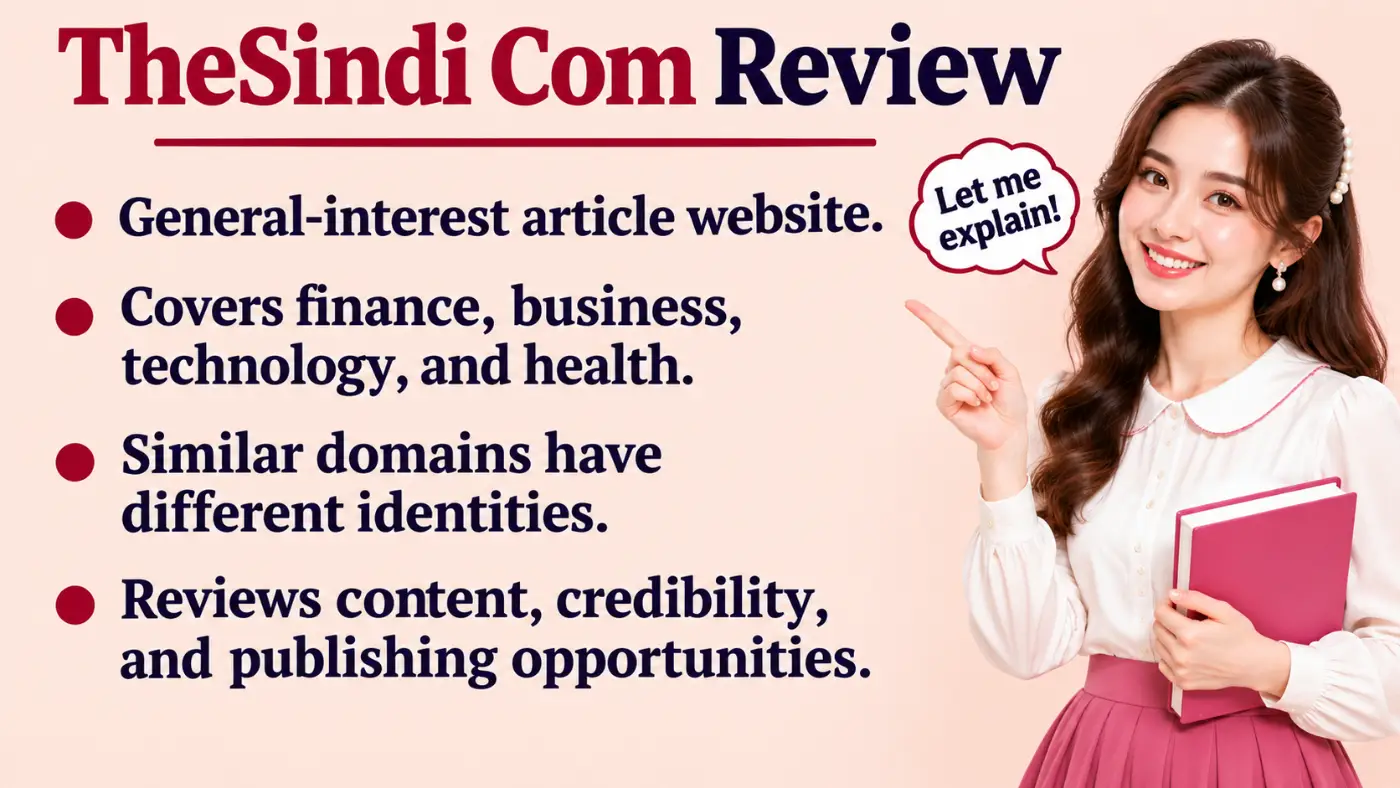
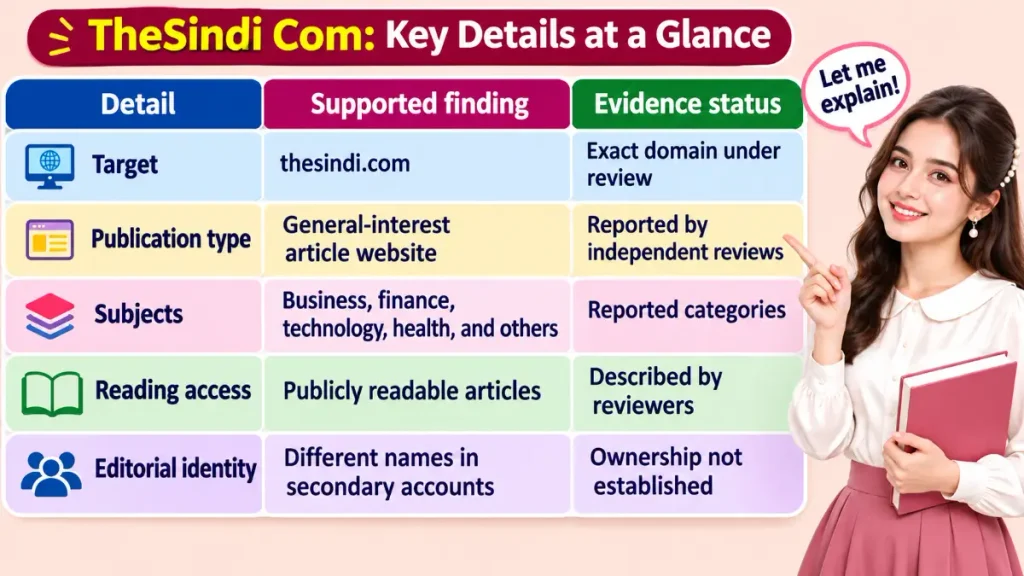
TheSindi Com refers to thesindi.com, a website described in independent reviews as a general-interest article publication. Reported subjects include finance, business, technology, health, law, education, travel, and lifestyle. The key distinction is the exact domain: similarly named websites make their own claims, and those claims should not automatically be attributed to the .com address.
This review explains what the available evidence supports, which editorial details remain uncertain, and how readers can assess the usefulness of individual articles. It also considers potential contributor inquiries without assuming that an advertised placement is officially authorized.
Related Post: zvodeps com
What Is TheSindi Com?
Independent reviewers describe thesindi.com as an informational website covering a variety of everyday topics. That is different from operating a financial service, healthcare provider, technology product, or shopping platform. An article about a business is not proof that the publisher runs that business.
A menu label is evidence of how a website organizes itself, not proof of deep expertise. Similarly, a contact page or author archive may provide useful information without establishing a registered company or the credentials of everyone involved.
Readers should use the site’s articles to understand topics and identify relevant questions. For important decisions, the supporting evidence matters more than a broad claim that a publication is informative or trustworthy.
Why Similar Domain Names Create Confusion
Several addresses use similar wording. thesindi.com, thesindi.co, and the-sindi.com are distinct domain names. A fourth variation, thesindi.net, also appears in domain comparisons. Their relationships should not be assumed merely because the names resemble one another.
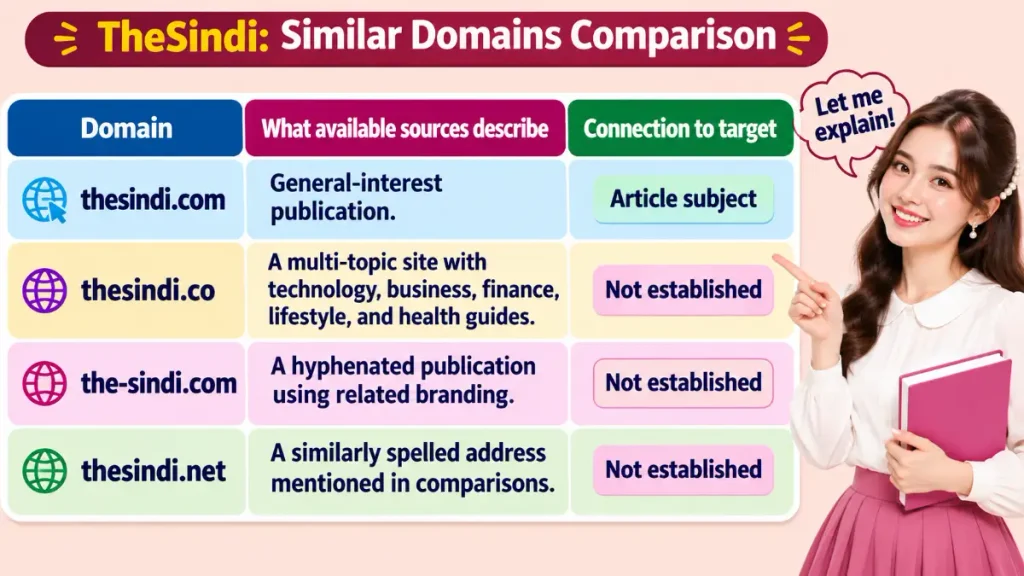
The .co homepage presents its own five-category publishing model and claims that articles receive expert review and regular updates. These statements belong to thesindi.co, not automatically to thesindi.com. Likewise, a page on the hyphenated domain cannot establish the .com site’s editorial staff or privacy practices.
This difference is especially important when searching by a spaced keyword rather than entering a complete domain. A search result may display a familiar name while pointing to another website. Before trusting an article or review, check the address bar and confirm the precise spelling and ending.
Similar design elements, broad subject categories, or overlapping first names do not prove common ownership. A credible affiliation claim requires a clear statement supported by reliable evidence. Without that, the proper conclusion is simply that the relationship has not been established.
What Topics and Article Formats Does It Offer?
Third-party descriptions associate the target publication with business, finance, technology, gaming, health, education, law, travel, lifestyle, and digital marketing. These are reported categories rather than a fully audited inventory of its current archive.
The distinction between a category and an actual article is important. A navigation menu can list a subject even if only a small number of posts are available. Conversely, individual posts may cover specialized questions that are not obvious from the main menu.
An introductory finance guide might define a financial concept, while a technology explainer could describe an emerging tool or software feature. A travel article may provide background about a destination, and a legal post might summarize a rule applying to a particular region. Each format requires a different standard of evidence.
An explainer should answer a clear question and distinguish settled facts from interpretation. A comparison should explain its criteria and the alternatives considered. A news article should identify when an event occurred and cite relevant reporting or original documents. A practical guide should make its assumptions and limitations clear.
Broad subject coverage can help readers discover unfamiliar ideas. However, the range of topics alone does not establish specialist expertise, regular publishing, or a consistent editorial review process. Those judgments require closer examination of individual pieces.
How to Judge an Individual Article
A complete firsthand sample of five articles from the exact .com domain has not been established in the evidence available for this review. It would therefore be misleading to invent titles, dates, bylines, or testing results. Instead, the following framework shows what to look for in any article that readers encounter.
| Article type | Reader check | Why it matters |
|---|---|---|
| Technology | Version, product documentation, dated claims | Features change |
| Finance | Assumptions, jurisdiction, risk explanation | Advice is context-dependent |
| Health | Clinical references and professional review | Treatment decisions have consequences |
| Law | Relevant government rules and location | Requirements vary by jurisdiction |
| Travel | Current prices, hours, and local details | Practical information ages |
First, compare the headline with the opening answer. Does the article address the promised question directly? A useful introduction establishes scope and avoids repeating vague claims without adding information.
Next, examine its sources. A citation should support the statement beside it, not merely link to a vaguely related homepage. A manufacturer’s product description may verify advertised specifications but not independent performance. A financial example may illustrate a calculation without proving that an investment will deliver the same result.
Look for distinctions between fact, opinion, and promotion. If a writer describes a product as reliable, readers should ask whether the claim comes from documented testing, a customer statement, or marketing copy. An external commercial link alone does not prove that the article is sponsored.
Finally, assess timing and geographic relevance. Technology features, laws, fees, and eligibility requirements change. A guide written for another country can still introduce useful concepts, but readers in the United States should verify the rules that apply locally.
Who Writes, Edits, and Operates the Publication?
Independent accounts describe different people and roles. Finance Wealth Tools reportedly names Roland Miller as an author or administrator. A Mrixe result refers to Kavin Paul in a chief author or editor capacity while also mentioning Roland bylines. Mix Raa presents a different picture of how much authorship information is visible.
These reports should not be forced into one explanation. The names could reflect different responsibilities or publishing periods, but those possibilities have not been independently resolved.
An author receives credit for a particular article. An editor may select and review material. A website administrator can maintain technical or publishing operations. The legal owner is the person or entity responsible under the relevant ownership arrangement. These roles may overlap, but one does not prove another.
A displayed byline helps attribute content. It does not automatically verify someone’s identity, professional qualifications, or responsibility for every post. Readers evaluating health, legal, or financial claims should look for topic-specific credentials and meaningful editorial accountability.
The exact site’s legal operator remains not independently established from the available evidence. This is a limit on verification, not evidence that no responsible operator exists.
Editorial Promises, AI Assistance, and Disclosures
Finance Wealth Tools reports statements about editorial review, AI assistance, and sponsorship practices. Until the underlying policy text on the exact domain is independently confirmed, those details should remain attributed to the reporting source.
Even a clearly published policy is not a guarantee that every article follows it. A statement promising fact-checking should be assessed against the quality of the sources and reasoning in actual articles. A corrections policy becomes more meaningful when readers can see how to report mistakes and whether important changes are explained.
The same principle applies to AI assistance. A publisher might use software for research organization, drafting, or editing. That does not prove that every article is machine-written, and polished language does not prove that a specialist reviewed the content. The central issue is who takes responsibility for accuracy.
Commercial relationships require separate attention. Product mentions may be editorial, promotional, or sponsored, depending on the circumstances. A link to another business does not by itself establish an affiliate relationship. Readers should look for clear disclosures when an article recommends a product or discusses a paid placement.
Where the exact policy or disclosure remains uncertain, it is better to say that the practice is not established than to assume either exemplary standards or misconduct.
Is It Useful and Trustworthy for US Readers?
Usefulness depends on the task. A general-interest article may provide definitions, background, and ideas for further research. Such material can be valuable without being suitable as the final authority for an expensive or consequential decision.
Regional context deserves particular attention. An investing article about Indian stocks may help explain market concepts, but US investors face different rules, currencies, products, and tax considerations. Similarly, an explanation of a Canadian provincial law should not be applied automatically to an American state.
Health articles require credible clinical evidence, especially when discussing treatments or personal risks. An introductory overview can help a reader formulate questions, but individualized care decisions belong with qualified professionals and current authoritative guidance.
Technology writing can also be location-dependent. A device may have different pricing, warranty terms, service availability, or privacy conditions in the United States. Verify the current manufacturer’s information before relying on a general comparison.
Editorial trust and technical safety are separate. HTTPS, where present, can protect data in transit, but it does not establish that a writer has expertise or that every article is accurate. No independent security audit is established here, so a blanket safety certification would be inappropriate.
The practical approach is to use the publication for initial orientation and then confirm decision-critical details with primary sources. Readers should also distinguish a publisher’s self-description from demonstrated expertise and accountability.
Guest Posts and Contact: What Is Actually Established?
Some reviews discuss publishing placements or commercial inquiries. A third-party advertisement, however, is not the same as official submission guidelines from the publisher of thesindi.com.
A reseller may list a fee or turnaround time without proving that these are the site’s own terms. A contact form, if available, would provide a way to inquire but would not establish automatic guest-post acceptance.
Prospective contributors should confirm topic requirements, editorial review, originality standards, disclosure obligations, link treatment, revisions, publication rights, payment terms, and removal policies. These details should come from someone demonstrably authorized to represent the exact domain.
Before submitting unpublished work or paying for a placement, request written clarification. That helps prevent confusion about what will be published, who controls the content, and what happens if an article needs correction.
Who Might Find the Website Useful?
Readers who enjoy exploring broad topics may find general-interest publishing convenient. Students can use introductory explanations to identify terminology and further reading. Business owners may encounter useful overviews of unfamiliar practices or technologies.
People seeking medical, legal, or financial decisions should apply a higher standard of evidence. Contributors should prioritize verified editorial contacts and clear commercial terms over third-party promises.
The publication’s potential value lies in discovering topics and building background knowledge, not in replacing original documents or qualified advice.
Overall Assessment
TheSindi.Com is described by independent sources as a broad informational publication, but its exact domain should not be confused with similarly named websites. Reported subject coverage may be useful for introductory reading. Ownership, editorial roles, professional review, and official contribution terms require further confirmation.
Readers should judge individual articles by their evidence, currency, and relevance. That is more useful than an unsupported site-wide trust score or an absolute safe-or-unsafe label.
Frequently Asked Questions
What kind of publication is this?
Independent reviews describe a general-interest article website covering multiple subjects. That description does not establish that it operates the products, professional services, or financial businesses mentioned in its articles.
Are the similarly named domains connected?
Similar spelling does not prove shared ownership or official affiliation. The .com, .co, and hyphenated addresses should be evaluated independently unless reliable evidence confirms a relationship.
Can articles be read without creating an account?
Third-party descriptions present the website as offering publicly readable articles. Any additional account features or current access requirements should be checked on the exact domain.
Who is responsible for the editorial content?
Different secondary accounts mention different author and editorial names. A byline alone does not establish legal ownership, and the precise responsibilities of the reported individuals remain unconfirmed.
Does the publication explain its use of AI?
One independent account reports statements about AI assistance and editorial review. The exact policy wording and whether individual articles follow those practices require separate verification.
How can readers assess an article’s accuracy?
Check whether its sources support specific claims, whether the writer has relevant expertise, and whether the information is current. Confirm consequential details using official documentation or qualified guidance.
Are outside writers allowed to submit articles?
An official open-submission process has not been established from the available evidence. Contributors should confirm authorization, editorial requirements, fees, rights, and acceptance terms before proceeding.
Does advice from another country apply to US readers?
Not automatically. General concepts may be useful, but laws, financial products, medical practices, and eligibility rules differ, so readers should consult relevant US sources.

Sophia Bennett writes educational content about English vocabulary, grammar, slang, and communication. She is passionate about making complex language topics accessible to students, professionals, and curious readers around the world.