Brasssmile Com Review: Articles, Tools, and Trust
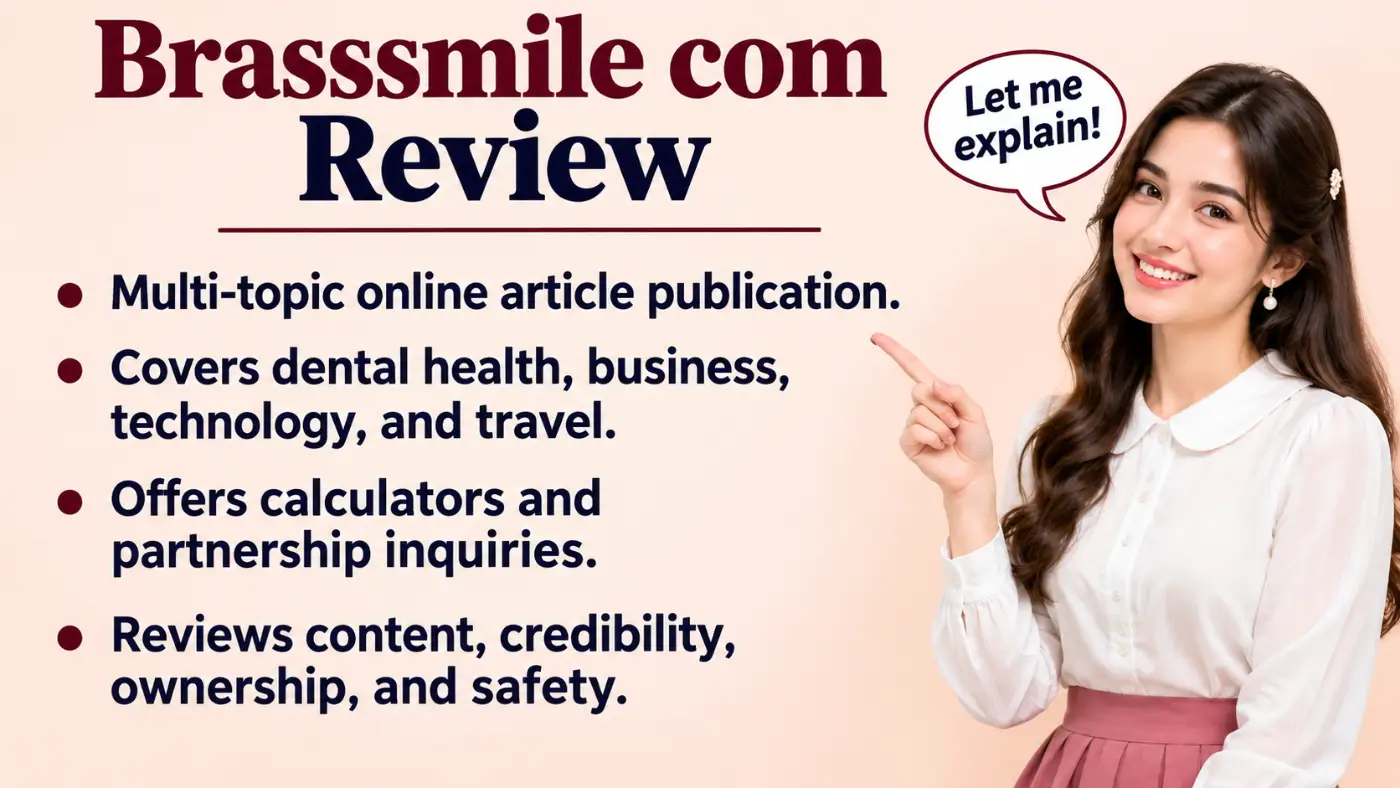
Brasssmile com is best understood as a multi-topic article publication with a noticeable dental and wellness presence, not an independently established dental clinic or treatment provider. Its reported pages include health articles alongside business, education, insurance, technology, travel, and other subjects. The website also presents a calculators page and a route for partnership inquiries. Those features tell readers what the publication discusses, but they do not by themselves establish professional medical oversight, working calculation tools, or the identity of its legal operator. This review looks at specific published examples and explains how to assess the site’s practical value without confusing an article with a service.
Related Post: vocalnewsmedia com
What Is Brasssmile Com?
The website functions primarily as an information publisher. Visitors encounter written explanations, guides, and profiles across several unrelated categories. Dental topics help explain its name and some of its front-page emphasis, but the wider archive is not limited to oral health. A reader looking for background information may find an introductory article; someone seeking a dentist, an aligner fitting, or an insurance quote should not assume the publisher supplies those services.
A Health-Focused Front Page With a Broader Archive
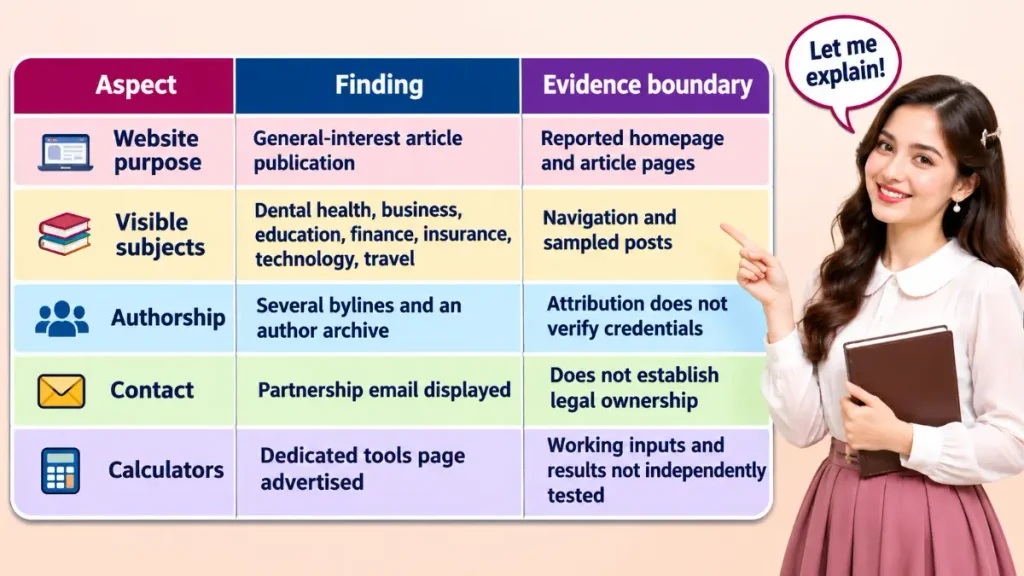
Dental and wellness subjects give Brasssmile.com a recognizable theme. An article about clear aligners, for example, fits naturally with a name suggesting a smile or oral care. Yet the reported navigation also includes business, education, finance, insurance, technology, and travel. Other entries reach beyond these subjects, demonstrating that the publication’s editorial scope is wider than dental information alone.
The sample supplied for this review illustrates the breadth: aligner treatment, car insurance, international education, a profile of another website, and seasonal air pollution. These subjects demand different kinds of expertise. Dental claims require appropriate clinical evidence; insurance estimates depend on location and personal circumstances; admissions guidance can change by academic year. No single broad publishing identity guarantees expertise in all of them.
What Five Articles Reveal About the Publication
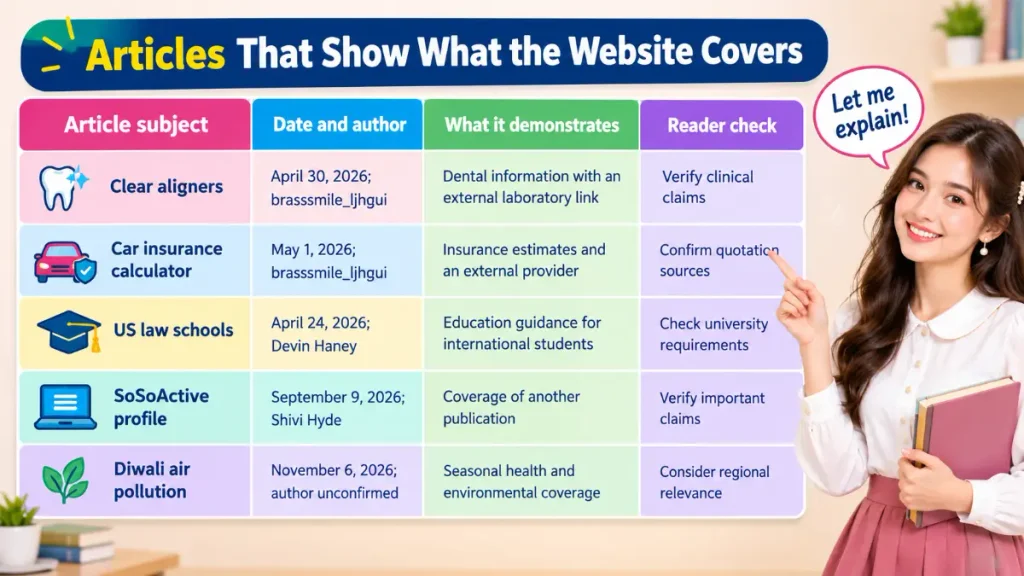
Five dated articles provide a clearer picture of Brasssmile.com’s content than general website descriptions. These examples highlight its subject diversity, author attribution, and important details readers should verify.
Dental and Insurance Articles
The clear aligners article discusses orthodontic treatment and includes an external dental-laboratory link. However, that link does not establish professional medical review. Readers should verify treatment claims through qualified dental professionals.
The car insurance calculator article explains premium estimates and references an outside provider. Publishing information about insurance calculations does not mean Brasssmile.com operates an insurance comparison service. Visitors should identify the actual quotation provider before sharing personal details.
Education and Website Coverage
The international law-school guide offers background information for prospective students. Admission requirements, tuition, and application deadlines may change, making official university websites essential for current decisions.
The SoSoActive profile demonstrates the publication’s interest in reviewing other online platforms. Readers should distinguish directly observable website features from promotional descriptions or unsupported claims about ownership and reliability.
Seasonal Health and Environmental Topics
The Diwali air-pollution article highlights the website’s international and seasonal coverage. Its subject may interest readers concerned about air quality, although regional conditions and health recommendations require careful consideration.
What These Examples Tell Readers
Together, these articles demonstrate broad subject coverage and visible author attribution. However, publishing across multiple categories does not automatically establish specialist expertise or consistent editorial accuracy.
Readers should evaluate individual articles based on their sources, publication dates, author qualifications, and relevance to their circumstances.
Free Calculators and Calculator Articles: What Is Verified?
The reported Free Calculators page deserves separate attention because an interactive tool differs from an article explaining how calculations work. Although the website advertises calculator features, their functionality and accuracy have not been independently verified. Visitors should confirm whether usable input fields appear, whether calculations produce accurate results, and how their entered information is handled.
The publisher describes calculations as staying in the browser. This is a publisher privacy statement, not a technical audit. Verifying it would require examining the functioning page and its behavior, including whether entered information is sent to external services. No such independent test is established in the supplied research.
Visitors should distinguish four important questions when evaluating online tools. First, is there a dedicated page advertising the tool? Next, does a functional input form appear? The third consideration is whether the tool produces mathematically accurate results using known sample values. Finally, users should understand how their entered information is processed and stored. The existence of a tool page does not automatically confirm its functionality, accuracy, or privacy safeguards.
The car-insurance article is another example of why this separation matters. Its explanation of premium calculators and its external link do not prove that the publisher provides on-site insurance quotations. If an outside provider supplies the estimate, that provider’s terms, data practices, and geographic coverage become relevant.
Who Writes the Content and Who Runs the Website?
The inspected material reportedly includes multiple article bylines and an author archive for Shivi Hyde. Other examples credit Devin Haney and the publishing label brasssmile_ljhgui. These details are useful because they allow readers to distinguish one credited contribution from another. They are not, however, independent proof of identity, training, or professional licensing.
An author archive establishes that posts are grouped under a displayed account. A biography, when available, may add context about the contributor’s interests or experience. Specialist credentials require stronger evidence, particularly for health, legal, and financial topics. A familiar personal name should never be assumed to identify a same-named public figure.
The homepage also reportedly displays a partnership contact email. That is a route for communication, not verification of the person or company legally responsible for the website. Ownership, editorial leadership, authorship, and contact administration are different roles. One individual may fill several roles, but the relationship should be established rather than assumed.
Readers seeking accountability can look for a clear publisher description, accessible corrections process, dated editorial standards, and named subject reviewers where appropriate. If those details cannot be established from the material reviewed, the accurate conclusion is that the relevant accountability information remains unconfirmed. Uncertainty is not itself evidence of misconduct.
How Much Confidence Should Readers Place in Its Content?
Confidence should depend on the individual article and the importance of the decision it informs. An introductory explanation of a familiar concept may require less verification than a treatment recommendation, insurance estimate, or admissions requirement. The fact that a page is readable and organized does not establish the accuracy of its claims.
Source quality matters more than the number of references. Each citation should support the specific statement beside it. Dental treatment information requires authoritative clinical guidance and qualified professional review. Law-school applicants should prioritize official university admission requirements over general-interest summaries. When evaluating insurance calculations, readers should examine the provider, underlying assumptions, and applicable jurisdiction.
Commercial context also deserves attention. The aligner article includes an external dental-laboratory link, and the insurance article points to an outside provider. Such links can be useful for further reading or practical action. Their presence alone does not prove payment, sponsorship, endorsement, or editorial interference. A separate disclosure, if present, should be evaluated on its own terms.
The website’s range of subjects makes author expertise and editorial review especially important. A writer experienced in describing digital publications may not be qualified to evaluate clinical evidence. Likewise, a useful overview of insurance terminology does not establish licensing to advise consumers on particular policies.
There is no basis in the supplied evidence for a numerical trust score, a claim that all articles are professionally reviewed, or a declaration that the website is entirely safe or unsafe. Content accuracy, privacy handling, and technical browsing security are separate questions. HTTPS can protect a connection while leaving the quality of published information unresolved.
A practical approach is to treat the site as a possible starting point, follow up on important claims, and make consequential decisions using current primary sources and qualified professionals where appropriate.
What US Readers Should Check Before Using Its Advice
A US audience should pay attention to regional applicability. The Diwali air-pollution topic may discuss conditions associated with particular places and seasons. Its general environmental concepts may be relevant elsewhere, but local air-quality guidance should come from current authorities serving the reader’s location.
Insurance terminology and quotation practices vary across US states and providers. An article discussing premiums cannot establish the price a particular driver will pay. Any estimate should be checked against the actual insurer’s documentation and terms.
Education content requires similar care. International applicants to US law schools face institution-specific rules that can change by admission cycle. Readers should confirm application requirements, program costs, and eligibility with each university.
For dental subjects, distinguish general information from personalized care. Treatment suitability depends on clinical assessment, not a website article alone. Checking the date, the author’s background, and the supporting evidence helps identify which parts of a guide remain useful.
Partnerships, Guest Posts, and Commercial Transparency
The reported homepage includes a partnership contact route, suggesting that businesses or contributors can inquire about working with the publication. An invitation to make contact is not the same as a verified guest-post program with publicly established acceptance rules.
Before submitting an article or agreeing to a promotional placement, a prospective partner should ask who approves submissions, whether fees apply, how commercial material is labeled, who owns the finished work, and whether revisions or removal are possible. Publication timing, attribution, and treatment of outgoing links should also be confirmed in writing.
These are questions to clarify, not rules that the site has been shown to impose. The supplied evidence does not establish a standard fee, minimum word count, payment to contributors, permanent placement, or guaranteed acceptance. A commercial link within an existing article does not settle any of those questions.
Similar Names and the Exact Domain
The subject of this review is brasssmile.com. A hyphen, added word, missing letter, or different domain ending can lead to a separate website with different operators and policies. Readers should check the complete address rather than rely on a similar logo or name.
Who May Find the Website Useful?
Brasssmile.com may be useful for introductory reading across several subjects, particularly for visitors looking for general explanations rather than direct professional services. Its visible bylines and dated article examples provide starting points for evaluating individual posts.
The main limitations are equally specific. A calculators page has not been independently verified as a functioning tool suite; author attribution does not establish specialist expertise; and partnership inquiries do not prove fixed publishing terms. The strongest use case is background research followed by verification where accuracy matters.
Readers should judge each article on its own evidence, not assume that a health-oriented name guarantees dental authority or that a broad archive makes every topic equally dependable.
Frequently Asked Questions
Is this a dental clinic or an article website?
Brasssmile.com is a general-interest publication covering dental health and other topics. There is no verified evidence that it operates a dental clinic or provides treatment.
Which subjects does the publication cover?
The website covers dental health, business, education, finance, insurance, technology, and travel. Its articles also explore lifestyle and online platforms.
Are the free calculators independently tested?
No, the calculators’ accuracy and functionality have not been independently verified. The website advertises free tools, but their performance and privacy practices remain unconfirmed.
Who is credited with writing the articles?
Displayed authors include brasssmile_ljhgui, Devin Haney, and Shivi Hyde. Their professional qualifications and legal identities have not been independently verified.
Is there evidence of professional medical review?
No confirmed evidence establishes that licensed medical professionals review the health articles. Readers should verify treatment information through qualified healthcare providers.
Can writers submit guest articles?
The website displays a partnership contact email for inquiries. However, guest-post requirements, pricing, and acceptance policies remain unconfirmed.
Does its financial and insurance content apply to US readers?
Not necessarily, because insurance regulations and financial requirements vary by state and provider. Readers should verify important details with official US sources.
Are similarly named websites necessarily connected?
No, similar domain names do not prove common ownership or affiliation. Always verify the exact website address and publisher information before assuming a connection.

Sophia Bennett writes educational content about English vocabulary, grammar, slang, and communication. She is passionate about making complex language topics accessible to students, professionals, and curious readers around the world.