
SimplifyDiggs Com Review: Content, Trust, and Key Facts
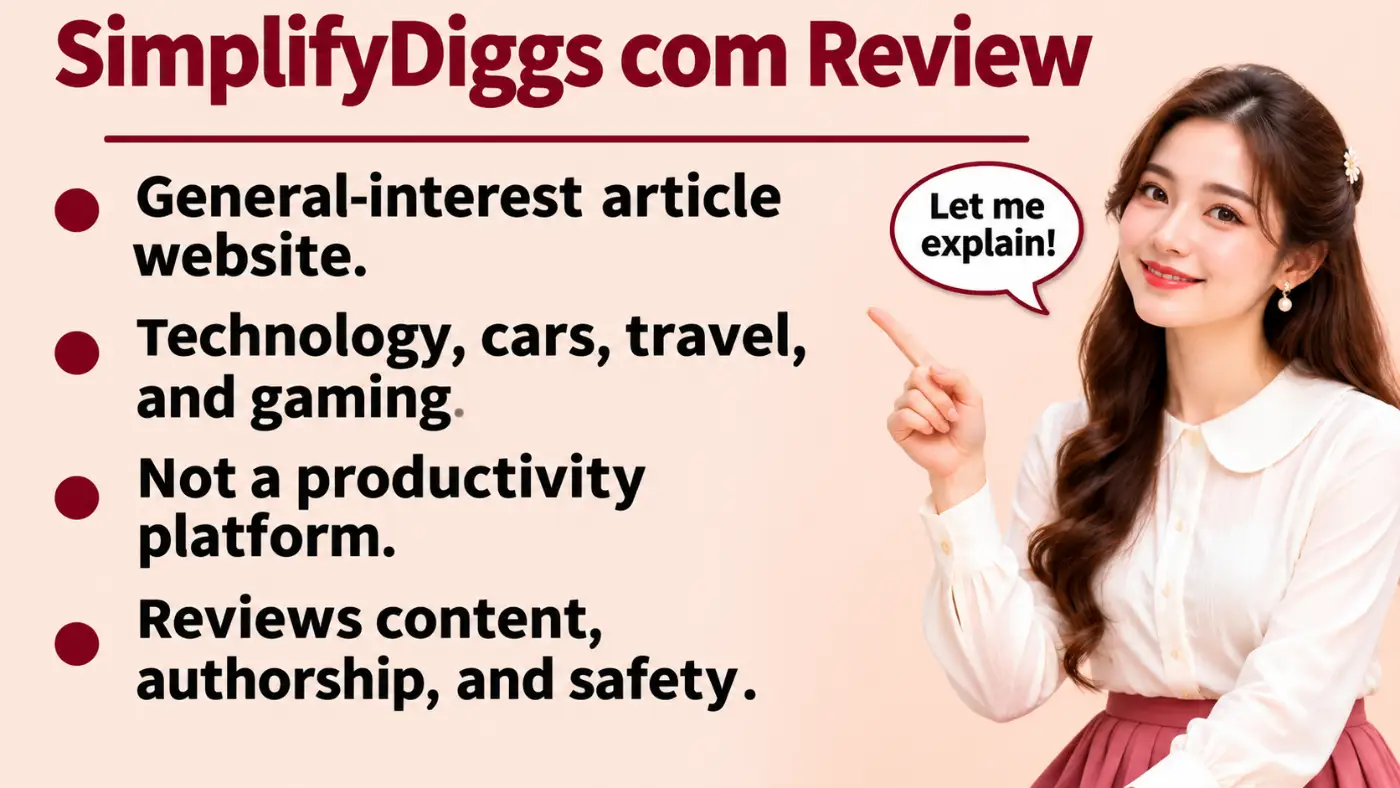
SimplifyDiggs com is best understood as a general-interest article website, not the productivity application or automated workflow platform suggested by some online descriptions. Independent examinations of SimplifyDiggs.com identify a WordPress-style publication with articles about technology, automobiles, travel, and online gaming. Its navigation reportedly names many more subjects than its documented article archive substantially covers.
That distinction helps visitors know what to expect. Someone looking for information about cloud services may find a basic explainer, while a reader seeking a working task-management dashboard should not assume one exists. This review examines the evidence for the site’s publishing identity, article subjects, author accountability, content freshness, contributor opportunities, and trust considerations. Descriptions attributed to outside reviewers should not be mistaken for independently verified features of the original website.
Related Post: Zavalio Com
What Is SimplifyDiggs Com?
SimplifyDiggs.com is described in several 2026 website examinations as a multi-topic informational blog. Instead of providing a specialized application, it appears to organize written posts into categories so visitors can select a subject and read an article. That is a familiar model for small online magazines and independent publishers.
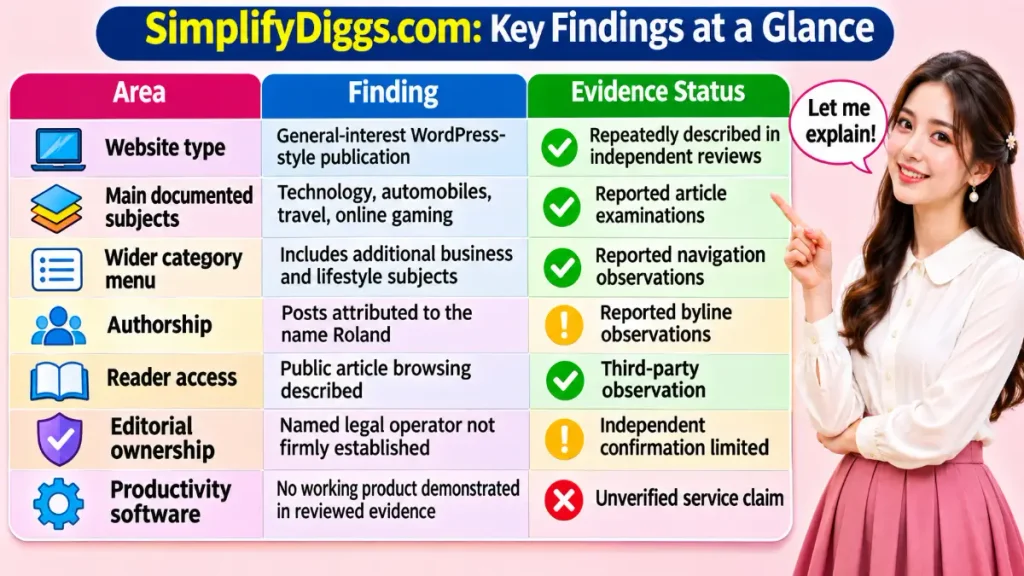
The clearest supported function is publishing articles. Readers should evaluate individual posts for their usefulness rather than treating the website name as a description of a product.
What the Category Menu Says Versus What Articles Show
One notable feature of SimplifyDiggs is the reported gap between the number of categories in its navigation and the subjects with documented articles. A September 2026 examination described 17 menu categories, including technology, automotive, travel, finance, education, entertainment, health, sports, and real estate. A separate November examination counted 18 categories. These differing totals may reflect inspection methods or changes in the menu; they should not be treated as a verified current count.
The more meaningful question is whether each section contains useful posts. Independent researchers consistently describe technology and automotive articles as prominent in the available sample, with smaller amounts of travel and gaming material. A category label alone cannot prove that a site publishes regularly or extensively on that subject.
A reader interested in finance, health, or property should therefore look for an actual relevant article, not rely on the category menu as evidence of specialized coverage. The number of categories is a design choice; the quality of each post depends on its sources, reasoning, and practical detail.
A Content Website or a Productivity Platform?
The name SimplifyDiggs may sound like a digital organization service. Some third-party descriptions have gone further, referring to productivity features, automation, dashboards, or workflow tools. The available website examinations do not establish a functioning productivity product on the exact .com domain.
There is an important difference between an article explaining a software product and a publisher operating that product. A blog can discuss cloud infrastructure without offering cloud hosting. It can describe task-management techniques without providing accounts, integrations, or project boards.
Evidence of a genuine application would normally include a clearly identified service, usable interface, documentation, supported features, and applicable terms. None should be assumed simply because another review uses the word platform.
For practical purposes, approach SimplifyDiggs as a place to read information. If a separate site promises downloads or a dashboard under a similar name, verify its full address and operator independently before entering credentials or making payments.
What the Reported Article Sample Reveals
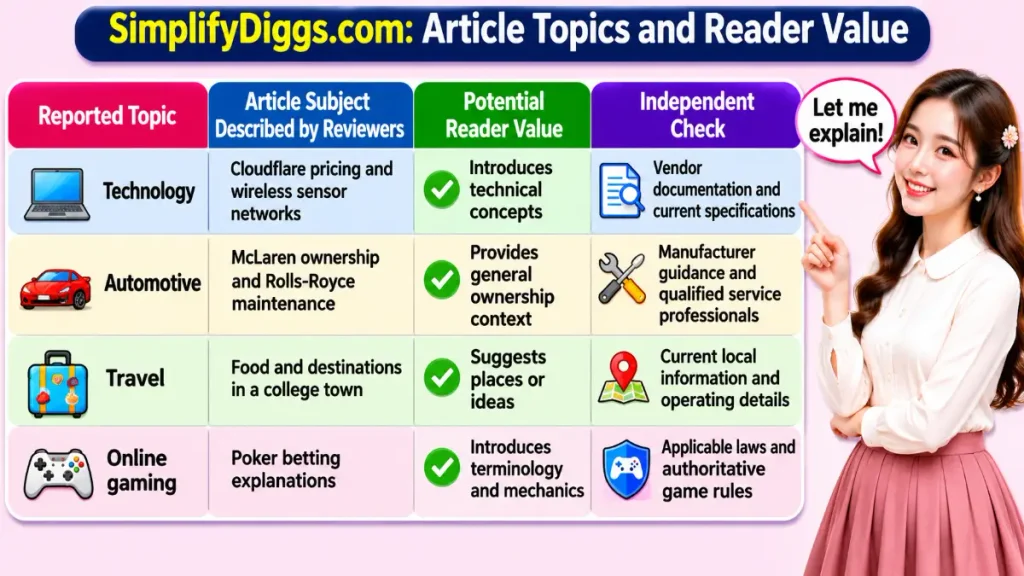
The most useful way to judge a multi-topic publisher is to inspect actual articles rather than relying on its branding. Independent examinations describe technology posts discussing Cloudflare pricing, wireless sensor networks, data visualization utilities, and network security alternatives. Other reported articles concern luxury car ownership, maintenance, poker, and travel.
These examples show breadth, but breadth is not the same as specialist expertise. A clear introduction to wireless sensors can help a beginner understand terminology. It cannot replace a manufacturer’s technical documentation when someone needs equipment specifications or installation requirements.
Likewise, an article about luxury-car maintenance may help a reader prepare questions for a service appointment. It should not be treated as an official maintenance schedule unless it cites the applicable model, year, service intervals, and manufacturer guidance. The practical standard is whether the article provides information precise enough for its intended purpose.
A good article sample should answer several questions. Does the headline match the substance? Are named products or services described accurately? Are prices and specifications dated? Does the writer identify sources for factual claims? Is an article mainly explanatory, or does it encourage readers toward a particular commercial provider?
No comprehensive original-domain article audit was completed for this review. Consequently, the named subjects above are attributed to published examinations, and no claim is made that all articles share the same strengths or weaknesses. The evidence supports a narrower conclusion: the site has been described as a readable, multi-subject publication whose individual claims still deserve checking.
Publication Dates and Information That Can Become Outdated
Independent reports describe articles appearing in 2023, a travel-related post in 2025, and automotive material in 2026. One November 2026 investigation reported an April 2026 latest-post date. These are dated observations, not a guarantee about the present publishing schedule.
Readers should check whether a displayed date indicates original publication or a substantive update. A recently changed timestamp does not automatically mean every figure has been rechecked. Conversely, an older article is not necessarily wrong if its central information remains valid.
For consequential decisions, fresh primary documentation matters more than the date alone. Compare the article’s specific claims with the latest official information available from the relevant organization.
Who Writes and Takes Responsibility for the Content?
Several independent inspections report that articles carry the byline Roland. They also describe an author archive whose address contains the name brijesh. This discrepancy is worth understanding, but it does not establish dishonesty. WordPress sites can retain an account slug after the public display name changes, and a shared publishing account can also create differences between internal and visible labels.
Editorial responsibility is a separate question. An editor may check sources, approve updates, and handle corrections even when a post shows only one author. A publisher may have legal ownership distinct from both the editor and the writer.
The website’s named controlling operator and consistent editorial oversight are not firmly established by the sources reviewed. That is a transparency limitation, not evidence of fraud. For readers, the practical issue is whether they can identify who stands behind a consequential claim and where to request a correction.
When assessing a technical or financial explanation, look for specific source references, dated information, and a clear distinction between reported facts and the writer’s opinion. Those qualities can be evaluated even when the author biography is brief.
Similar Names and the Exact Domain
The subject of this review is simplifydiggs.com, with that exact spelling and the .com ending. Similar-looking addresses can represent entirely different websites, even when they use nearly identical branding or publish articles about the same keyword.
Recent reviews mention variations such as simplifydiggs.net, mysimplifydiggs.com, and simplifydigg.com. Their existence or descriptions do not establish common ownership. A different extension, an added word, or a missing letter changes the domain identity.
Before using information about ownership, publishing dates, or contact methods, confirm which website the source actually examined. A statement about one domain should not be transferred to another without evidence of a documented relationship.
This distinction is especially important if a similarly named website asks visitors to register, download a file, or purchase a service. Verify the operator and terms on that exact website instead of relying on the reputation of a different address.
Guest Posts, Advertising, and Contributor Claims
Some independent reviews describe a sidebar promotion for a guest-post marketplace, and other reports mention commercial listings offering placements associated with SimplifyDiggs.com. Such reports suggest that contributor or advertising opportunities have been marketed, but a reseller listing is not the same as an official publisher policy.
Prospective writers should confirm who has authority to approve publication. Ask for written editorial requirements, acceptable subjects, payment terms, sponsorship labeling, revision rights, and any policy concerning outbound links. If an intermediary offers a placement, establish whether it has permission to sell that service.
A commercial listing also does not prove that every existing article was paid for. Without clear disclosures or transaction evidence, assigning sponsorship to individual posts would be speculative.
Businesses considering a placement should not confuse estimated domain-wide traffic with the likely readership of a particular article. Ask what evidence supports any audience claims and whether promised deliverables can be documented. Avoid relying on unverified guarantees about rankings, permanence, or engagement.
Trust, Browsing Safety, and Practical Reader Checks
A website can be a real publisher while still offering uneven information. It can also use HTTPS without having expert editorial review. Technical security, factual accuracy, and publisher accountability are different questions. None should be collapsed into a single safe-or-scam label.
The available evidence supports the view that SimplifyDiggs.com has operated as an article website. It does not establish that every post has been fact-checked by a specialist, that its operator has verified credentials in every category, or that every commercial arrangement is fully disclosed.
For ordinary reading, begin by checking that the address is the intended domain and that the page matches the subject you expected. Next, examine the article date and byline. Identify the one or two claims that could influence your decision, and see whether the article provides a traceable source.
Technology specifications and prices should be compared with official developer or manufacturer information. Vehicle maintenance guidance is best verified through the owner’s manual or a qualified professional. Travelers should confirm current local requirements before making plans. Health, legal, and financial information requires authoritative sources and professional advice when appropriate.
Do not submit passwords, financial details, identity documents, or payment information to an unfamiliar service without first verifying its operator and purpose. This is general online safety advice, not an allegation that the publication requests such information.
A measured assessment is more useful than a numerical trust score. The site’s apparent publishing function is supported by independent reporting; the reliability of a particular article depends on the evidence behind that article.
Who May Find the Website Useful?
SimplifyDiggs may be useful to readers who want an introductory explanation, a starting point for researching an unfamiliar term, or ideas for questions to explore further. Its reported subjects range from technology concepts to luxury vehicles and everyday interests.
It is less suitable as the only authority for a costly purchase, a technical installation, a financial decision, or a matter involving health or legal obligations. In those cases, use the article to identify terminology, then confirm the details with a primary or specialist source.
Writers considering guest contributions should focus on verified publishing terms rather than marketplace promises or unsubstantiated audience estimates.
Final Assessment
SimplifyDiggs com appears to be a multi-topic informational publication rather than a demonstrated productivity tool. Independent examinations describe a broad navigation menu, a narrower set of populated article topics, and limited public clarity about editorial responsibility. Its articles may be useful for orientation, but important claims should be checked against authoritative sources. Readers should confirm the exact domain, assess each article individually, and avoid assuming that a familiar-looking brand name proves specialized expertise or a software service.
Frequently Asked Questions
Is this mainly a blog or an online tool?
SimplifyDiggs.com is primarily described as an informational blog. A functioning productivity dashboard or automation platform has not been verified.
Which subjects have actual articles?
Reported articles cover technology, automobiles, travel, and online gaming. Other categories appear in the menu, but their content depth remains uncertain.
Who is credited with writing the posts?
Reviews identify Roland as a displayed author name. The writer’s qualifications and the publisher’s identity remain unverified.
Can older technology guides still be useful?
Yes, older guides can explain basic concepts. However, prices, features, and technical information should be checked against current official sources.
Do similar domain names belong to the same publisher?
Not necessarily. Similar names do not prove shared ownership, so readers should verify each website’s identity separately.
Are contributor offers officially confirmed?
Third-party listings mention guest-post opportunities. However, official pricing, submission requirements, and acceptance terms have not been independently confirmed.
Does a secure connection prove the information is reliable?
No. HTTPS protects data during transmission but does not guarantee accurate articles, qualified authors, or trustworthy advice.
What should readers check before relying on a guide?
Check the website address, publication date, author credentials, and supporting references. Verify important claims using current official sources.

Sophia Bennett writes educational content about English vocabulary, grammar, slang, and communication. She is passionate about making complex language topics accessible to students, professionals, and curious readers around the world.


2 Comments