
Zavalio Com Review: Content, Contributors, and Trust
Zavalio com is a general-interest online publication covering business, technology, finance, health, education, lifestyle, and related subjects. Its website presents informational articles, editorial policies, contact options, and opportunities to inquire about contributing or advertising.
The publication describes itself as independent and displays information about its editorial team. However, a publisher’s stated standards are different from independently verified editorial practices.
This review examines the website’s content categories, five reported article examples, contributor information, advertising arrangements, privacy disclosures, and credibility. It also explains why some older reviews describe the website differently and what readers should check before relying on its articles.
Related Post: SimplifyDiggs Com
What Is Zavalio Com?
Zavalio.com operates as a multi-topic informational publication designed for readers interested in practical explanations, industry developments, and everyday questions.
Its reported homepage includes categories such as technology, business, finance, health, education, and lifestyle. Visitors can browse articles, explore subject archives, and learn about the publication’s stated editorial approach.
The website also provides routes for contacting its publisher and proposing content. These are publishing-related activities rather than evidence of a self-service content creation platform.
Zavalio.com at a Glance
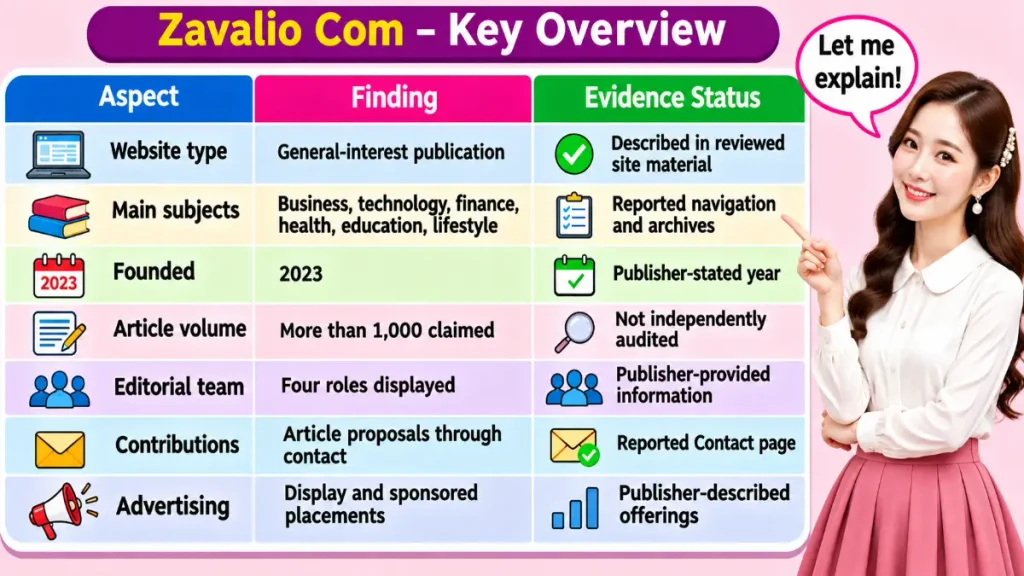
The distinction between publishing information and providing an interactive service matters. Reading a business article does not mean the website operates a business-management application. Likewise, information about investments does not establish that it offers brokerage services.
Its most clearly documented purpose is publishing articles for a broad readership.
Which Subjects Does the Publication Actually Cover?
Zavalio covers multiple subjects rather than concentrating exclusively on one professional field. However, its archive information suggests that some categories receive considerably more attention than others.
At the November 7, 2026 research checkpoint, the archive reportedly displayed the following category counts:
| Category | Displayed count | Typical subject matter |
|---|---|---|
| Business | 257 | Companies, services, operational topics |
| Health | 90 | Wellness and health explanations |
| Finance | 38 | Money-related information |
| Technology | 31 | Digital services and emerging technologies |
These are displayed category counts, not independently verified totals of unique articles. A post may appear in more than one category, and additional sections may contain content not represented in this table.
Business and Technology
Business appears particularly prominent in the reported archive. Its subjects extend beyond conventional entrepreneurship advice to technical and commercial topics such as wastewater treatment, VPN services, and fleet telematics.
Technology articles address subjects including artificial intelligence and changes in online information discovery.
Health and Finance
Health coverage includes practical explanations about physical discomfort and everyday wellness questions. Financial content serves readers interested in general money topics.
Such articles can introduce unfamiliar concepts, but medical and financial claims require stronger supporting evidence than ordinary lifestyle commentary.
Education and Lifestyle
These categories broaden the website’s appeal to readers seeking general explanations and practical ideas.
Category breadth does not automatically establish specialist expertise. A publication covering many subjects should be evaluated through the quality of individual articles, their authors, and the evidence supporting their conclusions.
What Five Published Articles Reveal
A useful website review should examine actual articles rather than relying entirely on the homepage’s description.
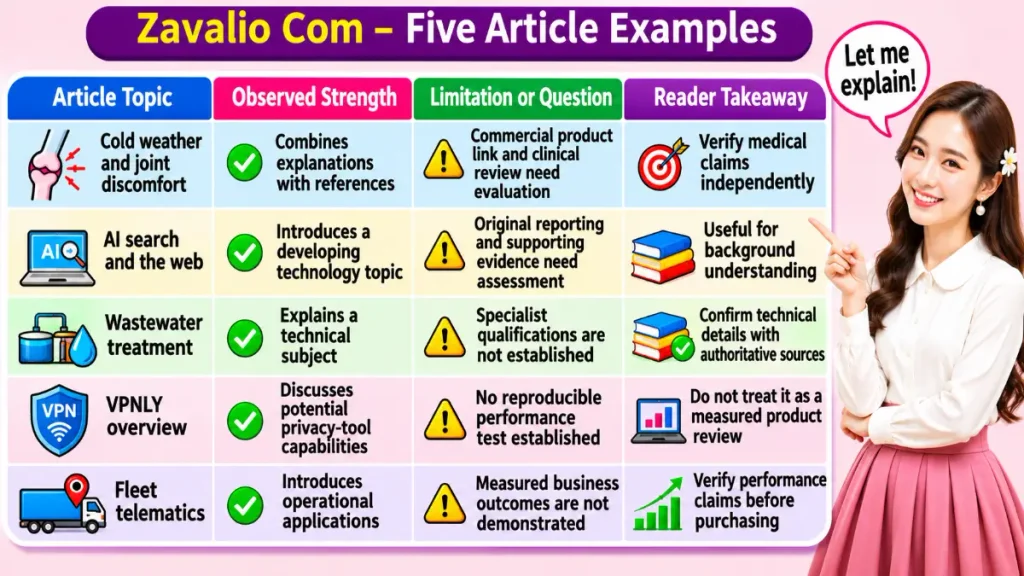
Five articles identified in the November 7 research sample illustrate Zavalio’s editorial approach. They cover health, artificial intelligence, environmental technology, online privacy, and fleet management.
Health Information and Commercial References
The October 23, 2026 article about cold weather and joint discomfort appeared in the Health category under the byline “zavalio.”
Its combination of educational references and a commercial product link raises a useful editorial question: Does each reference support the specific claim being made?
A product mention is not automatically inappropriate. However, readers should distinguish general medical explanations from claims intended to encourage a purchase.
The available evidence does not establish whether the article underwent qualified clinical review.
Technology and Business Explanations
The September 29 article about AI search addresses changes in how people discover information online. This subject benefits from current examples and evidence because search technologies evolve quickly.
Three August 31 articles illustrate the Business category’s unusually broad range.
The wastewater article discusses an environmental and industrial subject. The VPNLY overview considers possible privacy-related capabilities, while the fleet telematics article introduces technology used in commercial vehicle operations.
The latter two subjects can be helpful to readers exploring unfamiliar products or systems. Nevertheless, general explanations should not be mistaken for independent performance testing.
Across the five examples, the strongest established finding is topical variety. Their presence does not establish that every article contains original research or independently verified specialist advice.
Editorial Promises and Article-Level Evidence
Zavalio publishes an Editorial Policy dated September 19, 2026, and a Corrections Policy dated September 20, 2026, according to the research checkpoint.
These pages provide a stated framework for how the publisher intends to handle its material. They are relevant because readers need to know whether accuracy, updates, and corrections are treated as editorial responsibilities.
However, a published policy establishes a commitment, not automatic compliance.
An effective editorial assessment considers several separate questions.
Are Sources Relevant to the Claims?
A reference is valuable when it supports the particular statement beside it. For example, a technical manufacturer’s documentation may support product specifications, but it may not establish independent performance or customer satisfaction.
Similarly, a medical research paper should be relevant to the health claim being discussed.
Are Articles Clearly Attributed?
The reviewed sample displays bylines including “zavalio” and “Alena.” These labels identify publishing attribution, although they do not independently verify professional qualifications.
A useful author profile should explain relevant experience, areas of expertise, and editorial responsibilities.
Is Commercial Material Identifiable?
Several sampled business articles contained prominent outbound links. Such links can direct readers to useful resources, suppliers, or commercial websites.
An outbound link alone does not establish that an article was sponsored or paid for. Confirming a commercial relationship requires stronger evidence, such as a disclosure or publisher confirmation.
Readers should evaluate whether promotional material is clearly separated from independent explanations.
The combination of policies, bylines, and article references provides a basis for evaluating the publication. The remaining question is how consistently those practices operate across its broader archive.
Who Writes the Articles, and Who Runs the Site?
Zavalio’s homepage reportedly presents four named editorial roles, while individual articles may display different bylines.
This creates several distinct layers of responsibility.
An editorial team listing tells readers whom the publisher associates with its operations. An article byline identifies the name credited with a particular post. Legal ownership concerns the person or organization responsible for operating the publication.
These are related but not interchangeable.
For example, an article attributed to “zavalio” may have been published through a shared editorial account. That attribution does not establish the writer’s legal identity or specialist background.
Likewise, the name “Alena” on several articles provides attribution but does not independently establish expertise in wastewater treatment, VPN services, and fleet management.
The homepage’s named editorial roles are publisher-provided information. Independent authentication of those individuals and the controlling legal operator was not established by the evidence reviewed.
Readers researching important subjects should look for relevant author biographies, clear sourcing, and a practical corrections process.
Limited identity verification is an accountability consideration, not evidence that contributors or staff members are fictional.
Guest Contributions and Advertising Explained
Zavalio provides a contact-based route for prospective contributors.
Its Contact page reportedly invites article proposals and writing samples, subject to editorial review. This indicates that independent writers can inquire about submitting material.
However, an invitation to propose an article does not guarantee acceptance or publication.
The advertising page separately describes display placements, sponsored articles, brand features, and promotional material. According to the publisher, pricing depends on campaign requirements.
Editorial Contributions Versus Sponsored Placements
An editorial contribution is typically submitted for consideration based on its subject, originality, and usefulness to readers.
A sponsored article involves a commercial arrangement. Its terms may cover placement, editorial control, labeling, and publication duration.
These arrangements should not be treated as identical merely because both can result in published content.
Before agreeing to a placement, prospective contributors should obtain written clarification about fees, editing, author attribution, sponsorship disclosure, revision rights, publication timing, and link treatment.
Writers should also establish who approves the finished article and whether removal or refund conditions apply.
The available material does not establish fixed guest-post prices, contributor payments, guaranteed acceptance, or permanent placement terms.
Reported audience size is not a substitute for verified article readership. Businesses considering a sponsored placement should assess relevance and clearly documented deliverables rather than relying on broad promotional claims.
Privacy, Comments, and External Links
Zavalio’s Privacy Policy describes information associated with ordinary browsing, voluntary submissions, analytics, and possible third-party advertising.
The publisher identifies Google Analytics in its privacy disclosures. This is a statement about its reported data practices, not an independent technical audit.
Readers should distinguish different interactions with the website.
Reading Articles
According to the published privacy information, ordinary reading generally does not require creating an account.
That does not mean browsing involves no technical data collection. Website logs, analytics, and cookies may still be relevant.
Leaving Comments
Comment forms observed in the research sample request a name and email address, with an additional website field.
Readers should avoid entering unnecessary personal information and review the applicable privacy disclosures before submitting comments.
Contacting the Publisher
Sending an article proposal or advertising inquiry may require sharing contact details and written material.
Prospective contributors should consider what information is necessary for the initial inquiry rather than supplying sensitive documents without a clear reason.
Following External Links
Links within articles may lead to other websites with different privacy policies, commercial interests, and security practices.
The presence of a Privacy Policy is useful, but it does not independently establish complete compliance or guarantee technical safety.
Why Descriptions of This Website Differ
Some third-party reviews describe Zavalio differently from the pages documented in the November 7 research checkpoint.
For example, older descriptions have questioned whether the website provides detailed About information, named editorial staff, or visible article bylines.
The newer research material identifies editorial roles and bylines, including “zavalio” and “Alena.”
These differences matter because a website review represents the evidence available at a particular time.
They do not automatically establish that an earlier writer was dishonest or that the website underwent a particular redesign.
The publisher also describes a founding year of 2023 and more than 1,000 published articles. These figures should remain attributed to the publisher rather than presented as independently audited history.
Is It a Creator Platform?
Descriptions suggesting a public creator dashboard, earnings system, or automated publishing platform require evidence of functioning services.
The documented contribution process is based on contacting the publisher and submitting proposals for review.
That is different from operating a self-service platform where users manage publishing accounts or receive payouts.
Similar Domain Names
Search results also identify zavalio.net, a separate domain spelling. Its content, ownership, and policies should not be attributed to Zavalio.com without evidence of a relationship.
Readers should confirm the exact address before making inquiries or relying on claims about the publisher.
Who May Find the Site Useful?
Zavalio may appeal to readers who enjoy exploring different subjects through a single general-interest publication.
Its reported archive offers introductions to business systems, technology trends, health topics, and everyday questions. The variety can help visitors discover unfamiliar subjects.
Researchers and professionals should treat articles as starting points, especially when technical specifications, health claims, financial information, or purchasing decisions are involved.
Prospective contributors have a documented contact route and publisher-described advertising options, although commercial and editorial terms require direct confirmation.
The website’s principal strength is its broad informational coverage. Its main limitation is that publisher claims, author qualifications, and individual article evidence still require careful evaluation.
Frequently Asked Questions
What kind of content can readers find here?
The website covers business, technology, health, finance, education, and lifestyle. Its articles include practical guides, product discussions, and industry information.
Do visitors need an account to read articles?
No account is generally required to read public articles. However, commenting or contacting the publisher may require personal information.
Can independent writers submit articles?
Yes. Writers can submit article proposals and writing samples through the Contact page. Publication is subject to editorial approval.
Are guest contributions and sponsored articles the same?
No. Guest contributions are considered editorially, while sponsored articles involve commercial arrangements. Fees and publication terms should be confirmed beforehand.
Does the publication pay contributors?
A standard payment policy has not been confirmed. Writers should contact the publisher to clarify compensation before submitting work.
How can readers check an author’s background?
Review the author’s byline, biography, qualifications, and professional experience. A displayed name alone does not verify expertise.
Can readers request a factual correction?
Yes. The website publishes a Corrections Policy and provides a contact route. However, a specific response time is not guaranteed.
Is the similarly named .net website connected?
No verified connection between Zavalio.com and zavalio.net has been established. Treat them as separate websites unless official evidence confirms otherwise.

Sophia Bennett writes educational content about English vocabulary, grammar, slang, and communication. She is passionate about making complex language topics accessible to students, professionals, and curious readers around the world.

One Comment