Vocalnewsmedia Com Review: Features, Tools, and Trust
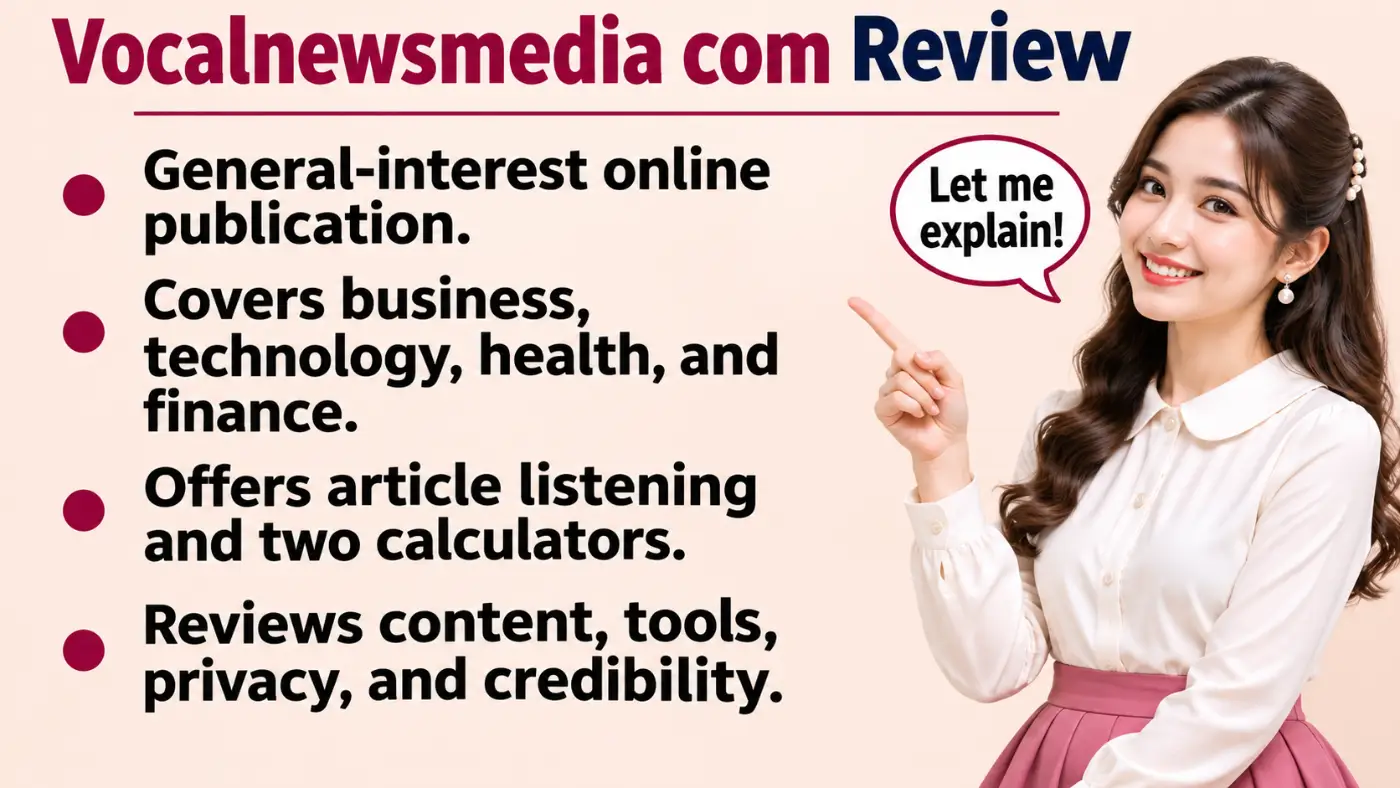
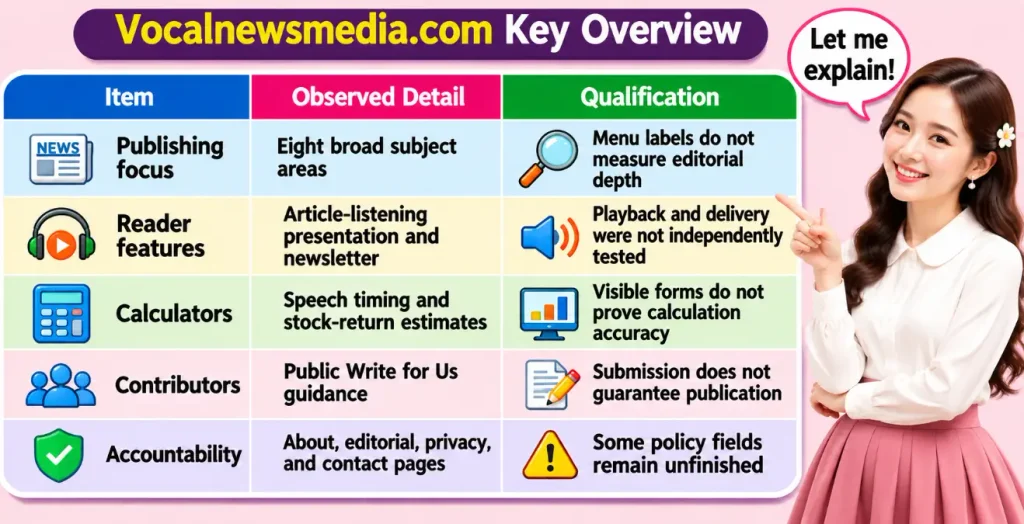
Vocalnewsmedia com is a general-interest online publication featuring articles on business, technology, education, health, finance, entertainment, lifestyle, and law. Its website also presents article-listening options, a newsletter, and two practical calculators. These features make it more than a collection of written posts, although their presence does not independently establish how reliably every feature works.
The central question for readers is not simply whether the website publishes material. It is how useful its articles are, what its tools actually offer, and how clearly the publisher explains responsibility for its content and reader information. This review examines the site’s reported pages and representative articles, separates visible features from untested claims, and explains what readers and potential contributors should check.
Related Post: EuroGamersOnline Com
What Is Vocalnewsmedia Com?
Vocal News Media presents itself as a publication with a news-and-opinion mission. Its About Us material emphasizes balanced perspectives and fact-checking. Those are publisher statements, rather than independent proof that every article meets a particular journalistic standard.
The material described in the November 7, 2026 research checkpoint shows a broader editorial mix. Alongside current-interest topics, readers encounter educational summaries, business explainers, practical guides, and reviews. This combination resembles a multi-topic information website more than a publication devoted exclusively to breaking news.
A visitor can browse categories, read articles, explore an archive, and examine the site’s additional tools. The website also offers a route for original contributor pitches. None of these activities should be confused with a verified professional advisory service or a financial trading platform.
What Does the Website Actually Publish?
The homepage’s eight main areas are entertainment, health, business, technology, finance, education, lifestyle, and law. They signal a wide intended audience, but category breadth should not be mistaken for specialist expertise in every field.
Two documented article examples show how the publication works. An explainer about AQL inspections, dated October 31, 2026 on the displayed page, discusses a technical business topic. A summary of The Fun They Had, dated August 31, 2026, presents educational material using headings and frequently asked questions. These are different kinds of articles, serving different reader needs.
An archive entry about budgeting comparisons carried a displayed November 4, 2026 date. That suggests recent publishing activity within the research checkpoint, although the date shown on a page is not an independently authenticated creation timestamp. The archive is a better place to examine the publication’s sequence of posts than a limited homepage selection.
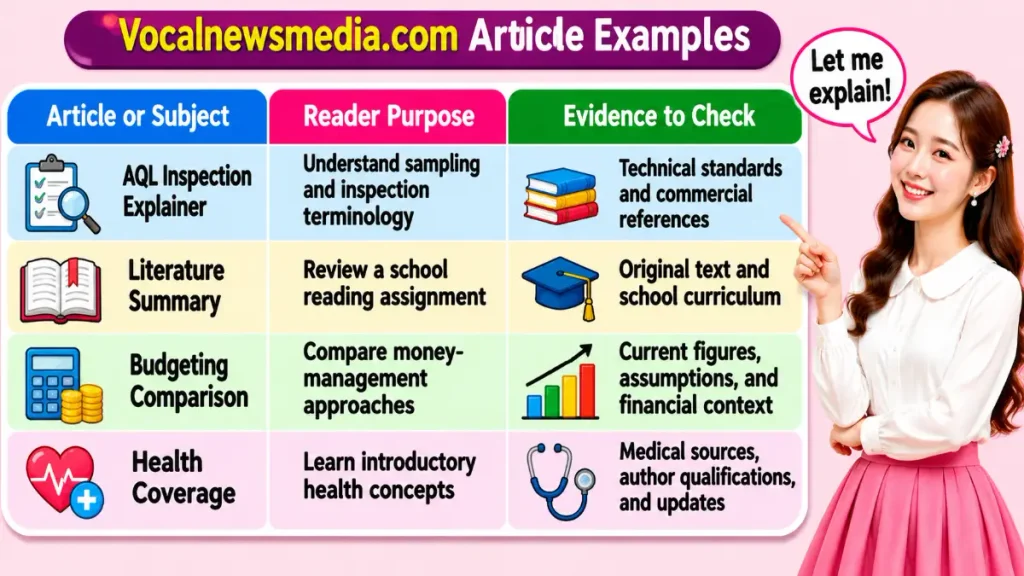
US readers should check jurisdiction, currency, dates, and product availability before applying practical advice. A clearly written explanation can still be unsuitable for a different country or a newer version of a product.
Reading, Listening, and Finding Recent Articles
The website offers several ways to approach its material. Topic navigation helps readers choose a subject, while the article archive gives a broader view of published work. An article’s displayed date, author line, and references can help a visitor decide whether to read it closely.
A featured-story section on a homepage is not necessarily a complete newest-first feed. Publishers may highlight older stories for editorial reasons, and a static selection can coexist with more recent archive entries. Anyone checking current activity should compare the archive with individual article dates rather than relying on the first visible cards.
Vocal News Media also promotes listening to articles. The AQL inspection page describes device-based reading aloud, which is different from a live radio broadcast or a professionally produced podcast series. A read-aloud label is evidence of an intended listening experience, not proof that playback has been tested across devices.
The newsletter, called The Daily Voice, is another separate feature. A subscription invitation indicates a proposed email product; it does not by itself establish delivery frequency, subscriber numbers, or the identity of the company handling addresses. Readers should review the privacy disclosures before entering an email address.
What the Two Free Calculators Offer
The site presents two utilities that address narrow, practical questions. Their purpose is different from the publication’s articles: each tool asks for inputs and is intended to return a numerical estimate. The research checkpoint documented the interfaces, not completed functional tests.
Speech Time Calculator
The Speech Time Calculator accepts written text or a word count. It also displays speaking-pace choices and a time-limit field. These inputs are useful for planning a presentation, classroom talk, video script, or short speech.
For example, 300 words at 150 words per minute equals approximately two minutes before pauses. A real presentation may take longer because the speaker emphasizes points, waits for reactions, or changes pace. The estimate is therefore a planning aid, not a promise of exact delivery time.
Stock Return Calculator
The Stock Return Calculator displays fields for purchase price, sale price, share quantity, dividends, transaction costs, and an optional holding period. The interface uses Indian rupees, an important detail for American readers expecting dollars.
Consider a simplified example: ten shares purchased at 100 each and sold at 110 each, with no fees or dividends. The difference is 100 in total profit, or a 10 percent return on the original 1,000 investment. This is expected arithmetic, not a recorded result from executing the website’s calculator.
A stock-return estimate cannot independently verify market prices, taxes, corporate actions, exchange rates, or whether a security is appropriate for an investor. The tool should not be confused with a brokerage account, real-time trading terminal, or personalized investment advice.
The publisher’s privacy material says calculator inputs remain in the browser. That statement is relevant, but confirming it technically would require separate testing of network activity and implementation. Users should avoid entering confidential financial details when a simple fictional example is enough.
Who Writes the Articles, and Who Runs the Site?
Author names help readers distinguish individual contributions, but a byline alone does not establish professional credentials or legal ownership. The documented AQL inspection article displayed Devin Haney as its byline, while the literature summary displayed Shivi Hyde. Those names identify how the articles are credited on the site; they should not be associated with unrelated public figures without evidence.
The inspected author boxes offered brief contributor descriptions rather than extensive professional biographies. That limits what readers can conclude about subject-matter qualifications. For a school summary, this may be less consequential than for an article making medical, legal, or financial recommendations.
A visible contact route is useful because it gives readers a place to raise questions. Yet a contact form does not verify the operator’s identity, and a displayed mailbox does not automatically identify the legal owner. Editorial accountability is strongest when bylines, meaningful biographies, correction procedures, and responsible publisher information work together.
Readers evaluating an important claim should start with the article itself: check its author information, references, date, and whether the explanation distinguishes evidence from opinion. The publication’s overall branding cannot substitute for that article-level review.
What the Policy Pages Reveal About Transparency
Vocal News Media provides an Editorial Policy and Privacy Policy. Their presence is a useful starting point because they explain what the publisher says it intends to do. However, a published policy is not an independent audit of compliance.
The Editorial Policy describes principles involving independence, updates, sponsorship labels, and paid-link treatment. At the November 7 research checkpoint, its research section still contained unfinished instructional wording. This matters because research standards are especially relevant for a website covering technical, health, and financial subjects.
A complete editorial policy would ideally explain how sources are selected, when outside expertise is sought, how corrections are requested, and how sponsored material is distinguished from independent editorial work. Stating these practices is helpful; consistent application must be assessed through actual articles over time.
The Privacy Policy discusses contact and newsletter information but reportedly retained placeholders for its revision date, newsletter provider, analytics or advertising services, and contact details. These omissions create specific unanswered questions about data handling. They do not establish that personal information has been misused.
The Contact Us page presents a form, while the research checkpoint noted an unfinished email placeholder there. Separately, the footer displayed an email address. It would therefore be inaccurate to say the website has no contact route. The more precise concern is that its contact disclosures are not fully consistent.
For a casual reader, incomplete fields may be an inconvenience. For someone sharing an email address, submitting a business inquiry, or discussing a paid placement, the missing details are more material. It is reasonable to ask who receives information, which providers process it, and how a reader can request deletion or unsubscribe.
Guest Contributions and Advertising Questions
The website’s Write for Us page invites original, sourced submissions across its main subject areas. The documented guidance excludes AI-spun or rewritten material and lists prohibited categories including casino, CBD, vaping, adult content, trading signals, and link-placement submissions.
These rules tell potential writers something about the publisher’s stated editorial preferences. They do not guarantee acceptance, payment, a publication date, or a particular author-link arrangement. The page directs contributors toward the contact route, so writers should confirm current requirements with the publisher before preparing a complete article.
An Advertise page is also linked from the site. Advertising inquiries and editorial contributions are different arrangements. A sponsored placement may involve payment and disclosure requirements, whereas an independently accepted contribution may follow separate editorial rules. The mere presence of an advertising page does not establish prices or available packages.
Before agreeing to any commercial placement, request written confirmation of the publisher’s identity, deliverables, review process, fees, sponsorship labeling, revision rights, and cancellation terms. Contributors should also clarify whether they retain ownership of submitted work and whether the publisher can edit or remove it later.
Is the Website Reliable and Safe to Use?
A useful assessment separates three issues: technical browsing safety, privacy transparency, and factual reliability. They overlap, but evidence about one does not settle the others.
A secure connection can protect data in transit, yet it does not prove that an article is accurate or that a publisher follows every stated policy. Likewise, the existence of a contact form does not establish that messages will receive a response. No independent security scan or end-to-end privacy audit is established by the supplied research checkpoint.
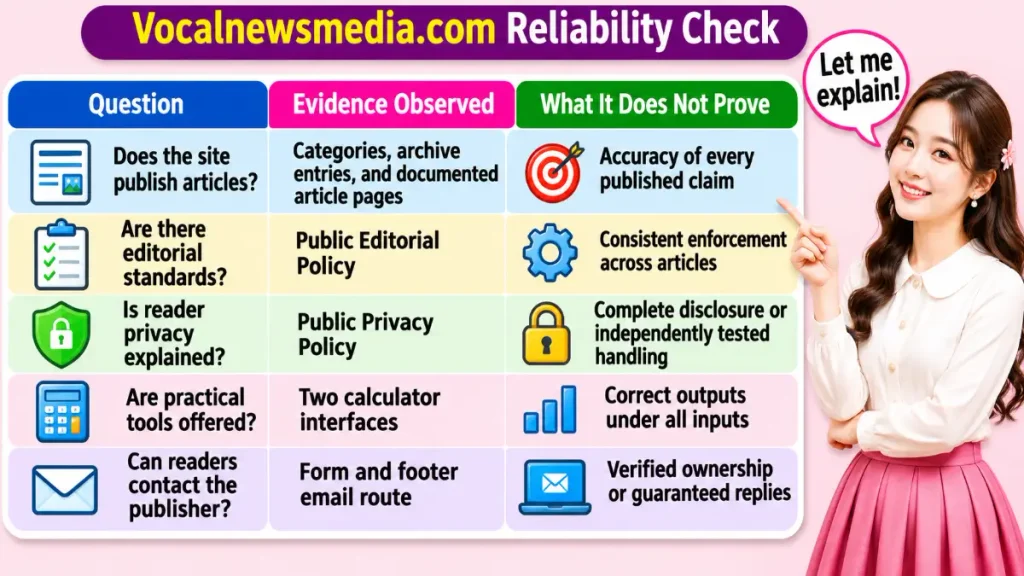
For everyday browsing, an introductory article may be useful as a starting point. More consequential topics demand stronger verification. Medical claims should be compared with established clinical authorities; financial details need current product documents and regulatory context; legal explanations require the rules that apply in the reader’s jurisdiction.
The most defensible conclusion is neither a blanket endorsement nor an unsupported accusation. The website presents identifiable publishing features, while some ownership, policy, privacy, and functional details deserve clarification.
Who Will Find It Useful?
Vocal News Media may suit readers looking for accessible introductions to varied topics, students seeking a starting explanation, and speakers estimating presentation length. Its archive and category menu can help visitors discover subjects they want to investigate more deeply.
Prospective contributors have a visible invitation to pitch original work, but should clarify editorial and commercial terms before submitting. Newsletter subscribers should examine the incomplete provider disclosures and decide whether they are comfortable sharing an address.
For health, investment, legal, and other high-stakes decisions, treat the articles as background reading rather than a substitute for authoritative sources. The strongest use case is orientation: learning the vocabulary, identifying questions, and finding out what to verify next.
Frequently Asked Questions
Is this mainly a news outlet or a general-interest publication?
It presents a news-and-opinion mission, but its documented content includes explainers, reviews, educational summaries, and practical guides. General-interest publication is the clearest description of the observed mix. That does not exclude news coverage; it simply avoids assuming every article is original reporting.
Can I listen to articles instead of reading them?
The website promotes article listening and describes device-based read-aloud functionality. This is different from a live radio channel or a dedicated podcast library. Playback performance across devices was not independently tested in the research supplied for this review.
What do the free calculators help with?
One estimates how long a speech may take based on text or word count and speaking pace. The other estimates stock investment returns using prices, quantity, dividends, and costs. Both are planning tools, not substitutes for rehearsal or financial advice.
Does a contributor name establish professional expertise?
No. A byline identifies the name credited on an article, but it does not verify a person’s qualifications, professional history, or legal identity. For important claims, look for relevant expertise and strong primary-source references rather than relying on the displayed name alone.
Can independent writers pitch an article?
Yes. The Write for Us guidance invites original, sourced contributions and describes excluded topics. Writers should use the publisher’s contact route to confirm current editorial requirements. The invitation does not promise acceptance, payment, a specific publication date, or permanent placement.
What do the unfinished policy fields mean?
They show that some public disclosures need completion or clarification, particularly around research methods and privacy providers. An unfinished field is not evidence of fraud, but it makes it harder to understand accountability and data handling. Readers can reasonably request details before subscribing or paying.
How can I find the newest published material?
Check the article archive and individual displayed publication dates rather than judging activity only from homepage features. A featured story may be older than another archive entry. Dates should still be treated as publisher-displayed information unless independently corroborated.
Should I verify health and money claims elsewhere?
Yes. Compare important health claims with recognized medical sources and investment details with current official documentation. Check whether advice applies to the United States, since some examples and tools use other educational systems or currencies. Independent verification matters most when a decision carries real consequences.
Final Verdict
Vocalnewsmedia.com is a general-interest information website covering business, technology, finance, health, education, and other everyday topics. Its article-listening features, speech-time calculator, stock-return calculator, and contributor opportunities provide additional value beyond traditional blog content.
However, editorial transparency and content accuracy deserve careful consideration. Some policy disclosures remain incomplete, and visible tools do not automatically guarantee reliable results. Readers should independently verify important financial, medical, and legal information.
Overall, Vocalnewsmedia.com can be a useful starting point for general reading and research, but its articles should not replace authoritative sources or professional guidance when making important decisions.

Sophia Bennett writes educational content about English vocabulary, grammar, slang, and communication. She is passionate about making complex language topics accessible to students, professionals, and curious readers around the world.