ALV Meaning In Text: Origin, Examples and Usage 2026
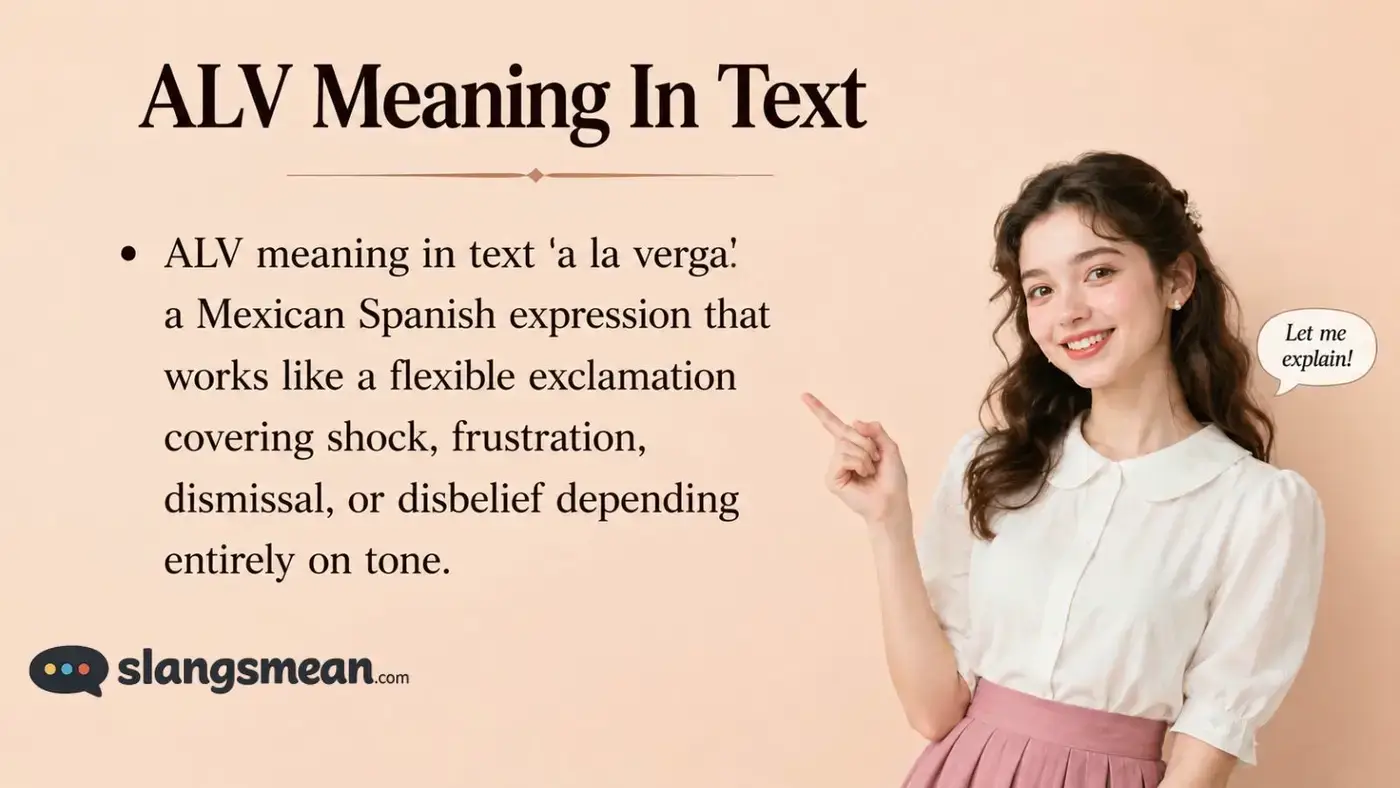
ALV meaning in text ‘a la verga’ a Mexican Spanish expression that works like a flexible exclamation covering shock, frustration, dismissal, or disbelief depending entirely on tone. It functions less like a fixed phrase and more like an all purpose emotional release, similar to how English speakers might drop a sharp “oh sh*t” or “screw it” depending on the moment.
You will see ALV most in Spanish speaking and bilingual group chats reacting to something surprising, annoying, or just plain wild. It carries real punch, the kind of word that does a lot of emotional work in just three letters.
Origin and Cultural Footprints
ALV grew out of everyday spoken Mexican Spanish, where the full phrase has functioned as casual, slightly vulgar shorthand for decades, long before texting compressed it down. The literal words reference a crude anatomical term, but Mexican Spanish speakers use the phrase the way English speakers use plenty of similarly rooted exclamations, more as an emotional release than a literal statement.
Mexican and broader Latin American social media communities carried the abbreviation into digital spaces throughout the 2010s, with TikTok, Twitter, and Instagram eventually pushing it into bilingual Gen Z conversations across the US. As Spanish language slang increasingly crosses into English dominant online spaces through creators and cultural exchange, ALV started showing up in conversations and searches well beyond its original Spanish speaking audience.
Other Meanings of ALV
A handful of other readings circulate for ALV, though their level of genuine documentation varies sharply from one to the next.
- Alive — Occasionally used as a phonetic shortcut for the word itself in casual English check in messages, unrelated to the Spanish slang entirely.
- Automatic Lung Ventilator — A legitimate medical and respiratory care term used in clinical documentation, completely disconnected from casual texting or social media.
Why Does ALV Have So Many Different Definitions?
The Spanish slang reading dominates by a wide margin, confirmed independently by established slang reference sites with usage history stretching back over a decade. Alive and Automatic Lung Ventilator stay confined to their own narrow, unrelated contexts, rarely overlapping with casual social media conversation in any confusing way.
A few recently published sites push a softer, unrelated expansion claiming ALV stands for All Love, though this reading shows essentially no real documented usage history compared to the well established Spanish phrase. That kind of sanitized substitute tends to appear when a term’s actual meaning carries some edge that content sites would rather avoid spelling out directly.
Does ALV Mean the Same Thing Outside the US?
The Spanish slang meaning stays strongest specifically in Mexico and among Mexican diaspora communities, since the phrase carries deep roots in Mexican street language rather than broader Latin American Spanish generally. Other Spanish speaking countries may recognize it through shared online content, but usage intensity drops outside that specific cultural context.
Within the US, bilingual Gen Z communities have picked it up readily, especially through content creators who move fluidly between English and Spanish online. The medical and phonetic English meanings stay essentially unrelated to any region specific pattern, since both function within narrow professional or casual contexts regardless of country.
Who Uses It Most?
ALV skews heavily toward Mexican and Mexican American communities, with growing visibility among bilingual Gen Z users more broadly.
Here’s a quick look at who reaches for ALV the most.
| Group | How They Use ALV |
|---|---|
| Mexican and Mexican American texters | Reacting to shock, frustration, or surprise in everyday Spanish |
| Bilingual Gen Z creators | Mixing ALV into English dominant captions and comments |
| Healthcare professionals | Using the unrelated medical ventilator abbreviation in clinical settings |
Real Conversation Examples Using ALV
Here is how ALV plays out reacting to genuinely shocking news shared between friends.
Text 1: “my mom died yesterday, still processing it” sent from one friend to another, sharing devastating personal news. Text 2: “alv, I’m so sorry, here for you whatever you need” replied the friend immediately, the exclamation carrying real shock rather than any dismissiveness. This exchange shows the word functioning as a genuine emotional reaction to terrible news, not as anything callous or careless.
Here is a second example using ALV to dismiss something frustrating in a casual back and forth.
Text 1: “that guy is still texting you after everything that happened” sent from one friend checking in on another going through a messy situation. Text 2: “yeah, alv, blocking him for good this time” replied the second friend, using the phrase to signal frustrated finality. This version leans into dismissal rather than shock, showing how much tone shifts the actual emotional register behind the same three letters.
Usage of ALV in Different Contexts
In a shocked or surprised context, ALV reacts to something genuinely unexpected, good or bad.
“alv, it’s pouring rain out of nowhere” This kind of message signals pure surprise, the texting equivalent of an exasperated exclamation when something unexpected happens.
In a dismissive context, ALV signals giving up on something or someone, often after frustration has built up over time.
“alv, I’m done arguing about this” This version shows up when someone wants to close a conversation firmly rather than continue going back and forth.
How Gen Z Uses ALV Today
Bilingual Gen Z creators have folded ALV into English dominant captions and comments, treating it as a flexible reaction word that carries more punch than typical English alternatives. Mixing Spanish slang into otherwise English conversations signals cultural fluency and comfort moving between both languages.
There is real identity signaling wrapped into this usage too, since reaching for ALV instead of an English equivalent marks familiarity with Mexican Spanish specifically, not just general Spanish language slang. It carries weight precisely because it comes from somewhere specific, rather than functioning as generic, interchangeable slang.
Does ALV Mean All Love?
Not really, despite some recently published sites claiming this softer expansion as the primary meaning. The well documented, decade plus history behind ALV points clearly toward the Spanish expression, not an English phrase about love or affection.
This softer claim likely exists because the actual Spanish phrase carries some vulgarity in its literal translation, making content sites hesitant to explain the real meaning directly. Treating All Love as the dominant reading would misrepresent how ALV genuinely functions across real conversations in Spanish speaking and bilingual communities.
Meaning Across ALV Social Media
| Platform | ALV Meaning | How It’s Used |
|---|---|---|
| TikTok | Spanish slang exclamation | Reacting to shocking or relatable content in captions |
| Spanish slang exclamation | Comment reacting strongly to dramatic or surprising posts | |
| Twitter/X | Spanish slang exclamation | Quick reply expressing shock, frustration, or disbelief |
| Spanish slang exclamation | Common in casual Mexican Spanish conversations | |
| Snapchat | Spanish slang exclamation | Reaction to a friend’s surprising or dramatic snap |
| Medical documentation | Automatic Lung Ventilator | Referenced in clinical respiratory care records |
Common Confusions
ALV trips up readers unfamiliar with Mexican Spanish, especially when encountered without any surrounding context.
- English phonetic readings sometimes mistake ALV for a shortened version of Alive, missing the Spanish slang entirely.
- Sanitized definitions claiming ALV means All Love lack real documented usage compared to the well established Spanish phrase.
- Tone misreadings can make ALV sound harsher than intended, since the same expression covers both genuine anger and lighthearted surprise.
- Non Spanish speakers encountering ALV in bilingual content may need surrounding context to catch the intended emotional register.
Related Slang Terms
- WTF — What The actual word
- SMH — Shaking My Head
- NGL — Not Gonna Lie
- OMG — Oh My God
- FML — A frustrated exclamation about one’s situation
- DAMN — A direct English equivalent covering similar emotional ground
How to Reply When Someone Says ALV
If a friend uses ALV reacting to shocking news, respond to the actual emotional weight of the situation rather than the specific word choice itself. Genuine support matters more here than parsing the exact phrase.
If ALV shows up signaling frustrated dismissal about a situation, acknowledging their frustration and letting the topic drop usually works better than pushing for more discussion. The word itself often signals someone is ready to move on.
When Did ALV Go Mainstream?
ALV has circulated in spoken Mexican Spanish for generations, long before any digital compression turned it into a three letter text abbreviation. Its transition into texting culture happened gradually through Mexican and Latin American social media communities throughout the 2010s.
Crossover into broader bilingual Gen Z spaces accelerated more recently, as Spanish language content and creators gained wider visibility across TikTok and other major platforms. Search interest from English dominant audiences encountering ALV without context has grown accordingly, even as the core meaning has stayed rooted firmly in its Mexican Spanish origins.
Conclusion
ALV means a la verga, a flexible Mexican Spanish exclamation covering shock, frustration, and dismissal. It carries real cultural roots that predate any digital slang trend by decades.
Tone and context decide the exact emotional register behind any given use. Once you read the surrounding conversation, the feeling behind ALV becomes obvious almost instantly.
FAQs
What does ALV mean in text?
ALV means “A La Verga,” a Spanish slang phrase used in texts and social media to express surprise, frustration, excitement, or disbelief. Its exact meaning depends on the context and is considered vulgar in some situations.
What is ALV used for?
People use ALV as a quick reaction to something shocking, funny, or unexpected. It’s common in memes, chats, and online conversations, especially among Spanish speakers.
What do you mean by ALV?
ALV is simply the abbreviation for “A La Verga.” In texting, it’s used to show strong emotions or emphasize a reaction to something.
What is ALV in Spanish?
In Spanish, ALV stands for “A La Verga,” a slang expression popular in Mexico and other Spanish-speaking regions. Depending on the context, it can express surprise, anger, or disbelief.
What is ALV in medical terms?
In medical settings, ALV can refer to Assisted Lung Ventilation or other terms related to alveolar functions. This medical meaning is entirely different from the slang abbreviation used in texting.

Sophia Bennett writes educational content about English vocabulary, grammar, slang, and communication. She is passionate about making complex language topics accessible to students, professionals, and curious readers around the world.