IKR Meaning In Text: The Text That Says I Feel You Too
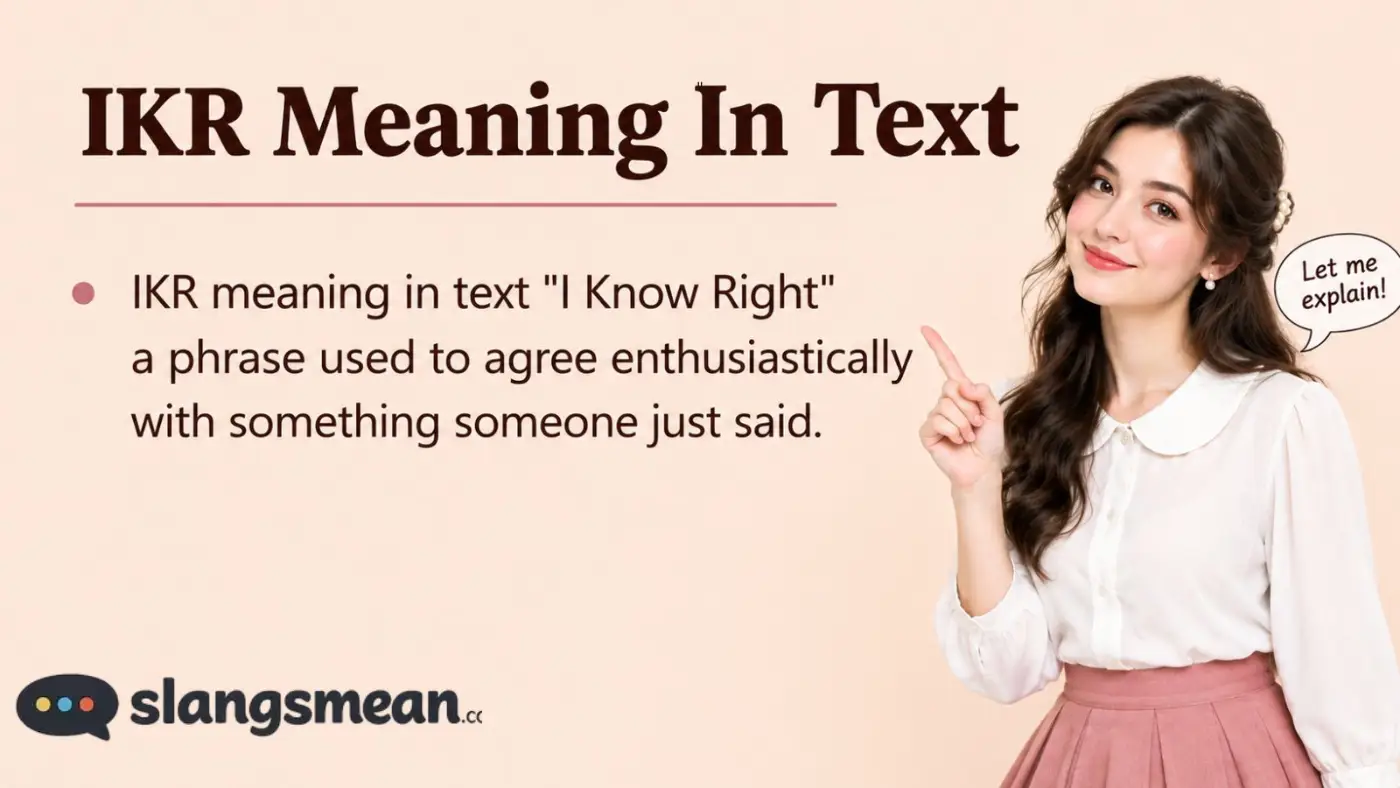
IKR meaning in text “I Know Right” a phrase used to agree enthusiastically with something someone just said. It’s less about literal agreement and more about validating a feeling, confirming that yes, you saw the same thing, felt the same frustration, or noticed the same absurdity. It shows up constantly in texts and comments as an instant, low effort way to say me too.
You’ll see it after complaints, jokes, surprising news, or shared observations. It works best as a quick reaction rather than the start of a longer conversation.
Related Meaning: NPC Meaning In Text
Origin And Cultural Footprints
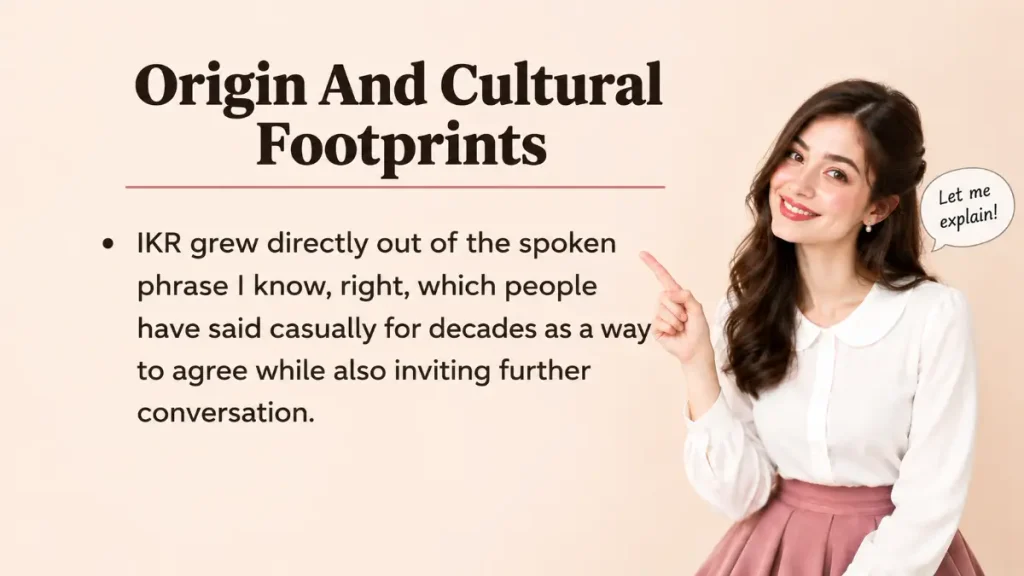
IKR grew directly out of the spoken phrase I know, right, which people have said casually for decades as a way to agree while also inviting further conversation. Texting culture in the 2000s compressed it into three letters, following the same efficiency driven pattern that shaped countless other abbreviations during that era.
As instant messaging and texting overtook phone calls for casual conversation, IKR spread quickly among teens and young adults who needed fast, natural sounding ways to react without slowing down a fast moving chat. It carried the same enthusiastic, validating tone as its spoken counterpart, just condensed into something you could type in half a second.
Other Meanings Of IKR
IKR mostly holds one dominant meaning, though a couple of looser variations show up occasionally.
- I Know Right — the overwhelmingly common meaning across texting and social media.
- I Know Really — a rare, slightly different phrasing some regions use interchangeably.
- Sarcastic agreement — sometimes used ironically to mock exaggerated statements rather than genuinely agree.
The sarcastic usage doesn’t change the letters themselves, just the tone behind them, which usually becomes obvious from the surrounding conversation.
Why Does IKR Have So Many Different Definitions
Honestly, IKR stays fairly consistent compared to most texting abbreviations, and that consistency comes down to how specific and natural the original phrase already was. There wasn’t much room for competing interpretations since I know right doesn’t easily map onto other common expressions.
Where variation does creep in is tone rather than definition. The same three letters can express genuine enthusiasm, mild sarcasm, or exaggerated disbelief depending entirely on punctuation, capitalization, or the message it follows, which is honestly more interesting than a simple definition shift would be.
Does IKR Mean The Same Thing Outside The US
Yes, IKR translates smoothly across English speaking countries without much distortion in meaning. The UK, Australia, Canada, and other English dominant regions all use it the same enthusiastic, agreeing way in casual texting.
Slight differences show up more in frequency than meaning. Some regions favor longer agreement phrases in texting, while others lean heavily on IKR as a near automatic response, especially among younger texters who grew up entirely within abbreviation heavy digital communication.
Who Uses It Most
IKR shows up across a wide range of ages, though certain groups reach for it far more naturally than others.
| Group | Typical Usage | Frequency |
|---|---|---|
| Gen Z | Reaction to texts and comments | Extremely high |
| Millennials | Casual texting and group chats | High |
| Content creators | Comment replies and captions | Frequent |
| Professionals | Informal internal chats only | Rare |
Younger users especially treat it almost like automatic punctuation, tossing it into conversation without much conscious thought behind each individual use.
Real Conversation Examples Using IKR
Here’s how IKR actually plays out in real texting situations, context included.
Example 1, venting to a friend: “This professor assigned another essay due tomorrow, I can’t.” A friend replies simply “IKR, it’s like they forgot we have other classes too.” This kind of exchange happens between people already frustrated about the same shared situation, and the reply validates that shared annoyance instantly. Following up with something like “seriously, when do they expect us to sleep” keeps the venting conversation going naturally.
Example 2, reacting to surprising news: “Did you hear they’re closing that restaurant we always go to?” The reply comes back “IKR, I was so shocked when I saw the post.” Here, IKR confirms mutual surprise about unexpected news rather than ongoing frustration. A natural follow up might be “we need to go one more time before it closes” to keep the conversation moving forward.
Usage Of IKR In Different Contexts
In casual texting, IKR often responds directly to a complaint or observation someone just made. “This weather has been absolutely miserable lately.” Replying “IKR, I can’t remember the last sunny day” confirms shared frustration without needing an elaborate response.
In comment sections, IKR frequently appears as agreement with something funny, relatable, or surprising in a post. “IKR this is exactly what happened to me last week.” Here, it signals both agreement and personal connection to whatever the original post described.
How Gen Z Uses IKR Today
For Gen Z, IKR often functions less as literal agreement and more as social bonding, a quick way to affirm connection and shared perspective within a conversation. Typing it signals you’re paying attention and genuinely relating, even in a fast moving group chat with dozens of messages flying by.
There’s also an identity layer worth mentioning here. Using IKR naturally, without overthinking it, signals fluency in casual digital communication and comfort with quick, low effort validation as a normal part of everyday interaction, rather than something that needs deeper explanation every time.
Does IKR Mean The Same As Same
No, though the two often get used interchangeably in casual conversation. Same generally confirms a shared experience or feeling directly, almost like saying me too. IKR carries a slightly different tone, closer to validating an observation someone else already articulated rather than simply mirroring their experience.
Think of same as agreeing with a feeling and IKR as agreeing with an observation or statement. The distinction feels subtle, and plenty of people genuinely do use them interchangeably, but native speakers often reach for IKR specifically when responding to something someone said rather than something happening to both of you simultaneously.
When Shared Frustration Becomes Shared Comfort
There’s a quieter, more meaningful side to this simple abbreviation worth naming directly. Sometimes IKR shows up not after something funny or trivial, but after someone shares something genuinely hard, a bad diagnosis update, a rough day at a job that’s been draining them for months, a fear they’ve been sitting with alone.
In moments like that, IKR becomes something closer to emotional solidarity than casual agreement. It says I see this too, I’m not dismissing what you’re feeling, you’re not imagining how hard this is. That tiny phrase, so often used for something as small as complaining about weather, can carry real weight when it shows up at exactly the right moment for someone who just needed to know they weren’t alone in noticing how hard something actually was.
Meaning Across Social Media
| Platform | IKR Meaning | How It’s Used |
|---|---|---|
| Twitter and X | I Know Right | Replies and quote tweets |
| I Know Right | Comment agreement | |
| TikTok | I Know Right | Comment section reactions |
| I Know Right | Thread replies | |
| Discord | I Know Right | Real time chat reactions |
| Snapchat | I Know Right | Quick chat replies |
Common Confusions
IKR trips people up more than its simplicity suggests, mostly due to tone rather than actual definition confusion.
- Mistaking sarcastic IKR for genuine agreement, missing an intended joke or exaggerated tone entirely.
- Confusing it with IDK, which means I Don’t Know and carries an opposite, uncertain tone.
- Assuming IKR always requires elaboration, when it often works perfectly fine as a standalone reply.
- Newer texters occasionally misreading it as an unfamiliar acronym rather than a common agreement phrase.
Related Slang Terms
- Same — a casual way to confirm a shared feeling or experience.
- Fr — short for For Real, often paired with IKR for extra emphasis.
- Literally — used to emphasize agreement or shared disbelief about something.
- No cap — slang meaning no lie, sometimes used alongside agreement phrases.
- Facts — a casual way to confirm something is completely true or relatable.
How To Reply When Someone Says IKR
If someone responds to your message with IKR after a lighthearted complaint or observation, the easiest follow up keeps the momentum going. Something like “right, it’s actually ridiculous” or adding a related detail keeps the conversation flowing naturally.
If IKR comes after something heavier you shared, take it as a sign the person genuinely understood you rather than brushing past your feelings. A good follow up might be sharing a bit more detail, since their IKR signals they’re actually listening and open to hearing more.
When Did IKR Go Mainstream
IKR became widely recognized shorthand throughout the mid to late 2000s, as texting and early social media platforms cemented abbreviation heavy communication as the norm rather than the exception. It never needed a single viral moment to spread. It simply became standard vocabulary alongside other everyday texting shorthand, sitting comfortably in group chats and comment sections everywhere.
Conclusion
IKR stands for I Know Right, a quick way to validate agreement or shared feeling. It’s efficient, relatable, and instantly understood across nearly every platform.
Sometimes three letters carry more connection than a full sentence ever could. It’s a small phrase that does a surprisingly good job of making people feel heard.
FAQs
What does IKR mean in text?
IKR means “I Know, Right?” in texting. It is used to strongly agree with something someone has said.
How to reply to IKR in chat?
You can reply with “Exactly!”, “Right?!”, “I know!”, or “Totally!” depending on the conversation.
What does IKER mean in text?
IKER is usually a misspelling or typo of IKR, which means “I Know, Right?” The intended meaning depends on the context.
What is IKR in Gen Z slang?
In Gen Z and casual online slang, IKR means “I Know, Right?” It shows agreement, often with an enthusiastic or relatable tone.
What does “I know, right?” mean?
“I know, right?” means “I completely agree with you.” It is commonly used when two people share the same opinion or reaction.
How do I reply “I know right”?
You can reply with “Exactly!”, “For real!”, “Same!”, “Right?!”, or “Totally agree!”
What does “IKR” mean in slang?
In slang and texting, IKR is short for “I Know, Right?” It is an informal way to express agreement or shared feelings.
Is IKR rude in texting?
No, IKR is generally not rude. It is a casual and friendly expression of agreement, although the tone can depend on the conversation.
What does “wwww” mean in WhatsApp?
In some online conversations, especially Japanese internet slang, “wwww” represents laughter, similar to “hahaha” or “lol.” Its meaning can vary by context.
What does “for” mean in a text?
“For” normally has its regular English meaning, such as indicating purpose, reason, or who something is intended for. In texting, its exact meaning depends on the sentence.

Sophia Bennett writes educational content about English vocabulary, grammar, slang, and communication. She is passionate about making complex language topics accessible to students, professionals, and curious readers around the world.