Mogging Meaning: What It Means in Slang, Texting, and TikTok
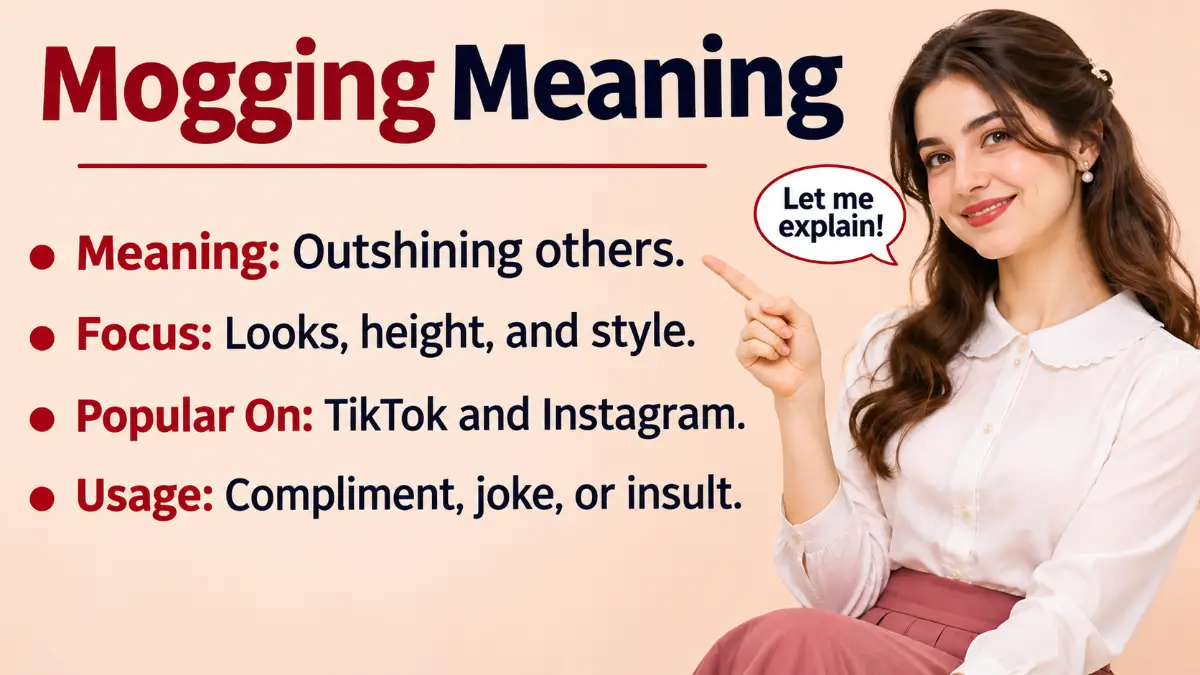
Mogging means noticeably outshining someone, especially in appearance, height, physique, fashion, or overall presence. Someone who gets “mogged” is seen as being overshadowed by another person. For example, “Her outfit mogged everyone at the party” means her style stood out compared with everyone else’s. The expression can be a compliment, a playful joke, or a put-down depending on the situation.
The word started in online communities focused on status and appearance before spreading into TikTok videos, Instagram comments, and everyday messages. Its meaning has broadened beyond physical looks, so context matters more than any rigid definition.
Related Post: Growth Navigate
What Does Mogging Mean?
In simple terms, mogging is outshining another person in a comparison. Most often, people use it when one person appears taller, more stylish, more muscular, or more attractive than someone nearby. But it can also describe a person whose confidence or performance makes them stand out.
The comparison does not have to be intentional. A friend might dress nicely for a party without trying to compete, yet someone could still joke that the friend “mogged” the entire group.
Mogging Meaning in Simple Words
Imagine two friends taking a picture. One is wearing a striking outfit, and a commenter says, “You mogged him.” The commenter thinks the first friend stands out more in that particular photo.
That does not make the judgment objective. Attractiveness and style are personal opinions, and the slang reflects the speaker’s impression rather than a measurable ranking of people.
What Does It Mean to Get Mogged?
Getting mogged means being outshined or overshadowed by someone else. The speaker might be serious, but many people say it dramatically to make their friends laugh.
An illustrative conversation might go like this:
Alex: I thought my jacket looked great until Jordan arrived.
Sam: You got mogged by that bright green suit.
Alex: Fair enough. That outfit deserves its own spotlight.
Here, the friends are teasing each other about fashion, not making a serious judgment about anyone’s value.
Where Did the Word Mogging Come From?
The term is commonly traced to AMOG, an acronym for “alpha male of the group.” It circulated in pickup-artist communities and later in online spaces that discussed attractiveness, status, and competition. Over time, “mog” became a verb describing one person supposedly dominating or outclassing another.
Documented examples appear in fitness forums and imageboards by at least 2016. That evidence helps establish early online use, but it does not prove a single person invented the word or identify an exact first occurrence.
The original communities often framed appearance as a contest. Modern users may know nothing about that history and use the word as a casual reaction to a photo, performance, or outfit.
How Mogging Became Popular Online
Fitness memes, group photographs, and exaggerated comparisons helped the expression spread beyond niche forums. Instagram meme pages and TikTok videos brought the term to wider audiences during the early 2020s.
Its popularity also overlaps with looksmaxxing, slang for trying to improve one’s physical appearance. Many videos combine dramatic edits, music, and comparisons to make an ordinary difference look like a major victory.
The joke works because the language is exaggerated. A person wearing better sneakers than a friend might be described as “brutally mogging” them, even though the stakes are obviously tiny.
What Does Mogging Mean on TikTok?
On TikTok, mogging usually describes someone standing out in looks, style, height, or presence. Creators and commenters use it in group photos, transformation videos, fashion clips, gym content, and humorous comparisons.
Sometimes a video explicitly compares two people. Other times, the creator simply posts a confident outfit video and viewers jokingly declare that everyone else has been mogged.
Mogging Meaning in TikTok Comments
The following are original illustrative comments, not quotations from real posts.
“She mogged the whole group photo.” The commenter thinks one person’s appearance or styling stood out most in the picture.
“Bro is height mogging everybody.” The speaker is joking about someone being noticeably taller than the people around them.
“That entrance was an aura mog.” The commenter is emphasizing a person’s confident or impressive presence rather than a particular facial feature.
Why Is Mogging Popular in Memes?
The term makes simple comparisons sound dramatic. Online humor often turns ordinary situations into mock competitions, so “mogged” is a convenient punchline.
A meme might show a beautifully decorated cupcake beside a plain cookie and claim the cupcake “mogged” the cookie. This kind of absurd comparison shows how far the word has moved beyond its original appearance-focused context.
Mogging Meaning in Text Messages
In texting, mogging is usually shorthand for “outshining” or “looking better than” someone. It is informal and fits best in conversations where both people understand the joke.
The same idea appears in several forms:
- Mog: The base verb, as in “That outfit will mog mine.”
- Mogging: The ongoing action, as in “You’re mogging us in every photo.”
- Mogged: The past tense, as in “I got mogged at the reunion.”
- Mogger: A person described as repeatedly outshining others.
A friend might text, “You absolutely mogged with that haircut,” to compliment someone’s new style. In another chat, “Stop trying to mog everybody” might mean the speaker thinks someone is showing off.
Context helps determine whether the message is supportive, sarcastic, or unfriendly. The words alone do not tell the whole story.
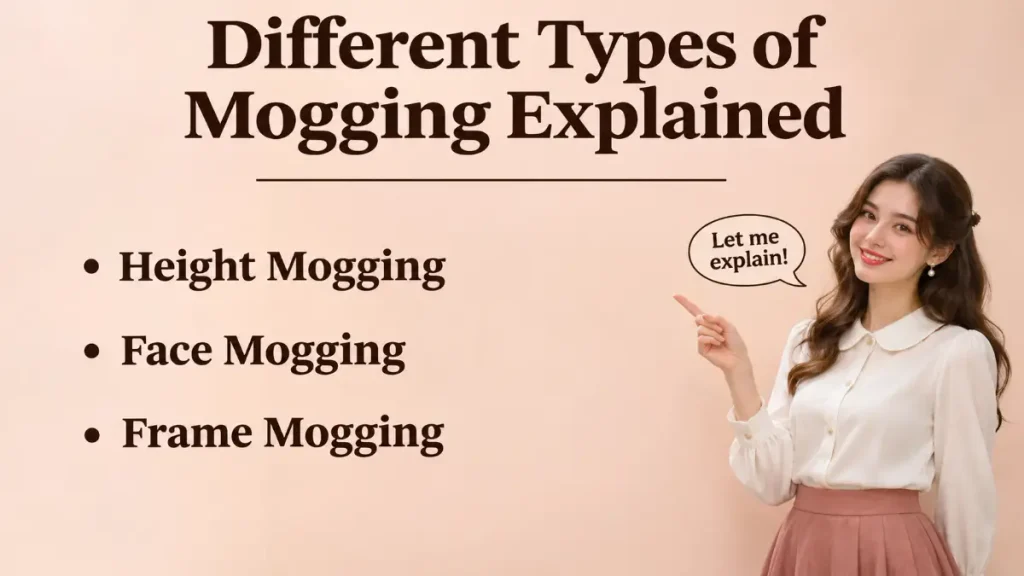
Different Types of Mogging Explained
People sometimes add a word before “mogging” to name the trait being compared. These labels are informal, and some appear more often in niche online communities than in ordinary conversation.
Height Mogging
Height mogging describes one person looking significantly taller than another. For example, “Our tallest teammate height-mogged everyone in the graduation picture” is a joking comment about the visible height difference.
It does not mean taller people are inherently better. The slang simply highlights a comparison that the speaker noticed.
Face Mogging
Face mogging refers to a perceived difference in facial attractiveness. Someone might say, “The comments claim the model face-mogged everyone in the photo.”
Because beauty judgments are subjective, this expression can be especially hurtful when used to rank real people publicly.
Frame Mogging
Frame mogging usually describes a comparison involving shoulder width, body frame, or overall build. It appears particularly in fitness and appearance-focused communities.
For example, “The bodybuilder frame-mogged his training partner in that pose” describes how their builds looked in a particular image.
Style Mogging
Style mogging or fashion mogging describes someone standing out through clothing, accessories, or overall presentation. “Her vintage coat style-mogged the entire room” is an enthusiastic compliment about an outfit.
This variation is often easier to use playfully because it focuses on fashion choices rather than unchangeable physical traits.
Hair Mogging
Hair mogging describes someone being perceived as having a more impressive haircut or hairstyle. “His fresh curls hair-mogged my messy morning look” is a self-deprecating joke.
The expression is less standardized than the basic word “mogging,” so not every reader will recognize it immediately.
Mogging vs. Looksmaxxing
These terms are related but not interchangeable. Mogging describes a comparison, while looksmaxxing describes efforts to change or improve appearance.
For instance, buying a new outfit, experimenting with a haircut, or learning a grooming routine might be called looksmaxxing. A friend then joking that the finished look “mogged” everyone is describing the perceived result.
Looksmaxxing also has an online history involving unhealthy and extreme appearance advice. Not every grooming habit is harmful, but people should be cautious about internet trends that pressure them to take risks or treat their appearance as their entire worth.
A person can be described as mogging someone without doing any deliberate self-improvement. Likewise, someone can try to improve their style without competing with anybody.
Is Mogging a Compliment or an Insult?
Mogging can be either a compliment or an insult. The relationship between speakers, the audience, and the delivery determine how the message lands.
When Mogging Is a Compliment
“Your prom outfit mogged everyone” may be a friend’s enthusiastic way of saying the outfit looked amazing. The intended focus is admiration for the person receiving the compliment.
Another example is “Your presentation mogged mine.” If said warmly, it acknowledges someone’s excellent performance without resentment.
When Mogging Is an Insult
“You got mogged because you’re ugly” uses the same slang to embarrass someone. The message becomes harmful because it attacks a person rather than simply celebrating someone else’s style.
Repeated comparisons can also make people feel judged, even when the speaker claims to be joking. A comment is not automatically harmless just because it uses trendy language.
When Mogging Is Just a Joke
A person might post a photo of their cat beside a much larger dog and write, “My cat got height-mogged.” No serious competition is involved.
This ironic style is common in meme culture. The speaker borrows intense language for an ordinary or ridiculous situation.
Can Girls Mog Other Girls or Boys?
Yes. Although the term has roots in male-focused online communities, modern usage is not limited to men. People use it when talking about women, men, mixed groups, celebrities, fictional characters, and even objects.
A woman might compliment a friend’s dress by saying, “You mogged us tonight.” A commenter could describe a female athlete as mogging the competition after an outstanding performance.
Neither example requires anyone to accept a rigid beauty ranking. The expression describes the speaker’s impression in a particular moment.
Real-Life Mogging Examples
The following examples are fictional and illustrate how the word changes across everyday situations.
Group Photograph
“Maya’s bright yellow jacket mogged the rest of our outfits.” This means the jacket drew attention and made her style stand out in the photo.
Birthday Party
“Everyone dressed casually, but Leo arrived in a tailored suit and mogged the room.” The speaker thinks Leo looked especially polished compared with the other guests.
Gym Conversation
“That experienced lifter mogged my pull-up count.” Here, the word refers to athletic performance rather than physical attractiveness.
Fashion Video
“The second outfit mogged the first one.” A viewer prefers the second outfit and uses slang to make the comparison sound more dramatic.
Sports Highlight
“The goalkeeper mogged everyone with that save.” The comment celebrates an impressive play, not a person’s looks.
Friendly Haircut Joke
“You got a fresh fade and immediately started mogging the group chat.” The speaker is teasing a friend who shared a confident selfie after a haircut.
These examples show why a simple definition is useful but not sufficient. You also need to notice what is being compared and whether the tone is supportive or mocking.
Is Mogging Good or Bad?
The word itself is not automatically good or bad. A playful compliment about a friend’s outfit can be harmless, while public comments that repeatedly rank people’s bodies or faces can be cruel.
Some communities treat appearance as an endless contest. That attitude can encourage unhelpful comparisons, especially when people start believing that every photo proves someone is superior or inferior.
A healthier way to use the slang is to celebrate a specific achievement or style choice without belittling someone else. “Your outfit looks incredible” delivers the compliment without turning another person into the loser.
For parents and teachers, hearing the word does not necessarily signal a serious problem. Ask what the speaker means and whether anyone is being singled out or hurt before drawing conclusions.
How to Respond When Someone Says You Got Mogged
You do not have to argue about the comparison. A response can be lighthearted, neutral, or firm depending on how the comment feels.
For a friendly joke, try “I’ll bring my best outfit next time” or “They definitely won the fashion round.” Both keep the exchange playful.
For a neutral reply, “That’s one opinion” or “I wasn’t competing” makes your position clear without escalating the conversation.
If the remark feels insulting, you can say, “Please don’t compare my appearance to other people’s” or “I’d rather not joke about how anyone looks.”
If someone keeps targeting you, stepping away from the conversation or using a platform’s moderation tools may be more useful than trying to win the argument.
Related Internet Slang You Should Know
Mogging often appears alongside other internet expressions. Understanding these terms can help you interpret a caption or comment without assuming they all mean the same thing.
- Looksmaxxing: Trying to improve physical appearance, often through grooming, fitness, or styling, though some online advice can be extreme.
- Mogged: Having been outshined or overshadowed in a comparison.
- Mogger: Someone perceived as outshining others.
- Rizz: Charm or flirting ability, especially the ability to attract romantic interest.
- Chad: An internet stereotype of a confident, attractive, or socially successful man; often used ironically.
- Gigachad: An exaggerated version of the Chad stereotype, commonly used in memes about extreme confidence or physique.
- Mewing: A tongue-posture practice promoted online with claims about jaw appearance; dramatic appearance benefits are not established simply by viral posts.
- Aura: A person’s perceived confidence, presence, or overall vibe, sometimes discussed jokingly as “aura points.”
These words come from different communities and have different histories. They may appear together in the same meme because they share a playful focus on image, confidence, and status.
Frequently Asked Questions About Mogging Meaning
What does mogging mean in slang?
Mogging means noticeably outshining or outperforming someone, often in looks or style. It can also describe confidence, physique, or performance.
What does mogging mean on TikTok?
On TikTok, mogging usually describes someone standing out in a comparison. The word frequently appears in humorous edits, captions, and comments.
What does it mean when someone says you got mogged?
It means someone supposedly outshined you in a particular way. The remark may be friendly teasing or an insult depending on context.
Is mogging a compliment?
It can be a compliment when someone praises your appearance or performance. It becomes insulting when used to embarrass or belittle another person.
What does mogging mean in texting?
In texts, mogging usually means looking better or standing out more than someone else. Friends often use it jokingly about outfits, pictures, or achievements.
What is height mogging?
Height mogging means appearing noticeably taller than someone else. It is an informal comparison rather than a judgment of personal worth.
What is face mogging?
Face mogging describes one person being perceived as more facially attractive than another. Because attractiveness is subjective, the term can be hurtful when aimed at someone.
What is frame mogging?
Frame mogging refers to a comparison of body build, often shoulder width or overall frame. It appears most often in fitness and appearance-focused discussions.
Can a girl mog someone?
Yes, girls and women can be described as mogging someone. Modern slang usage is not limited to any one gender.
Is mogging the same as looksmaxxing?
No, mogging describes a perceived comparison between people. Looksmaxxing refers to attempts to improve physical appearance.
Where did the word mogging originate?
Mogging is commonly traced to AMOG, meaning “alpha male of the group.” Its later use spread through online fitness, appearance, and meme communities.
Why do people say mogged in memes?
The word makes ordinary comparisons sound exaggerated and dramatic. Meme creators often use it ironically for people, animals, or objects.
Final Thoughts on Mogging Meaning
Mogging means outshining someone, usually through looks, height, style, physique, or perceived presence. The word has roots in appearance-focused online communities, but its modern meaning is broader and often humorous.
When you encounter “mogged” in a TikTok comment or text, look at what is being compared and how the speaker treats the people involved. It can be a friendly compliment, a ridiculous meme, or a hurtful remark. Understanding that difference helps you recognize the slang without accepting every comparison as meaningful.

Sophia Bennett writes educational content about English vocabulary, grammar, slang, and communication. She is passionate about making complex language topics accessible to students, professionals, and curious readers around the world.