
TYFA Meaning in Text: What Does TYFA Mean in Chat and Slang?
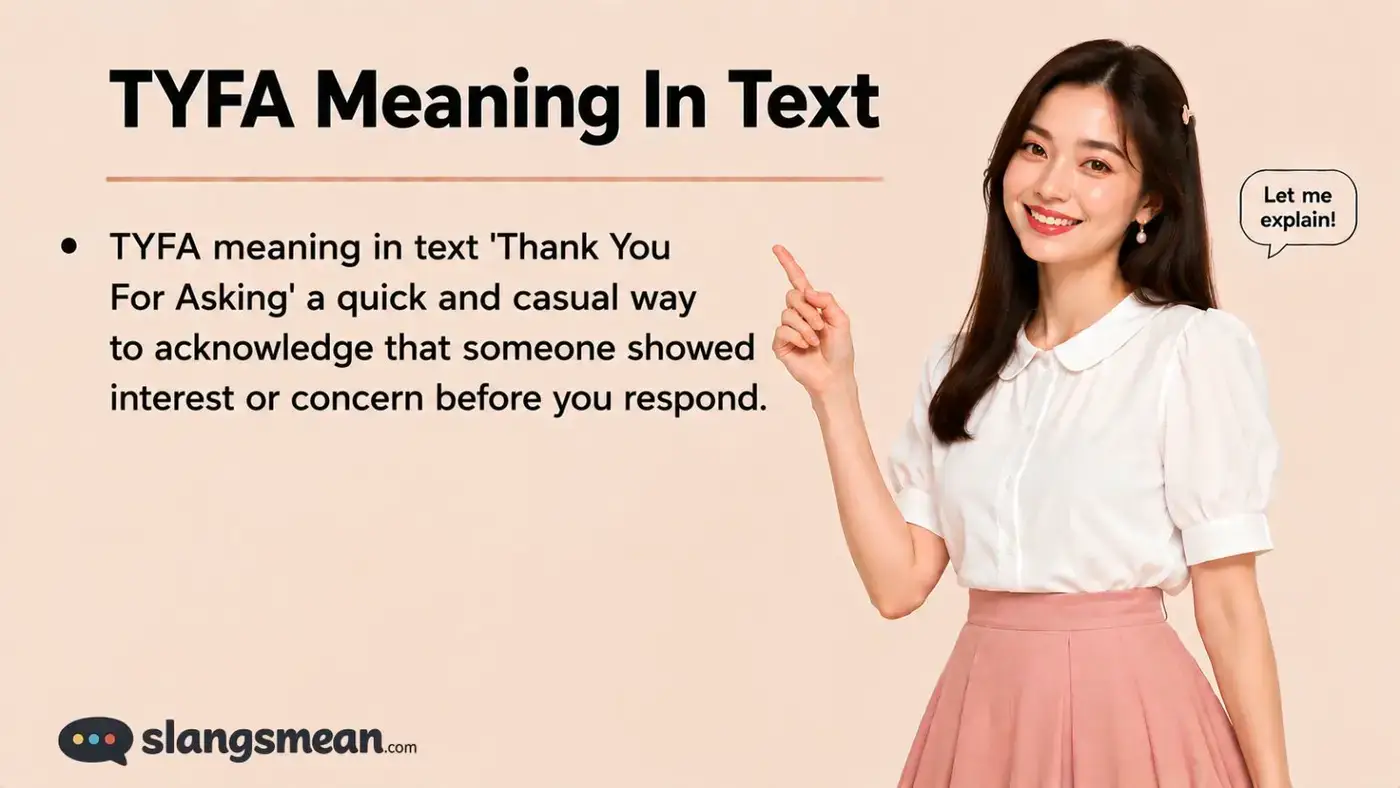
TYFA can mean “Thank You for Asking” in text messages and online chats. It’s an informal abbreviation used to appreciate someone who asks a question, checks on your well-being, or shows interest in your situation. However, TYFA is not as widely standardized as common texting abbreviations such as TY or TYSM, so context matters.
For example, if a friend asks how you’re feeling and you reply, “TYFA, I’m doing better,” you’re thanking them for taking the time to ask. The expression can sound sincere, polite, or occasionally sarcastic depending on the surrounding message.
Related Meaning: WWA Meaning In Text
What Does TYFA Stand For in Texting?
In casual messages, TYFA stands for “Thank You for Asking.”
The letters represent the words in the expression:
- T — Thank
- Y — You
- F — For
- A — Asking
The abbreviation acknowledges someone’s interest or concern rather than simply answering their question.
For example:
“TYFA! My interview went really well.”
This means:
“Thank you for asking! My interview went really well.”
The phrase works especially well when someone remembers an important event or checks how you’re doing.
Because TYFA is relatively uncommon, some readers may not recognize it immediately. Writing the full phrase is often clearer when communicating with someone unfamiliar with texting shorthand.
When Do People Use TYFA in Chat?
People may use TYFA when they want to acknowledge a thoughtful question without typing the complete expression.
It fits several everyday situations.
When Someone Checks on Your Well-Being
“TYFA, I’m feeling much better today.”
The sender appreciates someone asking how they’re doing.
When Someone Remembers an Important Event
“TYFA! The presentation went better than I expected.”
Here, the abbreviation acknowledges that someone remembered to ask about the presentation.
When Someone Shows Personal Interest
“TYFA, I’ve been working on my photography lately.”
The sender appreciates the other person’s curiosity.
When Someone Asks an Uncomfortable Question
“TYFA, but I’d rather not talk about that right now.”
This response acknowledges the question while politely setting a boundary.
In each case, the surrounding sentence makes the intended meaning easier to recognize.
Is TYFA Friendly, Polite, or Sarcastic?
TYFA can express different attitudes depending on how someone uses it.
The abbreviation itself doesn’t establish a particular emotion.
| Message | Likely Tone | Interpretation |
|---|---|---|
| “TYFA! That means a lot ❤️” | Warm | Genuine appreciation |
| “TYFA, I’m doing okay.” | Polite | Acknowledging concern |
| “TYFA, but it’s personal.” | Reserved | Setting a boundary |
| “Oh, TYFA. Finally someone asked 😂” | Possibly sarcastic | Playful or pointed reaction |
A message containing TYFA and a friendly follow-up usually suggests sincere gratitude.
However, if the sender uses exaggerated language or responds after being ignored, the same abbreviation could sound sarcastic.
Avoid judging the tone from the four letters alone.
Real Text Conversation Examples Using TYFA
These illustrative conversations show how TYFA can work in everyday messages.
Example 1: A Friend Checking In
Emma: “Hey, how are you feeling after being sick?”
Olivia: “TYFA! I’m finally getting better.”
Olivia uses TYFA to thank Emma for checking on her health.
Example 2: Asking About an Interview
Jake: “How did your job interview go yesterday?”
Ryan: “TYFA! I think it went pretty well.”
Ryan appreciates that Jake remembered his interview and asked about it.
Example 3: A Personal Question
Mia: “Are things getting better at home?”
Sarah: “TYFA, but I’d rather keep that private for now.”
Sarah acknowledges Mia’s concern without sharing information she’s uncomfortable discussing.
Example 4: A Playful Conversation
Noah: “So, how was your date?”
Liam: “TYFA 😂 It was interesting, to say the least.”
Liam uses the abbreviation in a lighthearted reply before discussing the experience.
These examples show that TYFA can fit both meaningful conversations and casual exchanges.
What Does TYFA Mean on Discord?
On Discord, TYFA may mean “Thank You for Asking” when someone uses it in a personal conversation.
For example:
Alex: “Did you manage to fix your microphone?”
Jordan: “TYFA! Yeah, it’s working now.”
Jordan is thanking Alex for following up.
However, Discord servers often develop their own abbreviations, nicknames, and community-specific expressions. TYFA isn’t a universal Discord command or a term with one officially assigned Discord meaning.
If it appears in a gaming discussion or server announcement without a clear question preceding it, the meaning may be different or unclear.
The safest approach is to check the surrounding conversation or ask the sender what they intended.
TYFA Meaning on Instagram, Snapchat, and WhatsApp
TYFA can have the same interpretation across social media and messaging platforms.
Someone might use TYFA in a direct message after a follower or friend asks about a personal update.
Example: “TYFA! The trip was amazing.”
Snapchat
A person may send TYFA after receiving a question about their day or recent activities.
Example: “TYFA 😊 Everything went fine.”
The abbreviation can appear in private or group conversations when someone acknowledges a thoughtful question.
Example: “TYFA, my family is doing well.”
These are illustrative uses, not evidence that TYFA is especially popular on any particular platform.
The meaning depends on the message rather than the app.
Is TYFA a Common Gen Z Slang Term?
TYFA follows the same initial-letter pattern as many internet abbreviations, but it isn’t established as a defining Gen Z expression.
Younger texters may understand or use it, especially if they’re familiar with other gratitude-related abbreviations.
Still, not everyone will recognize TYFA without context.
More familiar alternatives include:
- “Thanks for asking!”
- “Appreciate you checking in.”
- “TY for asking.”
- “Thanks for checking on me.”
Using the full phrase is often more natural when you want to make sure your appreciation is understood.
TYFA vs. TY, TYSM, and TYVM
TYFA belongs to a group of abbreviations related to gratitude, but each expression communicates something slightly different.
| Abbreviation | Full Form | Main Purpose |
|---|---|---|
| TYFA | Thank You for Asking | Appreciating a question |
| TY | Thank You | General gratitude |
| TYSM | Thank You So Much | Stronger gratitude |
| TYVM | Thank You Very Much | Emphatic or polite thanks |
For example, if someone helps you finish a project, TY or TYSM would be a natural response.
If someone remembers to ask how the project went, TYFA would express appreciation for their interest.
The distinction is about what you’re thanking someone for.
Does TYFA Have Other Meanings?
TYFA doesn’t have one universally established meaning across every context.
Although “Thank You for Asking” is a plausible texting interpretation, the same four letters could represent an organization, project name, or expression specific to a particular community.
An unfamiliar abbreviation should not be assigned a full form merely because the letters match a possible phrase.
For example, TYFA in an organizational document may refer to a name or title rather than a conversational response.
If the message isn’t about someone asking a question, don’t automatically assume it means “Thank You for Asking.”
Look for an explanation elsewhere in the conversation or ask the sender.
Where Did TYFA Come From?
TYFA follows a familiar method of forming texting abbreviations: taking the first letter of each word in a phrase.
Expressions such as TY, TYSM, and TYVM use a similar approach.
However, a precise origin, first recorded use, or date when TYFA became popular is not firmly established.
It’s reasonable to describe TYFA as an informal shortened form of “Thank You for Asking,” but claims that a particular platform or generation invented it would require stronger evidence.
How Should You Reply When Someone Says TYFA?
The best response depends on what the person says after the abbreviation.
When Someone Is Genuinely Thankful
Message: “TYFA! I’ve been feeling much better.”
Reply: “Glad to hear that! Take care.”
This keeps the conversation warm without making the person repeat their thanks.
When Someone Shares Good News
Message: “TYFA, I got the job!”
Reply: “That’s amazing! Congratulations!”
Respond to the news rather than focusing on the abbreviation.
When Someone Doesn’t Want to Answer
Message: “TYFA, but I’d rather not discuss it.”
Reply: “Of course, no pressure.”
This respects the person’s boundaries.
When the Meaning Is Unclear
Message: “TYFA.”
Reply: “Do you mean thank you for asking?”
A simple clarification prevents unnecessary confusion.
Common Mistakes When Understanding TYFA
One mistake is assuming TYFA is as universally recognized as LOL or BRB. It isn’t, and some people may have never encountered it.
Another is interpreting it as automatically sarcastic or affectionate. The tone comes from the entire message, not the abbreviation itself.
People may also confuse TYFA with similar-looking abbreviations.
For example, TY means “thank you,” while TYSM means “thank you so much.” Those are separate expressions and shouldn’t be treated as exact substitutes.
Finally, avoid assuming TYFA has a special meaning on Discord or another platform without evidence from the conversation.
Is TYFA Appropriate for Professional Messages?
TYFA is generally better suited to informal communication.
In a professional email, writing “Thank you for asking” is clearer and more polished.
For example:
Casual message: “TYFA! The meeting went well.”
Professional message: “Thank you for asking. The meeting went well, and we’re reviewing the next steps.”
The second version is easier for colleagues, clients, and other readers to understand.
You can still use abbreviations with coworkers who share an informal communication style, but clarity should come first.
Frequently Asked Questions
What Does TYFA Mean in Slang?
TYFA means “Thank You for Asking.” It’s an informal abbreviation used to express appreciation when someone asks about your feelings, experiences, or personal situation. This meaning is also documented by <Link url=”https://slang.net/meaning/tyfa” title=”Slang.net”/>. <Cite ref=”turn977219search3″/>
Is TYFA a Positive or Negative Expression?
TYFA is usually positive or polite because it expresses gratitude. However, it can also be sarcastic when someone uses it to respond to an unwanted or uncomfortable question.
Does TYFA Mean Something Different on Discord?
There is no widely established Discord-specific definition of TYFA. It can mean “Thank You for Asking” in ordinary conversations, but individual communities may use abbreviations differently.
What Does TYFA Mean When Someone Sends It Alone?
If someone sends only “TYFA” after you’ve asked a question, they’re likely thanking you for asking. If no question came before it, you may need to ask what they meant.
Is TYFA the Same as TFA?
Not exactly, although their meanings are closely related. TYFA means “Thank You for Asking,” while TFA can mean “Thanks for Asking.” <Cite refs={[“turn977219search3″,”turn977219search0”]}/>
Can TYFA Be Used Sarcastically?
Yes. Someone might use TYFA sarcastically when a question feels intrusive or when they want to make a pointed comment. The rest of the conversation helps distinguish sarcasm from sincere appreciation.
Final Takeaway
TYFA stands for “Thank You for Asking” in casual texting and online chat. It acknowledges someone’s interest, concern, or thoughtful question.
The expression is generally friendly, but it can also carry sarcasm depending on the situation. Because TYFA is less familiar than many common texting abbreviations, using the full phrase is the clearest option when you want to avoid confusion.

Sophia Bennett writes educational content about English vocabulary, grammar, slang, and communication. She is passionate about making complex language topics accessible to students, professionals, and curious readers around the world.



One Comment