YN Meaning in Text That Instantly Changes How You Read It
YN meaning in text “Your Name” conversations and online platforms, used as a placeholder in fan fiction, interactive stories, and creative writing where the reader inserts their own name into the narrative. It’s a storytelling device that pulls you directly into the plot.
But YN doesn’t stop there. It carries at least two other solid meanings depending on exactly where you encounter it, and getting them confused is easier than most people expect.
Related Meaning: DPMO Meaning In Text
Origin and Cultural Footprints
YN meaning in text grew most powerfully out of fan fiction culture, particularly on Tumblr and Wattpad during the early 2010s when reader-insert stories exploded in popularity. Writers wanted their readers to feel personally inside the story, and using YN as a stand-in for the reader’s actual name was the cleanest solution available at the time.
It spread rapidly through One Direction fan communities, K-pop fan spaces, and broader celebrity fan fiction circles where reader-insert content was practically its own genre. From there it bled into general creative writing spaces and eventually into casual texting, carrying different weight in each new home it found.
Other Meanings of YN
YN wears a few different hats depending entirely on the context around it. The letters stay the same. The meaning moves.
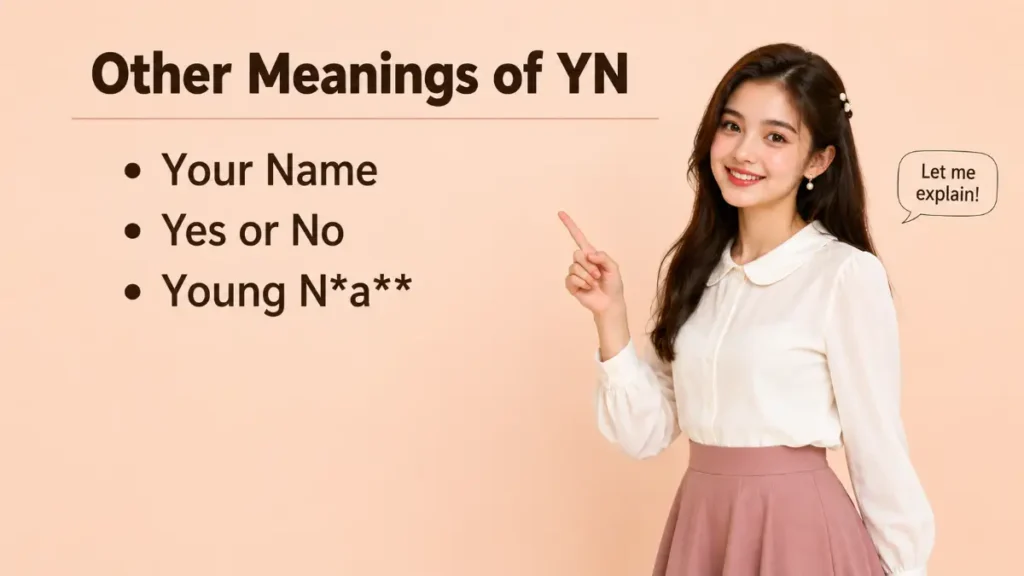
- Your Name — the dominant meaning in fan fiction and creative writing spaces, functions as a reader-insert placeholder so anyone reading can place themselves in the story
- Yes or No — used in casual conversation when someone wants a quick binary answer without preamble, a conversational shortcut that skips the full question
In some online communities, particularly those built around music and street culture, YN takes on a third identity entirely.
- Young N*a** — used in certain hip-hop adjacent spaces as a term of address or reference, carries cultural specificity and should be understood in its proper context before use
Why Does YN Have So Many Different Definitions?
Two-letter acronyms are contested territory by nature, but YN is particularly layered because its primary meaning comes from a specific creative tradition that most people outside fan fiction communities have never encountered. Someone who’s never read a Wattpad story has no frame of reference for “Your Name” as a text placeholder.
That knowledge gap is exactly where alternate meanings fill in. A person who’s never touched fan fiction reads YN in a text and reaches for whatever makes the most logical sense to them given the letters. “Yes or No” is an intuitive reach. So the same acronym gets used meaningfully in two completely unrelated ways by people who are each using it correctly within their own context.
Does YN Mean the Same Thing Outside the US?
In the UK and Australia, YN as “Your Name” in fan fiction contexts is immediately understood by anyone active in those creative communities, which are genuinely global. Wattpad and Tumblr don’t have borders, and the reader-insert tradition built up the same way across English-speaking countries simultaneously.
The “Yes or No” interpretation travels just as cleanly because it’s logical rather than culturally specific. Someone in Canada or Ireland reads YN in a direct question context and lands on “Yes or No” without any friction. Outside English-speaking countries the acronym is largely unfamiliar unless someone is deeply embedded in English-language fan fiction communities, which do exist internationally but require active participation to join.
Who Uses It Most?
YN has two very distinct user groups that rarely overlap, which is part of what makes it such an interesting acronym to track across different spaces.
| Group | How They Use YN |
|---|---|
| Fan Fiction Writers and Readers | Your Name placeholder in reader-insert stories |
| K-pop and Celebrity Fan Communities | Active reader-insert culture on Tumblr and Wattpad |
| Casual Texters | Quick Yes or No shorthand in direct conversation |
| Creative Writing Communities | Interactive storytelling and choose-your-own narratives |
Outside these groups, YN remains genuinely unfamiliar to most people, which means encountering it for the first time almost always prompts a search for its meaning.
Real Conversation Examples Using YN
Example 1: Inside a fan fiction reading community
Context: Two friends who both read the same fan fiction account on Tumblr are texting about a new story that dropped overnight, excited about the reader-insert format.
“Did you read the new fic?? The YN parts hit so different when you actually imagine yourself in it.”
How to reply: “I read it three times. The scene in chapter two I was literally not breathing. So good.”
Example 2: Quick decision-making in a casual text exchange
Context: A friend is trying to finalize plans for the weekend and needs a fast answer before they book something, no time for a long back and forth.
“We’re getting dinner at 7, YN? I need to know now before they close reservations.”
How to reply: “Y. Book it. I’ll be there.”
Usage of YN in Different Contexts
YN shifts register completely depending on which world it’s operating in. Inside creative writing it’s a structural tool. Inside casual texting it’s a conversational shortcut. The same two letters doing fundamentally different jobs.
Example: “The way this author wrote the YN character actually made me feel things I wasn’t prepared for on a Tuesday afternoon” — here it signals active fan fiction engagement, the kind where the reader is genuinely emotionally invested in a story that places them at its center.
In a completely different register the same acronym becomes purely functional. “YN on the road trip because I’m booking the Airbnb tonight and I need a headcount.” No creativity, no storytelling, just a clean binary request that needs an answer before something closes or fills up. Same letters, completely different purpose, zero overlap between the two worlds using them.
How Gen Z Uses YN Today
Gen Z fan fiction readers have fully internalized YN as a standard storytelling convention. For them it’s not even a thing they consciously think about anymore. When they see it in a story they automatically insert their own name and keep reading without breaking stride. It’s become invisible infrastructure in their creative reading experience.
Outside fan fiction, Gen Z also uses the “Yes or No” interpretation with a casual efficiency that fits their broader communication style. They don’t ask long questions when two letters will do the job. YN at the end of a message is a closed-question signal that says “I need an answer, not a conversation.” That economy of language is very much part of how they text, and YN fits it perfectly.
Does YN Mean “You’re Nice”?
No. That interpretation shows up on a handful of slang listing sites but it doesn’t reflect real usage in any consistent community. People don’t abbreviate compliments into two-letter acronyms in normal conversation, and “You’re Nice” as a standalone text message would almost never need shortening.
The confusion comes from people scanning acronym lists without context and landing on whichever expansion sounds plausible to them. But plausible and actual are two different things in slang. Real usage patterns don’t support “You’re Nice” as a genuine YN meaning, and if you try using it that way in a text, the person receiving it will almost certainly have no idea what you mean. Stick with “Your Name” or “Yes or No” and you’ll be right every time.
YN Meaning Across Social Media
| Platform | YN Meaning | How It’s Used |
|---|---|---|
| Tumblr | Your Name | Reader-insert fan fiction, story tags and headers |
| Wattpad | Your Name | Interactive stories where readers are the main character |
| Twitter / X | Your Name or Yes or No | Fan fiction discussions and quick reply threads |
| TikTok | Your Name | Fan fiction content, reader-insert story videos |
| Yes or No | Quick polls, story replies, casual DM exchanges | |
| Discord | Context-dependent | Fan servers use Your Name, friend servers use Yes or No |
Common Confusions
YN meaning in text creates genuine confusion at the intersection of two very different communities that use the same acronym for unrelated purposes.
- YN as Your Name vs Yes or No — the biggest source of confusion; both are legitimate but context tells you which one applies within about two seconds of reading the message
- YN in fan fiction vs YN in casual texting — someone outside fan culture reading a story will be confused by YN in a narrative context; someone inside fan culture receiving a quick text will immediately think Yes or No
- YN vs Y/N — the slash version is more common in written fan fiction while YN without punctuation tends to appear more in texts and social media posts; same meaning, different formatting convention
- YN as Young N*a** — carries cultural weight and specificity; using it without understanding that context is a meaningful misstep
Reading who sent the message and what platform or context it arrived in almost always resolves the confusion before it becomes a problem.
Related Slang Terms
- YN — Your Name, the fan fiction placeholder that started this whole conversation
- OC — Original Character, a character created by the writer rather than taken from existing media
- AU — Alternate Universe, a fan fiction setting that reimagines characters in a different world
- HMU — Hit Me Up, casual invitation to reach out
- LMK — Let Me Know, waiting for someone’s input or decision
- WYD — What You Doing, casual check-in that often precedes a plan
- IRL — In Real Life, distinguishing real events from fictional or digital ones
- NGL — Not Gonna Lie, honest statement incoming
How to Reply When Someone Says YN
If YN lands in a fan fiction or creative context, the natural reply is to engage with the content itself. “The YN scenes in this one are so well written” or “I love when authors do YN right, it actually pulls you in” keeps the conversation in the world it belongs to without making things awkward.
If YN arrives as a “Yes or No” request, keep your reply equally clean and direct. A single “Y” or “N” with maybe one sentence of context if needed is all it takes. The person asking used two letters because they wanted efficiency, and a paragraph reply defeats the entire purpose of the shorthand they chose.
The YN Story That Made Someone Cry on the Bus
A seventeen-year-old was reading a reader-insert fan fiction on her phone during her morning commute, fully immersed, headphones in, world completely blocked out. The story was a reunion scene where the main character finally told YN everything they’d been holding back for months.
She cried. On the bus. In public. A stranger handed her a tissue without a word. She was crying over a story where the character was technically her, and she still couldn’t explain why it hit that hard when she got home and her mom asked what happened. Sometimes YN makes it too personal. That’s exactly the point.
When Did YN Go Mainstream?
YN as a fan fiction convention reached its peak mainstream awareness around 2013 to 2016, riding the wave of One Direction and K-pop reader-insert content that dominated Tumblr and Wattpad during those years. It never broke into general public consciousness the way OMG or LOL did, but within its communities it became completely standard.
The “Yes or No” interpretation has no single origin moment. It grew organically from the natural impulse to shorten common questions in text conversations, which means it built quietly and consistently across casual texting culture without ever needing a viral push. Both meanings are stable today and neither shows signs of fading from the communities that use them.
Conclusion
YN meaning in text splits cleanly between two worlds that rarely meet. In creative spaces it means Your Name and places you inside a story. In casual conversation it means Yes or No and cuts straight to the answer. Now you know exactly which one is which and how to read the difference.
Two letters. Two lives. Zero confusion once you know where to look.
FAQs
What does YN mean in text?
YN means “Your Name.” It is commonly used in fan fiction and interactive stories as a placeholder for the reader’s name.
What does YN mean in UK slang?
In UK slang, YN usually still means “Your Name” in online content. It is not a traditional British slang term.
What does YN mean in social media?
On social media, YN stands for “Your Name.” Creators use it in posts, videos, and fan edits to make content feel personal and interactive.
What does YN mean in chat?
In chat, YN means “Your Name” when someone uses a placeholder instead of typing a person’s actual name.
What does YN mean on Instagram?
On Instagram, YN commonly means “Your Name.” It appears in fan fiction, Reels, captions, and story templates where followers imagine themselves in the content.
How is YN used online?
Online, YN is used as a placeholder for “Your Name” so readers or viewers can imagine themselves as part of a story, conversation, or scenario.
What does Y/N stand for?
Y/N stands for “Your Name.” It lets anyone reading the content insert their own name to create a more personalized experience.

Sophia Bennett writes educational content about English vocabulary, grammar, slang, and communication. She is passionate about making complex language topics accessible to students, professionals, and curious readers around the world.