LMY Meaning in Text Nobody Sends Without a Reason
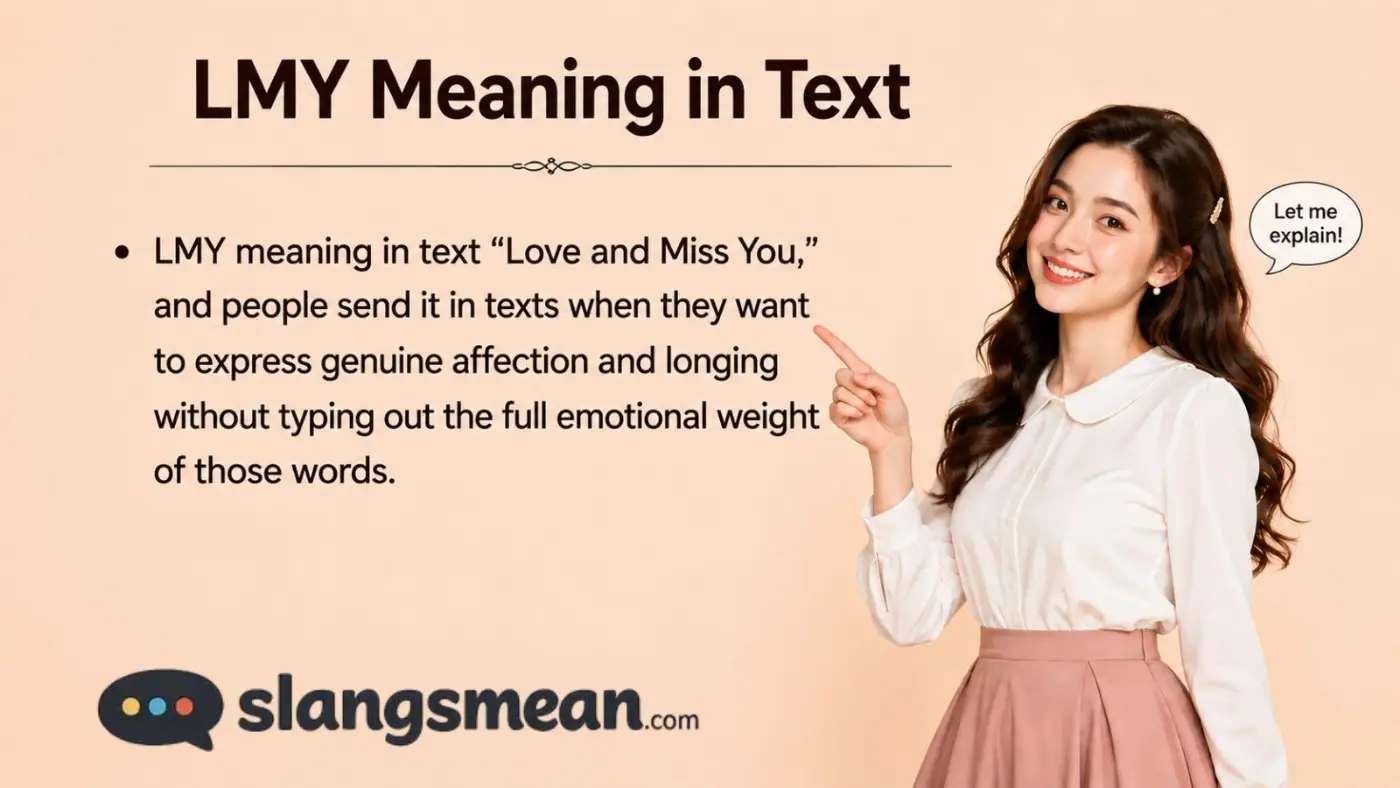
LMY meaning in text “Love and Miss You,” and people send it in texts when they want to express genuine affection and longing without typing out the full emotional weight of those words. It’s warm, it’s soft, and it hits differently than a simple “miss you” ever could.
It carries real feeling in a tiny package. Three letters that somehow manage to hold an entire emotion without spilling over into something that feels too heavy for a text message.
Related Meaning: NN Meaning In Text
Origin and Cultural Footprints
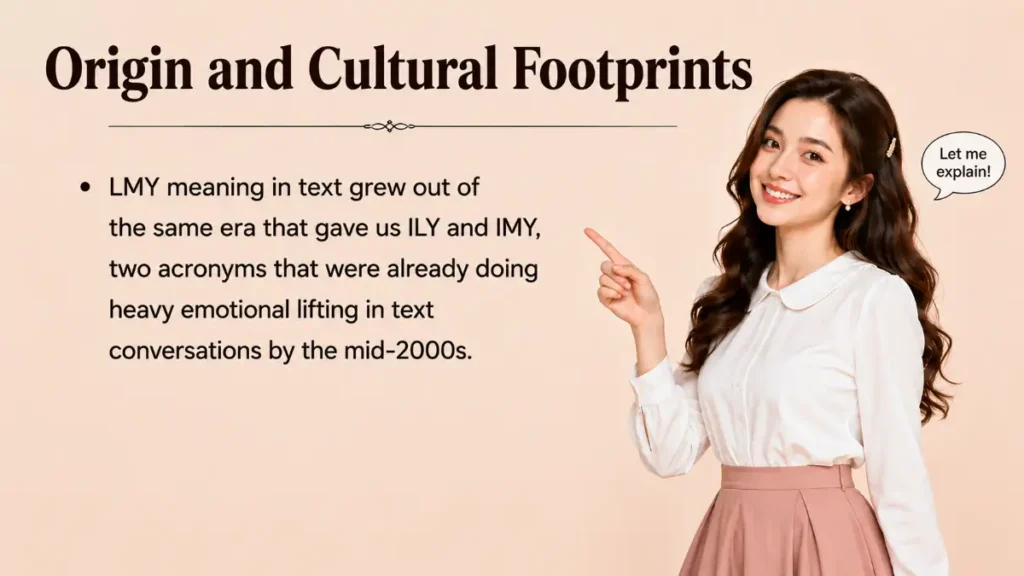
LMY meaning in text grew out of the same era that gave us ILY and IMY, two acronyms that were already doing heavy emotional lifting in text conversations by the mid-2000s. LMY essentially merged them, combining love and missing into one compact expression that felt more complete than either alone.
It spread through personal texting between close friends, family members, and romantic partners rather than through public social media. That private origin is part of why it stayed warmer and more sincere than a lot of internet slang. It never got ironic because the people using it actually meant it.
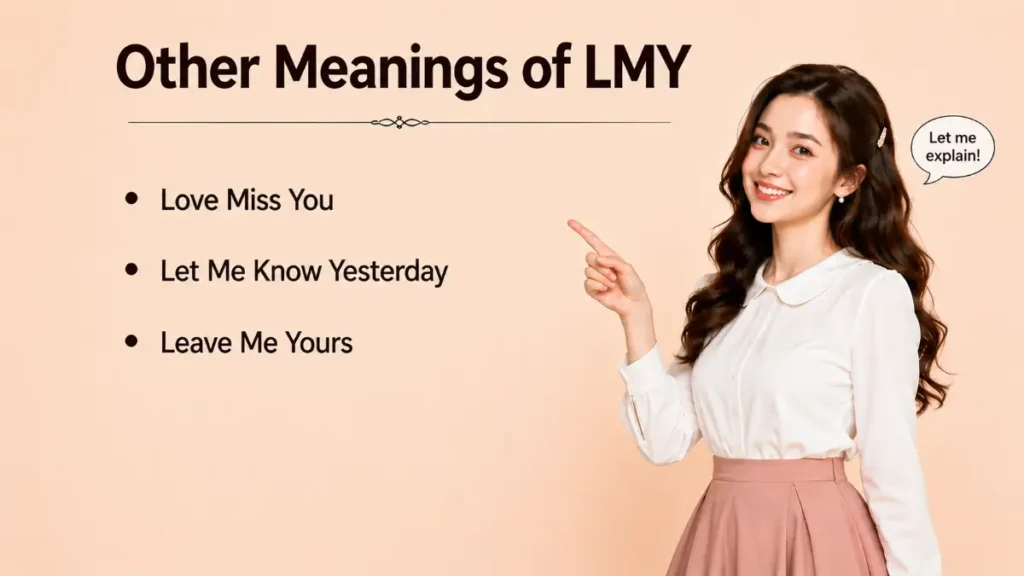
Other Meanings of LMY
LMY doesn’t carry nearly as much alternate meaning baggage as other acronyms, but it does show up in a couple of different interpretations depending on the context.
- Love Miss You — the primary and most widely used meaning, sent between people with genuine emotional connection
- Let Me Know Yesterday — a workplace or productivity context meaning, used humorously to express urgency about something already overdue
In some very niche online gaming communities, LMY occasionally appears in a completely different context.
- Leave Me Yours — used when someone wants contact details or a username, asking the other person to drop their information before the conversation ends
Why Does LMY Have So Many Different Definitions?
Three-letter acronyms live and die by context. LMY is short enough that different communities can claim it and reshape it without ever crossing paths. A person texting their mom “LMY” and a project manager firing off “LMY on those reports” are using the same letters in completely different emotional universes.
The internet accelerates this. Every subculture builds its own vocabulary, and when the available letter combinations are limited, overlap happens naturally. LMY is mild enough in all its meanings that the confusion rarely causes real problems. Still, reading the conversation around it is always the smarter move than assuming.
Does LMY Mean the Same Thing Outside the US?
In the UK, LMY meaning in text reads exactly the same way in emotional contexts. British texters use it between close friends and family with the same warmth American users do, and the “Love Miss You” interpretation translates perfectly without any cultural friction.
In Australia it appears less frequently but carries the same meaning when it does show up. Outside English-speaking countries, LMY is rarely recognized at all. Emotional acronyms like this one require fluency not just in English but in the specific emotional shorthand that native speakers build over years of texting. That’s a harder thing to learn from a dictionary.
Who Uses It Most?
LMY lives primarily in private, emotionally intimate conversations. It’s not a public-facing acronym. You won’t see it trending on Twitter or showing up in comment sections.
| Group | How They Use LMY |
|---|---|
| Close Friends | Warm sign-off after long conversations |
| Romantic Partners | Affectionate daily check-ins and goodbyes |
| Family Members | Parents, siblings, long-distance relatives |
| Long-Distance Friends | Keeping connection alive across time zones |
The people who use LMY most consistently are the ones in relationships where emotional honesty is already the default. It’s a shorthand that only works when the foundation of genuine care is already there.
Real Conversation Examples Using LMY
Example 1: Between longtime friends living in different cities
Context: Two best friends who moved to different states after college text regularly to stay connected, and one wraps up a long catch-up conversation before bed.
“Okay I have to sleep but this was exactly what I needed tonight. LMY, genuinely.”
How to reply: “LMY too. Same time next week? I’ll actually pick up this time I promise.”
Example 2: A parent texting their college kid
Context: A mom texts her daughter after dropping her off at the airport after a holiday visit, watching the car disappear into traffic.
“Just got home. The house already feels too quiet. LMY so much. Text me when you land.”
How to reply: “Just boarded. LMY Mom. I’ll call you tomorrow, okay? Don’t cry.”
Usage of LMY in Different Contexts
LMY works hardest in moments of separation, real or temporary. It’s the kind of thing someone types at the end of a conversation that mattered, not in the middle of small talk.
Example: “I know we just saw each other but LMY already, is that weird” — here it signals that the connection between these two people runs deep enough that even a short goodbye creates a pull. It’s vulnerable without being overwhelming.
In a lighter moment it still carries weight but wears it more easily. “Okay going offline for the weekend but LMY, don’t do anything interesting without me.” Same genuine feeling, wrapped in humor so it doesn’t land too heavily. That balance is exactly what makes LMY so versatile across different types of close relationships.
How Gen Z Uses LMY Today
Gen Z uses LMY with a sincerity that might surprise people who assume younger generations keep everything ironic. When they send LMY, they usually mean it completely. It shows up in texts to best friends after sleepovers end, in DMs to online friends they’ve never met in person, and in late-night messages to people they’re quietly in love with.
There’s also an identity signal here. Choosing LMY over a simple “miss you” tells the other person that love is part of the equation too. Gen Z tends to be more emotionally expressive in text than previous generations, and LMY fits that pattern perfectly. It’s direct, it’s warm, and it doesn’t apologize for meaning exactly what it says.
Does LMY Mean “Leave Me Alone You”?
No. That interpretation surfaces occasionally on slang aggregator sites, but it doesn’t reflect how real people use it in actual conversations. Nobody constructs “leave me alone you” into a tidy three-letter acronym and sends it to someone they’re genuinely annoyed with.
The confusion probably comes from people who see LMY out of context and try to fit it into a negative emotional register because many text acronyms carry frustration or sarcasm. LMY doesn’t. It sits firmly in the warm, affectionate category, and any interpretation that pulls it toward hostility is a misread of both the letters and the emotional culture around them.
LMY Meaning Across Social Media
| Platform | LMY Meaning | How It’s Used |
|---|---|---|
| Love Miss You | DMs between close friends and partners | |
| Snapchat | Love Miss You | Personal snaps, goodbye streaks |
| Twitter / X | Rarely used publicly | Occasional personal tweets to friends |
| TikTok | Love Miss You | Comments on emotional or nostalgic videos |
| Discord | Love Miss You | Private message channels between friends |
| Love Miss You | Posts and messages between family members |
Common Confusions
LMY meaning in text gets mixed up more often than you’d expect, mostly because people encounter it for the first time in a context where the emotional weight feels surprising.
- LMY vs IMY — IMY means “I Miss You” and is far more widely known; LMY adds love to the equation which changes the emotional depth significantly
- LMY vs ILY — ILY means “I Love You” without the missing element; LMY combines both feelings into one send
- LMY vs LMAO — visually similar at a glance if you’re reading fast; completely opposite in tone, one is tender and the other is laughter
- LMY as workplace slang vs emotional slang — the “Let Me Know Yesterday” meaning lives in a completely different context; the surrounding conversation makes it obvious which one applies
Reading who sent it and what came before it in the thread is always the fastest path to the right interpretation.
Related Slang Terms
- ILY — I Love You, direct affection without the missing element
- IMY — I Miss You, the most common longing acronym
- ILYSM — I Love You So Much, intensified version of ILY
- IMYSM — I Miss You So Much, intensified version of IMY
- BFF — Best Friends Forever, affectionate relationship label
- TTYL — Talk To You Later, casual sign-off between friends
- HMU — Hit Me Up, invitation to reach out or connect
- XOXO — Hugs and Kisses, classic affectionate closer
How to Reply When Someone Says LMY
If someone sends you LMY and the relationship is one where that kind of warmth is already normal, just reflect it back genuinely. “LMY too, more than you know” or “same, can’t wait to see you again” lands perfectly and keeps the emotional tone exactly where it should be.
If the LMY catches you slightly off guard, maybe from someone you weren’t expecting it from, you don’t have to match every word of it immediately. A warm “that means a lot, thinking of you too” acknowledges the feeling without pressure. The goal is to honor what they sent without making it awkward by overthinking your reply.
The LMY Text That Came Too Late
A guy found an unsent draft in his phone months after a falling-out with his closest friend. It just said “LMY man, hope you’re doing okay.” He’d typed it one night and never sent it, talked himself out of it, told himself it was too much.
He sent it eventually. Just the draft, exactly as it was, with a note saying “found this from eight months ago, still true.” His friend replied in four minutes. Some texts are worth sending even when the moment already passed.
When Did LMY Go Mainstream?
LMY never went fully mainstream in the viral sense. It built its presence quietly through private conversations and stayed there, which is actually a sign of how genuine its emotional territory is. Slang that stays in intimate spaces tends to hold its meaning longer than slang that goes public.
Its steadiest growth came through the smartphone era of the early 2010s when texting became the primary way people maintained close relationships across distance. Long-distance friendships, college goodbyes, and family separations all created exactly the kind of emotional moment where LMY made perfect sense. It’s been earning its place three letters at a time ever since.
Conclusion
LMY is one of the few text acronyms that carries genuine emotional weight every single time it’s sent. It means love and missing, and that combination lands differently than either word alone. Now you know exactly what it means and why it matters.
Three letters. Real feeling. Zero ambiguity when it comes from the right person.
FAQs
What does LMY mean in text?
LMY most commonly stands for “Love and Miss You.” It’s a warm, affectionate message used to express both love and that you miss someone.
What does LMY mean in UK slang?
In UK slang, LMY is not a unique local expression. Online, it generally means “Love and Miss You.”
What does LMY mean on social media?
On social media, LMY means “Love and Miss You.” People use it in posts, captions, comments, and DMs to show affection.
What does LMY mean in chat?
In chat, LMY stands for “Love and Miss You.” It’s a quick way to tell someone you care about them and miss them.
What does LMY mean on Instagram?
On Instagram, LMY usually means “Love and Miss You.” It often appears in captions, stories, and direct messages.
What is the full form of LMY?
LMY stands for “Love and Miss You.” It’s a common texting abbreviation for expressing affection and longing.
What does LMY stand for?
LMY stands for “Love and Miss You.” People use it to send a caring, heartfelt message in just three letters.

Sophia Bennett writes educational content about English vocabulary, grammar, slang, and communication. She is passionate about making complex language topics accessible to students, professionals, and curious readers around the world.