TIA Meaning in Text: What It Means in Chat and Email
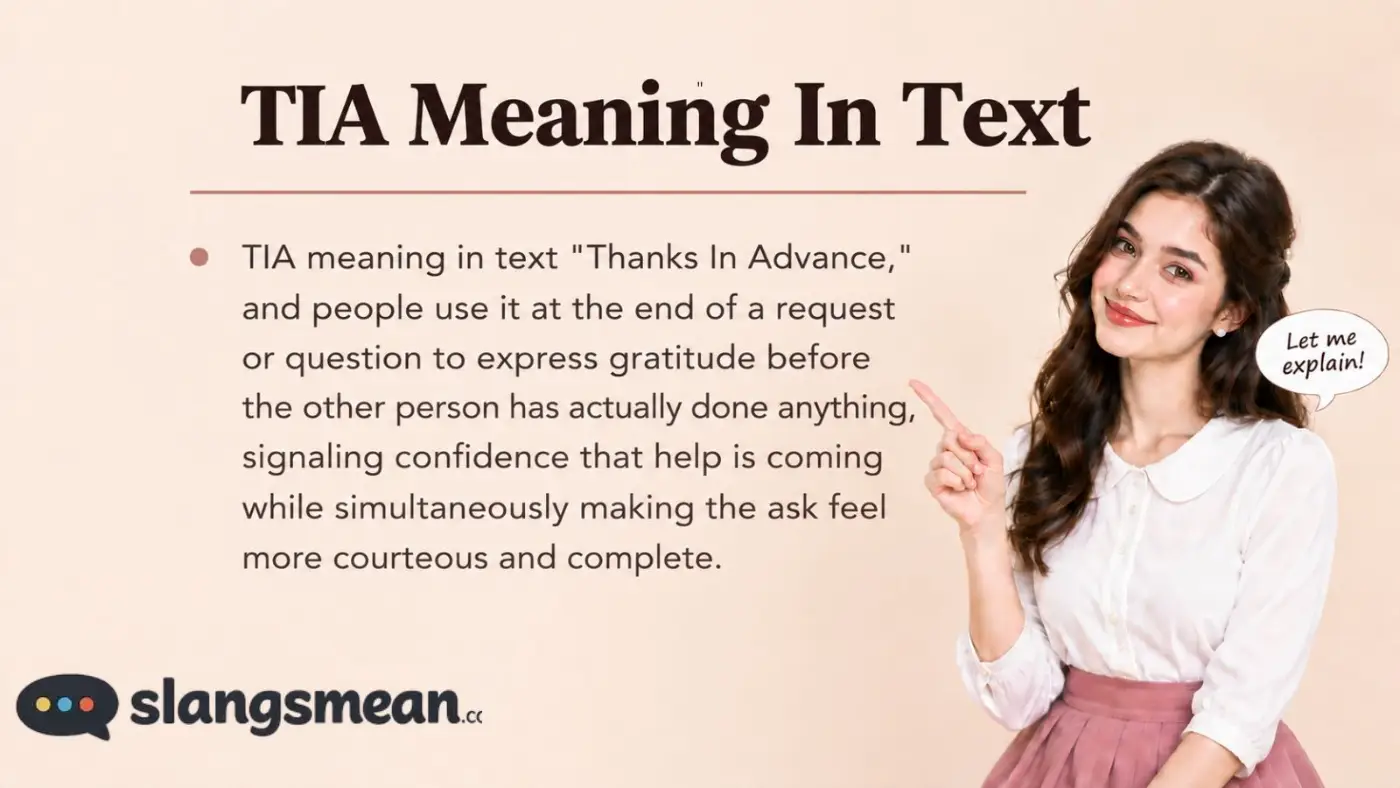
TIA meaning in text is “Thanks in Advance.” It is a common abbreviation used to thank someone before they provide help, answer a question, or complete a favor. People use it in text messages, emails, group chats, and online discussions.
For example, “Can someone recommend a good laptop? TIA!” means “Can someone recommend a good laptop? Thanks in advance!” The expression usually sounds polite, but it can sometimes feel demanding if the sender assumes the other person will help.
Related Meaning: ICL Meaning In Text
What Does TIA Mean in Texting?
TIA stands for “Thanks in Advance.” It expresses appreciation for help that someone hopes to receive.
People commonly use it when asking for information, recommendations, advice, or assistance.
Here are some examples:
- “Can you send me the notes? TIA!” — The sender is thanking someone before receiving the notes.
- “Does anyone know a good dentist nearby? TIA.” — The sender appreciates any recommendations.
- “Please review this document when you have time. TIA!” — The sender expresses gratitude before the review.
- “Any tips for my interview tomorrow? TIA!” — The sender thanks people who might offer advice.
TIA is especially useful in group chats and online communities where someone is asking several people for help.
Unlike TY (Thank You), which can express gratitude after receiving assistance, TIA specifically thanks someone ahead of time.
What Is the Full Form of TIA in Chat?
The full form of TIA in casual chat is Thanks in Advance.
Each letter represents one word:
- T: Thanks
- I: In
- A: Advance
The phrase means that someone is expressing gratitude before another person responds or completes a request.
Example:
Message: “Could you share the meeting link? TIA.”
Full meaning: “Could you share the meeting link? Thanks in advance.”
TIA is usually written in capital letters, although lowercase “tia” is also understandable in informal messages.
Why Do People Use TIA in Messages?
People use TIA to make requests sound more appreciative.
Instead of ending a message immediately after asking for something, they acknowledge the time or effort another person may spend helping them.
Compare these messages:
Without TIA: “Can you help me find the correct address?”
With TIA: “Can you help me find the correct address? TIA!”
Both messages ask the same question. The second adds an expression of gratitude.
However, TIA can also suggest that the sender expects the request to be fulfilled. Whether it sounds friendly or presumptuous depends on the situation.
Is TIA Polite or Rude?
TIA is generally intended to be polite, but its tone depends on how the request is written.
When someone asks for a small favor or a recommendation, TIA usually sounds friendly.
For example:
Friendly: “If anyone has suggestions for beginner running shoes, I’d appreciate them. TIA!”
The sender is inviting people to help without placing pressure on anyone.
Now compare:
Potentially demanding: “Finish my report before lunch. TIA.”
This message may sound presumptuous because it assumes the recipient will complete the task.
The difference is not the abbreviation itself. It is the expectation created by the request.
For larger favors, phrases such as “I’d appreciate your help” or “Please let me know if you have time” may sound more considerate.
What Does TIA Mean in Email?
TIA in email means “Thanks in Advance,” just as it does in texting.
It often appears at the end of an email requesting documents, feedback, information, or assistance.
Example email:
Subject: Meeting Notes
Hi Jordan,
Could you send me the notes from yesterday’s meeting when you have a chance?
TIA,
Alex
Here, Alex is thanking Jordan before receiving the notes.
TIA can work in informal workplace emails, especially when colleagues are familiar with texting abbreviations.
For formal communication, writing “Thank you in advance” is usually clearer.
Is TIA Professional in a Work Email?
TIA can be acceptable in a casual professional conversation, but it may not suit every audience.
A coworker who regularly uses abbreviations may understand it immediately. A client or someone unfamiliar with texting shorthand may prefer the full expression.
Compare these examples:
Casual: “Could you upload the updated file? TIA!”
More formal: “Could you please upload the updated file when convenient? Thank you for your help.”
The second message sounds more professional and gives the recipient room to respond.
TIA vs. Thank You in Advance
“Thanks in Advance” and “Thank You in Advance” have essentially the same meaning. Both express gratitude before receiving help.
The main difference is their level of formality.
| Expression | Meaning | Typical Tone |
|---|---|---|
| TIA | Thanks in Advance | Brief and informal |
| Thanks in advance | Early gratitude | Friendly |
| Thank you in advance | Early gratitude | More formal |
| Thank you | General gratitude | Neutral |
TIA works well when brevity matters and the recipient understands the abbreviation.
The full phrase is usually a better choice for formal emails or unfamiliar readers.
What Does TIA Mean on Social Media?
On social media, TIA usually means “Thanks in Advance” when someone asks for information, recommendations, or advice.
It can appear in Facebook groups, Reddit discussions, Instagram messages, and other online conversations.
Examples include:
Facebook: “Does anyone know a reliable moving company? TIA!”
Reddit: “Looking for advice on my first camping trip. TIA.”
Instagram DM: “Can you send me the name of that restaurant? TIA!”
Group chat: “Does anyone have the updated schedule? TIA.”
The meaning stays the same across these situations.
The sender is expressing appreciation for any help they may receive.
When Should You Use TIA?
TIA works best when you are making a reasonable request and want to thank someone briefly.
Common situations include:
- Asking friends for recommendations.
- Requesting information in a group chat.
- Seeking advice in an online community.
- Asking a coworker to share a document.
- Requesting clarification about instructions.
However, TIA may be less appropriate when the request is urgent, sensitive, or requires significant effort.
For example, asking a friend to help you move for an entire weekend deserves a more personal request than simply adding TIA.
TIA should support a polite request rather than replace consideration for someone’s time.
Real Conversation Examples Using TIA
The following illustrative conversations show how TIA works in everyday situations.
Example 1: Asking for Help at Work
Alex: “Could you send me the updated sales report before our meeting? TIA!”
Jordan: “Sure. I’ll send it in ten minutes.”
Alex: “Perfect, thank you!”
Meaning: Alex expresses gratitude before Jordan sends the report.
Example 2: Requesting a Recommendation
Taylor: “Does anyone know a good place to get my laptop repaired? TIA.”
Morgan: “I used a repair shop downtown last month. I’ll send you the details.”
Taylor: “That would be great!”
Meaning: Taylor thanks the group in advance for possible recommendations.
Example 3: Asking a Friend for a Favor
Jamie: “Can you pick up some milk on your way home? TIA!”
Casey: “No problem. Anything else?”
Jamie: “That’s all. Thanks!”
Meaning: Jamie uses TIA to express appreciation for a small favor.
Example 4: When TIA Sounds Demanding
Sam: “Can you finish my entire presentation tonight? TIA.”
Riley: “I can’t take that on tonight. I have my own deadline.”
Sam: “Understood. Thanks anyway.”
Meaning: TIA does not mean the recipient has agreed to help. Riley can politely decline.
How to Reply When Someone Says TIA
When someone uses TIA, the best response is to address their request rather than focus only on the abbreviation.
If you can help, you might reply:
- “Sure, happy to help!”
- “No problem. I’ll send it shortly.”
- “Of course! Here’s the information.”
- “I’ll check and get back to you.”
- “Happy to help!”
If you cannot help, a direct response is better than making a promise you cannot keep.
For example:
“Sorry, I don’t have that information.”
You can also suggest another option when appropriate.
TIA expresses gratitude, not an obligation. You can decline a request even when someone has thanked you in advance.
Other Meanings of TIA Outside Texting
Although Thanks in Advance is the relevant meaning in many casual messages, TIA has other meanings in different contexts.
TIA Means Transient Ischemic Attack
In medicine, TIA stands for Transient Ischemic Attack, a temporary interruption of blood flow to part of the brain that can cause stroke-like symptoms.
For example:
“The doctor suspects a TIA.”
In this sentence, TIA refers to a medical condition rather than an expression of gratitude.
A suspected TIA requires emergency medical evaluation even if the symptoms disappear.
Sudden weakness, facial drooping, speech difficulties, or vision changes should be treated as possible stroke symptoms.
Does TIA Mean Aunt?
In Spanish, “tía” means “aunt.”
It is a regular Spanish word rather than an abbreviation for Thanks in Advance.
For example:
Spanish: “Mi tía vive en Madrid.”
English: “My aunt lives in Madrid.”
In an English text asking for assistance, TIA is more likely to mean Thanks in Advance.
Tia as a Person’s Name
Tia is also used as a given name.
For example:
“Tia will join us tomorrow.”
Here, Tia refers to a person rather than a texting abbreviation.
The sentence and surrounding conversation help identify the correct meaning.
Common Mistakes When Using TIA
Assuming TIA Means Thank You for Something Already Done
TIA expresses appreciation before help is provided.
If someone has already helped you, TY (Thank You) or the full phrase “Thank you” is generally more appropriate.
Using TIA for Every Request
Adding TIA does not automatically make a message polite.
A demanding instruction can still sound inconsiderate even when it ends with an expression of gratitude.
Confusing Texting TIA With Medical TIA
The same three letters can refer to an expression of gratitude or a medical condition.
Look at whether the conversation concerns a request for help or a health-related issue.
Assuming Everyone Understands TIA
Not every reader recognizes texting abbreviations.
When communicating with unfamiliar readers, writing “Thanks in advance” is clearer.
TIA vs. Other Common Texting Abbreviations
Several abbreviations express gratitude or appear in conversations involving requests.
| Abbreviation | Full Form | Common Use |
|---|---|---|
| TIA | Thanks in Advance | Gratitude before help |
| TY | Thank You | General gratitude |
| TYSM | Thank You So Much | Strong appreciation |
| NP | No Problem | Reassuring response |
The main difference is when the gratitude is expressed.
TIA thanks someone before receiving help, while TY and TYSM can express appreciation after someone has assisted.
NP is commonly used to reassure someone or respond to thanks.
Frequently Asked Questions
What does TIA mean in chat?
TIA means “Thanks in Advance.” People use it when asking for help, advice, or information and want to express appreciation before receiving a response.
What does TIA stand for in an email?
In email communication, TIA stands for Thanks in Advance. It commonly appears at the end of a request, although the full phrase is usually clearer in formal messages.
Is TIA the same as Thank You in Advance?
Yes. “Thanks in Advance” and “Thank You in Advance” communicate the same basic idea. TIA is formed from the words “Thanks in Advance.”
Is TIA rude in a message?
TIA is not inherently rude. However, it may sound presumptuous when someone uses it while demanding a favor or assuming the recipient has already agreed.
What are the different meanings of TIA?
In casual texting, TIA usually means Thanks in Advance. In medicine, it means Transient Ischemic Attack. The surrounding context determines the intended meaning.
Does TIA Mean This Is Awesome?
“This Is Awesome” is not an established standard meaning of TIA in everyday texting. When TIA appears at the end of a request, Thanks in Advance is the expected interpretation.
Final Takeaway
TIA meaning in text is “Thanks in Advance,” a short expression of gratitude used before someone provides help or information.
It is useful in casual chats, emails, and online discussions, but the wording of the request determines whether it sounds considerate or demanding.
For professional communication or unfamiliar audiences, writing the full phrase is often the clearer choice.
Sources

Sophia Bennett writes educational content about English vocabulary, grammar, slang, and communication. She is passionate about making complex language topics accessible to students, professionals, and curious readers around the world.