Mogging Meaning In Text: The Word That Makes You Feel Small
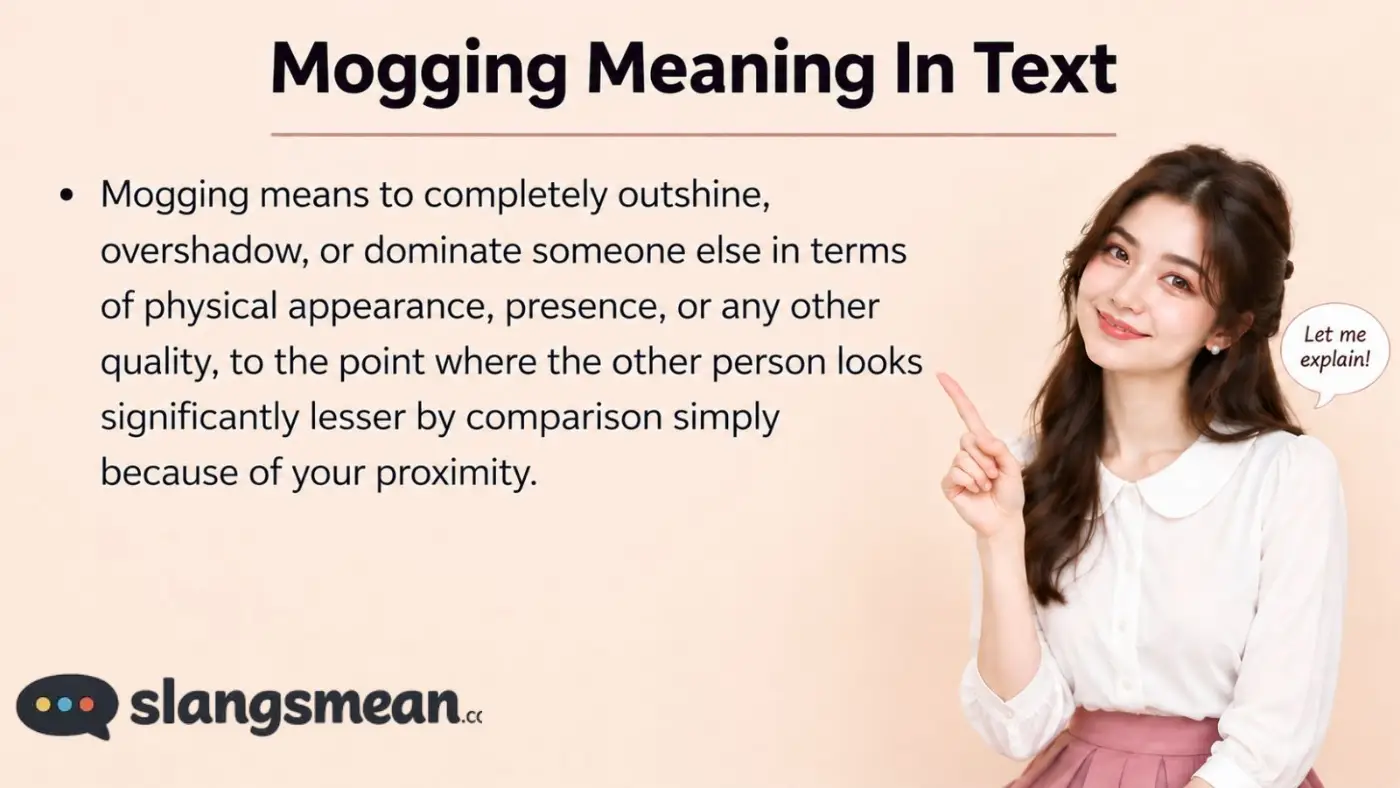
Mogging means to completely outshine, overshadow, or dominate someone else in terms of physical appearance, presence, or any other quality, to the point where the other person looks significantly lesser by comparison simply because of your proximity. One word that describes a very specific kind of effortless dominance.
It’s not about being mean. It’s about the objective gap. When someone is mogging you, you’re not necessarily bad. They’re just operating on a completely different level.
Related Meaning: WDP meaning In Text
Origin and Cultural Footprints
Mogging meaning in text traces directly to incel and looksmaxxing internet communities in the mid-2010s, where the term was originally used specifically in the context of physical attractiveness hierarchies. The word itself derives from “mog,” which is believed to be a variation of “to dominate” in that community’s vocabulary, with mogging being the active form.
It spread beyond its original community through Reddit, 4chan, and eventually TikTok and mainstream social media as the vocabulary of these forums crossed into broader internet culture. Once the word escaped its original context, it shed most of its original ideological baggage and became general internet slang for being outclassed or outshone in any category, not exclusively physical appearance.
Other Meanings of Mogging
Mogging carries its primary meaning consistently but applies across a wider range of situations than its original community used it for.
- Outshining someone in appearance or presence — the original meaning, describing when one person’s physical attractiveness or presence makes another person look significantly lesser by comparison
- Outclassing someone in any skill or category — the broader evolved meaning, applied to any situation where one person so completely dominates a comparison that the other person is visibly overshadowed
In some gaming and competitive communities, mogging takes on a third application.
- Dominating an opponent so completely that the comparison is embarrassing — used after matches, competitions, or comparisons where the gap in performance was so significant it qualified as a mog
Why Does Mogging Have So Many Different Definitions?
Words that originate in niche online communities and then escape into mainstream use almost always shed their original specific meaning and become broader as they travel. Mogging followed this exact pattern. In its original context it described a very specific kind of physical attractiveness dominance. In mainstream usage it became a general-purpose word for any kind of total effortless superiority.
That semantic broadening happened because the core emotional concept, being so visibly superior to someone that the comparison itself is uncomfortable, is universal and useful across many situations. Once people had the word, they applied it wherever it fit.
Does Mogging Mean the Same Thing Outside the US?
In the UK, Australia, and Canada, mogging carries the same general meaning as in the US. The word traveled through English-language internet culture without geographic restriction, and the communities where it first spread operated internationally through the same forums and platforms.
Outside English-speaking countries, mogging reaches anyone embedded in international internet culture through Reddit, TikTok, and YouTube communities where this vocabulary circulates consistently. The concept it describes translates intuitively across cultures even when the specific word requires context for new audiences.
Who Uses It Most?
Mogging shows up most consistently in communities that engage with appearance, fitness, competitive performance, and internet culture discourse.
| Group | How They Use Mogging |
|---|---|
| Fitness and Looksmaxxing Communities | Original context of appearance hierarchy and physical comparison |
| Gaming and Competitive Communities | Describing total domination of an opponent in a match |
| Gen Z on Social Media | General-purpose outshining in any category |
| Internet Culture Enthusiasts | Broad application to any obviously unequal comparison |
The general outshining meaning dominates in mainstream casual texting. The original appearance-specific meaning persists in communities directly connected to the looksmaxxing and self-improvement spaces where the word originated.
Real Conversation Examples Using Mogging
Example 1: A fitness or appearance context
Context: Two friends are texting after attending the same event and one of them is describing an interaction where someone’s presence made an obviously dramatic difference in how the room responded.
“He walked in and was genuinely mogging every other guy in the venue. Not even trying. Just stood there and the whole energy of the room shifted. It was remarkable to witness.”
How to reply: “That’s the highest form of mogging. When it’s completely effortless and everyone can see it but nobody wants to say it out loud. Did he even notice?”
Example 2: In a competitive or skill context
Context: Two gamers are texting after watching a tournament match where the skill gap between players was so extreme it stopped being a competition and became something else entirely.
“That match was pure mogging from start to finish. The guy never even had a chance. It looked like a professional playing against someone who learned the game yesterday.”
How to reply: “Complete mog. There should be some kind of mercy rule for situations like that. The gap was just too visible.”
Usage of Mogging in Different Contexts
Mogging works as both a verb describing an action and a noun describing the state of being outclassed. Both uses appear naturally in conversation depending on whether someone is describing what’s happening or categorizing a situation after the fact.
Example: “She walked into the audition and was mogging the entire waiting room before she even opened her mouth. The posture, the preparation, the absolute certainty that she knew what she was doing. Everyone else recalibrated their expectations the moment she arrived” — here mogging describes a presence-based dominance that goes beyond any single attribute into overall bearing and confidence.
In a more lighthearted everyday context the same word applies to much lower stakes. “My friend brought homemade food to the potluck and was completely mogging everyone else who brought store-bought stuff. I will not name names but I did not bring homemade food.” Same concept of total outclassing, completely different emotional stakes, and the self-aware humor makes the mog feel generous rather than harsh.
How Gen Z Uses Mogging Today
Gen Z took mogging out of its original ideological context and made it a genuinely flexible tool for describing any situation where one thing is so obviously better than another that the comparison becomes its own observation. They apply it to food, fashion, creative work, athletic performance, and casual social situations with equal comfort.
There’s also a self-aware ironic dimension in Gen Z’s use of mogging. Describing yourself as being mogged by something completely non-threatening, like a friend’s home-cooked meal versus your takeout order, applies the word’s competitive intensity to something that has no competitive stakes. That gap between the word’s original weight and the situation’s actual lightness is its own comedic device.
Does Mogging Mean “Bragging”?
No. This is one of the most common misreadings, and the distinction matters. Bragging is the active promotion of your own qualities or achievements. Mogging is what happens to someone else as a result of your presence or qualities, often without any deliberate action on your part.
The confusion happens because both involve someone looking significantly better than someone else. But bragging requires intentional self-promotion while mogging can be completely passive. The most impressive form of mogging is when the person doing it doesn’t even realize they’re doing it. They’re just being themselves, and that’s enough to make the comparison visible to everyone in the room.
Mogging Meaning Across Social Media
| Platform | Mogging Meaning | How It’s Used |
|---|---|---|
| TikTok | Outshining in appearance or any category | Reaction videos, comparison content, and social commentary |
| Twitter / X | General outclassing in any comparison | Sports commentary, entertainment commentary, and cultural observations |
| Appearance-specific or general dominance | Fitness, gaming, and internet culture subreddits | |
| Appearance and presence-based outshining | Fitness content and lifestyle comparison posts | |
| Discord | Gaming and general outclassing | Competitive gaming servers and friend group conversation |
| YouTube | General outclassing or appearance-specific | Gaming commentary and internet culture analysis content |
Common Confusions
Mogging meaning in text creates confusion most often around the distinction between its original specific meaning and its broader evolved use.
- Mogging as appearance-specific vs general — the original meaning was narrowly about physical attractiveness; the mainstream use covers any category of total outclassing; both are legitimate but point at different things
- Mogging as active vs passive — someone can mog you without trying; understanding the passive dimension changes how you read situations described as mogging
- Mogging vs bragging — the most important distinction; mogging happens to others, bragging is done to others; the direction of agency is completely different
- Mogging as negative vs neutral observation — being mogged isn’t necessarily an insult; sometimes it’s just an observation about an obvious gap; tone and context tell you which register is operating
Reading the surrounding context and the relationship between the people in the conversation resolves every mogging ambiguity clearly.
Related Slang Terms
- Mog — the root form, used as both noun and verb for the act or state of total outclassing
- Looksmaxxing — the self-improvement practice around optimizing physical appearance, the community where mogging vocabulary originated
- Sigma — internet culture archetype often associated with effortless dominance and mogging
- Chad — internet slang for someone who would typically be described as doing the mogging
- Slay — approval for someone performing with excellence, overlaps with mogging in positive framing
- Outclass — the standard English equivalent of mogging without the internet culture connotation
- W — Win, the outcome signal that mogging someone in competition represents
- Ratio — social media term for being overwhelmed by a response, related concept of being outperformed
How to Reply When Someone Says Mogging
If someone describes a situation where they witnessed mogging and they’re sharing it as an observation, engage with the specifics of what made the gap so obvious. “What was the moment where it became undeniable?” or “did the person being mogged realize it?” moves the conversation into the interesting territory the observation was pointing at. Mogging observations are usually invitations to analyze what created the gap.
If someone says they’re being mogged by a situation, person, or thing, the reply depends entirely on the tone. Humor calls for matching energy and acknowledgment that yes, the gap is real and funny. Genuine frustration underneath the observation calls for addressing the feeling before the vocabulary. The word is casual enough to cover both registers, and reading which one is present tells you everything about how to respond.
The Mog That Nobody Expected From the Quiet Corner
An art department end-of-year show had twenty students displaying work. Most people expected the students who had been the most vocal about their projects all year, the ones who had talked about their concepts in every critique, to produce the standout pieces.
The student nobody had heard from much all year hung one painting. Just one. In the quietest corner of the room.
By the end of the first hour, every faculty member had spent more time in that corner than anywhere else. Two people had asked if the work was for sale. Nobody could quite explain why it was better. It just visibly was.
The class groupchat that night had one message from someone who’d seen it happen in real time: “She mogged the entire room with one painting. No words.”
Sometimes the most complete mog is the one nobody saw coming from the person nobody had been watching.
When Did Mogging Go Mainstream?
Mogging as mainstream internet slang built its significant visibility through TikTok from roughly 2021 onward, when vocabulary from incel and looksmaxxing adjacent communities crossed into broader internet culture through the platform’s algorithm. TikTok’s short-form video format was particularly suited to the kind of side-by-side comparison content that makes mogging instantly visible and understandable.
By 2022 to 2023 the word had shed most of its original ideological associations for mainstream users who encountered it through TikTok rather than through its source communities. Gen Z adopted it as general-purpose vocabulary for obvious quality gaps, and it has maintained consistent presence in online communication since.
Conclusion
Mogging meaning in text describes the specific experience of being so completely outclassed by someone’s presence, appearance, or performance that the gap becomes visible and undeniable without any deliberate effort from the person doing the mogging. It’s a precise, flexible word that captures something effortless dominance that other vocabulary doesn’t quite nail. Now you know exactly what it means and how to use it correctly.
One word. One effortless gap. Always obvious once you know what you’re seeing.
FAQs
What Does Mogging Mean in Text?
Mogging means completely outshining, overshadowing, or dominating someone, especially in appearance, style, confidence, or physical presence.
What Does Mog Mean in Text?
Mog means to outshine or look noticeably better than someone else, usually when comparing two people.
What Is Female Mogging?
Female mogging refers to a woman noticeably outshining another person, usually in appearance, height, style, confidence, or overall presence.
Is Mog an Insult?
Mog can be insulting when it is used to mock or put someone down by saying they look inferior to another person. However, it can also be used jokingly or casually.
Is Mogging Good or Bad?
It depends on the context. Mogging can be playful slang among friends, but it can also be negative when it is intended to embarrass, belittle, or compare someone unfavorably.
What Is a Mog Guy?
A mog guy is slang for a man who is perceived as significantly more impressive than someone else, particularly in physical appearance, height, physique, or confidence.
Is Mog a Compliment?
It can be a compliment, especially when someone says you “mogged” another person to mean that you looked exceptionally good or stood out. However, the comparison can make the expression insulting toward the other person.
How Do You Mog Someone?
In slang, to mog someone means to outshine them in a noticeable way—for example, through appearance, style, physique, height, confidence, or another quality.
What Is Mog TikTok Slang?
On TikTok, mog or mogging is commonly used to describe someone who noticeably outshines another person, especially in looks, physique, height, or overall presence.
How to Mog Correctly?
There is no official way to “mog” someone. In internet slang, it generally means standing out through appearance, style, confidence, physique, or another noticeable quality.

Sophia Bennett writes educational content about English vocabulary, grammar, slang, and communication. She is passionate about making complex language topics accessible to students, professionals, and curious readers around the world.