Draconian Meaning In Text: The Word That Means No Mercy
Draconian meaning in text excessively harsh, severe, or cruel in its application of rules, punishments, or measures, well beyond what the situation actually requires or justifies. One word that cuts straight to the heart of disproportionate authority.
When someone calls something draconian in a text, they’re not just saying it’s strict. They’re saying it crosses a line into something genuinely excessive and hard to defend.
Related Meaning: OBJ Meaning In Text
Origin and Cultural Footprints
Draconian meaning in text traces directly to Draco, an Athenian lawmaker who codified the laws of ancient Athens around 621 BCE. His legal code was notorious for its severity. Minor offenses carried the death penalty. The laws were reportedly written in blood rather than ink, a phrase attributed to the orator Demades. Most people who lived under those laws considered them brutal and wildly disproportionate.
The word entered English as an adjective derived from Draco’s name, carrying all of that historical weight with it. By the time it reached modern usage, draconian had become one of the standard vocabulary words for describing rules, punishments, or policies that apply force completely out of proportion to the situation they’re addressing.
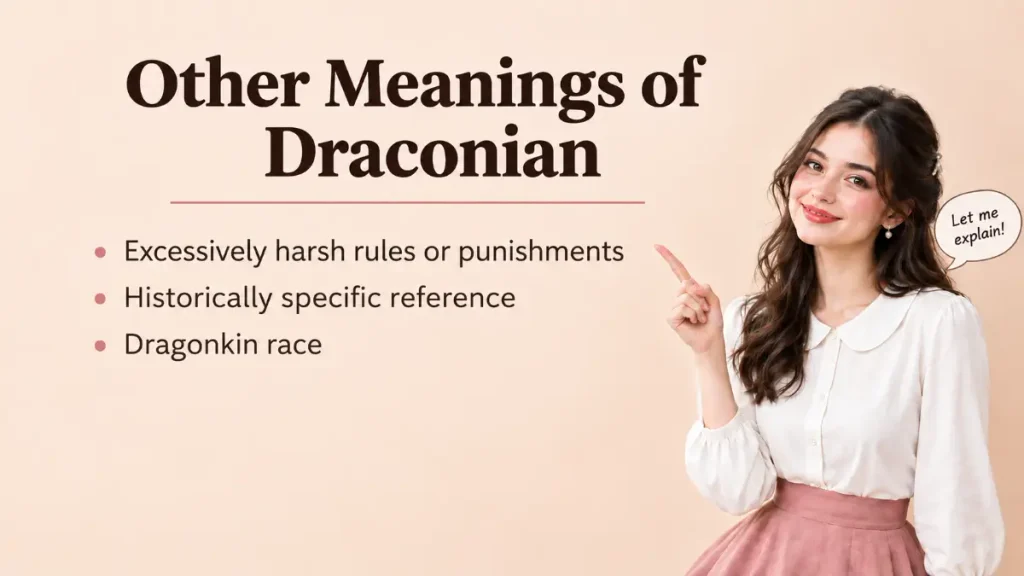
Other Meanings of Draconian
Draconian stays close to its primary meaning. The word’s historical specificity and strong negative connotation keep alternate interpretations from developing significant traction.
- Excessively harsh rules or punishments — the dominant meaning in everyday conversation, describing any policy, rule, or measure that applies disproportionate severity to a situation
- Historically specific reference — used in historical, legal, and academic discussions to reference Draco’s actual laws in ancient Athens and their significance in the development of written legal codes
In some fantasy and gaming contexts, draconian takes on a third meaning.
- Dragonkin race — in the Dragonlance fantasy universe, Draconians are a specific race of dragon-human hybrids; referenced in fantasy literature and gaming discussions separate from the political or legal meaning
Why Does Draconian Have So Many Different Definitions?
Words derived from historical figures develop primary meanings based on what those figures were known for, but they can also get claimed by communities that find the sound or structure of the word useful for their own vocabulary. Draconian landed at the intersection of political language, legal history, and fantasy world-building through exactly this process.
The political and legal meaning and the fantasy gaming meaning are so far apart in context that confusion between them is essentially impossible in any real conversation. Someone describing workplace policy and someone discussing a Dragonlance campaign are not sending each other ambiguous messages.
Does Draconian Mean the Same Thing Outside the US?
In the UK, Australia, Canada, and across most English-speaking countries, draconian carries exactly the same meaning as in the US. The word entered English through shared classical education traditions that were broadly consistent across the English-speaking world, and its meaning has remained stable across those cultures.
Outside English-speaking countries, draconian is recognized in legal, political, and journalistic contexts internationally because political commentary and legal discourse use the word across languages that engage with English-language media. The concept it describes, punishment disproportionate to the offense, translates universally even when the specific word doesn’t.
Who Uses It Most?
Draconian shows up most consistently in political commentary, legal discussion, workplace grievances, and any context where someone wants to call out rules that have overstepped into genuinely excessive territory.
| Group | How They Use Draconian |
|---|---|
| Political Commentators and Journalists | Describing government policies that exceed reasonable severity |
| Legal Professionals and Advocates | Critiquing sentencing guidelines or legal penalties |
| Employees and Workers | Calling out workplace rules that are disproportionately restrictive |
| Students and Academic Communities | Describing school policies applied with excessive harshness |
The people who reach for draconian most naturally are those who want to make a precise argument that something isn’t just strict but genuinely excessive in a way that demands justification.
Real Conversation Examples Using Draconian
Example 1: Critiquing a workplace or institutional policy
Context: A colleague texts another about a new policy that’s been announced internally and both of them are trying to process how extreme the response feels relative to whatever problem it was meant to address.
“They’re making everyone reapply for their own jobs after a restructure that affects three people. That’s genuinely draconian. The cure is worse than the disease here.”
How to reply: “Completely agree. There’s strict and then there’s this. Someone made a decision without thinking through how it would land and now everyone’s anxious for no real reason.”
Example 2: Discussing a news story or political policy
Context: Two people are texting about a news story involving a legal or governmental response that seems massively disproportionate to what triggered it.
“The sentence for that is fifteen years. For that. That’s draconian by any reasonable measure. The punishment has completely lost the connection to the actual offense.”
How to reply: “I read that and had the same reaction. At some point the punishment becomes the problem. That’s not justice, that’s just severity for its own sake.”
Usage of Draconian in Different Contexts
Draconian works wherever someone needs to make the argument that a rule or punishment isn’t just firm but actively unjust in its severity. It’s a word that takes a position rather than just describing a fact.
Example: “The school suspended both students for the same length of time despite one of them being the aggressor and one of them defending themselves. That’s a draconian interpretation of zero-tolerance policy that punishes context out of existence” — here draconian does precise analytical work, identifying not just that the rule is harsh but that its application has produced an outcome that can’t be defended on any reasonable proportionality standard.
In a more personal and domestic context the same word carries slightly more humor. “My landlord’s new no-guests policy is honestly draconian. Two hours of advance notice in writing to have a friend over for dinner. I feel like I’m living in ancient Athens.” The reference to ancient Athens lands as both accurate and funny once you know the history.
How Gen Z Uses Draconian Today
Gen Z reaches for draconian when they want to make a precise argument about proportionality rather than just complaining that something is unfair. The word signals that the speaker has a specific critique about the relationship between offense and response, not just a general objection to authority.
There’s also a generational comfort with classical vocabulary that shows up in how Gen Z integrates words like draconian into casual conversation. Using it in a text about a school policy or a workplace rule isn’t performing sophistication. It’s just reaching for the most accurate word available, which happens to have a 2,600-year-old origin story attached to it.
Does Draconian Mean “Dramatic”?
No. This confusion comes up because both words suggest something excessive, but they describe completely different kinds of excess. Dramatic describes exaggerated emotional response or presentation. Draconian describes excessively severe rules or punishments.
Someone being dramatic is overreacting emotionally. A policy being draconian is applying disproportionate consequences. You can have a draconian policy delivered without any drama, and you can have a dramatic reaction to a policy that is perfectly reasonable. The words aren’t interchangeable, and using one when you mean the other loses the precision that makes each word worth knowing.
Draconian Meaning Across Social Media
| Platform | Draconian Meaning | How It’s Used |
|---|---|---|
| Twitter / X | Excessively harsh rules or policy | Political commentary and institutional critique threads |
| Disproportionate policy or punishment | Legal, political, and workplace discussion subreddits | |
| Harsh rule critique | Caption commentary on news or institutional decisions | |
| TikTok | Excessive policy or rule critique | Commentary videos and response content to news |
| Disproportionate workplace policy | Professional critique of institutional decisions | |
| Harsh policy critique | News commentary and community discussion threads |
Common Confusions
Draconian meaning in text creates confusion most often around the dramatic versus draconian distinction and around how broadly the word can legitimately be applied.
- Draconian vs dramatic — completely different meanings; draconian describes rule severity, dramatic describes emotional exaggeration; using them interchangeably loses important precision
- Draconian as hyperbole vs genuine critique — sometimes people use draconian casually for any strict rule; in its most accurate use it describes genuine disproportionality between offense and response
- Draconian vs strict — strict describes rules firmly applied; draconian describes rules applied with severity beyond what’s defensible; the difference is proportionality
- Draconian in fantasy vs political contexts — the Dragonlance race meaning and the political severity meaning share the word; context makes the distinction immediate
Reading the surrounding argument tells you everything about how draconian is being deployed in any specific sentence.
Related Slang Terms
- Authoritarian — describing excessive governmental or institutional control, related territory to draconian
- Tyrannical — describing oppressive rule, stronger and more personal than draconian
- Overreach — describing authority exceeding its appropriate limits, related concept to draconian policy
- Disproportionate — the underlying principle that makes something draconian rather than just strict
- Punitive — focused on punishment rather than correction, often accompanies draconian in policy criticism
- Zero-tolerance — policy approach that draconian is often applied to critically
- Excessive — simpler synonym that draconian implies but with more historical and rhetorical weight
- Orwellian — another historical eponym used for excessive control, from the same vocabulary family as draconian
How to Reply When Someone Says Draconian
If someone uses draconian to describe a policy they’re genuinely frustrated with, don’t just validate the complaint. Engage with the specific disproportionality they’re pointing at instead. Ask something like “what’s the actual rule they broke to get that response” or “is there any argument for why the severity is justified.” That kind of question moves the conversation from labeling to analysis. Someone reaching for a precise word like draconian is usually looking for exactly that.
If draconian appears in a more casual or humorous context, like someone describing an overprotective parent’s household rules or an absurdly strict gym policy, match the tone. “2,600 years and Draco’s still causing problems” or “you should submit that to the historical record alongside his original laws” acknowledges the reference with the lightness the context calls for.
The Rule That Made Everyone Quit the Same Day
A small company introduced a new attendance policy that required employees to clock in within a two-minute window of their scheduled start time or face a formal written warning, regardless of traffic, public transit delays, or any other external factor. Three warnings in a calendar year meant termination.
The policy was announced in a Monday all-hands meeting. By Wednesday, seven people had submitted resignations. The founding team’s response was to call the departing employees unprofessional. The departing employees’ group chat had one word for the policy in the first message that appeared after the announcement: draconian.
They were right. Not just as an insult. As a precise description of what had happened. A rule designed to address a real but minor problem had been calibrated so severely that it destroyed more than it could ever have fixed. Draco would have recognized the approach. He would probably have also recognized the outcome.
When Did Draconian Go Mainstream?
Draconian entered English political and legal vocabulary through classical education traditions that were standard in British and American schools from the 18th century onward. Students who studied Greek history and rhetoric encountered the word through the story of Draco’s laws, and the word moved from academic to everyday use as classical education produced a generation of writers, lawyers, and politicians who used it naturally in public discourse.
Its mainstream everyday use accelerated significantly through the 20th century as media commentary on government policy, legal reform debates, and institutional criticism created consistent demand for precise language about disproportionate authority. Today it appears regularly in journalism, political commentary, legal discussion, and increasingly in casual personal texting, where people reach for it because it captures something that simpler words don’t quite nail.
Conclusion
Draconian meaning in text describes a specific and important critique: that a rule, punishment, or measure has crossed the line from firm into genuinely excessive and unjustifiable. It means disproportionately harsh, and it carries that meaning with historical authority behind it. Now you know exactly what it means and how to use it when the moment calls for precision rather than a simpler complaint.
One word. One precise critique. Always earned by what it describes.
FAQs
What Does Draconian Mean?
Draconian means excessively harsh, severe, or strict, especially when describing rules, laws, punishments, or measures that seem far more severe than necessary.
Are Draconians Evil or Good?
If you mean Draconians as fictional dragon-like beings, whether they are good or evil depends on the particular book, game, or fantasy world. The term itself does not automatically mean evil.
What Does “Drako” Mean in Slang?
Drako can have different meanings depending on the slang community and context. It may also be a name or a variation of Draco, so the surrounding conversation matters.
What Is an Example of Draconian?
A draconian rule might be a policy that gives an extremely severe punishment for a relatively minor violation, such as imposing a very long suspension for a small first-time offense.
What Is a Synonym for Draconian?
Common synonyms include harsh, severe, strict, oppressive, rigid, and merciless, depending on the context.
Who Is a Draconian?
A Draconian can refer to someone or something associated with Draco, an ancient Athenian lawgiver. More commonly in modern English, draconian is an adjective describing unusually harsh rules or measures.
What Is a Draconian Sentence?
A draconian sentence is an exceptionally harsh legal punishment that is considered much more severe than the offense might ordinarily warrant.
What Does Draconian Rule Mean?
Draconian rule refers to governing through extremely strict laws, severe punishments, or rigid measures. It usually emphasizes the unusually harsh nature of the rules.
How Do You Pronounce “Draconian”?
Draconian is commonly pronounced drə-KOH-nee-un, with the main stress on the second syllable.
What Does It Mean to Have a Draconian Personality?
A draconian personality describes someone who tends to be extremely strict, rigid, or uncompromising, particularly when enforcing rules or expectations.

Sophia Bennett writes educational content about English vocabulary, grammar, slang, and communication. She is passionate about making complex language topics accessible to students, professionals, and curious readers around the world.