Roster vs Roaster: What’s the Difference?
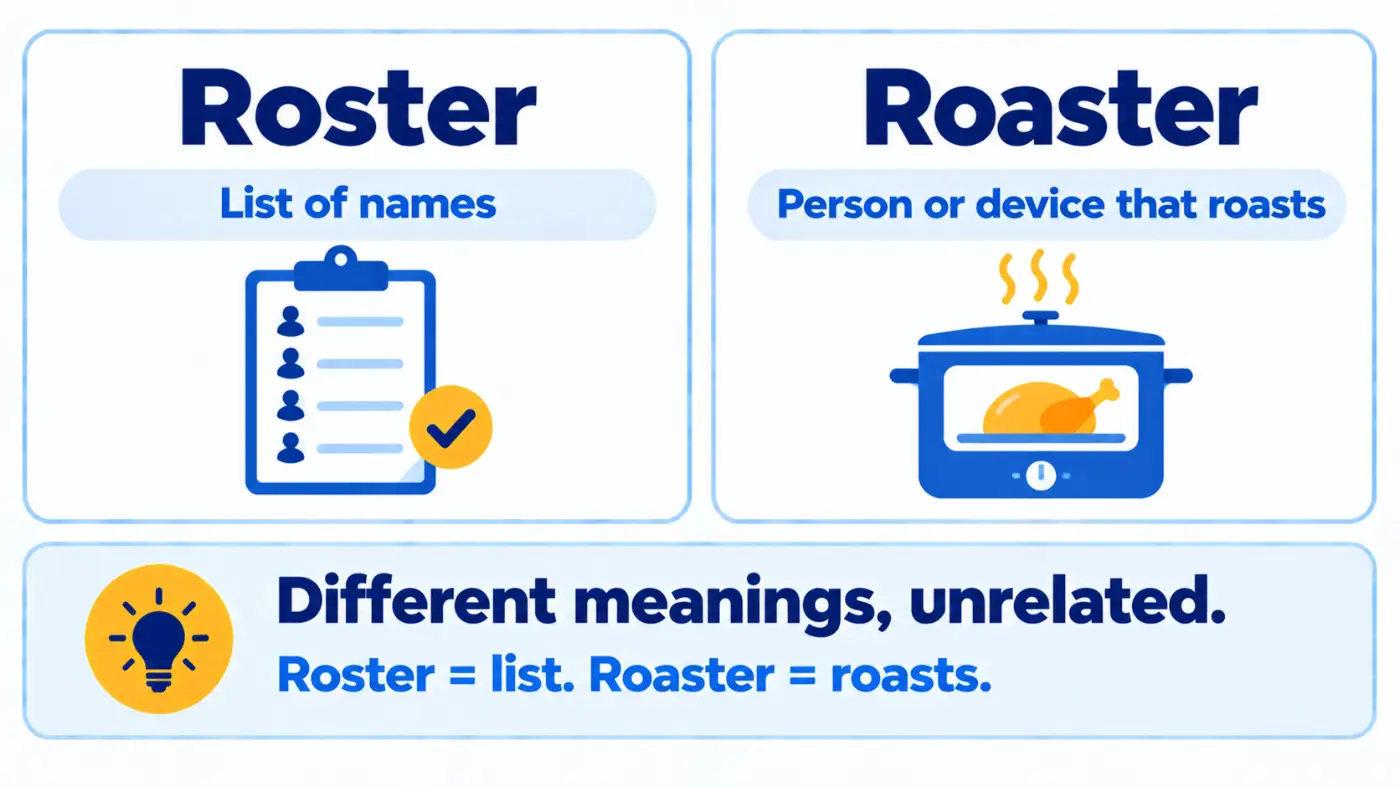
Roster refers to a list of names, typically for a team, staff, or schedule. Roaster refers to a person or device that roasts something, usually food. They’re unrelated in meaning despite looking and sounding almost identical.
The Short Answer at a Glance
| Form | What it names | Typical use | Example |
|---|---|---|---|
| roster | A list of names, players, employees, or scheduled participants | Sports, workplaces, schools, military | The coach finalized the roster before the season opener. |
| roaster | A person who roasts something, or a device/container used for roasting | Cooking, coffee production, appliances | She bought a new roaster to prepare the Thanksgiving turkey. |
If you’re talking about a list of people, you want roster. If you’re talking about something or someone that roasts, you want roaster.
What Roster Means and How It Works
Roster is a noun referring to a list of names, most often used to identify the members of a team, organization, staff, or group scheduled for a particular duty or role. It’s a word deeply embedded in sports, workplaces, schools, and the military, anywhere a defined group of people needs to be tracked or organized.
In sports, a roster typically lists the players officially registered to a team for a season, game, or tournament. In workplaces, a roster might refer to a staff list or a schedule assigning employees to shifts. In academic or military contexts, roster often refers to attendance lists or duty assignments.
Grammatically, roster functions as a standard countable noun: a roster, the team’s roster, several rosters. It can also function as a verb in more specialized or informal usage, as in “she’s rostered for the morning shift,” though this verb form appears far more often in British and Australian English than in American English.
The word traces back to a Dutch term originally associated with a list or table used for military duty assignments, which explains its long association with organized scheduling and personnel tracking. That military and organizational connection persists strongly in how the word is used today, even in completely civilian contexts like sports teams or office schedules.
What Roaster Means and How It Works
Roaster is a noun with two main uses. Most commonly, it refers to a container, pan, or appliance specifically designed for roasting food, such as a turkey roaster or a coffee roaster. Less commonly, but still correctly, it can refer to a person who roasts something, particularly in specialized fields like coffee production, where a “roaster” is someone whose job is roasting coffee beans.
The word is formed simply by adding the agent or tool-forming suffix “-er” to the verb “roast,” following the same pattern as many English words describing a person or device that performs an action: a baker bakes, a toaster toasts, and a roaster roasts.
Grammatically, roaster functions as a standard countable noun: a roaster, several roasters, the restaurant’s industrial roaster. Context almost always makes clear whether it’s referring to a piece of equipment or to a person, since the two senses rarely cause genuine confusion in practice.
Roaster shows up constantly in cooking and kitchen contexts, from home cooking during the holidays to professional food service and specialty coffee culture, where “roaster” often specifically refers to either the equipment or the skilled professional overseeing the coffee roasting process.
Roster vs Roaster: Key Differences Side by Side
| Feature | Roster | Roaster |
|---|---|---|
| Part of speech | Noun (occasionally verb) | Noun |
| Core meaning | A list of names, players, or scheduled participants | A device, container, or person that roasts something |
| Typical use | Sports, workplaces, schools, military scheduling | Cooking, coffee production, kitchen appliances |
| Register | Common in both formal and casual writing | Common in both formal and casual writing |
| Example | The nurse checked the weekend roster before her shift. | The nurse used a large roaster to cook the hospital fundraiser’s turkey. |
What the table can’t fully capture is just how unrelated these two words actually are in real usage, despite their nearly identical spelling. Unlike many confusable word pairs that share a root or overlap in meaning, roster and roaster simply happen to look alike, and confusing them tends to come down to a single added letter rather than any genuine overlap in what they describe.
Correct Examples in Real-Life Contexts
Everyday speech
- Coach posted the final roster on the locker room door this morning.
- We need a bigger roaster if we’re cooking a turkey that size.
- Check the roster before you show up, I think practice got moved to Tuesdays.
- My uncle got really into coffee roasting and bought an actual roaster for his garage.
Workplace writing
- HR updated the on-call roster for the holiday weekend.
- Facilities confirmed the kitchen’s industrial roaster passed inspection.
- Please review the shift roster and flag any scheduling conflicts by Friday.
- The catering team requested an additional roaster for the company picnic.
Texting
- did you make the final roster for the tournament
- just ordered a new roaster for my home coffee setup, so excited
School and academic
- The debate team’s roster includes twelve students this semester.
- Her culinary school project focused on comparing roaster types for different meats.
- The professor asked us to review the class roster before the first exam.
- The agricultural program studies how commercial coffee roasters affect bean flavor profiles.
Formal writing
- The organization’s official roster lists all active members in good standing.
- The manufacturer’s roaster meets current food safety certification standards.
- Military personnel are assigned according to the unit’s approved duty roster.
- The company’s specialty coffee division employs three full-time roasters.
Common Mistakes People Make (and How to Catch Them)
Adding an unnecessary “a” out of habit
Wrong: Check the team roaster before Saturday’s game. Right: Check the team roster before Saturday’s game.
This is the most common version of the mix-up. Because “roaster” is a familiar kitchen word, some writers default to that spelling even when they mean the list of team members.
Dropping the “a” when discussing cooking equipment
Wrong: We need to buy a bigger roster for the holiday turkey. Right: We need to buy a bigger roaster for the holiday turkey.
This happens in the opposite direction, where a writer familiar with “roster” from sports or work contexts accidentally applies that spelling to a cooking-related sentence.
Autocorrect swapping the word unexpectedly
Wrong: My phone changed roster to roaster, and I didn’t catch it before sending the email. Right: Reviewing autocorrect suggestions carefully before sending scheduling-related messages.
Because both words are common and correctly spelled, autocorrect doesn’t always catch this particular swap, since neither version registers as an outright typo.
Confusing the two due to similar sound
Wrong: The coffee shop’s roster does small batches every week. Right: The coffee shop’s roaster does small batches every week.
Spoken aloud, the words differ by only a single vowel sound, which can make it easy to type the wrong one, especially when writing quickly or transcribing from speech.
A Fast Trick to Choose the Right One
Think about what the sentence is actually describing: a list of people, or something related to cooking. If it’s a list, you want roster, which conveniently shares its first few letters with “roll,” another word associated with lists and names, like a class roll or an attendance roll.
If it’s about cooking, remember that roaster contains the word “roast” almost entirely intact, just with “-er” added at the end. That direct visual connection to “roast” is a reliable clue that you’re dealing with the cooking-related word, not the list-related one.
This trick works well because the two words’ meanings map cleanly onto two clearly different mental categories, people-lists versus cooking-equipment, so once you identify which category your sentence belongs to, the correct spelling tends to follow naturally.
How They Sound in Real Situations
A text exchange
Jordan: Did you make the roster for the softball tournament?
Casey: Yes! Sending it over now, we’ve got ten solid players.
Jordan: Perfect, can’t wait for Saturday.
Roster is correct here because the conversation is about a list of players for a sports team.
A workplace email
Subject: Kitchen equipment order
Hi Marcus,
We’re placing an order for a new commercial roaster for the cafeteria upgrade. Could you confirm the space requirements before Friday’s delivery window?
Thanks, Elena
Roaster is correct because the email is specifically about kitchen equipment used for cooking.
An article-style excerpt
The specialty coffee shop’s head roaster spends hours each week testing new bean combinations, adjusting temperature and timing to bring out subtle flavor notes. Regulars say the shop’s small-batch approach has made it a neighborhood favorite.
Roaster is correct here, referring to the skilled person responsible for roasting the coffee.
Formal Writing vs Casual Writing
Both roster and roaster are equally standard across formal and casual writing, so this isn’t a matter of register at all. What matters is simply which meaning fits the sentence, since both words are common enough to appear comfortably in a legal document, a business email, a text message, or casual conversation.
In formal writing, roster often appears in structured, official contexts, such as military duty rosters, court schedules, or corporate staffing documents. Roaster tends to appear in more specialized formal writing tied to food service regulations, appliance specifications, or coffee industry documentation. In casual speech, both words show up constantly, roster for sports teams and work shifts, and roaster for cooking and coffee.
Related Mix-Ups People Also Search For
Roster vs Rooster
Rooster refers to an adult male chicken, and it’s unrelated in meaning to both roster and roaster, though its spelling looks similarly close. Example: The farm’s rooster crowed every morning long before anyone checked the day’s chore roster.
Roast vs Roaster
Roast is the verb describing the cooking action itself, or a noun referring to the food being cooked or a specific event, while roaster is the noun for the person or equipment performing that action. Example: She used her new roaster to roast the vegetables for Sunday’s roast dinner.
Toaster vs Roaster
These two follow the identical word-formation pattern, both adding “-er” to a cooking-related verb, but they describe different appliances used for different purposes. Example: The kitchen counter had a toaster for bread and a roaster for larger cuts of meat.
Quick Practice: Test Yourself
Choose the correct word for each blank.
- The coach announced the final ______ for the championship game. (roster / roaster)
- We borrowed a large ______ from my aunt for the holiday dinner. (roster / roaster)
- HR sent out the updated weekend ______ this morning. (roster / roaster)
- The specialty shop’s head ______ has been perfecting the blend for months. (roster / roaster)
- Please double-check the class ______ before submitting attendance. (roster / roaster)
- The manufacturer recalled several models of its electric ______ due to a wiring issue. (roster / roaster)
Answer Key
- roster: refers to the list of players for the game.
- roaster: refers to the cooking equipment used for the holiday meal.
- roster: refers to the staff schedule.
- roaster: refers to the person responsible for roasting coffee.
- roster: refers to the list of students for attendance purposes.
- roaster: refers to the cooking appliance being recalled.
Frequently Asked Questions
What’s the difference between roster and roaster?
Roster refers to a list of names, typically for a team, staff, or schedule. Roaster refers to a person or device that roasts something, most often related to cooking or coffee.
Can roster ever refer to something related to cooking?
No. Roster specifically refers to lists of people or scheduled participants, and it has no established meaning connected to cooking or roasting.
Is roaster ever used to describe a person, not just equipment?
Yes. In fields like coffee production, “roaster” commonly refers to the skilled person responsible for roasting beans, in addition to referring to the equipment itself.
Why do people confuse roster and roaster so often?
The two words differ by only one letter and sound very similar when spoken, which makes it easy to type or say the wrong one, especially in fast or informal writing.
Is roster ever used as a verb?
Yes, though this usage is more common in British and Australian English than in American English, where “rostered” can describe someone being scheduled for a particular shift or duty.
Does roaster only refer to kitchen equipment?
No. While it commonly refers to a cooking device like a turkey roaster, roaster can also refer to a person, particularly in specialized industries like coffee roasting.

Sophia Bennett writes educational content about English vocabulary, grammar, slang, and communication. She is passionate about making complex language topics accessible to students, professionals, and curious readers around the world.