DSL Meaning in Text: Internet Connection and Slang Explained
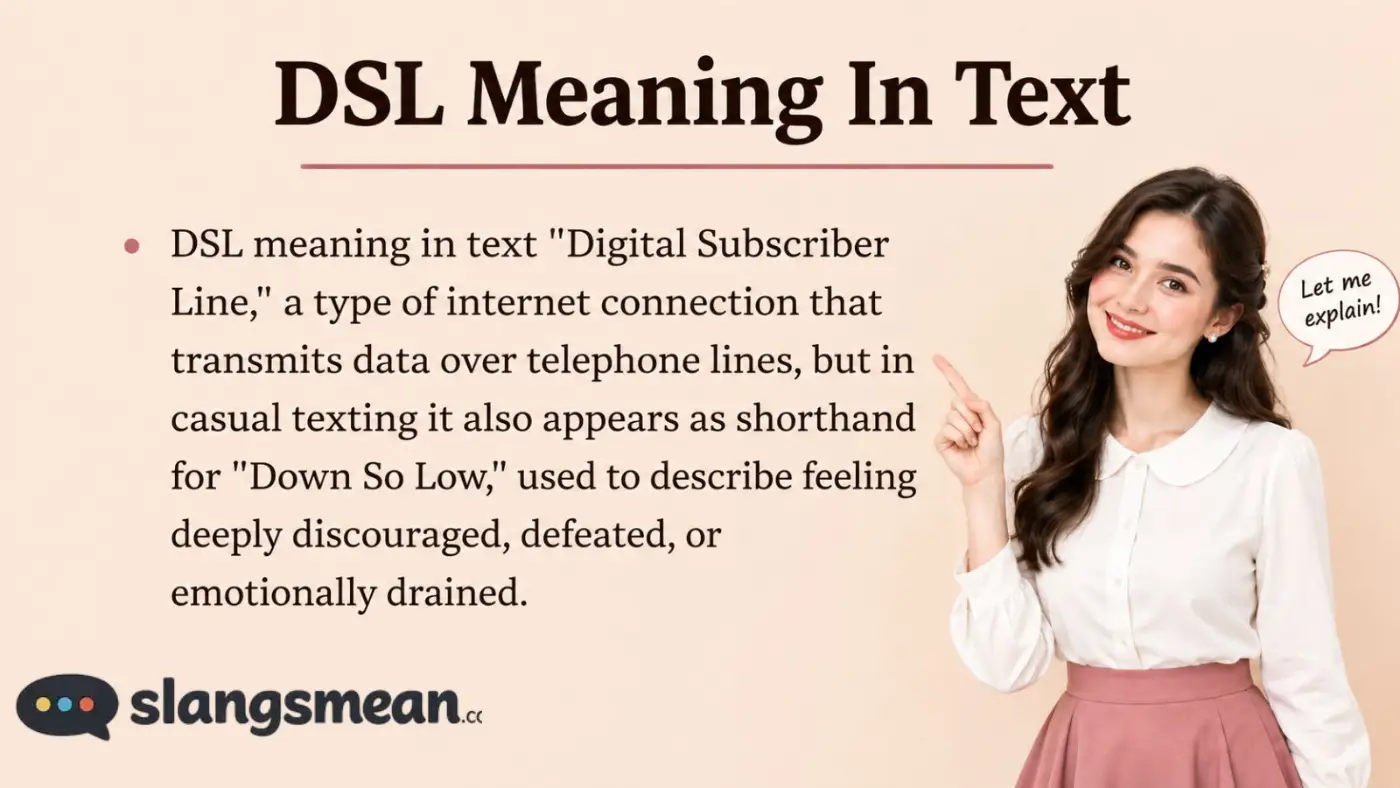
DSL meaning in text depends on the context. In technology, DSL stands for “Digital Subscriber Line,” a broadband internet technology that transmits data over telephone lines. In informal slang, DSL can also stand for “dick-sucking lips,” a vulgar expression referring to someone’s lips or mouth.
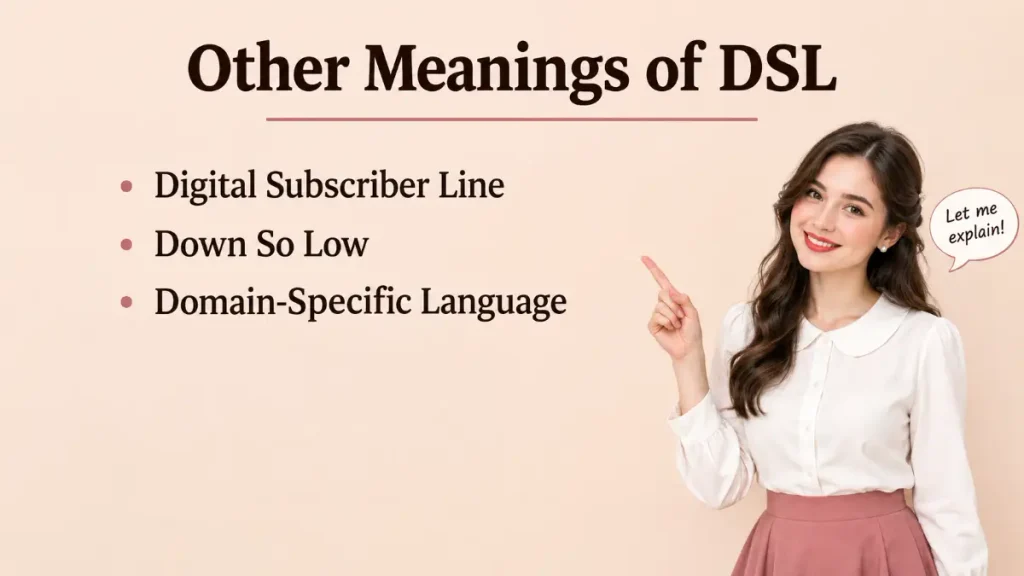
DSL has another established meaning in programming: Domain-Specific Language. These definitions are unrelated, so the topic of the conversation is the best clue to what someone means.
Related Post: Huzz Meaning In Text
What Does DSL Mean in Text?
DSL is a three-letter abbreviation with different meanings in technology, programming, and informal conversation.
The most relevant interpretations are:
- Digital Subscriber Line: A type of broadband internet connection that uses telephone wiring.
- Dick-Sucking Lips: A vulgar slang expression sometimes used to describe someone’s lips, often in a sexualized or objectifying way.
- Domain-Specific Language: A specialized computer language designed for a particular kind of task.
Some online articles also expand DSL as “Down So Low” to describe sadness or discouragement. However, that interpretation is not sufficiently established to present as a common texting definition.
How to Identify the Intended Meaning
Consider these messages:
“My DSL connection keeps dropping.”
This refers to internet service.
“That programming project uses a DSL.”
Here, the abbreviation refers to a specialized programming language.
“Someone commented DSL on my selfie.”
In this situation, the sender may be using the vulgar slang meaning, particularly if the comment is directed at the person’s lips.
The abbreviation alone cannot confirm the sender’s intention. The surrounding words and situation matter.
What Does DSL Stand for in Internet Technology?
DSL stands for Digital Subscriber Line. It is a technology that provides internet access through copper telephone lines.
DSL was an important development in home internet service because it allowed users to access broadband without relying on traditional dial-up connections.
Unlike dial-up internet, which occupied the telephone connection during a data session, many DSL installations allowed internet and voice services to operate simultaneously using appropriate equipment.
How Does DSL Internet Work?
DSL transmits digital information over copper telephone wiring between a customer’s location and equipment operated by the internet provider.
The process is relatively simple:
- A telephone line connects the home or business to the provider’s network.
- A DSL modem converts signals so internet data can travel over the line.
- Provider equipment receives and processes those signals.
- A router may distribute the internet connection to multiple devices.
Some homes use a combined DSL modem and Wi-Fi router.
DSL technology can operate over existing telephone wiring, but service availability depends on the provider’s network and the condition of the line.
Is DSL the Same as Wi-Fi?
No. DSL is an internet access technology, while Wi-Fi is a wireless networking technology.
DSL provides a connection between a customer’s premises and an internet provider.
Wi-Fi allows compatible devices to connect wirelessly to a local network.
For example, a household might receive internet service through DSL and use a Wi-Fi router to connect phones, laptops, and televisions.
The two technologies can work together.
Types of DSL Internet Connections
DSL includes several technologies designed for different connection requirements.
ADSL: Asymmetric Digital Subscriber Line
ADSL provides different download and upload speeds.
Typically, the download speed is higher than the upload speed.
This arrangement was designed for activities such as browsing websites and downloading files, where users often receive more data than they send.
SDSL: Symmetric Digital Subscriber Line
SDSL generally refers to DSL services designed to provide similar upload and download data rates.
Symmetric connections can be useful when sending large amounts of information is as important as receiving it.
The exact technical meaning of SDSL can vary by equipment and service implementation.
VDSL: Very-High-Bit-Rate Digital Subscriber Line
VDSL is a DSL technology designed to support higher data rates over relatively short copper connections.
Some providers use fiber infrastructure for part of the connection and copper wiring for the remaining distance.
Actual performance depends on the technology, line length, and quality of the connection.
DSL vs Cable vs Fiber Internet
DSL is one of several technologies used to provide home internet service.
| Connection | Main transmission medium | General characteristic |
|---|---|---|
| DSL | Copper telephone wiring | Performance depends strongly on line conditions and distance |
| Cable | Coaxial cable networks | Often supports higher speeds than older DSL services |
| Fiber | Optical fiber | Can provide very high speeds and low latency |
| Satellite | Radio signals via satellites | Useful in areas without suitable wired service |
No single connection type guarantees a particular speed or reliability level.
Performance depends on the service plan, network design, local conditions, and provider.
Is DSL Internet Still Used?
Yes. DSL remains available in some locations, particularly where telephone infrastructure exists but newer broadband networks have limited coverage.
However, cable and fiber services often offer higher speeds than older DSL connections.
Availability varies by address, so users should check which technologies their local providers actually offer.
Is DSL Internet Fast Enough?
That depends on the connection and what the household needs.
A suitable DSL plan may support activities such as email, ordinary web browsing, and some video streaming.
However, slower DSL services can struggle with multiple simultaneous high-bandwidth activities.
The advertised speed, actual measured performance, and number of connected devices are more useful than the DSL label alone.
DSL Meaning in Slang
Outside technology, DSL can stand for “dick-sucking lips,” a vulgar expression referring to someone’s lips or mouth.
The phrase is sexually suggestive and may be used as an objectifying remark about someone’s appearance.
It is not an appropriate compliment in every situation, and receiving such a comment can feel uncomfortable or disrespectful.
What Does It Mean When Someone Says “You Have DSL”?
In a slang context, this statement may be a sexualized comment about the person’s lips.
The speaker could intend it as flirtation, teasing, or an insult.
However, the expression itself does not establish that the recipient welcomes the attention.
For example:
“Someone told me I have DSL. What does that mean?”
If the conversation concerns physical appearance, the vulgar slang interpretation is more likely than the internet connection meaning.
Is DSL a Compliment?
Not necessarily.
Some people may use the expression while flirting, but others may find it offensive or inappropriate.
The intention of the sender and the feelings of the recipient can differ.
A person does not need to accept an unwanted sexual comment simply because someone presents it as a compliment.
DSL Meaning on TikTok
On TikTok, DSL can refer to the vulgar slang expression, particularly in comments or videos discussing physical appearance.
However, TikTok does not assign one official meaning to the abbreviation.
A video about internet connections could use DSL in its technical sense.
A programming tutorial could use it to mean Domain-Specific Language.
A comment about someone’s lips may suggest the sexual slang interpretation.
How to Understand DSL in TikTok Comments
Consider the subject of the video.
When a creator reviews home internet service, DSL probably means Digital Subscriber Line.
In conversations about someone’s appearance, the slang meaning may be more relevant.
Videos about software development may use DSL to mean Domain-Specific Language.
Avoid assigning the slang interpretation to every occurrence of DSL on TikTok.
DSL Meaning on Snapchat and Instagram
DSL can appear in direct messages, comments, captions, and conversations on social media.
Its meaning depends on what the sender is discussing.
DSL on Snapchat
In a Snapchat message about internet service, DSL retains its technical meaning.
If someone sends DSL while making a remark about another person’s lips, the slang meaning may apply.
A standalone message containing only “DSL” is ambiguous.
DSL on Instagram
Instagram users may encounter DSL in technology posts or comments about physical appearance.
For example:
“My DSL internet has been slow all week.”
This is clearly about an internet connection.
A comment containing only “DSL” beneath someone’s selfie could have a different and potentially inappropriate meaning.
The platform itself does not determine the definition.
What Does DSL Mean in Programming?
DSL stands for Domain-Specific Language in software development.
A Domain-Specific Language is designed to express instructions or information for a particular problem area.
Unlike a general-purpose programming language, which can be used to build many kinds of software, a DSL focuses on a narrower set of tasks.
Examples of Domain-Specific Languages
SQL is a familiar example of a language designed for a specific domain.
It allows users to query and manage data in relational databases.
Other DSLs may be designed for configuration, mathematical modeling, build systems, or business rules.
For example, a developer might say:
“We created a DSL to describe our application’s workflow.”
Here, the developer means a specialized language, not an internet connection.
DSL vs General-Purpose Programming Language
A general-purpose language such as Python can support many different kinds of applications.
A DSL is designed around a more specific problem.
The distinction concerns the purpose and design of the language rather than whether it is simple or difficult to learn.
Real Conversation Examples Using DSL
The following are illustrative conversations showing how the abbreviation can appear in different situations.
Example 1: Discussing Internet Problems
Situation: Two friends are talking about a slow connection.
Jake: “My DSL internet keeps disconnecting.”
Emma: “Have you checked the modem?”
Jake: “I restarted it twice.”
Emma: “You might need to contact your provider.”
DSL means Digital Subscriber Line because the conversation concerns internet service.
Example 2: Talking About Programming
Situation: Two developers are discussing a project.
Sophia: “We’re using a DSL for the configuration rules.”
Daniel: “Is it easier than writing everything in Python?”
Sophia: “For this particular task, yes.”
The abbreviation refers to Domain-Specific Language.
Example 3: Receiving an Inappropriate Comment
Situation: Someone receives an unfamiliar comment about their appearance.
Ryan: “Someone commented DSL on my picture.”
Olivia: “That can be a vulgar remark about lips.”
Ryan: “I didn’t know that.”
Olivia: “You can ignore it or ask them not to comment like that.”
This example shows why the slang interpretation can matter when someone receives an unwanted comment.
Example 4: Clarifying an Ambiguous Message
Situation: A friend sends an abbreviation without context.
Mia: “DSL?”
Noah: “Do you mean the internet connection?”
Mia: “Yeah, I’m comparing internet plans.”
Noah: “Got it. What speeds are available?”
The clarification prevents a misunderstanding.
How to Reply When Someone Says DSL
The best response depends on which meaning fits the conversation.
When DSL Refers to Internet Service
Respond to the technical issue.
For example:
Emma: “My DSL keeps dropping.”
Jake: “Does the modem lose its connection light when that happens?”
This question helps identify whether the problem involves the DSL connection itself.
When DSL Refers to Programming
Ask about the specific language or its purpose.
For example:
“What is the DSL designed to do?”
Or:
“Is it used for configuration or data queries?”
These questions fit a software development discussion.
When DSL Is Used as a Sexual Comment
You can choose whether to respond.
If the remark is unwanted, possible replies include:
- “Please don’t comment on my appearance like that.”
- “That’s inappropriate.”
- “I’m not comfortable with that.”
Ignoring, blocking, or reporting an unwanted comment may also be appropriate depending on the platform and situation.
When the Meaning Is Unclear
Ask:
“What do you mean by DSL?”
There is no need to guess when the same abbreviation has several unrelated meanings.
Common Misunderstandings About DSL
Assuming DSL Always Refers to Internet Service
Digital Subscriber Line is an established technical meaning, but the abbreviation also has slang and programming uses.
A comment about someone’s appearance should not automatically be interpreted as a reference to broadband.
Treating DSL as a Harmless Compliment
The slang meaning is sexually explicit.
Even when intended as praise, it can be unwelcome or disrespectful.
Assuming DSL Means “Down So Low”
Some online explanations suggest this expansion, but it lacks the same established support as the telecommunications, programming, and vulgar slang meanings.
It should not be treated as a standard expression for sadness or discouragement.
Confusing DSL With Wi-Fi
DSL describes a technology for delivering internet access.
Wi-Fi describes wireless communication between devices and a local network.
A household can use both technologies together.
When Did DSL Become Popular?
DSL has different histories depending on its meaning.
DSL in Internet Technology
During the 1990s and 2000s, DSL became a familiar consumer technology as broadband internet expanded.
This technology offered an alternative to traditional dial-up connections and became common in home internet advertising and technical support discussions.
DSL as Internet Slang
The vulgar slang expression has a documented online history dating back to at least 2005, when it appeared in an Urban Dictionary entry.
It gained renewed attention on TikTok in the early 2020s, including videos in which users discussed learning what the abbreviation meant. <Cite refs={[“turn374644search0″,”turn374644search2”]}/>
This history concerns the slang meaning, not the telecommunications technology.
Frequently Asked Questions
What Does DSL Mean in Text?
DSL can mean “Digital Subscriber Line” or the vulgar slang phrase “dick-sucking lips,” depending on context. It can also mean Domain-Specific Language in programming discussions.
What Does DSL Stand for in Internet Technology?
DSL stands for Digital Subscriber Line. It is a broadband technology that uses telephone wiring to transmit internet data.
What Does DSL Mean on TikTok?
On TikTok, DSL can be a sexually suggestive slang term describing someone’s lips. In technology-related videos, it can still mean Digital Subscriber Line.
What Does It Mean When Someone Says You Have DSL?
In slang, the expression is a sexualized comment about your lips. It may be intended as flirtation or teasing, but it can also be inappropriate or offensive.
Is DSL the Same as Wi-Fi?
No. DSL delivers internet service through telephone-line infrastructure, while Wi-Fi connects devices wirelessly to a local network.
What Does DSL Mean in Programming?
DSL stands for Domain-Specific Language, a specialized computer language designed for a particular category of tasks.
Final Takeaway
DSL meaning in text changes depending on the conversation. In internet technology, it stands for Digital Subscriber Line, while programmers use it to mean Domain-Specific Language. Casual slang gives DSL another meaning: a vulgar sexual expression referring to someone’s lips.
When you encounter DSL, pay attention to whether the discussion concerns internet service, software, or someone’s appearance. That context usually makes the intended meaning clear.

Sophia Bennett writes educational content about English vocabulary, grammar, slang, and communication. She is passionate about making complex language topics accessible to students, professionals, and curious readers around the world.