Nonga Meaning in Text: Is It Really Australian Slang?
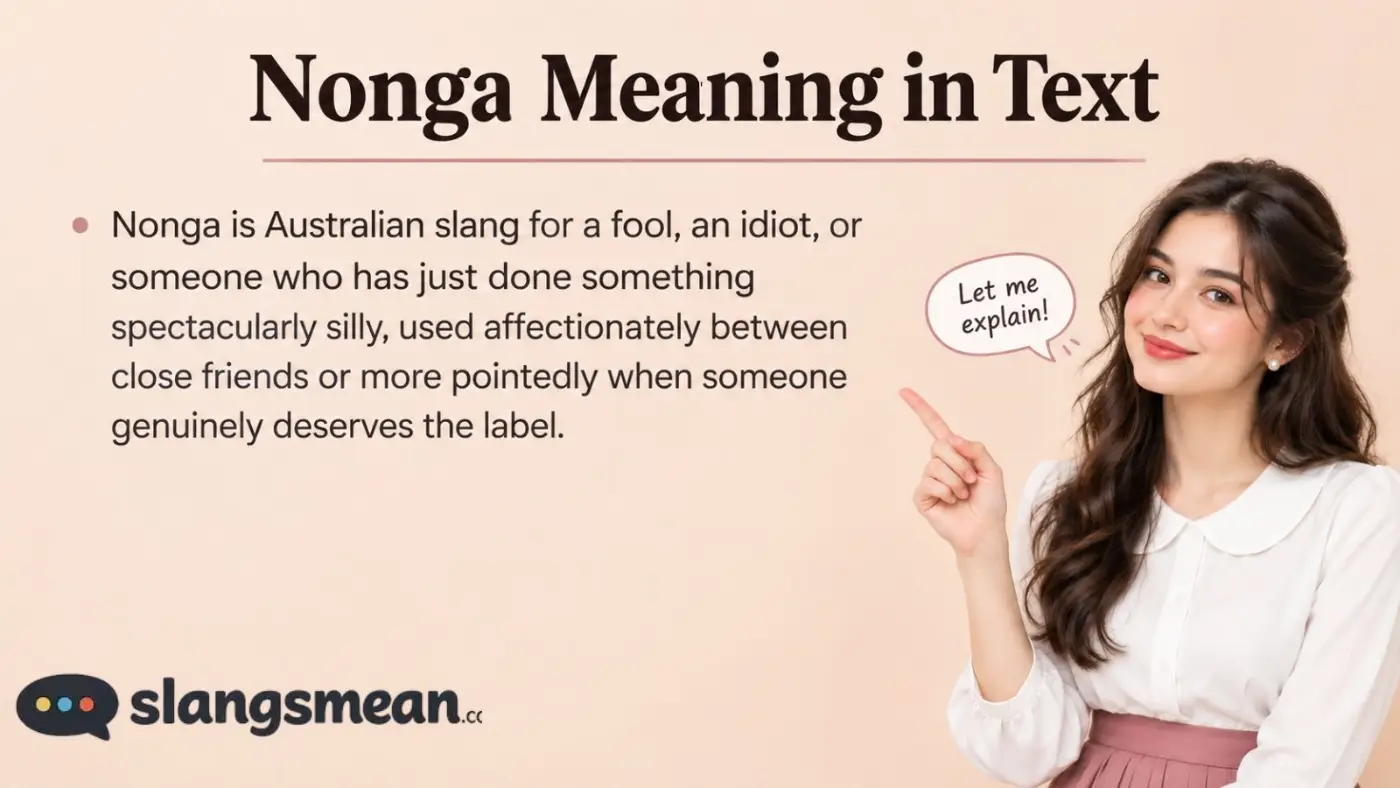
Nonga meaning in text is sometimes described online as “fool,” “idiot,” or “silly person” in Australian slang. However, this definition is not well established in major Australian English references. It should therefore be treated as an uncertain interpretation rather than a confirmed, widely recognized Australian expression.
If someone calls you a “nonga” in a message, they might be teasing you about a mistake. The intended meaning depends on the sender, the surrounding conversation, and whether the word is being used as a nickname or an unfamiliar expression.
Related Meaning: WYFF Meaning In Text
What Does Nonga Mean in Text?
Some online explanations define nonga as a person who behaves foolishly or makes a silly mistake.
Under this interpretation, calling someone a nonga would be similar to saying:
- Fool: Someone who has made a poor decision.
- Silly person: Someone behaving in an amusing or careless way.
- Idiot: An informal insult expressing annoyance or criticism.
- Goose: A playful term for someone acting foolishly.
These comparisons help explain the proposed meaning. They do not establish that nonga is a common Australian word.
For example, imagine receiving this message:
“You forgot your keys again, you nonga!”
The context suggests that the sender is criticizing or teasing someone for being forgetful.
However, without knowing how the sender uses the word, the exact meaning remains uncertain.
Is Nonga an Australian Slang Word?
Nonga is presented as Australian slang in some online articles, but its status as an established Australian English term is unclear.
Australia has a rich tradition of informal expressions, including words used to describe foolish behavior. Well-documented examples include drongo, galah, and goose.
Nonga should not automatically be placed in the same category.
A reliable explanation needs to distinguish between a word with documented regional usage and a definition repeated by websites without supporting evidence.
Why Is Nonga Associated With Australia?
Some explanations describe nonga as a playful Australian insult.
That description resembles the way certain established Australian expressions can be used between friends. However, similarities in tone do not prove that nonga has the same cultural history.
There is insufficient evidence to identify a specific Australian region where the word originated or to establish when it entered everyday speech.
Claims that nonga became popular through TikTok, Instagram, or Australian texting culture also require supporting examples.
Is Nonga Used Throughout Australia?
There is no reliable basis for claiming that nonga is recognized across Australia.
A word might be used within a particular family, friendship group, or local community without being familiar to the wider population.
If an Australian sender uses nonga, asking what they mean is more reliable than assuming every Australian understands it.
Is Nonga an Insult or a Friendly Expression?
If someone uses nonga to mean “fool,” the tone could be playful or insulting.
The word alone cannot establish the sender’s intention.
Playful Teasing
Friends sometimes use mild insults to joke about harmless mistakes.
Illustrative example:
Jack: “I went to the store and forgot what I needed.”
Oliver: “You nonga!”
Jack: “I know. I’ll make a list next time.”
If Oliver intends nonga to mean “silly person,” the exchange is playful rather than hostile.
This dialogue illustrates a possible interpretation, not documented common usage.
Genuine Criticism
An unfamiliar word can also appear in a serious disagreement.
Illustrative example:
Emma: “You sent the documents to the wrong person.”
Ryan: “I made a mistake.”
Emma: “That was a nonga thing to do.”
If Emma is using the proposed meaning, her message criticizes Ryan’s judgment.
The surrounding conversation makes the negative tone clearer than the unfamiliar word itself.
How Can You Tell the Difference?
Consider three details before interpreting the message:
- Relationship: Close friends may tease each other in ways that would sound rude between strangers.
- Situation: A harmless mistake suggests a different tone from a serious argument.
- Response: Follow-up messages can reveal whether the sender intended humor or criticism.
Do not assume an unfamiliar expression is affectionate simply because someone describes it as slang.
How to Understand Nonga in Different Text Messages
The surrounding words can help identify the sender’s likely intention.
| Message | Possible meaning | Context clue |
|---|---|---|
| “You nonga!” | Playful teasing | A harmless mistake |
| “Stop being a nonga.” | Criticism | Frustrated tone |
| “Hey, Nonga!” | Name or nickname | Direct greeting |
| “What does nonga mean?” | Request for a definition | Language discussion |
These are illustrative contexts. They do not prove that each use is common.
A message containing only “nonga” offers too little information for a confident interpretation.
Is Nonga an Abbreviation?
Nonga is not an established English texting abbreviation with a recognized full form.
Unlike LOL, BRB, or WYD, the letters do not correspond to a widely documented English phrase.
It is better to treat nonga as a possible word, nickname, or unfamiliar expression rather than inventing an expansion.
For example:
- LOL: Laughing Out Loud
- BRB: Be Right Back
- WYD: What You Doing?
These abbreviations have recognizable meanings in everyday digital communication.
Nonga does not have a similarly established expansion.
Nonga vs Drongo, Galah, and Goose
If you are trying to understand Australian expressions for a foolish person, several documented terms provide clearer comparisons.
| Word | Meaning | Typical use |
|---|---|---|
| Drongo | Fool or incompetent person | Informal Australian English |
| Galah | Foolish or silly person | Australian informal speech |
| Goose | Silly person | Often playful or mildly critical |
| Nonga | Uncertain; sometimes described as “fool” | Not firmly documented |
Drongo
Drongo is an established Australian informal word for a foolish or incompetent person.
Example:
“Don’t be a drongo. Check the address first.”
The speaker is telling someone not to act foolishly.
Galah
Galah is the name of an Australian cockatoo and is also used informally to describe a foolish person.
Example:
“You left your phone in the refrigerator, you galah!”
The sentence uses the word as a playful insult.
Goose
Calling someone a goose can mean they are acting silly.
Example:
“You wore your shirt backward, you goose!”
Depending on the relationship and tone, the comment may be affectionate or critical.
Unlike nonga, these three expressions have established meanings in Australian English.
Nonga Meaning on Social Media
An unfamiliar word may appear on TikTok, Instagram, Snapchat, Facebook, or another platform without having a recognized meaning specific to that service.
Nonga on TikTok
A TikTok user might encounter nonga in a comment or caption.
If the comment describes someone’s mistake, the proposed “silly person” interpretation could fit.
However, there is insufficient evidence to classify nonga as a widespread TikTok slang term.
The video and surrounding comments should guide your interpretation.
Nonga on Instagram
On Instagram, nonga could appear as a nickname, username, caption, or unfamiliar word.
For example:
“Nice one, Nonga!”
Here, capitalization and direct address might indicate a person’s nickname.
That interpretation differs from using nonga as an insult.
Nonga on Snapchat
A Snapchat message containing nonga does not have an official platform-defined meaning.
If the sender is joking about a mistake, they might intend the proposed insult.
When the meaning is unclear, ask the sender directly.
Does Nonga Have a Different Meaning Outside Australia?
Nonga should not automatically be treated as an Australian word whenever it appears online.
The same spelling can occur in different languages, names, and contexts.
For instance, nonga is also a Korean romanization of 농가, a word referring to a farming household or farm family.
This meaning is unrelated to the proposed Australian slang definition.
A reader encountering nonga in Korean-related material should not interpret it as an English insult.
What About Spanish?
Nonga is not a standard Spanish word with a single widely established meaning.
It should not be confused with ñonga, which has different spelling and may appear in regional or vulgar Spanish usage.
The letter ñ is distinct from n in Spanish, so changing it can change the word.
If the original message is in Spanish, the surrounding sentence and regional context matter more than an English slang explanation.
How to Reply When Someone Calls You Nonga
Your response depends on whether the message sounds friendly, critical, or unclear.
When Someone Is Joking
If the sender is teasing you about a harmless mistake, you could reply:
“Yeah, that was pretty silly of me.”
Or:
“I know. I can’t believe I did that.”
These responses acknowledge the situation without assuming a particular cultural meaning.
When Someone Sounds Annoyed
If the message follows a genuine mistake, focus on resolving the problem.
For example:
“You’re right. I’ll fix it.”
Another option is:
“Sorry about that. It won’t happen again.”
You do not need to repeat an unfamiliar word to respond appropriately.
When You Don’t Know the Meaning
Ask a short question:
“What do you mean by nonga?”
Or:
“Is that a nickname or slang?”
A direct question is especially useful when the word appears without enough context.
Common Misunderstandings About Nonga
Assuming Every Australian Knows the Word
A website describing nonga as Australian slang does not establish that Australians commonly use or recognize it.
Regional claims need reliable evidence.
Treating Nonga as a Confirmed Mild Insult
The proposed meaning suggests a mild insult, but the strength and tone of a word cannot be established without documented usage.
Avoid assuming it is always harmless.
Confusing Nonga With Drongo
Drongo is a documented Australian slang word meaning a fool.
The similar proposed meaning does not make nonga a recognized synonym.
Inventing an Origin Story
There is no sufficiently supported origin date, creator, or historical development for nonga as an Australian slang expression.
It would be misleading to assign the word a specific century or claim it became popular through a particular social media trend without evidence.
Frequently Asked Questions
What Does Nonga Mean in Text?
Nonga is sometimes explained online as a silly or foolish person in Australian slang. However, that definition is not firmly established, so the meaning should be confirmed from the message’s context.
Is Nonga a Real Australian Slang Term?
Its status as an established Australian slang term is uncertain. Better-documented Australian words for a foolish person include drongo and galah.
Is Being Called Nonga Offensive?
If someone uses nonga to mean “fool,” it could be playful or insulting. The sender’s intention and your relationship determine how the message comes across.
Does Nonga Have a Full Form?
There is no recognized English texting expansion for nonga. It should not be treated as a standard acronym.
Is Nonga the Same as Drongo?
No confirmed linguistic relationship has been established. Drongo is a documented Australian insult, while the proposed Australian meaning of nonga remains uncertain.
What Should I Say if Someone Texts Me Nonga?
If the message seems playful, you can respond casually. When you cannot determine the meaning, simply ask, “What does nonga mean?”
Final Takeaway
Nonga is sometimes described as Australian slang for a fool or silly person, but that explanation lacks strong documentation. Unlike established Australian expressions such as drongo and galah, its meaning cannot be confidently assumed from the spelling alone.
If you encounter nonga in a text, consider the surrounding conversation and ask the sender for clarification when necessary.

Sophia Bennett writes educational content about English vocabulary, grammar, slang, and communication. She is passionate about making complex language topics accessible to students, professionals, and curious readers around the world.