XD Meaning in Text: The Laughing Emoticon Explained
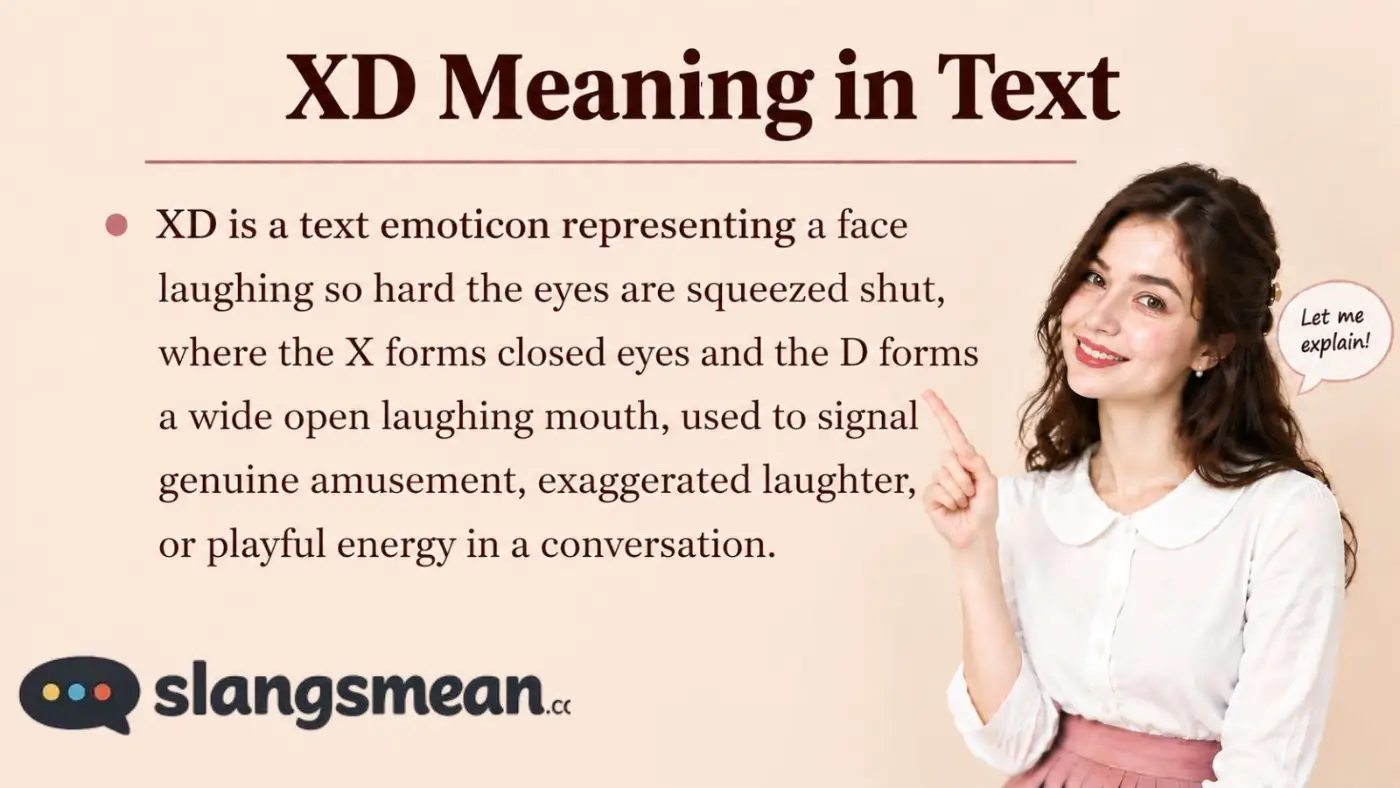
XD meaning in text is a laughing face made from two keyboard characters. The X represents tightly closed eyes, while the D represents a wide-open laughing mouth. People use XD to show amusement, react to something funny, or make a message sound playful.
Unlike LOL, XD is not an abbreviation for a phrase. It is a text emoticon, meaning the characters form a facial expression when viewed sideways. Although it became familiar during the early internet messaging era, people can still use it in casual conversations in 2026.
Related Meaning: WYDM Meaning In Text
What Does XD Mean in Texting?
XD means laughter, amusement, or playful excitement. It works much like a laughing emoji, but instead of using a picture, it creates a face with letters.
Imagine receiving this message:
“I just waved at someone who wasn’t waving at me XD”
The sender is laughing at an awkward moment rather than expressing serious embarrassment.
Another example:
“That video was hilarious XD”
Here, XD reinforces the idea that the video was funny.
The emoticon can appear at the beginning, middle, or end of a message. Its purpose is usually to communicate emotion rather than add information.

What Does the XD Face Look Like?
To understand the XD face, imagine turning the characters sideways.
- X represents two eyes squeezed shut while laughing.
- D represents a large open mouth.
- XD combines those features into a laughing expression.
The face resembles someone laughing with their eyes closed and mouth wide open.
This is why XD is sometimes called the laughing face emoticon.
Is XD an Acronym?
No.
An acronym or initialism represents words through letters. For example, LOL stands for “Laughing Out Loud.”
XD works differently because the characters create a picture.
The X and D are not initials for a standard phrase. Their visual appearance gives the emoticon its meaning.
XD Meaning as an Emoji
People often search for XD emoji meaning, but XD is technically an emoticon rather than a standard Unicode emoji.
An emoticon uses ordinary keyboard characters to represent a facial expression.
An emoji is a standardized pictographic character that can be displayed across supported devices and applications.
For example:
- XD — A laughing face made from text.
- 😆 — A grinning squinting face emoji.
- 😂 — A face with tears of joy.
- 🤣 — A rolling-on-the-floor-laughing emoji.
These expressions can communicate similar feelings, but they are not identical in every conversation.
Which Emoji Is Closest to XD?
The grinning squinting face emoji (😆) is a particularly close visual match.
Both show a wide smile or open laughing mouth with tightly closed eyes.
The face with tears of joy (😂) is another reasonable equivalent when someone wants to emphasize laughter.
However, XD may feel more informal, nostalgic, or deliberately playful because it uses older keyboard-style expression.
What Does XD Mean in Gen Z Slang?
In Gen Z texting, XD still represents laughter or amusement, but it may also be used ironically or nostalgically.
The emoticon predates Gen Z’s widespread use of social media, so some younger users associate it with older internet culture.
Someone might use XD sincerely because they find something funny.
Another person might choose it deliberately to imitate an old-fashioned internet conversation or make a sarcastic comment sound playful.
Neither interpretation applies to everyone in the same age group.
Is XD Still Popular With Gen Z?
XD remains recognizable, but usage varies by person and online community.
Some Gen Z users prefer expressions such as:
- LOL
- LMAO
- 😭
- 💀
- 😂
Others continue using XD because they like its appearance or are familiar with it through gaming and online conversations.
There is no universal rule that Gen Z has stopped using XD.
Does XD Sound Sarcastic?
Sometimes.
Consider these two messages:
Genuine amusement: “Your cat just knocked over the camera XD”
The sender probably finds the situation funny.
Possible sarcasm: “Great, another three-hour meeting XD”
The laughing face may soften a complaint or emphasize the absurdity of the situation.
The difference comes from the surrounding words, not from XD alone.
When Did XD Become a Thing?
XD became familiar through early internet chat, forums, and instant messaging, particularly during the 2000s.
Before graphical emoji became common on smartphones, internet users frequently expressed emotions with keyboard characters.
Examples included:
- 🙂 for a smile.
- 🙁 for sadness.
- for a big smile.
- 😉 for a wink.
- XD for laughter.
These expressions were useful because they could be typed using ordinary keyboards.
Did XD Start on MSN Messenger?
XD was associated with the broader instant-messaging era, including services such as MSN Messenger and AOL Instant Messenger.
However, attributing its invention to MSN Messenger would be inaccurate without specific historical evidence.
The emoticon circulated through multiple online communities, and its exact first use is not firmly established.
When Did XD Become Popular?
XD was already familiar in many internet communities during the 2000s.
Online forums, multiplayer gaming chats, and messaging services helped make keyboard emoticons recognizable.
As graphical emoji became more accessible, many users began choosing illustrated reactions instead.
That change did not eliminate XD. Text emoticons remained useful for people who preferred them.
Why Do People Still Use XD in 2026?
XD continues to work because its meaning is easy to recognize once someone understands the sideways face.
It also has a different feel from a modern emoji.
A person might use XD because:
- They are accustomed to typing it.
- They enjoy older internet expressions.
- They want to make a message sound playful.
- They prefer keyboard emoticons over graphical emoji.
- They are joking about an awkward or ridiculous situation.
For some users, XD is simply part of their normal texting style.
For others, it is a deliberate reference to earlier online culture.
Is XD Outdated?
XD is an older internet expression, but older does not mean incorrect.
Texting language changes as people adopt new expressions. Still, individuals and communities often keep familiar habits.
Using XD in a friendly message is perfectly understandable when the recipient recognizes it.
XD Meaning in Different Texting Situations
The same emoticon can communicate slightly different tones depending on the message.
| Situation | Likely tone | Example |
|---|---|---|
| Funny story | Genuine laughter | “I tripped over my own shoes XD” |
| Friendly teasing | Playful | “You’re so dramatic XD” |
| Awkward mistake | Self-deprecating humor | “Sent that to the wrong chat XD” |
| Sarcastic complaint | Ironic amusement | “Another Monday meeting XD” |
The emoticon does not establish the sender’s emotional state with certainty.
A laughing face may represent genuine amusement, nervous laughter, sarcasm, or an attempt to keep the conversation light.
Real Conversation Examples Using XD
These illustrative conversations show how XD can appear naturally in everyday texting.
Example 1: Laughing at an Embarrassing Moment
Situation: A friend shares an awkward experience at school.
Jake: “I accidentally called my teacher Mom today.”
Emma: “XD no way!”
Jake: “The whole class started laughing.”
Emma: “That’s actually hilarious.”
Emma uses XD to express amusement at Jake’s story.
Example 2: Reacting to a Funny Video
Situation: Two friends are sharing videos.
Sophia: “Did you watch the video I sent?”
Daniel: “Yes XD that dog is so dramatic.”
Sophia: “The way it jumped off the couch!”
Daniel: “I watched it three times.”
XD shows that Daniel found the video entertaining.
Example 3: Playful Teasing
Situation: Someone makes a harmless mistake during a game.
Ryan: “I ran straight into the wall again.”
Olivia: “XD you’re supposed to avoid those.”
Ryan: “Thanks for the helpful advice.”
Olivia: “Anytime!”
The emoticon helps Olivia’s teasing sound playful rather than harsh.
Example 4: Sarcastic Laughter
Situation: A student receives another assignment.
Mia: “We just got more homework.”
Noah: “Amazing XD exactly what I needed.”
Mia: “Right? We already have two projects.”
Noah: “This week is going to be long.”
Here, XD accompanies sarcasm. Noah is not necessarily happy about the extra work.
XD Meaning on Social Media
XD can appear in comments, direct messages, gaming chats, and online discussions.
Its basic meaning remains the same across platforms: a laughing or amused face.
XD on Instagram
Someone might comment:
“That last photo XD”
The commenter may find the photo funny or unexpected.
A reply such as “Haha, I know!” would fit if the comment is friendly.
XD on TikTok
XD may appear in reactions to funny videos or amusing comments.
For example:
“The ending XD”
The sender is highlighting the humorous ending of a video.
XD on Discord
In Discord conversations, XD can be used while chatting about games, sharing jokes, or reacting to unexpected moments.
For example:
“I accidentally eliminated myself XD”
The sender is making light of a gaming mistake.
XD on Snapchat
In a Snapchat message, XD may follow a funny picture, story, or comment.
For example:
“Why did you make that face XD”
The sender is probably teasing the recipient about a humorous expression.
The platform does not give XD a completely different meaning.
XD vs LOL: What’s the Difference?
Both XD and LOL communicate amusement, but they do so differently.
LOL is an abbreviation for “Laughing Out Loud.”
XD is a visual representation of a laughing face.
For example:
“That was funny LOL.”
“That was funny XD.”
Both messages express amusement. However, XD adds a visual facial expression, while LOL communicates laughter through words.
Does XD Mean Stronger Laughter Than LOL?
Not necessarily.
Some people use XD when something is especially funny, while others use it casually.
Similarly, LOL does not always mean someone is literally laughing out loud.
Neither expression has a fixed intensity that applies to every conversation.
XD vs xD vs XDD
Different capitalizations and repeated letters can change the appearance of the emoticon.
XD
The uppercase form is the most visually recognizable version of the laughing face.
Example:
“That joke was terrible XD”
xD
The lowercase x is a common variation.
Example:
“I can’t believe that happened xD”
Both forms generally communicate the same emotion.
XDD
Some users add another D to exaggerate the expression.
Example:
“You actually fell for that XDD”
The repeated D can suggest stronger laughter or playful exaggeration.
However, this is an informal stylistic variation rather than a separate standardized emoji.
Does xd in Lowercase Mean Something Different?
Usually not.
Lowercase “xd” may be intended as the same laughing emoticon, although its appearance is less visually distinct.
Capitalization can reflect typing habits rather than a meaningful difference in emotion.
Does XD Mean Something Romantic?
XD does not inherently express romantic attraction.
If someone sends XD after a compliment or playful message, they may be laughing, teasing, or trying to sound friendly.
For example:
Jake: “You’re really funny.”
Emma: “Haha thanks XD”
Emma’s reply communicates amusement or friendliness.
It does not prove that she is flirting.
A romantic interpretation would require additional clues from the conversation and the relationship.
What Does XD Mean From a Girl?
The meaning does not change based on the sender’s gender.
A girl sending XD is generally expressing laughter, amusement, or a playful tone.
The same applies when a boy or anyone else uses it.
How to Reply When Someone Sends XD
You do not need a special response to XD.
A natural reply depends on what the other person said.
If Someone Is Laughing at Your Joke
You can respond with:
- “Haha, glad you liked it.”
- “I knew you’d find that funny.”
- “Right? I couldn’t stop laughing.”
These responses continue the friendly conversation.
If Someone Is Teasing You
You might say:
- “Okay, that was embarrassing.”
- “Don’t remind me!”
- “You’re never letting me forget that, are you?”
The tone can remain playful if the teasing is welcome.
If XD Appears in a Sarcastic Message
Respond to the underlying situation rather than assuming the sender is happy.
For example:
Sophia: “Another surprise test tomorrow XD”
Daniel: “Seriously? We just had one yesterday.”
Daniel recognizes the complaint rather than treating XD as genuine excitement.
Common Mistakes About XD
Thinking XD Stands for Two Words
XD is primarily a facial expression made from characters.
It is not normally decoded letter by letter as an acronym in casual texting.
Assuming XD Always Means Genuine Laughter
XD may be used sincerely, sarcastically, or simply to make a message feel less serious.
The surrounding conversation determines the likely tone.
Confusing XD With a Standard Emoji
XD is a text emoticon.
Although it resembles certain laughing emoji, it is created using ordinary characters rather than a dedicated pictographic symbol.
Believing Only One Generation Uses XD
XD is associated with older internet communication, but people of different ages can understand and use it.
Age alone does not determine whether someone uses the emoticon sincerely or ironically.
Other Meanings of XD Outside Texting
Although XD usually represents laughter in casual messages, the same letters can refer to unrelated names or terms.
Adobe XD
Adobe XD is the name of a user-interface and user-experience design application developed by Adobe.
In a conversation about website layouts, prototypes, or design files, XD may refer to the software rather than a laughing face.
For example:
“Can you open the XD design file?”
Here, XD is part of a software name.
XD in Film Editing
In some production workflows, XD may be used as shorthand for cross-dissolve, a transition in which one image gradually fades into another.
However, terminology and abbreviations vary between editing systems and production teams.
The letters should not automatically be interpreted as cross-dissolve without a relevant technical context.
Related Texting Expressions
Several other expressions can communicate laughter or amusement.
- LOL — Laughing Out Loud: A common abbreviation used to react to something funny.
- LMAO — Laughing My Ass Off: A stronger, informal expression of laughter.
- ROFL — Rolling On the Floor Laughing: Used to describe intense amusement.
- — Big smile emoticon: A text face representing happiness or a wide smile.
- 😂 — Face with Tears of Joy: An emoji commonly used for laughter.
- 💀 — Skull emoji: Sometimes used in internet slang to express extreme amusement.
These expressions can overlap in meaning, but the exact tone depends on how they are used.
Frequently Asked Questions
What Does XD Mean in Text?
XD represents a laughing face, with X showing tightly closed eyes and D showing an open mouth. It usually communicates laughter, amusement, or playful humor.
What Does XD Mean in Gen Z Slang?
Gen Z users may use XD to express laughter, sometimes sincerely and sometimes ironically. The emoticon can also carry a nostalgic association with older internet conversations.
Is XD an Emoji or an Emoticon?
XD is an emoticon because it uses keyboard characters to form a facial expression. It is not a standard graphical emoji.
When Did XD Become Popular?
XD became familiar through internet messaging, forums, and online gaming during the 2000s. Its exact invention date is not firmly established.
Is XD Still Used in 2026?
Yes. XD remains a recognizable way to express laughter in casual online communication, although individual preferences and community usage vary.
Is Using XD Considered Cringe?
That depends on the audience. Some people view XD as nostalgic or old-fashioned, while others use it naturally. There is no universal rule that makes the emoticon inappropriate in casual texting.
Final Takeaway
XD meaning in text is a laughing face created from the letters X and D. It can express genuine amusement, playful teasing, or occasional sarcasm.
Although XD is associated with early internet culture, its meaning remains easy to understand in 2026. When someone sends it, read the surrounding message to decide whether the laughter is sincere, ironic, or simply friendly.

Sophia Bennett writes educational content about English vocabulary, grammar, slang, and communication. She is passionate about making complex language topics accessible to students, professionals, and curious readers around the world.