
Yonochomp Com Review: Content, Trust, and Guest Posts
Yonochomp com refers to Yonochomp.com, a general-interest article website described in independent reviews as covering fashion, travel, online games, social media, and other everyday subjects. Its main reported function is publishing information, not operating a shopping platform, gaming service, or financial application. Readers can use its articles as starting points, but important claims deserve verification against original sources.
The useful question is not simply whether the domain exists. It is what its published material can reliably tell readers, who is accountable for that material, and what prospective contributors should establish before entering a commercial arrangement.
Related Post: snapjotz com
What Is Yonochomp Com?
Yonochomp is best understood as a small online publication with a conventional blog format. Reviews describe category navigation, individual posts, author attribution, and information pages. These are familiar features of a content website: visitors find an article, read an explanation, and may follow references to another service.
That distinction matters because an article about a shopping site is not a shopping service. Likewise, writing about a social-media feature does not make the publisher an official representative of the platform. The same principle applies to games, travel providers, and financial products.
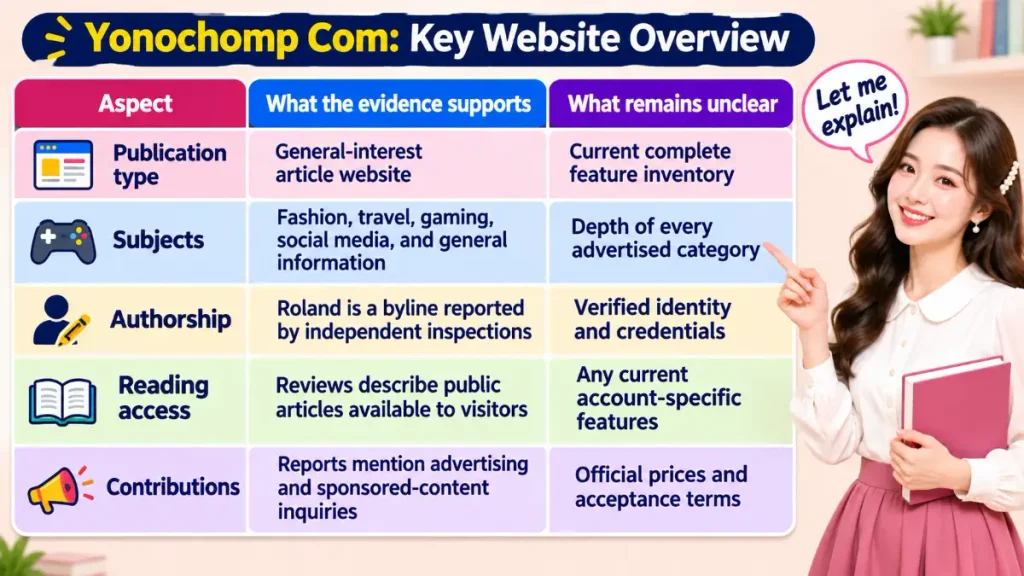
The table reflects attributed reporting rather than a certification of the website’s present operations. Its strongest conclusion is the publishing model; the more detailed questions require their own evidence.
What Does the Website Actually Publish?
Independent descriptions identify a broad category menu. Reported labels include fashion, travel, online gaming, social media, business, technology, finance, education, and health. A long menu can help visitors navigate, but a category label is not evidence of a large or regularly updated archive.
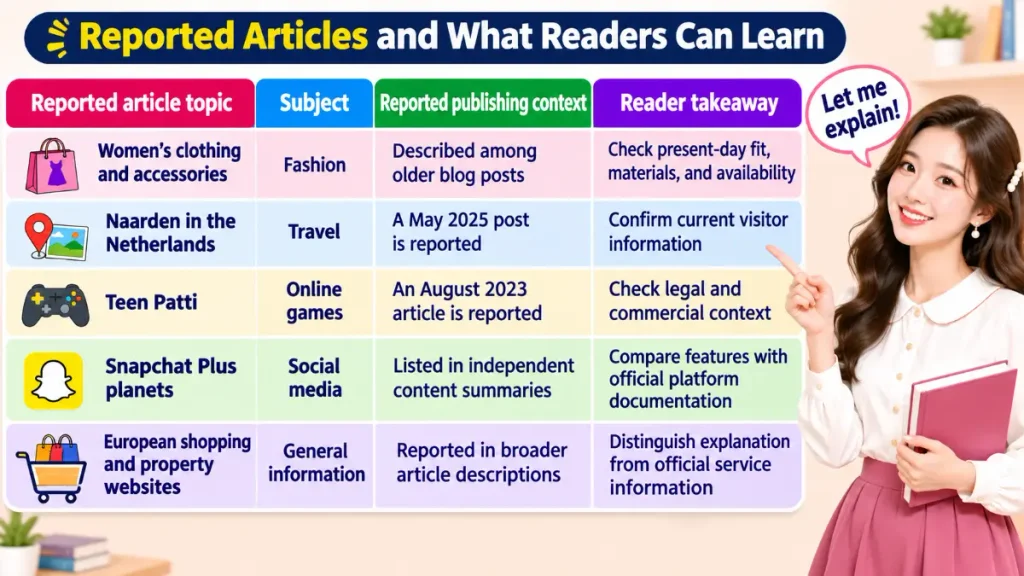
Several reviews describe specific subjects from older posts. Because those descriptions do not establish a fresh inspection of every original article, the examples below are intentionally labeled as reported topics rather than independently verified exact titles.
Fashion and Everyday Products
Clothing and accessory articles can introduce styles, terminology, and practical considerations. A reader comparing walking shoes, for example, may learn which factors deserve attention: comfort, sizing, materials, and intended use. That is different from independently tested product advice.
If an article names a particular product, its price or availability may have changed since publication. The strongest shopping guidance would identify specific models, describe testing or comparison methods, and make commercial relationships visible. Without those details, treat recommendations as ideas to investigate rather than definitive buying instructions.
Travel and Destination Coverage
The reported Naarden article suggests that the website sometimes moves beyond general consumer subjects into destination information. A travel introduction can help readers recognize a place and decide whether to research it further.
Practical travel decisions demand fresher evidence. Museum hours, transportation, entry prices, seasonal access, and local rules are controlled by relevant providers or authorities. An older destination article can remain enjoyable while becoming less useful as a planning checklist.
Games, Social Media, and Other Websites
A reported Teen Patti article requires a different reading approach from a fashion overview. Card games can involve real-money services, advertising, regional restrictions, and age requirements. Coverage of a game does not establish that Yonochomp operates the game or endorses every linked provider.
Similarly, an article explaining Snapchat Plus planets is not official platform documentation. Subscription features and interface details may change. When a feature matters to a purchase or account decision, the original service’s current documentation should carry more weight.
What the Publishing Timeline Really Shows
Third-party inspections describe articles from July and August 2023, followed by a travel post in May 2025. Some also report informational-page activity in 2026. These are useful clues about the site’s publishing history, but they are not a complete live archive audit.
Article publication dates and policy-page dates answer different questions. A new privacy notice may show administrative maintenance without demonstrating that new editorial articles have appeared. Conversely, a gap between visible posts does not prove that the site has closed or will never publish again.
Readers should check the date printed on the specific article they intend to use. A fashion trend overview may age differently from an explanation of a subscription feature or an online service. An update label is most meaningful when the substance of the article has actually been revised.
A reported domain-registration date is another separate milestone. Registration can precede publication, and a long registration term does not establish readership, editorial quality, or honest business conduct. These dates should never be collapsed into a single claim about how long the publication has actively operated.
Who Writes and Operates the Website?
Several independent reviewers report a public byline named Roland. That tells readers which display name appears on the material those reviewers examined. It does not establish the writer’s full legal identity, qualifications, or relationship to the domain’s owner.
A useful author profile would explain relevant experience, provide a consistent publication history, and identify areas of expertise. A publication covering unrelated topics may use generalist writers, contributors, editors, or commercial partners. None of those arrangements should be assumed without documentation.
The legal operator is also not independently established by the available evidence. A domain registrar, hosting company, or privacy-protection service is not necessarily the publisher. Likewise, an About page describing a mission is not a substitute for a verifiable business identity.
Readers looking for accountability can examine the Contact, About, Disclaimer, and editorial pages, when available. Useful details include the responsible organization, a functioning contact route, a corrections procedure, and clear sponsorship policies. The absence of independent verification is a reason for measured confidence, not proof of misconduct.
Yonochomp.com and Similar Domain Names
The exact address matters. Yonochomp.com, Yonochomp.org, and Yonochomps.com are different domain names. Similar spelling does not establish shared ownership, a formal relationship, or an attempt to deceive visitors.
A review of one domain should not borrow the author biography, privacy policy, guest-post prices, or safety reputation of another. Even two websites using the same publishing theme can be operated independently.
When following a search result, inspect the address before using contact details or entering information. If a source makes an affiliation claim, look for a clear statement from the relevant operators rather than relying on visual similarity.
This caution also applies to similarly styled articles across unrelated websites. Repeated wording or overlapping subject categories may suggest a common publishing approach, but neither alone proves a common legal owner.
How Reliable Are the Articles?
The right standard depends on the claim. A light article about accessories may be useful for inspiration even without extensive citations. Advice about a financial service, account security, health treatment, or a paid gaming provider requires stronger evidence.
Check Whether Sources Support the Claims
A source is valuable when it directly supports the statement beside it. Official documentation is often the most reliable starting point for verifying platform features. Product specifications should be checked against manufacturer information, while travel restrictions require confirmation from the relevant authorities or service operators.
General references are less useful when they do not substantiate specific numbers, dates, or guarantees. A post may contain several links while still leaving its central claim unsupported. The number of references is not a substitute for their quality.
Look for Expertise and Disclosure
A byline helps identify attribution, but expertise must be established separately. The relevant qualifications for fashion commentary differ from those needed for health or financial advice. Readers should not assume that a writer is a specialist in every subject a broad blog covers.
Commercial links also deserve context. A link to a retailer or service does not automatically mean the article is sponsored. At the same time, where payment or affiliate incentives exist, clear disclosure helps readers interpret the recommendation.
Consider Currency and Specificity
An older article can remain useful for stable background concepts. It becomes less dependable when it makes claims about live pricing, application features, legal eligibility, or current availability. Look for dated examples, explicit assumptions, and an explanation of how the writer reached a conclusion.
The most productive way to use Yonochomp is therefore article by article, rather than assigning one blanket reliability score to every topic.
Reading Safety and Content Accuracy Are Different
A site can deliver an article through an encrypted connection and still publish an inaccurate statement. HTTPS helps protect data in transit; it does not verify an author’s credentials, guarantee that an external link is trustworthy, or audit the quality of advice.
Likewise, an old domain or a favorable third-party review is not a technical security certification. The available research does not establish a comprehensive current malware assessment or independent privacy audit of Yonochomp.
For ordinary reading, users can apply proportionate caution. Check where links lead, avoid unnecessary downloads, and verify the identity of any service requesting payment or personal information. Extra care is warranted for real-money gaming, account signups, and financial products.
These steps are not evidence that Yonochomp itself is malicious. They are ways to avoid confusing a general article with the separate company or service it discusses.
Guest Posts, Sponsored Articles, and Publishing Terms
Some published reviews report that Yonochomp’s contact material has welcomed advertising or sponsored-content inquiries. This supports the possibility of commercial publishing discussions, but it does not establish an open self-service publishing platform or guaranteed acceptance of submissions.
An invitation to inquire is different from a formal contributor agreement. A prospective writer needs to know whether original articles are reviewed, which topics are appropriate, who edits the final copy, and what happens if corrections are required.
Commercial partners should also clarify whether the placement is identified as sponsored, how outbound links are treated, whether an article can later be changed or removed, and whether payment is refundable under any circumstances.
Are Marketplace Prices Official?
Third-party marketplaces may list placements on the domain. Such listings are offers from the parties displaying them, not automatically the publisher’s own price schedule. Without direct confirmation, a quoted amount should not be described as an official fee.
A sensible inquiry asks for written terms identifying the responsible party, total price, editorial review process, publication conditions, and disclosure requirements. Avoid assuming a guaranteed publication date, permanent placement, or particular search result from a marketplace advertisement.
Paid links intended to manipulate search rankings can also raise compliance concerns. Google’s spam policies describe link-spam practices, and its guidance on qualifying outbound links explains how commercial links should be marked.
How Useful Is the Content for US Readers?
A US reader may find introductory value in fashion articles, social-media explanations, travel overviews, and descriptions of unfamiliar websites. These subjects can be interesting even when their examples originate elsewhere.
Regional differences matter when an article moves from general explanation to practical advice. A European shopping website may have different shipping rules and consumer protections. A destination guide may quote local prices or transportation options. A gaming service may be subject to jurisdiction-specific restrictions.
Rather than dismissing international content, readers should identify which parts transfer. A description of a clothing style may be broadly useful; a claim about availability or returns needs a current local check. General game rules can be informative, while legal eligibility and payment terms require jurisdiction-specific confirmation.
This distinction makes a broad publication more useful without asking it to serve as an authority on every country or industry.
Overall Assessment
Yonochomp.com is most reasonably described as a small general-interest article publication with reported coverage of fashion, travel, online gaming, social media, and other topics. Its archive history and public byline have been discussed by multiple independent reviewers, but current legal ownership, specialist credentials, and official publishing prices remain unconfirmed.
For casual discovery, its articles may offer useful starting points. For purchases, financial decisions, gaming services, or commercial placements, verify the underlying facts with the responsible provider and obtain clear terms. Neither a blanket endorsement nor an unsupported fraud allegation is warranted by the available evidence.
Frequently Asked Questions
Is this a blog, an app, or a gaming service?
It is primarily described as a general-interest blog publishing informational articles. Writing about games or applications does not mean it operates those services.
Do readers need an account to view articles?
Independent reviews describe publicly readable posts without a required reader account. Current access conditions should be checked on the exact domain.
Who is responsible for the published content?
A displayed author name, Roland, has been reported in website inspections. The responsible legal operator and the writer’s professional qualifications are not independently established.
How can I tell whether an article is current?
Check its displayed publication and update dates, then compare time-sensitive details with official sources. A recently changed policy page does not make an older article current.
Does the similarly named .org address belong to the same publisher?
Common ownership has not been verified. Treat the .org and .com addresses as separate sources unless their operators establish a relationship.
Can contributors submit sponsored articles?
Third-party reports describe invitations for advertising and sponsored-content inquiries. Acceptance rules, editorial review, and current commercial terms require confirmation from the responsible publisher.
Are marketplace publishing fees official?
Not necessarily; a reseller’s listing is not automatically an official publisher price. Request written confirmation of the fee, deliverables, and responsible party before paying.
What should I check before trusting a product recommendation?
Look for current specifications, relevant testing, credible sources, and clear commercial disclosures. Confirm prices and availability with the actual seller or manufacturer.

Sophia Bennett writes educational content about English vocabulary, grammar, slang, and communication. She is passionate about making complex language topics accessible to students, professionals, and curious readers around the world.



2 Comments