
Plusstories Com Review: Content, Features, and Trust
Plusstories com is a multi-topic online publication featuring English informational articles and Hindi storytelling. Its reported pages cover business, finance, education, health, technology, and travel, while individual posts also address literature, personal finance, and practical calculations. Despite the name, the available evidence does not establish a self-service platform where visitors can create accounts and immediately publish their own stories.
This review examines the publication’s content, authorship, external calculator links, contact options, and privacy practices. It helps readers understand the website’s features, evaluate its credibility, and distinguish verified information from claims that have not been independently confirmed.
Related Post: pressvibepulse com
What Is Plusstories Com?
PlusStories is best described as an article-based general-interest website. Readers encounter category navigation, individual posts, author attribution, and a mixture of practical explanations and narrative writing. The publication’s name suggests stories, but its editorial range extends beyond storytelling.
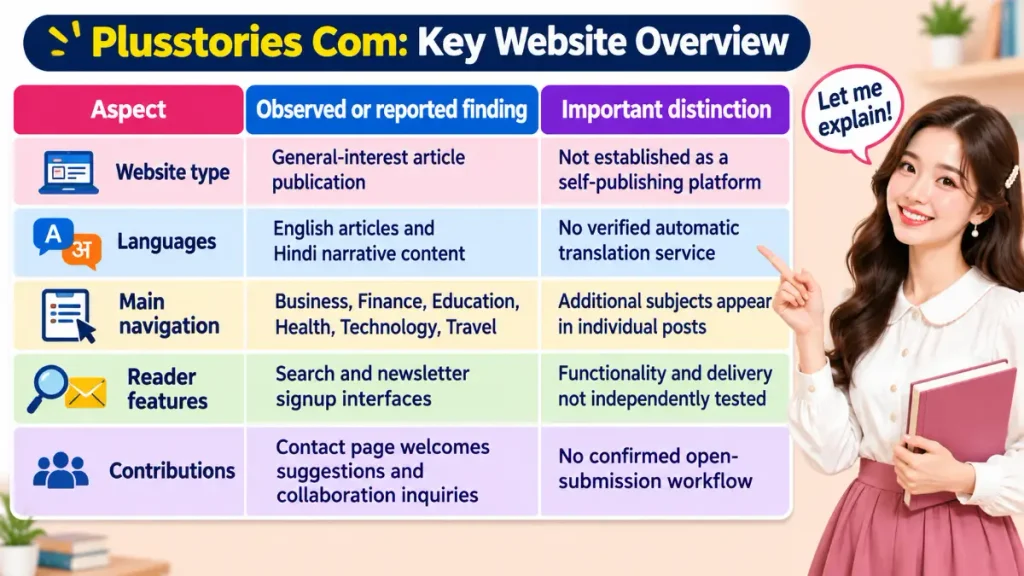
The reported homepage presents a search field and a newsletter signup interface. These are recognizable features of a publishing website, although seeing a control does not establish that search works as expected or that a newsletter follows any particular schedule. Similarly, a contact invitation does not automatically mean visitors have a personal publishing dashboard.
What the Category Menu Reveals and Leaves Out
Six prominent navigation categories provide a quick orientation: Business, Finance, Education, Health, Technology, and Travel. These labels indicate how the publisher organizes major subjects, not how many articles each category contains or how frequently it is updated.
A broader picture emerges from sampled pages. A school-literature explanation belongs naturally in education, while a Hindi road-trip narrative emphasizes storytelling and cultural setting. An investing guide concerns personal finance, and an article on blockchain credentials brings together technology and education. Practical calculator instructions are another recognizable format.
Breadth is not the same as subject expertise. An article about investing should be evaluated differently from a literary summary or fictional narrative.
A menu label alone cannot establish whether a category has a deep archive, qualified contributors, or current information. Readers seeking a particular subject should open its actual article list, inspect dates, and look for supporting references where factual claims matter.
Hindi Stories, English Guides, and Regional Context
One distinguishing feature is the presence of both English and Hindi content. The inspected research examples include an English explanation of a school text and a Hindi road-trip narrative. This is more specific evidence than a general claim that the website serves a multilingual audience.
The two formats also serve different purposes. A school-literature article may help a student understand a plot, theme, or classroom question. A road-trip narrative can offer entertainment, atmosphere, and cultural detail without claiming to be a verified account of an actual journey.
For US readers, regional context deserves attention. The literature example concerns CBSE Class 9, an Indian school curriculum. Its explanation may still be useful to anyone studying the text, but its classroom framing is not necessarily aligned with a US course. Financial terminology, educational requirements, and local examples can likewise differ across countries.
Content language and regional references do not establish the publisher’s nationality, headquarters, or audience demographics. Those are separate facts requiring separate evidence.
Five Articles That Show What Readers Actually Get
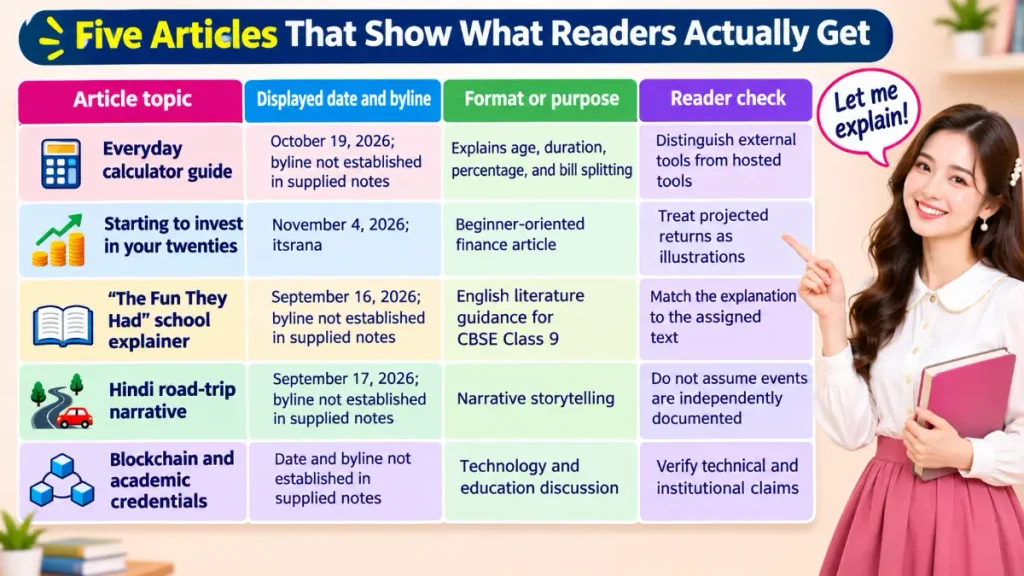
A sample of five articles illustrates the publication’s mixture of educational guidance, financial discussion, technology explanation, and storytelling. The dates and attribution below come from the supplied November 7 research notes; any details not recorded there remain unconfirmed.
Practical Guides Versus Hosted Services
The calculator guide explains common everyday calculations and directs readers to calculators on another website. That is useful as an instructional resource, but it is not evidence that PlusStories itself provides interactive calculation software. The distinction matters when readers want to enter information, evaluate accuracy, or understand where their data goes.
The investing article provides another example of a boundary worth respecting. It includes an illustrative treatment of returns and points readers toward a compound-interest calculator hosted on Brasssmile. A link to another website does not establish shared ownership, a paid arrangement, or a formal partnership.
Education, Narrative, and Technology
The school-literature explainer is tied to a specific curriculum and text. Readers can use such a page to frame their understanding, but should still consult the original work and their teacher’s requirements. The Hindi road-trip narrative demonstrates that storytelling is genuinely part of the site’s content mix, rather than merely a branding promise.
The blockchain credentials article broadens the sample into technical material. Claims about credential verification, security, or institutional adoption warrant careful checking against primary technical documentation and the practices of the institutions involved.
Taken together, these examples establish variety. They do not prove that all articles receive expert review, contain equally strong citations, or meet the same standard of freshness.
Does the Website Offer Calculators or Link to Them?
The October 19 guide discusses age, date-duration, percentage, and bill-splitting calculations. Its reported calculator links lead to WE Post Today, an external destination. This supports a narrower description than saying the reviewed website operates those tools itself.
Three different experiences should be kept separate: reading instructions about a calculation, following a link to another website’s calculator, and using a working calculator directly on the current domain. The first is clearly supported by the article example. The second is supported by the reported outbound links. The third has not been established by the supplied observations.
No calculator outputs were independently tested as part of the research baseline. Accordingly, it would be inaccurate to promise correct answers, secure processing, or specific functionality. Readers using any linked tool should inspect the destination, identify the operator, and test a harmless example before relying on an important result.
Can Readers Publish Their Own Stories?
The name PlusStories may lead some visitors to expect a community where anyone can register, upload writing, and build a public author profile. The reviewed material does not establish that kind of self-service publishing system.
Its Contact Us page reportedly welcomes feedback, topic suggestions, advertising proposals, and collaboration inquiries. Those invitations create a way to express interest. They do not, by themselves, confirm that unsolicited articles are accepted or that every proposal receives a response.
A useful distinction is between suggesting a topic, offering an editorial contribution, proposing a commercial collaboration, and uploading an article through an account. Each involves different permissions and expectations. The supplied research does not establish a public writer dashboard, a formal submission form, a fixed editorial process, or guaranteed publication.
Potential contributors should ask who reviews submissions, whether original work is required, what rights the publisher requests, and whether any fees or payments apply. They should also confirm how promotional material is labeled and whether accepted articles can later be corrected or removed.
Until written terms are provided, contribution opportunities should be treated as inquiries rather than confirmed publishing arrangements.
Who Writes the Articles, and Who Is Accountable?
The investing article displays the byline itsrana, and a separate author archive groups articles under Shivi Hyde. These are useful attribution signals: they help readers locate other posts associated with a displayed name.
However, a byline is not the same as a verified professional identity. An author archive is also different from a substantive biography that explains relevant training, employment, subject expertise, and editorial responsibilities. The available observations do not independently establish those qualifications or identify the legal operator of the website.
This distinction matters most for consequential advice. A personal-finance writer may offer accessible explanations without being a licensed adviser. Similarly, an author discussing health topics should not be assumed to hold clinical credentials merely because their name appears beside an article.
For stronger transparency, readers would benefit from clear author biographies, editorial standards, correction procedures, and an identifiable responsible publisher. These features can help assess accountability, although their presence alone would still not prove that every statement is accurate.
How to Judge Reliability and Privacy
Reliability is best evaluated article by article, with the level of scrutiny matched to the stakes. A cultural narrative can be enjoyed for its storytelling. A classroom explanation should accurately represent its assigned text. Financial or health information requires closer attention to sources, assumptions, qualifications, and current guidance.
Consider whether the article identifies where its important facts come from. References are useful only when they support the specific claims beside them. A link to a calculator or another publisher is not automatically evidence for an unrelated assertion.
Publication dates also matter. Investment products, consumer rules, educational requirements, and technical capabilities can change. A useful introductory article may become unreliable for a current decision if its underlying details have shifted.
The reported Privacy Policy describes possible voluntary submissions, technical usage information, cookies, analytics, third-party advertising, and external links. These are statements made by the publisher, not findings from an independent privacy or security audit. Conditional language such as “may” should not be rewritten as proof that every described technology is active.
Readers should also distinguish several kinds of trust. A website can be reachable without being editorially authoritative. A displayed byline can improve attribution without proving credentials. A privacy statement can describe intended practices without independently confirming implementation.
For everyday browsing, these distinctions may simply guide sensible caution. For sensitive financial, health, or personal information, readers should verify the destination and operator before sharing details. Important decisions deserve confirmation from qualified professionals or current primary sources.
Publication Dates and Homepage Labels Need Context
Labels such as “Latest,” “Recent,” and “Most Discussed” can help visitors browse, but they should not be treated as independently verified measures of freshness or popularity. A homepage label does not disclose the selection method, engagement counts, or editorial criteria behind it.
The sampled articles display dates spanning September to November 2026. That shows dated content across multiple subjects, not that every category is updated at the same pace. A date appearing in a website header is likewise different from an individual article’s publication or revision date.
When information could change quickly, readers should check the specific article date and compare key details with newer primary documentation. Historical material may remain useful for background even when it is not suitable for current decisions.
Who Will Find This Publication Useful?
PlusStories may appeal to casual readers who enjoy moving between practical explanations and narrative content. Its English and Hindi examples offer different reading experiences, while the category menu provides a starting point for discovering unfamiliar subjects.
Students may find introductory explanations helpful, particularly when they match an assigned curriculum. People interested in regional storytelling may appreciate the Hindi narrative format. Readers researching calculators can learn what a tool is meant to do, although the actual tool may be hosted elsewhere.
The publication is a less certain fit for someone seeking specialist financial advice, independently tested software, or an instant self-publishing account. Prospective contributors can explore the contact route but should verify terms before submitting original work or agreeing to a commercial arrangement.
Overall Assessment
PlusStories.com is a bilingual, general-interest website that publishes informative articles and Hindi stories. Its content covers education, finance, technology, practical guides, and everyday topics. The website also provides author information and contact options, although details about professional expertise, ownership, and publishing opportunities remain unclear.
Readers may find PlusStories com useful for general knowledge, educational explanations, and storytelling. However, important information should be verified through reliable sources. Writers interested in contributing should confirm submission guidelines, editorial policies, and commercial terms before proceeding.
Frequently Asked Questions
Is this mainly a story website or a general-interest blog?
PlusStories is primarily a general-interest blog covering finance, education, technology, and lifestyle topics. It also publishes Hindi stories and narratives.
Are articles available in both English and Hindi?
Yes, the website publishes English articles and Hindi stories. However, automatic translation and bilingual availability for every topic are not confirmed.
Can anyone register and publish a story?
A public registration or self-publishing system has not been verified. Interested writers can inquire about contributions through the website’s contact page.
Are the featured calculators hosted on the same website?
The reviewed calculator guide links to tools hosted on another website. There is no confirmed evidence that PlusStories operates those calculators directly.
Do author pages establish professional expertise?
No, author pages show publishing attribution but do not automatically verify professional qualifications. Readers should independently check credentials when evaluating specialized advice.
What should contributors confirm before submitting work?
Writers should verify submission guidelines, editorial requirements, fees, and publication rights. They should also confirm acceptance terms before sending unpublished content.
How should readers assess financial and health information?
Check publication dates, author qualifications, and supporting sources. Verify important claims through authoritative references or qualified professionals before making decisions.

Sophia Bennett writes educational content about English vocabulary, grammar, slang, and communication. She is passionate about making complex language topics accessible to students, professionals, and curious readers around the world.



2 Comments