Anise vs Aniseed: What’s the Difference?
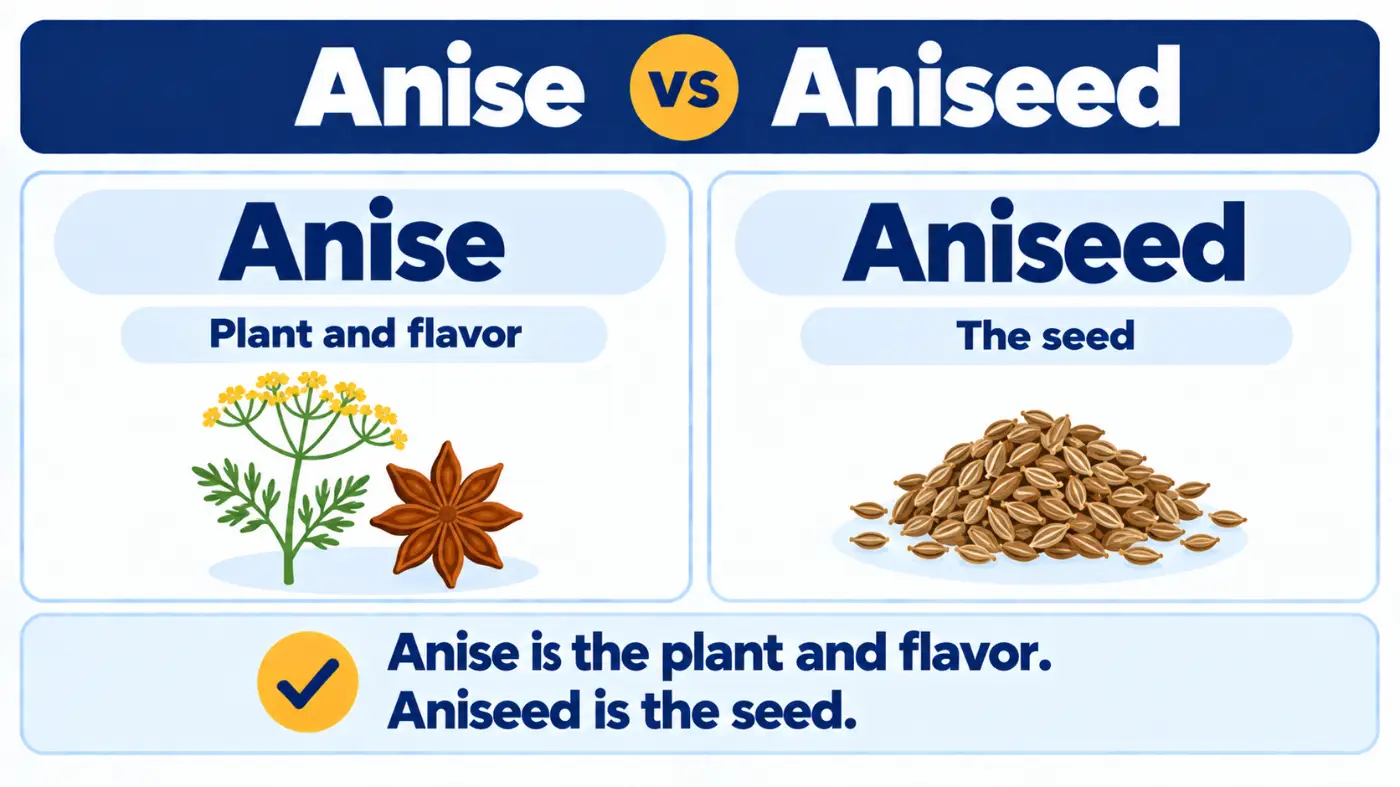
Anise refers to the plant itself and its distinctive licorice-like flavor, while aniseed refers specifically to the seed of that plant. They’re closely related, but anise is the broader term, and aniseed names one particular part of it.
The Short Answer at a Glance
| Form | What it names | Typical use | Example |
|---|---|---|---|
| anise | The plant, its flavor, or the seed informally | Flavoring, essential oil, general cooking references | The cookies had a subtle anise flavor. |
| aniseed | Specifically the dried seed of the anise plant | Baking, spice blends, precise culinary or botanical writing | She toasted the aniseed before grinding it. |
Anise is the umbrella term for the plant and its flavor. Aniseed narrows that down to the actual seed, which is the part most often used in cooking.
What Anise Means and How It Works
Anise is a noun that refers to a flowering plant native to the eastern Mediterranean and parts of Asia, prized for its sweet, licorice-like flavor and aroma. The word also describes that flavor itself, independent of any specific plant part, as in “an anise-flavored liqueur.”
In everyday cooking language, anise often gets used loosely to mean the seeds, even though the word technically refers to the whole plant or its characteristic taste. This looseness is extremely common and generally understood, since most home cooks encounter anise primarily through its seeds or through extracts and flavorings derived from it.
Grammatically, anise functions as a standard countable or uncountable noun depending on context. You can refer to “anise” as a general flavor or plant (uncountable, like “sugar” or “flour”), or occasionally to “an anise plant” as a specific individual plant (countable). It also works as a modifier in compound terms: anise extract, anise oil, anise flavor, anise liqueur.
Anise shows up across a wide range of dishes and drinks, from Mediterranean cookies and Italian biscotti to French pastis and Middle Eastern arak. Its flavor compound, anethole, is the same one found in fennel and star anise, which is part of why these three ingredients often get mentioned together despite being botanically distinct from one another.
What Aniseed Means and How It Works
Aniseed is a noun that refers specifically to the small, dried seeds of the anise plant. It’s the harvested, usable part of the plant that shows up in spice jars, baking recipes, and traditional remedies.
The word is essentially a compound of “anise” and “seed,” and it functions as a more precise, technical term than anise alone when the actual seed is what’s being discussed. Where anise can refer to the plant, the flavor, or loosely to the seeds, aniseed points directly and only at the seeds themselves.
Grammatically, aniseed usually functions as an uncountable noun, similar to how you’d talk about “cumin” or “coriander” as a spice. You’d more commonly say “a teaspoon of aniseed” than “three aniseeds,” though the plural form does exist in botanical or more formal writing when referring to individual seeds.
Aniseed is especially common in British English and in more traditional or formal culinary writing, where precision about plant parts matters more. American recipes often use “anise seed” as two words, or simply “anise,” to describe the same ingredient, which adds another layer to this word pair’s regional texture.
Anise vs Aniseed: Key Differences Side by Side
| Feature | Anise | Aniseed |
|---|---|---|
| Part of speech | Noun (plant, flavor, or loosely the seed) | Noun (specifically the seed) |
| Core meaning | The plant itself or its characteristic flavor | The dried seed of the anise plant |
| Typical use | General flavor references, extracts, liqueurs | Baking, spice blends, precise recipes |
| Register | Common in both US and UK English | More common in British and formal culinary English |
| Example | The tea had a faint anise aroma. | The recipe calls for a pinch of crushed aniseed. |
What the table can’t fully capture is how much overlap exists in everyday use. Most people saying “anise” in a recipe context actually mean the seeds, and few home cooks stop to distinguish the plant from its flavor from its seed. The distinction matters most in botanical writing, precise recipes, or when a text specifically discusses different parts of the plant.
Correct Examples in Real-Life Contexts
Everyday speech
- This licorice candy has way too much anise in it for my taste.
- My grandmother always added a little anise to her holiday cookies.
- I can’t quite place that flavor. Is it anise or fennel?
- The bakery down the street makes an incredible anise-flavored bread.
Workplace writing (food and hospitality)
- Our new dessert menu features a panna cotta infused with anise.
- Please confirm whether the supplier’s anise extract is alcohol-based.
- The tasting notes describe a subtle anise finish on the palate.
- We’re testing a cocktail that pairs gin with a touch of anise liqueur.
Texting
- do you like anise flavor or does it taste too much like black licorice to you
- found a recipe that uses aniseed instead of regular anise extract, wanna try it
School and academic
- The botany lecture covered how anise differs from star anise despite the similar name.
- Her research paper examines traditional uses of aniseed in folk medicine.
- Students compared the essential oil composition of anise and fennel in the lab.
- The culinary history course traced how anise became popular across Mediterranean cuisines.
Formal writing
- The product label lists anise extract among the natural flavoring ingredients.
- Aniseed has long been used in traditional herbal preparations across several cultures.
- The imported spice blend contains cumin, coriander, and aniseed in equal parts.
- Regulatory guidelines classify anise oil as generally recognized as safe for food use.
Common Mistakes People Make (and How to Catch Them)
Treating anise and aniseed as unrelated words
Wrong assumption: Anise and aniseed are two different spices with different flavors. Right understanding: Aniseed is simply the seed of the anise plant, and both share the same core flavor.
This isn’t a spelling error, but a meaning mix-up. Some writers assume the two words name entirely separate ingredients, when aniseed is really just a more specific term for one part of the anise plant.
Confusing anise with star anise
Wrong assumption: Anise and star anise are the same plant. Right understanding: They’re different plants that happen to share a similar licorice-like flavor because both contain the compound anethole.
This confusion is extremely common because the names sound related and the flavors are similar, but anise and star anise come from botanically unrelated plants.
Using “aniseed” and “anise seed” inconsistently
Wrong: The recipe lists both aniseed and anise seed in different sections, treating them as separate ingredients. Right: Aniseed and anise seed refer to the exact same thing, just written as one word or two.
Writers sometimes accidentally treat these as different ingredients when editing a recipe, simply because the spelling looks different in different spots.
Overgeneralizing anise to mean any licorice-flavored ingredient
Wrong: All licorice-flavored candies contain anise. Right: Many licorice-flavored products use anise, but some use fennel, star anise, or actual licorice root instead.
Because several different plants share a similar flavor profile, it’s easy to assume anise is present whenever that taste shows up, even when a different ingredient is actually responsible.
A Fast Trick to Choose the Right One
Ask whether you’re talking about the plant and its flavor in general, or specifically about the seed. If you mean the broader idea, anise covers it. If you mean the actual seed sitting in your spice jar, aniseed is the more precise word.
A simple test: try adding the word “seed” after anise in your sentence. If the sentence is really about the seed specifically, as in “anise seed cookies,” you can just as easily say “aniseed cookies,” and the meaning stays exactly the same. If the sentence is about flavor or the plant broadly, like “anise flavoring,” adding “seed” wouldn’t quite fit the same way.
This trick works well for most everyday writing, but it has a limit: in very casual cooking contexts, plenty of people use anise and aniseed interchangeably without anyone batting an eye, so precision matters more in formal or botanical writing than in a quick recipe note.
How They Sound in Real Situations
A text exchange
Priya: What gives this bread its flavor? It’s amazing.
Marco: Aniseed! My grandma always adds a spoonful to the dough.
Priya: I need this recipe immediately.
Aniseed is correct here because Marco is specifically referring to the actual seeds used in the dough.
A workplace email
Subject: New dessert flavor profile
Hi Chef,
I tasted the updated shortbread recipe, and the anise flavor really comes through nicely without being overpowering. Should we still list aniseed as a specific allergen note, or just anise in general on the menu?
Thanks, Elena
Both words appear correctly here: anise describes the general flavor, while aniseed refers to the specific ingredient for labeling purposes.
An article-style excerpt
Traditional Mediterranean baking often relies on anise for its warm, sweet aroma, with many recipes calling specifically for whole aniseed rather than extract. Toasting the seeds briefly before grinding brings out a deeper, more complex flavor.
Both terms work naturally together here, with anise describing the flavor tradition and aniseed specifying the exact ingredient used.
Formal Writing vs Casual Writing
Both anise and aniseed are acceptable across formal and casual writing, so this isn’t a right-versus-wrong issue tied to register. What shifts is precision. In casual conversation and everyday recipes, anise often gets used loosely to cover the seed, the flavor, and the plant all at once, and nobody minds.
In more formal culinary writing, botanical descriptions, or ingredient labeling, aniseed tends to appear when the seed specifically is the subject, since precision matters more in those contexts. A cookbook aimed at professional bakers might consistently use aniseed, while a casual food blog might use anise throughout without any loss of clarity for most readers.
Neither AP nor Chicago style offers specific guidance distinguishing these two words, since the choice is more a matter of culinary precision than a formal grammar or style rule.
US vs UK English Differences
There’s a real regional pattern here, though it’s more about tendency than strict rule. Aniseed is more commonly used in British English, appearing frequently in UK cookbooks, candy names, and everyday speech, such as the classic British sweet called aniseed balls.
American English more often uses “anise” or the two-word “anise seed” instead of the single compound “aniseed,” though aniseed does still appear in American writing, particularly in more formal or botanical contexts. Neither usage is incorrect in either country; it’s simply a difference in which term shows up more often.
Related Mix-Ups People Also Search For
Anise vs Star Anise
Anise and star anise share a similar licorice-like flavor because both contain the compound anethole, but they come from entirely different, unrelated plants. Example: The recipe calls for star anise in the broth, not regular anise, so double-check your spice cabinet before starting.
Anise vs Fennel
Fennel is another plant that shares anise’s licorice-like flavor and the same underlying flavor compound, but it’s a distinct plant often used for its bulb as a vegetable in addition to its seeds. Example: If you’re out of aniseed, fennel seed makes a reasonable substitute in most recipes.
Aniseed vs Licorice Root
Licorice root is yet another separate plant that produces a similar flavor, often used in candy and herbal remedies, but it isn’t related to anise botanically. Example: Old-fashioned licorice candy sometimes uses actual licorice root, while other brands rely on anise or aniseed for the same flavor effect.
Quick Practice: Test Yourself
Choose the term that best fits each context.
- The British candy shop sells traditional ______ balls near the register. (anise / aniseed)
- The tea has a light, sweet ______ aroma that’s hard to place at first. (anise / aniseed)
- Grind a tablespoon of ______ before adding it to the cookie dough. (anise / aniseed)
- The liqueur gets its distinctive flavor from ______ extract. (anise / aniseed)
- The spice jar in the British recipe was simply labeled ______. (anise / aniseed)
- Her thesis compares the essential oil content of ______ and star anise. (anise / aniseed)
Answer Key
- aniseed: this British candy is traditionally named using the British-preferred term.
- anise: describing a general aroma or flavor calls for the broader word.
- aniseed: this sentence specifically refers to grinding the actual seeds.
- anise: extracts are typically described using the broader term for the flavor.
- aniseed: matches the more common British labeling convention.
- anise: comparing the plant itself to star anise calls for the broader term.
Frequently Asked Questions
Is aniseed just another word for anise?
Not exactly. Aniseed specifically refers to the seed of the anise plant, while anise can refer to the plant, its flavor, or, more loosely, the seed itself.
Can I substitute aniseed for anise in a recipe?
In most everyday recipes, yes, since anise and aniseed usually refer to the same seed in practical cooking contexts. The distinction matters more in precise or formal writing than in typical home cooking.
Is aniseed British or American English?
Aniseed is more commonly used in British English, while American English more often uses “anise” or “anise seed” as two words, though both terms appear in each region.
Does anise taste the same as star anise?
They taste similar because both contain the same flavor compound, anethole, but anise and star anise come from completely different, unrelated plants.
Is anise the same as licorice?
No. Anise is a plant that produces a licorice-like flavor, but true licorice flavor typically comes from licorice root, a separate plant entirely.
Why do some recipes say “anise seed” instead of “aniseed”?
This is largely a regional and stylistic choice. American recipes often write it as two words, “anise seed,” while British recipes more frequently use the single compound word, “aniseed.”

Sophia Bennett writes educational content about English vocabulary, grammar, slang, and communication. She is passionate about making complex language topics accessible to students, professionals, and curious readers around the world.