Possible vs Posible: Which Spelling Is Correct?
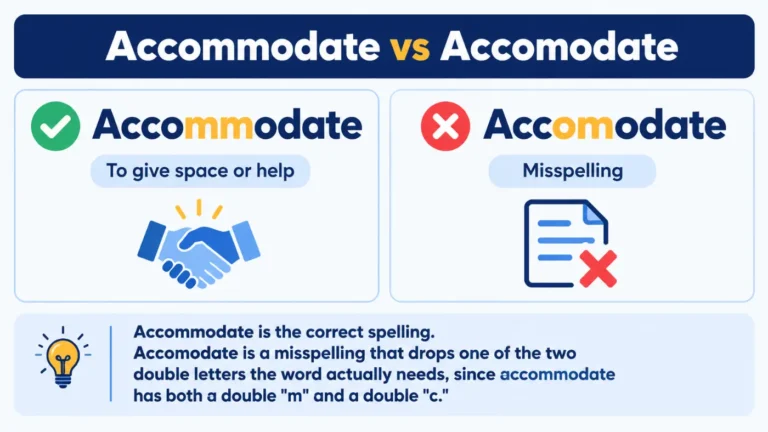
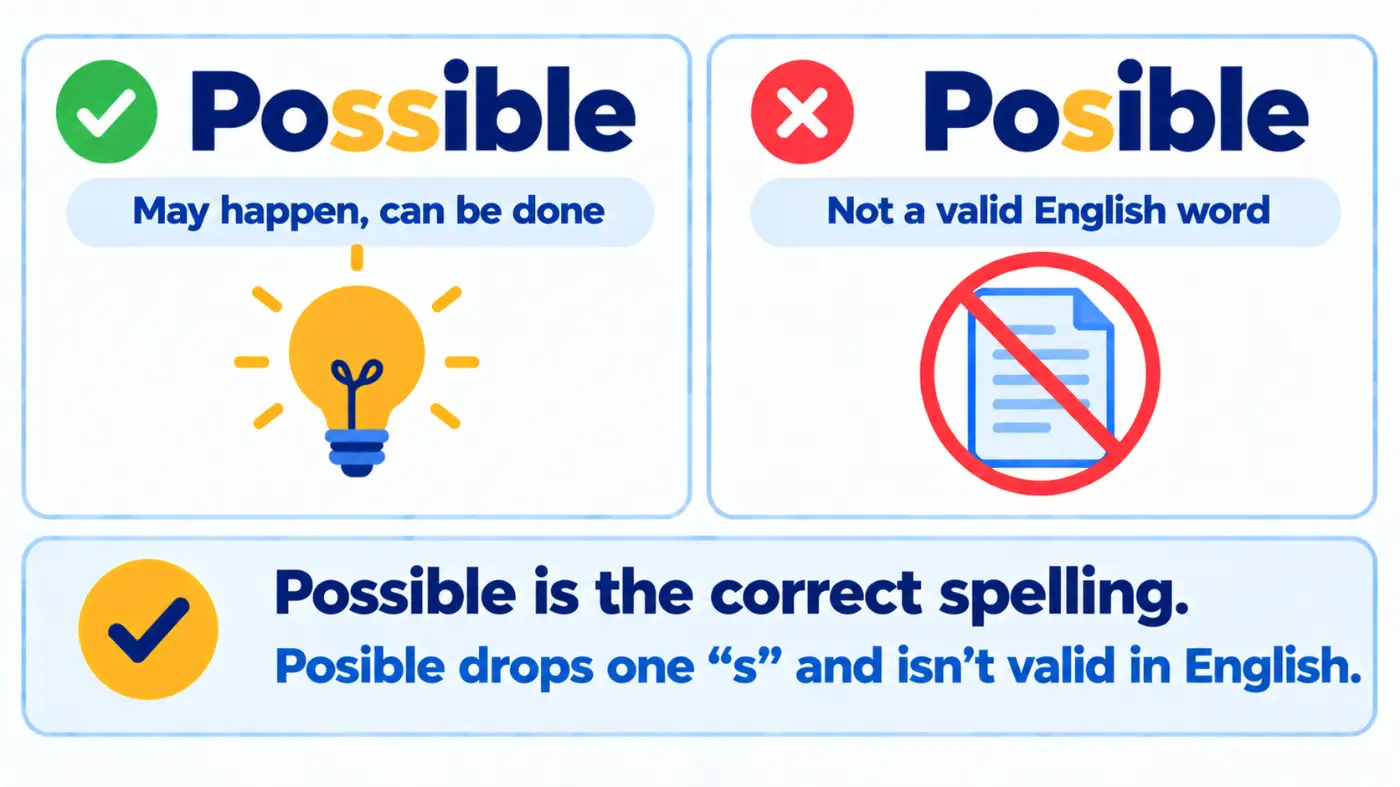
Possible is the correct spelling in English. Posible drops one of the two “s” letters the word needs, and while that single-s version happens to be the correct spelling in Spanish, it isn’t valid in English.
The Short Answer at a Glance
| Form | Status | What it does | Example |
|---|---|---|---|
| possible | Correct in English | Adjective describing something that can happen, exist, or be done | It’s still possible to catch the early train if we hurry. |
| posible | Not standard English | Correct spelling of the equivalent word in Spanish, but not an English word | Avoid it in English writing; use possible instead. |
Only one spelling is correct in English, and it uses a double “s.” The single-“s” version is a real, correctly spelled word, just in a different language.
What Possible Means and How It Works
Possible is an adjective describing something that can happen, exist, be done, or be true, given the right circumstances. It’s one of the most frequently used words in English, showing up in casual conversation, scientific writing, planning documents, and virtually every other kind of communication.
The word typically appears after a linking verb, as in “it’s possible,” or before a noun, as in “a possible solution.” It often pairs with infinitive phrases, like “possible to finish” or “possible to attend,” describing conditions under which something could occur.
Grammatically, possible doesn’t have a comparative or superlative form in typical usage. You wouldn’t usually say something is “more possible” or “most possible”; instead, English speakers rely on words like “likely,” “feasible,” or “probable” to express degrees of possibility. Possible tends to function as more of a yes-or-no descriptor: something either falls within the realm of possibility, or it doesn’t.
The related noun is possibility, referring to the state or fact of something being possible, or to a specific potential outcome, as in “there’s a possibility of rain” or “we need to consider every possibility.” The adverb possibly modifies verbs or entire statements to express uncertainty, as in “she might possibly join us later.”
Possible comes from a Latin root related to ability and capability, and English inherited its double “s” spelling from that source. That double consonant is exactly the detail that separates the correct English spelling from the single-“s” version.
Is “Posible” Ever Correct in English?
No, not in English. Posible isn’t listed in English dictionaries, and it isn’t a recognized variant, informal shortcut, or regional spelling within English. However, it’s worth noting that posible is the correctly spelled word for “possible” in Spanish, which adds an interesting wrinkle to why this particular misspelling shows up as often as it does.
For English writers, the mistake usually comes down to a simple missed doubled letter. English has many words that double a consonant for reasons rooted in Latin spelling patterns, and possible is one of them. Writers who aren’t attentive to double letters, or who are influenced by Spanish spelling in a bilingual household or workplace, sometimes drop the second “s” without realizing English requires it.
This cross-language overlap makes posible a slightly different kind of error than a completely random typo. It’s not a nonsense string of letters; it’s an entirely legitimate word, just one that belongs to a different language’s spelling system. That distinction matters for accuracy: posible isn’t “wrong” in an absolute sense, but it is wrong specifically as an English spelling of “possible.”
Because Spanish and English share so much vocabulary derived from Latin, this kind of near-miss spelling happens with several other word pairs as well, and it’s one of the more understandable and common mistakes bilingual or Spanish-influenced writers make in English.
Possible vs Posible: Key Differences Side by Side
| Feature | Possible | Posible |
|---|---|---|
| Recognized word in English | Yes | No |
| Recognized word in Spanish | No | Yes |
| Part of speech (English) | Adjective | Not applicable in English |
| Core meaning | Able to happen, exist, or be done | Same meaning, but only in Spanish |
| Typical use | All English writing and speech | Spanish writing and speech only |
| Register | Works in all English registers | Never correct in English, regardless of register |
| Example | It’s possible we’ll finish the project early. | It’s posible we’ll finish the project early. (wrong in English) |
The table draws a clear line between the two languages, but what it can’t fully capture is how naturally this mix-up can occur for writers who move between English and Spanish regularly, since the word looks and sounds so similar in both languages, differing by exactly one letter.
Correct Examples in Real-Life Contexts
Everyday speech
- Is it possible to reschedule our appointment for next week instead?
- I don’t think it’s possible to finish all of this by Friday.
- It’s entirely possible she just forgot to reply, don’t read too much into it.
- We should keep every possible option open before deciding.
Workplace writing
- Please let us know as soon as possible if you can attend the meeting.
- It’s possible the shipment will be delayed due to weather conditions.
- We’re exploring every possible solution to reduce production costs.
- The client asked whether a same-day turnaround was possible.
Texting
- is it possible to push our call to tomorrow instead
- honestly not sure it’s possible to finish this tonight lol
School and academic
- The professor asked students to list every possible interpretation of the poem.
- It’s possible that early climate shifts influenced migration patterns significantly.
- Researchers explored whether it was possible to replicate the original study’s results.
- The exam included a question about all possible outcomes of the experiment.
Formal writing
- The committee will explore every possible avenue before finalizing the policy.
- It is not possible to guarantee delivery times during peak holiday periods.
- The report outlines all possible risks associated with the proposed merger.
- Applicants should submit all required documents as soon as possible.
Common Mistakes People Make (and How to Catch Them)
Dropping the second “s” due to Spanish influence
Wrong: It’s not posible to finish this by tomorrow. Right: It’s not possible to finish this by tomorrow.
For bilingual writers or those working across English and Spanish, the correctly spelled Spanish word can bleed into English writing, especially in fast typing or informal messages.
Typing quickly and missing the doubled letter
Wrong: Let me know if that’s posible on your end. Right: Let me know if that’s possible on your end.
Even without Spanish influence, doubled letters are commonly dropped during fast typing, since the second “s” doesn’t add a distinct sound that reminds the writer to include it.
Relying on pronunciation alone
Wrong: It’s posible we’re overthinking this. Right: It’s possible we’re overthinking this.
Spoken English doesn’t clearly signal the doubled consonant, so writers spelling purely by ear can easily miss it.
Autocorrect not catching the error in bilingual settings
Wrong: A device set to a Spanish keyboard or dictionary doesn’t flag posible as incorrect. Right: Checking the language settings on your device before finalizing English text, especially if you switch between languages often.
Because posible is a legitimate word in Spanish, spellcheck tools calibrated for Spanish won’t flag it, which can let the error slip through in mixed-language environments.
A Fast Trick to Choose the Right One
Anchor possible to its close relative, possibility. Since possibility is a longer, more clearly double-“s” word that most people spell correctly without hesitation, recalling it can help lock in the correct doubled consonant in possible as well.
A second trick, especially useful for bilingual writers: remember that English almost always doubles consonants in words derived from this particular Latin root, while Spanish typically doesn’t. If you’re writing in English and typing a word that feels like it should have doubled letters based on similar English words, trust that instinct rather than defaulting to the single-letter Spanish spelling.
This trick works well for possible specifically, but it won’t cover every case where English and Spanish spellings diverge slightly, since each word pair has its own particular pattern.
How They Sound in Real Situations
A text exchange
Priya: Is it possible to meet earlier tomorrow instead?
Sam: Yeah, that should be possible. What time works?
Priya: How about 9 instead of 10?
Possible is correct here, used naturally in a casual scheduling conversation.
A workplace email
Subject: Timeline update
Hi team,
I wanted to check whether it’s still possible to hit the original launch date given the recent delays. If not, let’s discuss a revised timeline during tomorrow’s call.
Thanks, Devon
Possible is correct because the email is asking about feasibility within a business context.
An article-style excerpt
Scientists say it may soon be possible to detect certain diseases years before symptoms appear, thanks to advances in early biomarker testing. Researchers caution that widespread clinical use is still likely years away.
Possible fits naturally here, describing a capability that may exist in the near future.
Formal Writing vs Casual Writing
The correct English spelling doesn’t change based on formality. Possible is right in a scientific journal, a business email, a text message, and a casual conversation. Posible is wrong in all English writing, regardless of tone, though it remains entirely correct when writing in Spanish.
What shifts with register is phrasing rather than spelling. In formal writing, possible often appears in more structured expressions, such as “to the extent possible” or “wherever possible,” reflecting careful, precise language. In casual speech, it’s used more loosely and frequently, often in quick questions like “is that possible?”
AP and Chicago style both treat possible as a standard English adjective with a fixed spelling, and neither offers any accepted alternate form.
Related Mix-Ups People Also Search For
Possible vs Possibly
Possible is the adjective describing something that can happen or exist, while possibly is the adverb expressing uncertainty about an action or outcome. Example: It’s possible she’ll join us, though she’ll possibly need to leave early.
Possible vs Possibility
Possible is the adjective, while possibility is the noun form referring to the state of being possible or to a specific potential outcome. Example: There’s a real possibility of rain, so it’s still possible we’ll need to move the event indoors.
English-Spanish Cognates with Doubled Letters
Several English words derived from Latin double a consonant where the equivalent Spanish word does not, following a pattern similar to possible versus posible. Example: The English word “necessary” doubles its “s,” while the Spanish equivalent, “necesario,” does not, mirroring the same pattern seen in possible and posible.
Quick Practice: Test Yourself
Choose the correct English spelling for each blank.
- Is it ______ to reschedule our flight for an earlier time? (possible / posible)
- The team explored every ______ explanation before reaching a conclusion. (possible / posible)
- We need this finished as soon as ______. (possible / posible)
- It’s ______ that the delay was caused by a system error. (possible / posible)
- The report lists all ______ risks associated with the new policy. (possible / posible)
- She said it might ______ take longer than expected. (possibly / posibly)
Answer Key
- possible: correct English spelling with the required double “s.”
- possible: consistent with standard English spelling.
- possible: correct in this common set phrase, “as soon as possible.”
- possible: correct spelling regardless of sentence position.
- possible: correct spelling in a formal, report-style context.
- possibly: the adverb form, also requiring the doubled “s.”
Frequently Asked Questions
Is “posible” ever correct in English?
No. Posible isn’t a recognized English word. It is, however, the correctly spelled equivalent word in Spanish, which is why it sometimes appears in English writing by mistake.
Why does English double the “s” in possible when Spanish doesn’t?
English and Spanish both derive this word from a shared Latin root, but they inherited slightly different spelling conventions over time, with English retaining the doubled consonant that Spanish simplified.
Is posible a misspelling or just a different language’s word?
It’s both, depending on context. In English writing, it’s a misspelling. In Spanish writing, it’s the correct spelling.
What’s the adverb form of possible?
The adverb is possibly, which also requires the doubled “s,” following the same spelling pattern as the adjective.
Does possible have a comparative form, like “more possible”?
Not typically. English usually expresses degrees of likelihood using separate words like “likely,” “feasible,” or “probable” rather than modifying possible itself.
Why might a bilingual writer accidentally use posible in English?
Because posible is a legitimate, correctly spelled word in Spanish, writers who regularly switch between English and Spanish may occasionally carry that spelling over into English without noticing, especially during quick or informal writing.

Sophia Bennett writes educational content about English vocabulary, grammar, slang, and communication. She is passionate about making complex language topics accessible to students, professionals, and curious readers around the world.