Bad Rap vs Bad Rep: Which Phrase Is Correct?
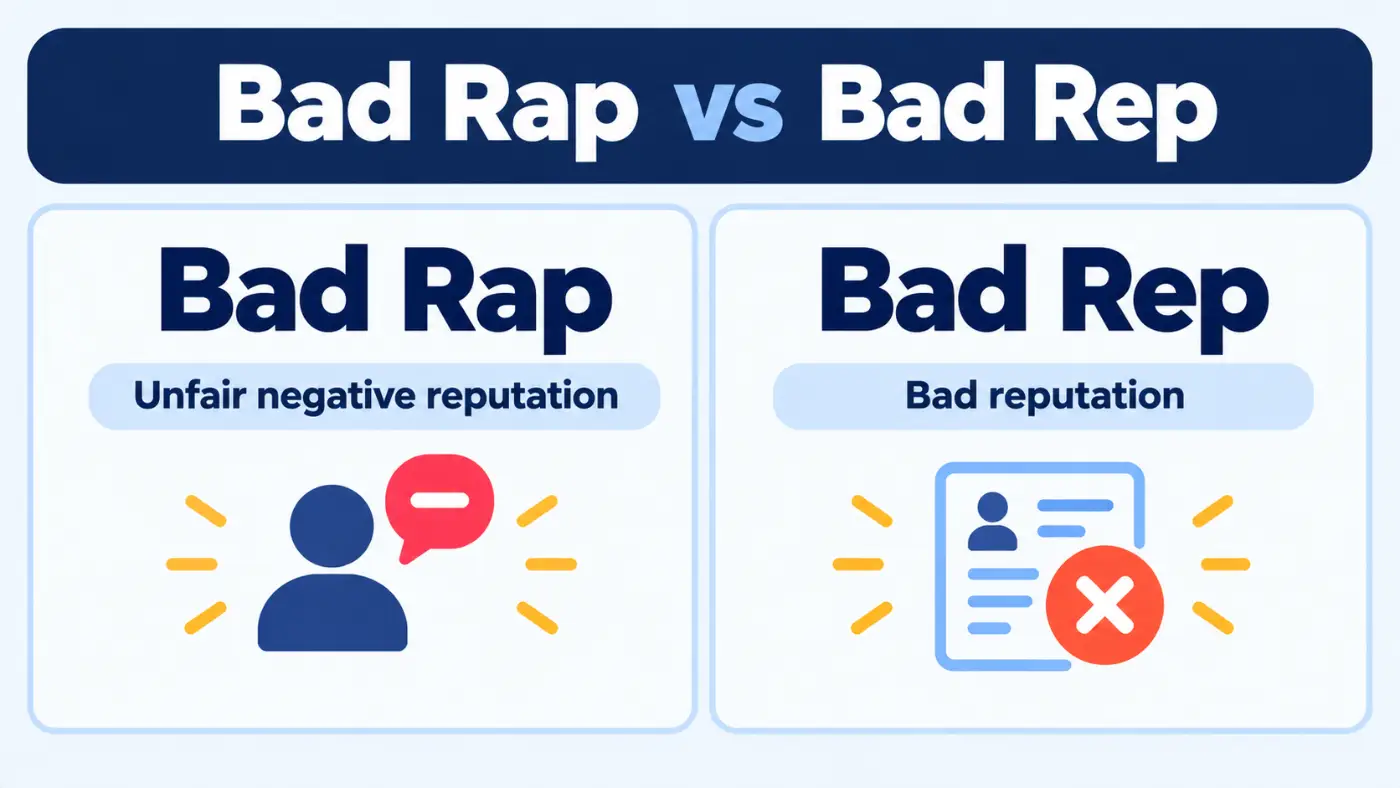
Bad rap is the established idiom, meaning an unfair or undeserved negative reputation, often tied to blame someone hasn’t earned. Bad rep is a more informal shorthand for “bad reputation,” and while both phrases circulate widely, they come from different roots and carry slightly different shades of meaning.
The Short Answer at a Glance
| Phrase | Origin | Core meaning | Example |
|---|---|---|---|
| bad rap | Established idiom | An unfair or undeserved negative reputation or blame | Pit bulls get a bad rap, even though most are gentle family pets. |
| bad rep | Informal shorthand | A shortened, casual way of saying “bad reputation” | That restaurant has a bad rep for slow service. |
Bad rap is the phrase most dictionaries and style guides recognize as the fixed idiom. Bad rep functions more as a casual abbreviation of “reputation” and is widely understood, even if it’s less formally established.
Is “Bad Rap” Correct?
Yes, bad rap is a well-established English idiom, and it’s the form most consistently recognized in dictionaries and usage guides. It means an unfair, undeserved, or exaggerated negative reputation, often implying that the criticism or blame attached to someone or something isn’t entirely justified.
The word “rap” in this context relates to an older sense of the word meaning a criminal charge or blame, as in the phrase “take the rap,” meaning to accept blame or punishment, often unfairly. “Bad rap” extends that same idea to reputation more broadly: getting a bad rap means being unfairly blamed, criticized, or characterized.
Grammatically, “bad rap” functions as a noun phrase, typically appearing after verbs like “get,” “have,” or “give,” as in “sharks get a bad rap” or “don’t give him a bad rap he doesn’t deserve.” It almost always implies some degree of unfairness or exaggeration in the negative perception being described, which is a key nuance separating it from a completely neutral, accurate reputation.
This idiom shows up constantly in discussions defending misunderstood people, animals, foods, professions, or ideas, precisely because it carries that built-in suggestion that the negative view isn’t the full or fair picture.
Is “Bad Rep” Correct?
Yes, though in a different way. Bad rep functions as an informal, shortened version of “bad reputation,” rather than as its own separate, historically rooted idiom the way “bad rap” is. It’s widely used and understood, particularly in casual speech and writing, but it’s essentially a clipped form of a longer, more neutral phrase.
Unlike “bad rap,” which specifically implies unfairness, “bad rep” simply describes a negative reputation without necessarily suggesting that reputation is undeserved. Something or someone with a bad rep might genuinely deserve that reputation, or might not; the phrase itself doesn’t carry the same built-in defense that “bad rap” does.
Grammatically, “bad rep” behaves like “bad reputation” itself, functioning as a noun phrase that can follow verbs like “have,” “get,” or “earn,” as in “the bar has a bad rep for fights” or “he earned that bad rep fair and square.” Because it’s a casual abbreviation rather than a fixed idiom, it feels more at home in informal speech and writing than in formal or polished prose.
Bad Rap vs Bad Rep: Key Differences Side by Side
| Feature | Bad Rap | Bad Rep |
|---|---|---|
| Status | Established idiom | Informal shorthand for “bad reputation” |
| Core meaning | An unfair or undeserved negative reputation | A negative reputation, deserved or not |
| Implies unfairness | Yes, typically | Not necessarily |
| Typical use | Defending someone or something misunderstood | General casual reference to reputation, positive or negative context |
| Register | Works in both casual and semi-formal writing | Mostly casual and conversational |
| Example | Snakes get a bad rap, but most species are harmless. | That food truck has a bad rep since the health inspection story went around. |
What the table can’t fully capture is how often these two phrases get used interchangeably in casual speech, even though their underlying implications differ. Many speakers use “bad rep” the way they’d use “bad rap,” without necessarily meaning to draw a distinction, which is part of why people so often search the two phrases together.
Correct Examples in Real-Life Contexts
Everyday speech (bad rap)
- Motorcycles get a bad rap for being dangerous, but a lot of that comes down to rider experience.
- I think carbs get an unfair bad rap in a lot of diet culture.
- Middle children always get a bad rap for being forgotten, but honestly, I loved being one.
- Cats have this bad rap for being aloof, but mine follows me everywhere.
Everyday speech (bad rep)
- That gym has a bad rep for overcrowding during peak hours.
- He’s got a bad rep at school for talking back to teachers.
- The neighborhood used to have a bad rep, but it’s really turned around in the last few years.
- I heard that landlord has a bad rep for ignoring maintenance requests.
Workplace writing
- Remote work sometimes gets an undeserved bad rap when it comes to productivity concerns.
- The vendor has a bad rep for missing deadlines, so we’re proceeding cautiously.
- Our department doesn’t want a bad rep for being difficult to work with.
- Certain industries get a bad rap for poor work-life balance, though that varies widely by company.
Texting
- lol pigeons get such a bad rap, they’re actually kind of smart
- that place has such a bad rep, are you sure we should eat there
School and academic
- The essay argues that introverts get an unfair bad rap in leadership research.
- Her thesis explores why certain historical figures earned a bad rep that later scholarship complicates.
- The debate topic examined whether social media truly deserves its bad rap regarding mental health.
- Group projects tend to have a bad rep among students, often for uneven workload distribution.
Formal writing
- The report challenges the industry’s bad rap by presenting updated safety data.
- Public relations efforts aimed to counter the company’s bad rep following the recall.
- Despite its bad rap, the medication has shown strong results in recent clinical trials.
- The article traces how the neighborhood’s bad rep developed over several decades of underinvestment.
Common Mistakes People Make (and How to Catch Them)
Using “bad rep” when the intended meaning is specifically “unfair blame”
Less precise: The chemical has a bad rep, even though studies show it’s completely safe. More precise: The chemical gets a bad rap, even though studies show it’s completely safe.
Since “bad rap” carries a built-in sense of unfairness, it fits more naturally when the point is specifically that the negative view doesn’t hold up.
Assuming “bad rap” always relates to music
Wrong assumption: “Bad rap” must be connected to rap music somehow. Right understanding: The idiom predates and is unrelated to rap music; it comes from an older use of “rap” meaning blame or a criminal charge.
This confusion is understandable given how common the word “rap” is in a musical sense today, but the idiom’s roots are entirely separate from that genre.
Writing “bad wrap” instead of “bad rap”
Wrong: He always gets a bad wrap for being too quiet. Right: He always gets a bad rap for being too quiet.
This is a homophone-driven error, since “wrap” and “rap” sound identical but mean completely different things. “Wrap” relates to covering or enclosing something, which has no connection to blame or reputation.
Treating the two phrases as fully interchangeable in formal writing
Wrong: The formal report states the industry has a bad rep despite improved safety records. (when precision about unfairness matters) Right: The formal report states the industry has an undeserved bad rap despite improved safety records.
In more formal or persuasive writing where the point specifically hinges on unfairness, “bad rap” communicates that nuance more precisely than the more neutral “bad rep.”
A Fast Trick to Choose the Right One
Ask whether your sentence is specifically defending something against unfair criticism, or simply describing a negative reputation without making a case either way. If you’re defending, “bad rap” fits the idiom’s built-in implication of unfairness. If you’re just describing a negative reputation, whether deserved or not, “bad rep” works as a casual, neutral shorthand.
A second trick: remember that “bad rap” is the older, dictionary-recognized idiom, tied to the historical sense of “rap” as blame or a charge. “Bad rep” is simply a clipped version of “bad reputation,” useful in casual speech but without that same deeper idiomatic history.
This trick works well for choosing the phrase that best fits your intended nuance, but it has a real limit: in casual, everyday conversation, most people use the two interchangeably without drawing this distinction, so neither choice will typically confuse a listener either way.
How They Sound in Real Situations
A text exchange
Priya: Why do people hate mushrooms so much lol
Sam: Idk, they get such a bad rap, they’re actually great in like everything
Priya: Agreed, mushroom slander needs to stop
Bad rap fits naturally here, defending mushrooms against what the speaker sees as unfair criticism.
A workplace email
Subject: Vendor concerns
Hi team,
I wanted to flag that this vendor has a bad rep in our industry for delayed shipments. Before we finalize the contract, let’s confirm updated references to make sure recent performance has actually improved.
Thanks, Renata
Bad rep works well here, describing a general negative reputation without necessarily claiming it’s unfair.
An article-style excerpt
Sharks have long carried a bad rap in popular culture, largely thanks to decades of sensationalized media coverage. Marine biologists point out that the vast majority of species pose little to no threat to humans.
Bad rap fits precisely here, since the article is explicitly arguing that critics have exaggerated the negative perception and treated it unfairly.
Formal Writing vs Casual Writing
Bad rap is the more broadly accepted choice in semi-formal and published writing, since it’s the recognized idiom with dictionary standing. It appears comfortably in journalism, essays, and persuasive writing making the case that critics have unfairly maligned something.
Bad rep leans more casual and conversational, showing up frequently in everyday speech, texting, and informal writing. It’s less common in polished, formal writing, though it isn’t incorrect; it simply carries a more relaxed, colloquial tone compared to the more established “bad rap.”
Neither AP nor Chicago style offers specific guidance distinguishing these two phrases, since the difference is more about idiomatic precision and register than a formal grammar rule.
Related Mix-Ups People Also Search For
Bad Rap vs Bad Wrap
These two are pure homophones with completely unrelated meanings. Bad rap refers to an unfair reputation, while “wrap” relates to covering or enclosing something, as in a sandwich wrap or a wrap dress. Example: He complained about getting a bad rap at work, then went to grab a chicken wrap for lunch.
Take the Rap vs Take the Blame
“Take the rap” is a closely related idiom meaning to accept blame or punishment, often for something someone else did. By contrast, “take the blame” is a more neutral, literal phrase describing the same basic action without any special idiomatic flavor. For example, he took the rap for his brother’s mistake, even though he didn’t have to take the blame at all.
Reputation vs Rep
“Reputation” is the full, formal noun for how people generally regard someone or something, while “rep” is just its casual, shortened form. For example, she’s built a strong professional reputation over the years, and among her coworkers, she’s got a great rep too.
Exceptions, Edge Cases, and Tricky Situations
Regional and generational variation in casual use
“Bad rep” tends to skew slightly more common in casual speech among younger speakers and in informal digital communication, while “bad rap” remains more consistent across formal writing and journalism. Neither pattern is a strict rule, but it reflects a general tendency in how the two phrases circulate.
When both phrases could arguably work
In many casual sentences, listeners understand both phrases similarly enough that either could work without causing confusion, particularly when the speaker isn’t making a precise point about fairness. In these cases, the choice often comes down to personal habit or regional speech patterns rather than a strict rule.
Quick Practice: Test Yourself
Choose the phrase that best fits each context.
- Spiders get such a ______, even though most species are completely harmless. (bad rap / bad rep)
- That diner has a ______ for cold coffee and slow service. (bad rap / bad rep)
- Despite its ______, the medication has proven effective in multiple studies. (bad rap / bad rep)
- He’s earned his ______ at work after missing three deadlines in a row. (bad rap / bad rep)
- Vaccines have gotten an undeserved ______ in certain online communities. (bad rap / bad rep)
- The used car dealership has had a ______ for years, and it’s honestly deserved. (bad rap / bad rep)
Answer Key
- bad rap: implies the negative view of spiders is exaggerated or unfair.
- bad rep: a straightforward, casual description of a negative reputation.
- Bad rap: suggests the evidence doesn’t support the negative perception.
- Bad rep: describes a reputation that, in this case, the person has clearly earned.
- Bad rap: fits the sentence’s explicit claim that the criticism doesn’t hold up.
- bad rep: fits naturally since the sentence states the reputation is accurate.
Frequently Asked Questions
Is “bad rap” or “bad rep” the correct phrase?
Dictionaries recognize bad rap as the established idiom, meaning an unfair or undeserved negative reputation. Bad rep is a casual shorthand for “bad reputation,” and many people use it widely, though it’s less formally established as its own idiom.
Does “bad rap” have anything to do with rap music?
No. The idiom predates modern rap music and comes from an older sense of “rap” meaning blame or a criminal charge, as in the phrase “take the rap.”
Is “bad wrap” ever correct?
No, “bad wrap” is a common misspelling based on the identical pronunciation of “rap” and “wrap.” The correct idiom is always spelled “bad rap.”
Does “bad rep” always imply the reputation is unfair?
Not necessarily. Unlike “bad rap,” which typically suggests undeserved criticism, “bad rep” simply describes a negative reputation without making a claim about whether it’s fair or accurate.
Which phrase is more appropriate for formal writing?
Bad rap is generally better suited to formal or published writing, since it’s the recognized idiom, while bad rep tends to read as more casual and conversational.
Can bad rap and bad rep be used interchangeably?
In casual conversation, many speakers do use them interchangeably without much distinction, though bad rap carries a more specific implication of unfairness that bad rep doesn’t necessarily share.

Sophia Bennett writes educational content about English vocabulary, grammar, slang, and communication. She is passionate about making complex language topics accessible to students, professionals, and curious readers around the world.