Anticlockwise vs Counterclockwise: Who Says Which?
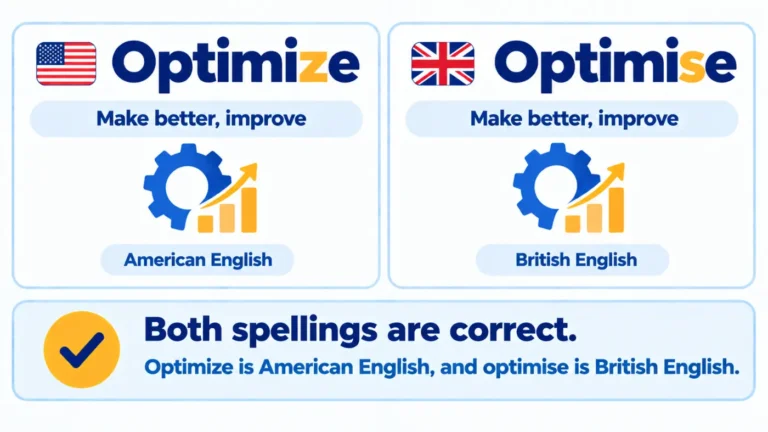
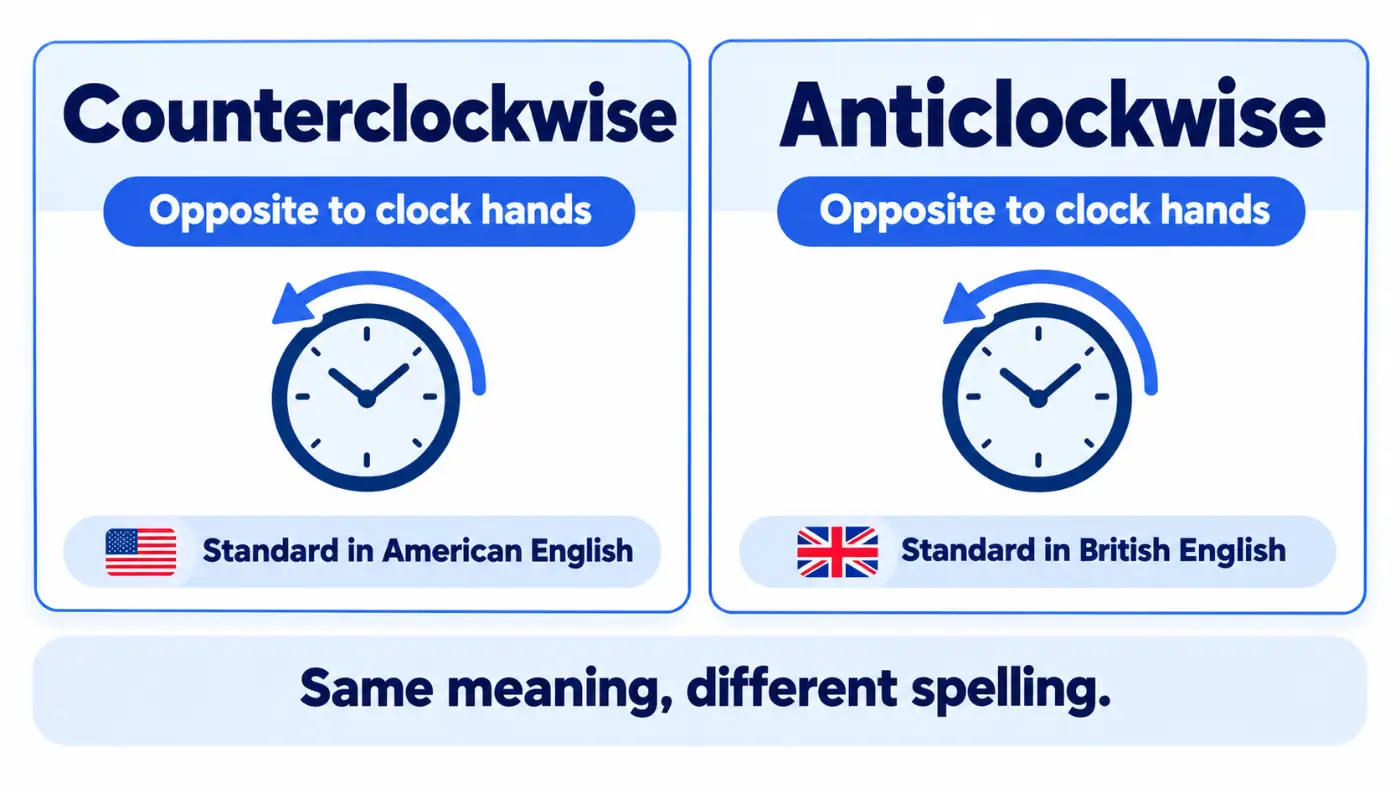
Anticlockwise and counterclockwise mean exactly the same thing: the direction opposite to the way clock hands move. Counterclockwise is the standard choice in American English, and anticlockwise is the standard choice in British English. Pick the one your readers expect.
The Short Answer at a Glance
| Word | Function | Meaning | Example |
|---|---|---|---|
| Counterclockwise | Adjective and adverb | Against the movement of clock hands | Turn the valve counterclockwise to shut off the water. |
| Anticlockwise | Adjective and adverb | Against the movement of clock hands | Walk anticlockwise around the square to reach the station. |
Neither word is an error. The only difference is which side of the Atlantic feels at home with it.
What Counterclockwise Means and How It Works
Counterclockwise describes motion that travels opposite to the hands of a clock. Picture the top of a clock face. A counterclockwise path leaves the 12 and heads toward the 11, then the 10, then the 9.
It works as an adjective and as an adverb. As an adjective, it sits before a noun (a counterclockwise spiral). As an adverb, it modifies a verb (the fan spins counterclockwise). It has no noun form, so you can’t say the counterclockwise as if it were a thing.
The word is built from counter, meaning against, plus clockwise. That structure is easy to see, and it explains why the meaning never wobbles.
Counterclockwise is the dominant form in American writing. You’ll find it in manuals, recipes, sports coverage, and classroom materials across the US. Some writers add a hyphen between the parts, but the closed form is the more common spelling.
What Anticlockwise Means and How It Works
Anticlockwise also means moving opposite to clock hands, and it does the same grammatical work. It’s an adjective before a noun (an anticlockwise rotation) and an adverb after a verb (the dial turns anticlockwise).
The word pairs the prefix anti, meaning against, with clockwise. The logic matches counterclockwise exactly. Only the prefix changes.
Anticlockwise is the usual form in British English, and it’s common in other varieties that follow British conventions. Americans understand it instantly. It just reads as a British choice, so it can look out of place in a US manual or news story.
Like its twin, it has no noun form. Writers who want to name the concept use a phrase such as the anticlockwise direction.
Anticlockwise vs Counterclockwise: Key Differences Side by Side
| Feature | Counterclockwise | Anticlockwise |
|---|---|---|
| Part of speech | Adjective and adverb | Adjective and adverb |
| Core meaning | Opposite to clock hands | Opposite to clock hands |
| Typical use | American English | British English |
| Register | Standard, neutral | Standard, neutral |
| Example | The dancers circled counterclockwise. | The dancers circled anticlockwise. |
The table shows that the two words match in every row except the audience. That’s why this pair belongs with color and colour rather than affect and effect. Nobody has to learn a new rule, because only a convention changes.
What the table can’t show is how invisible the choice feels to native speakers. A reader rarely pauses at the word their own dialect prefers. They do notice the other one, so consistency inside a single document matters more than the choice itself.
Correct Examples in Real-Life Contexts
Counterclockwise
- Everyday speech: Loosen the jar lid by twisting it counterclockwise, and run it under hot water first if it’s stuck.
- Texting: the fan on my desk is spinning counterclockwise and i have no idea why
- Workplace writing: Rotate the filter housing counterclockwise a quarter turn before you pull it free.
- School or academic: Seen from above the North Pole, Earth spins counterclockwise.
- Formal writing: Base runners in American baseball circle the diamond in a counterclockwise direction.
Anticlockwise
The following examples use British settings, because that’s where the word lives.
- Everyday speech: Go anticlockwise round the roundabout and take the second exit.
- Texting: turned the oven dial anticlockwise and it finally clicked off
- Workplace writing: Please turn the isolation valve anticlockwise until it stops, then confirm by email.
- School or academic: Year 8 students plotted the triangle after an anticlockwise rotation of ninety degrees.
- Formal writing: The Thames Path walk is described as an anticlockwise circuit of the Isle of Dogs.
Common Mistakes People Make (and How to Catch Them)
Mistake 1: Mixing both spellings in one document. Wrong: Turn the knob counterclockwise, then rotate the bracket anticlockwise. → Right: Turn the knob counterclockwise, then rotate the bracket counterclockwise. Writers copy instructions from several sources and keep each source’s spelling. Decide on one form, then search the file before you publish.
Mistake 2: Splitting the word in two. Wrong: Spin the wheel counter clockwise. → Right: Spin the wheel counterclockwise. Speech puts a small break after counter, and writers copy that pause onto the page. The space form isn’t standard. Spelling it as a single word is the safest choice.
Mistake 3: Trusting a spellchecker set to the wrong dialect. Wrong: The UK shipping guide says to rotate the lid counterclockwise. → Right: The UK shipping guide says to rotate the lid anticlockwise. A US spellchecker may flag anticlockwise, and a UK one may flag counterclockwise. Check the language setting before you accept a suggestion.
Mistake 4: Choosing the wrong direction, not the wrong word. Wrong: To loosen the cap, twist it clockwise. → Right: To loosen the cap, twist it counterclockwise. Most people tighten things with a clockwise turn, so the brain defaults to it. Standard threads loosen in the opposite direction.
Mistake 5: Forgetting the viewpoint. Wrong: The bolt turns counterclockwise. → Right: The bolt turns counterclockwise when viewed from above the head. Direction depends on where you stand. The same spinning object looks clockwise from one side and counterclockwise from the other.
A Fast Trick to Choose the Right One
Match the prefix to your audience. If you’re writing for readers in the US, use counter. If you’re writing for readers in the UK, use anti. Both prefixes mean against, so you can’t go wrong on meaning.
For direction, picture a clock face and follow the hand backward. From 12, the hand that moves counterclockwise or anticlockwise goes to 11, not 1. If your turn heads toward the 9 before it reaches the 3, you’re going the right way.
A second check is the phrase against the clock. If it fits your sentence, either word works.
The trick has one limit. It settles the dialect and the direction, but it can’t tell you where the viewer is standing. You still need to name that for any object that can be seen from two sides.
How They Sound in Real Situations
A text exchange
Amara: The hinge on my cabinet door is loose. Which way do I turn the screw? Diego: Tighten it clockwise. If it’s stripped, loosen it counterclockwise and start over. Amara: Perfect, thanks.
Counterclockwise is an adverb here, and it fits a US conversation. The pairing with clockwise keeps the directions clear.
An email snippet
Subject: Filter replacement steps
Hi team, to swap the coffee machine filter, turn the housing anticlockwise until it releases. Hold it level so the water doesn’t spill. Reply to me if the seal looks cracked.
Anticlockwise suits this email because the office is in Manchester and the team uses British spelling. The audience decides the form.
An article excerpt
Every lap of the half mile oval at Riverside Speedway runs counterclockwise. Drivers lean left for four hours, and the crew chief tapes a small pad to the driver’s seat for that reason.
Here counterclockwise is an adjective describing the noun lap. The setting is American, so the American form fits.
Formal Writing vs Casual Writing
Register doesn’t change the choice. Both words are standard in academic papers, business email, journalism, social media, and texting. The deciding factor is the audience.
Technical writers sometimes use the abbreviation CCW in diagrams and parts lists. In running text, most editors prefer the full word, because abbreviations can slow a first time reader. If you write for an international audience, consider adding the viewpoint, as in counterclockwise when viewed from above.
Journalism and academic work follow the same rule as everything else. Use the dialect of the publication, and keep it consistent from the headline to the last paragraph.
US vs UK English Differences
Counterclockwise is the usual form in American English, and anticlockwise is the usual form in British English. The meaning is identical, and the spelling of clockwise doesn’t change.
Americans rarely write anticlockwise, but they understand it. British readers understand counterclockwise just as quickly, though it may look slightly American to them.
If your audience is global, choose by the publication’s house dialect, not by personal taste. A site aimed at US readers should use counterclockwise everywhere, including headings, image captions, and metadata.
Related Mix-Ups People Also Search For
Counterclockwise With a Hyphen or a Space
The closed spelling is the most common form, and it’s the safest. Some dictionaries accept a hyphenated version, so you may see it in older or style specific writing. A version with a space between the parts isn’t standard.
Turn the dial counterclockwise until you hear a click.
Widdershins
Widdershins is an old word that means in a direction opposite to the sun’s apparent path, which for most of the Northern Hemisphere is the same as counterclockwise. It turns up in folklore and literary writing. It’s not a normal instruction word, so don’t use it in a manual.
The story describes villagers walking widdershins around the well at midnight.
Clockwise and the Direction Opposite
Clockwise is the direction clock hands move, and both words in this guide name its opposite. The confusion is almost never the word. It’s the assumption that everyone views the object from the same side.
The propeller turns clockwise when seen from the tail, but it turns counterclockwise when seen from the nose.
Exceptions, Edge Cases, and Tricky Situations
Mathematics. In mathematics, the positive direction for angles is counterclockwise. A rotation of ninety degrees with no other detail normally means a counterclockwise turn. British math classes use anticlockwise for the same idea.
Weather and Earth. Northern Hemisphere cyclones spin counterclockwise when seen from above, and Southern Hemisphere cyclones spin clockwise. Writers should avoid using counterclockwise as a general description of storms everywhere.
Standard threads. Ordinary screws, bolts, and jar lids loosen when you turn them counterclockwise. A few fittings use reverse threads, and some gas fittings do. If you write repair instructions, verify the thread type before you commit to a direction.
Mirrors and screens. Video and mirrored images reverse left and right. A clock that runs clockwise in person can appear to run counterclockwise on a screen that flips it.
Abbreviations. CCW and ACW appear in technical drawings. Spell the word out in general writing, because readers can’t always guess which abbreviation matches their dialect.
Quick Practice: Test Yourself
Choose the best word or direction for each sentence.
- A US repair blog says to rotate the faucet handle ___ to open it. (counterclockwise or anticlockwise)
- A London estate agent says to turn the key ___ to unlock the gate. (counterclockwise or anticlockwise)
- Which is standard? A) counter clockwise B) counterclockwise
- To loosen a standard jar lid, twist it ___. (clockwise or counterclockwise)
- A US geography quiz asks which way Earth spins when seen from above the North Pole. (clockwise or counterclockwise)
- A writer has used counterclockwise in every paragraph but anticlockwise in the last one. What’s the fix?
Answer key
- Counterclockwise. The audience is American, so the US form fits.
- Anticlockwise. The audience is British, so the UK form fits.
- B. The closed spelling is standard, and the space form isn’t.
- Counterclockwise. Standard lids loosen in that direction.
- Counterclockwise. Earth spins that way when seen from above the North Pole.
- Change the last paragraph to counterclockwise. Consistency inside one document matters.
Frequently Asked Questions
Are anticlockwise and counterclockwise the same thing?
Yes. Both words describe motion opposite to the hands of a clock, and they work the same way grammatically.
Which is correct, anticlockwise or counterclockwise?
Both are correct. Use counterclockwise for American audiences and anticlockwise for British audiences.
Is anticlockwise only used in the UK?
It’s most common in British English and in varieties that follow British conventions. Speakers elsewhere understand it, and some use it.
Which way do I turn a screw to loosen it?
For a standard screw, turn it counterclockwise, viewed from the head. Reverse thread fittings are the exception.
Is widdershins the same as counterclockwise?
Usually, but widdershins is a literary and folkloric word. Use counterclockwise or anticlockwise in practical writing.
Should counterclockwise have a hyphen?
The closed spelling is the most common, and it’s the safest. Some dictionaries accept a hyphenated form as a variant.

Sophia Bennett writes educational content about English vocabulary, grammar, slang, and communication. She is passionate about making complex language topics accessible to students, professionals, and curious readers around the world.