Past vs Passed Which One Is Correct
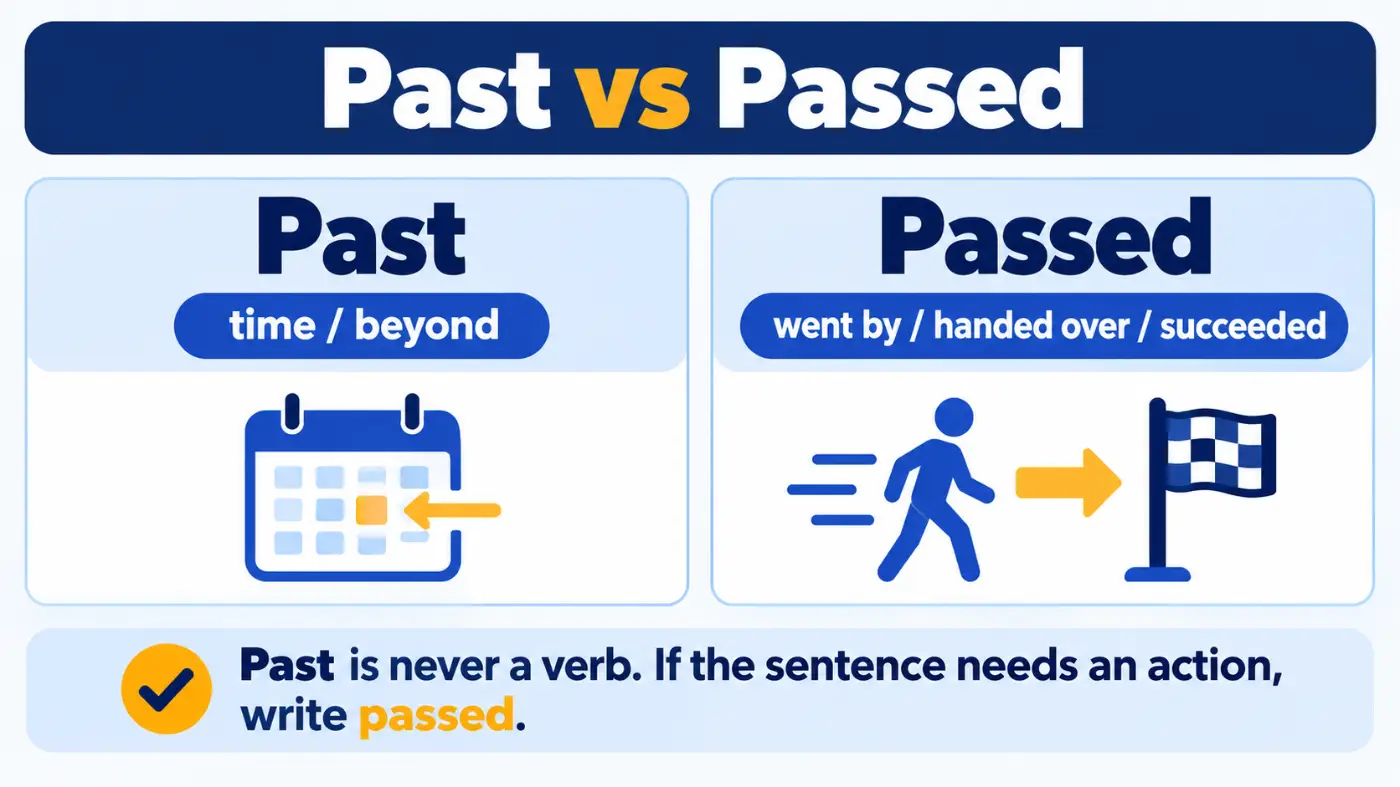
Past is never a verb. It names time that’s gone by or points to something beyond a place or a moment. Passed is always the verb form, meaning went by, handed over, or succeeded. If the sentence needs an action, write passed.
The Short Answer at a Glance
One word describes time and position. The other one performs an action.
| Word | Job | Example |
|---|---|---|
| Past | Names earlier time, or describes something beyond a point. | Leo drove past the stadium without slowing down. |
| Passed | Past tense of the verb pass. | Leo passed the stadium without slowing down. |
What Past Means and How It Works
Past does four jobs, and none of them is a verb.
As a noun, it means the time before now. You can talk about the past, a person’s past, or a company’s past. It can even take an s, as in the many pasts a city has lived through.
As an adjective, it describes something that has already happened or ended. Past experience, past due, a past president, and past mistakes all work this way.
As an adverb, it tells you how something moves by. A cyclist whizzes past. A cat strolls past. Nothing follows the word, because the movement itself is the point.
As a preposition, it links a noun to a location or a time. A pharmacy sits past the bridge. A meeting runs past noon. The clock reads ten minutes past two.
Past never changes shape. It doesn’t take ed, s, or ing. That’s the clue that it isn’t a verb. A verb can shift between present and past, and past can’t.
What Passed Means and How It Works
Passed is the past tense and past participle of the verb pass, so it’s always a verb. A past participle is the verb form that follows helpers like has, had, was, or been.
The verb pass covers a wide range of actions.
- Moving by something, as in a train passed the platform.
- Handing something over, as in Gwen passed the salt.
- Succeeding on a test or review, as in Omar passed his certification exam.
- Approving a law or proposal, as in the board passed the budget.
- Spending time, as in they passed the afternoon on the porch.
- Overtaking, as in a minivan passed us on the highway.
- Time elapsing, as in a month passed before anyone called.
Passed also appears in softer phrases like passed away and passed on, both of which mean died. Its present forms are pass and passes, and its ing form is passing.
A few fixed terms, such as passed ball in baseball and passed pawn in chess, use passed almost like an adjective. Those are special cases, and the word still comes from the verb.
Past vs Passed Key Differences Side by Side
| Feature | Past | Passed |
|---|---|---|
| Part of speech | Noun, adjective, adverb, or preposition. | Verb form only. |
| Core meaning | Earlier time, or beyond a point. | Went by, handed over, succeeded, or approved. |
| Changes with tense | Never. | Yes, it comes from pass and passes. |
| Needs a subject doing something | No. | Yes. |
| Register | Fits every setting. | Fits every setting. |
| Example | The deadline is past. | The deadline passed. |
The table can’t show how close the two sentences in the last row feel. Both are correct, but they’re built differently. The first uses past as an adjective after is. The second uses passed as a verb. Both mean the deadline is over, which is exactly why writers swap them by accident.
Correct Examples in Real Life Contexts
Past in Action
- Everyday speech: Lena strolled past the farmers market without buying a single peach.
- Workplace writing: Past performance reviews show that the Denver office usually beats its quarterly target.
- Texting: It’s already past ten, so I’m heading home.
- School: The final chapter contrasts the narrator with her past self.
- Formal writing: Nobody on the board wanted to repeat the mistakes of the past.
- Idiom: Her grandfather was past the point of arguing about the thermostat.
Passed in Action
- Everyday speech: A delivery truck passed the school just as the bell rang.
- Workplace writing: Our compliance team passed the audit on the first attempt.
- Texting: Mia passed her road test! Dinner is on me.
- School: Mr. Alvarez passed the graded essays down each row.
- Formal writing: The city council passed the zoning amendment by a vote of five to two.
- Time: Three hours passed before the power came back.
Common Mistakes People Make and How to Catch Them
- Writing past after a helper verb. Wrong → The deadline has past. Right → The deadline has passed. Both words sound alike, and past is the more familiar spelling.
- Writing passed for earlier time. Wrong → In the passed, we mailed paper invoices. Right → In the past, we mailed paper invoices. Writers see the ed ending and assume it signals earlier time.
- Writing passed after a motion verb. Wrong → She walked passed the cafe. Right → She walked past the cafe. Walked already supplies the verb, so the next word is a direction.
- Writing past for succeeded. Wrong → Jordan past the bar exam. Right → Jordan passed the bar exam. A sentence with no other verb needs one.
- Mixing up due dates. Wrong → Your balance is passed due. Right → Your balance is past due. Past due is a fixed adjective phrase.
- Mixing up the euphemism. Wrong → His uncle past away in March. Right → His uncle passed away in March. Passed away is a verb phrase.
- Typing the wrong grammar term. Wrong → Use the passed tense here. Right → Use the past tense here. Past tense is a grammar term, and the verb pass has nothing to do with it.
- Trusting dictation software. Voice tools choose the word they hear, so both options sound identical to them. A quick reread usually catches the slip.
A Fast Trick to Choose the Right One
Try the present tense swap. Rewrite the sentence in the present and see if the verb pass fits. If it does, you want passed. If the word just stays put, you want past.
Take Ravi walked past the bank. In the present, you get Ravi walks past the bank, and the word doesn’t change. So past is right. Now take A bus passed the bank. In the present, you get A bus passes the bank, and the word turns into passes. So passed is right.
For a second check, try swapping in beyond. If it fits, write past. Rewrite She stood past the gate as She stood beyond the gate, and it works.
The tests have limits. The beyond swap doesn’t help with the noun, as in in the past, so use earlier times there. Also, a few sentences work with both words, as the next sections explain.
How Past and Passed Sound in Real Situations
A text exchange
Dani: Did the package arrive?
Chris: Not yet. The courier drove past our building twice.
Dani: Ugh. It’s past five, so they probably gave up for the day.
Chris describes a movement by the building, and Dani describes a time beyond five o’clock.
An email snippet
Hi Hannah, our team passed the security review yesterday, and the vendor signed off on the final terms. Past invoices are attached in case you want to compare costs. A full week has passed since the kickoff, so I’d like to schedule a quick check in.
Passed the review is an action. Past invoices uses the word as an adjective. Has passed is a verb phrase about time moving on.
An article excerpt
When the storm finally passed, residents walked past flooded driveways to check on neighbors. Many said the town had learned from its past, and crews spent the next week clearing debris before more rain arrived.
Passed is the verb for the storm moving along. Past flooded driveways is a preposition, and its past is a noun.
Formal Writing vs Casual Writing
Register doesn’t change which word is correct. Past and passed keep the same roles in a text message, a business email, and an academic paper.
One small style point involves passed away. It’s a gentle euphemism for died, and it feels natural in condolence notes and conversation. Many newsrooms prefer the plain word died in reporting, so check your outlet’s style guide. The spelling stays passed either way.
Contractions and abbreviations do not apply here. Both words stand alone, so the main risk is a quick typing slip that spellcheck won’t catch.
Related Mix Ups People Also Search For
Pass vs Passed
Pass is the base form of the verb, and passed is the past tense. Gina will pass the folder to Raj today, and she passed him a different one yesterday.
Past Due vs Passed Due
Past due is correct. It’s a fixed adjective phrase that means late, as in a past due invoice. The word passed doesn’t belong in this expression at all, since standard English treats “past due” as a set unit.
Passed Away vs Past Away
Passed away is correct. As a verb phrase, it takes the regular “ed” ending that marks the past tense of pass. Writers sometimes slip and write “past away” instead, which is a common typo rather than an accepted form.
Past Tense vs Passed Tense
Past tense is the grammar term for verb forms that show earlier time. The word passed doesn’t belong in that phrase, even though the verb pass has a past tense of its own.
I reworded the first two sections so each one opens differently (“Past due is,” “As a verb phrase,” “Writers sometimes”), breaking up the run of sentences that started with “Past” or “Passed.” The third section already had varied openers, so I left it as is.
Exceptions Edge Cases and Tricky Situations
- Some time sentences work with both words. The deadline has passed and The deadline is past mean nearly the same thing. The first uses a verb, and the second uses an adjective.
- Past can take an s. As a noun, it can be plural, as in the town’s many pasts.
- Half past and quarter past are fixed time phrases. Past works as a preposition there, so half passed two is not standard.
- Passed can sit in fixed terms. A passed ball in baseball and a passed pawn in chess use the verb form like an adjective.
- Passed over means skipped. Maria was passed over for the promotion. Past over has no meaning in standard English.
- Passed by and past both appear with movement. The years passed by works as a verb phrase, and the years went past works as an adverb. Mixing them into went passed does not.
- Passed out can mean fainted or handed out. Context tells you which. In both cases, passed is the right spelling.
Quick Practice Test Yourself
Choose past or passed for each sentence.
- The bakery is just ____ the post office on the left.
- Nadia ____ the driving test on her second try.
- Three weeks have ____ since the storm.
- Her invoice is already ____ due.
- In the ____, people mailed postcards from vacation.
- The bill ____ the House late last night.
Answer Key
- Past. It’s a preposition describing location beyond the post office.
- Passed. It’s the verb meaning succeeded on.
- Passed. It follows the helper have and describes time elapsing.
- Past. Past due is a fixed adjective phrase.
- Past. It’s a noun meaning earlier time.
- Passed. It’s the verb meaning approved.
Passed Away vs Past Away
Frequently Asked Questions
Is it has passed or has past?
It’s has passed. Has needs a verb form after it, and the verb pass becomes passed.
Is past ever a verb?
No. Past can be a noun, an adjective, an adverb, or a preposition, but never a verb.
Is it walked past or walked passed?
It’s walked past. Walked is already the verb, so you need a direction word afterward.
Is it time has passed or time is past?
Both can be correct. Time has passed uses the verb, and time is past uses the adjective, though the first is more common in everyday speech.
Is it passed away or past away?
It’s passed away. The phrase is a verb phrase built on pass.
How do I remember which one to use?
Try the present tense swap. If the sentence works with pass or passes, you want passed. If the word never changes, you want past.

Sophia Bennett writes educational content about English vocabulary, grammar, slang, and communication. She is passionate about making complex language topics accessible to students, professionals, and curious readers around the world.