Sheath vs Sheathe: Which One Do You Need?
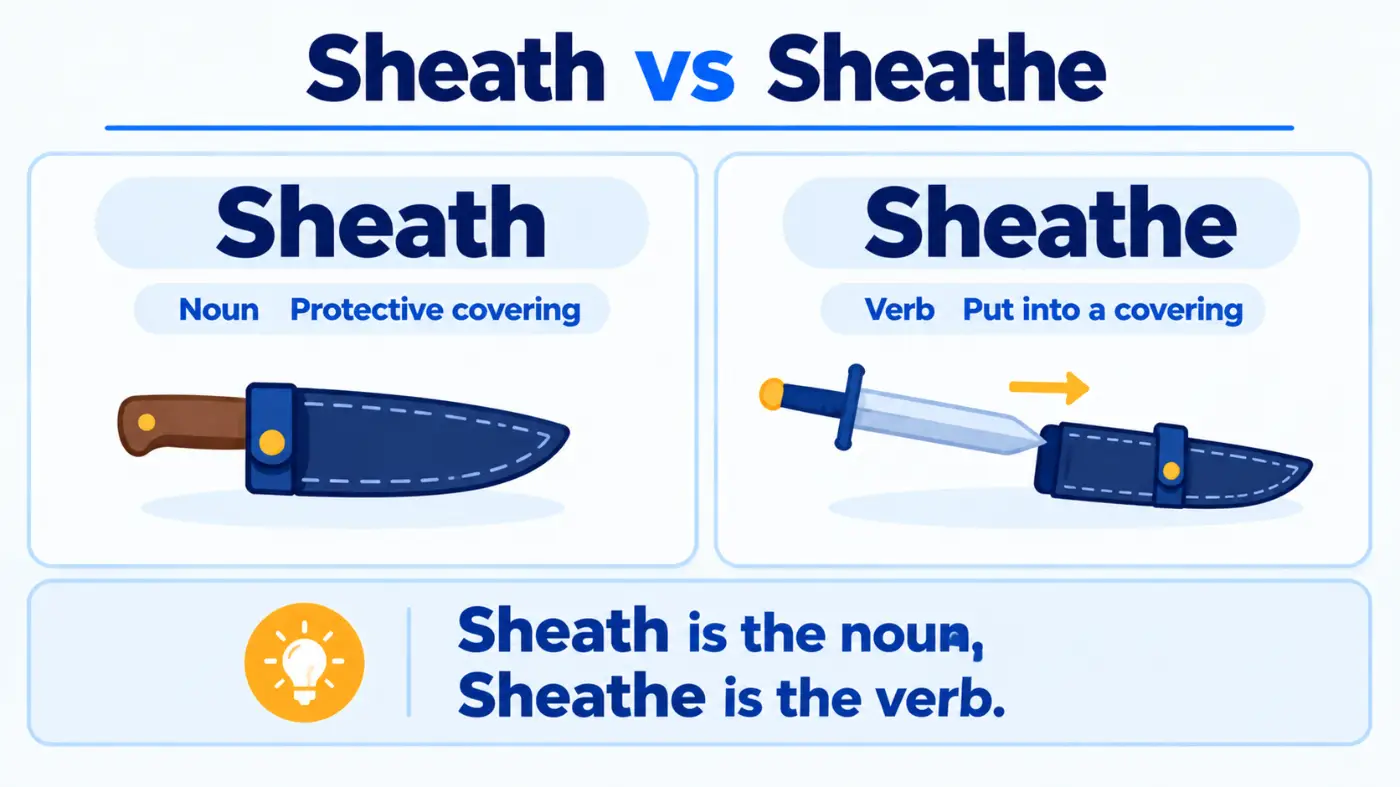
Sheath is the noun, referring to a protective covering or case, usually for a blade. Sheathe is the verb, meaning to put something into that covering or to encase it. The difference comes down to whether you’re naming the object or describing the action.
The Short Answer at a Glance
| Form | Part of speech | What it does | Example |
|---|---|---|---|
| sheath | Noun | A protective case or covering, often for a blade | He slid the knife back into its leather sheath. |
| sheathe | Verb | To put something into a sheath or encase it | She sheathed her sword after the duel ended. |
If you’re naming the object itself, you want sheath. If you’re describing the action of putting something into that object, you want sheathe.
What Sheath Means and How It Works
Sheath is a noun referring to a protective covering or case designed to hold something, most commonly a blade like a knife or sword, though the word extends to other protective coverings as well, including certain types of cables, medical instruments, and even some biological structures, like the protective covering around a nerve or muscle fiber.
The word carries a sense of close-fitting protection. A sheath is typically shaped specifically to match whatever it holds, keeping the object safe, contained, and ready for quick access. This precise fit distinguishes a sheath from a more general container like a box or bag.
Grammatically, sheath functions as a standard countable noun: a sheath, several sheaths, a leather sheath, a protective sheath. It pairs naturally with prepositions describing placement, as in “a knife in its sheath” or “a sword drawn from its sheath.”
Beyond its literal meaning, sheath also appears in a more specialized, technical sense in fields like electrical engineering, where a cable’s protective outer layer is often called a sheath, and in anatomy, where certain nerve and muscle structures are described as having a sheath.
What Sheathe Means and How It Works
Sheathe is a verb meaning to put something into a sheath, or more broadly, to cover or encase something in a protective layer. The most common and literal use involves sliding a blade, like a knife or sword, back into its protective case after use.
The verb also carries a figurative extension, describing the act of covering or encasing something else entirely, as in “the building was sheathed in copper panels,” where sheathe describes a protective or decorative outer layer applied to a structure, not literally a blade-related action at all.
Grammatically, sheathe is a regular transitive verb, meaning it takes a direct object: you sheathe a sword, sheathe a knife, or sheathe a building’s exterior. It conjugates following the standard pattern:
- sheathe (base form)
- sheathes (third-person present)
- sheathed (past tense and past participle)
- sheathing (present participle)
The verb’s spelling, ending in a silent “e,” follows the exact same pattern as other English verbs built from nouns with an added “e” to signal the action, similar to how “breath” the noun relates to “breathe” the verb. That silent “e” is precisely what separates sheathe from sheath, both visually and functionally.
Sheath vs Sheathe: Key Differences Side by Side
| Feature | Sheath | Sheathe |
|---|---|---|
| Part of speech | Noun | Verb |
| Core meaning | A protective case or covering | To put something into a sheath or encase it |
| Typical use | Naming the object itself | Describing the action of covering or encasing |
| Pronunciation | Ends with an unvoiced “th” sound | Ends with a voiced “th” sound, closer to “th” in “breathe” |
| Example | The sheath on his belt held a small hunting knife. | He sheathed the knife before shaking hands. |
What the table can’t fully capture is how closely related these two words actually are in both spelling and sound, differing by only a single silent “e.” That tiny difference carries the entire weight of distinguishing the object itself from the action of using it.
Correct Examples in Real-Life Contexts
Everyday speech
- The knife came with a sturdy leather sheath for safe storage.
- He quickly sheathed his pocketknife when the ranger walked by.
- I keep my hiking knife’s sheath attached to my belt loop.
- She sheathed the sword carefully, making sure not to nick the blade.
Workplace writing
- The product listing specifies that the sheath is made from genuine leather.
- Employees must sheathe all cutting tools before transporting them between stations.
- The electrician inspected the cable’s protective sheath for signs of wear.
- Please ensure every blade is properly sheathed before placing it in the storage case.
Texting
- found my old pocketknife but the sheath is missing, so annoying
- just sheathed my knife and now I can’t find it again lol
School and academic
- The biology lecture described the myelin sheath that insulates certain nerve fibers.
- Her archaeology paper examines ancient sword sheaths recovered from burial sites.
- Students learned proper technique for sheathing a blade safely during the woodworking unit.
- The engineering course covered how cable sheaths protect wiring from environmental damage.
Formal writing
- The museum exhibit displays an ornate ceremonial sheath dating back several centuries.
- Safety protocols require that all blades be sheathed immediately after each use.
- The report details how the building’s exterior was sheathed in weather-resistant paneling.
- Medical staff are trained to properly sheathe needles to prevent accidental injury.
Common Mistakes People Make (and How to Catch Them)
Using “sheath” as a verb
Wrong: He sheathed, no wait, he sheath the knife before leaving. Right: He sheathed the knife before leaving.
Because sheath and sheathe look so similar, some writers mistakenly reach for the noun form when they actually need the verb, especially in fast or casual writing.
Using “sheathe” when naming the object itself
Wrong: The knife comes with a durable leather sheathe. Right: The knife comes with a durable leather sheath.
This reverses the previous mistake, applying the verb spelling to a sentence that’s simply naming the protective case, not describing an action.
Dropping the silent “e” in the verb form
Wrong: She sheath the sword and walked away. Right: She sheathed the sword and walked away.
Since sheathe needs that silent “e” to function correctly as a verb, forgetting it both misspells the word and breaks the sentence’s grammar, since “sheath” alone can’t function as a conjugated verb this way.
Mishearing the subtle pronunciation difference
Wrong: Written as sheath when describing an action, based on how similar the two words sound when spoken quickly. Right: Sheathe, recognizing the slightly different “th” sound used in the verb form compared to the noun.
The pronunciation difference between these two words is subtle, with the verb using a slightly softer, voiced “th” sound, similar to “breathe,” which can make it easy to miss the distinction when writing from memory of speech.
A Fast Trick to Choose the Right One
Pair sheath and sheathe with the similar noun-verb pair breath and breathe. Breath is the noun you take in, and breathe is the verb describing the action. Sheath is the noun object, and sheathe is the verb describing the action of using it. If you already know the difference between breath and breathe, you already understand the exact same pattern for sheath and sheathe.
A second trick: try substituting “case” for sheath and “encase” for sheathe in your sentence. “The knife’s case” makes sense, so sheath fits. “He encased the knife” makes sense, so sheathe fits. This substitution test reliably mirrors the noun-versus-verb distinction between the two words.
This trick works well for sorting out which word you need, but it won’t help you remember the correct spelling of sheathe itself if you’re prone to dropping silent e’s in general, since that’s a separate, broader spelling habit worth watching for.
How They Sound in Real Situations
A text exchange
Jordan: Did you find your knife sheath?
Casey: Yes! It was stuck in the bottom of my backpack the whole time.
Jordan: Classic.
Sheath is correct here, referring to the physical object itself in casual conversation.
A workplace email
Subject: Safety reminder for tool storage
Hi team,
Just a quick reminder to sheathe all cutting tools before placing them back in the shared equipment bin. We’ve had a couple of near misses this week, so let’s be extra careful.
Thanks, Marcus
Sheathe is correct because the email describes the action of putting tools safely away.
An article-style excerpt
The historical exhibit features a beautifully preserved ceremonial sword, complete with its original ornate sheath. Curators say the sword was likely never drawn in combat, based on wear patterns on both the blade and the sheath itself.
Sheath is correct here, referring specifically to the physical protective covering in a museum and historical context.
Formal Writing vs Casual Writing
The grammatical distinction doesn’t shift based on formality. Sheath remains the noun and sheathe remains the verb whether you’re writing a museum catalog entry, a workplace safety memo, a text message, or a casual conversation. Neither word becomes more or less appropriate in any particular register; the choice simply depends on which part of speech your sentence calls for.
What does shift slightly with register is frequency and context. In formal and technical writing, both words appear often in specialized fields like medicine, engineering, and historical or archaeological writing. In casual speech, sheath and sheathe appear more often in everyday contexts involving knives, tools, and outdoor activities.
AP and Chicago style both treat these words as standard vocabulary requiring no special formatting, and neither offers any accepted alternate spelling for either form.
Related Mix-Ups People Also Search For
Breath vs Breathe
This closely related noun-verb pair follows the exact same pattern as sheath and sheathe. Breath is the noun, and breathe is the verb describing the action of taking breaths. Example: Take a deep breath before you breathe out slowly.
Bath vs Bathe
Another noun-verb pair built the same way, where bath is the noun and bathe is the verb describing the action. Example: After a long bath, she liked to bathe the dog too, since the tub was already full.
Sheath vs Scabbard
These two are closely related, though scabbard specifically and traditionally refers to a sheath designed for a sword, while sheath is the broader term covering knives and other blades as well. Example: The knight’s scabbard protected his sword, while the hunter’s sheath held a much smaller blade.
Quick Practice: Test Yourself
Choose the correct word for each blank.
- He carefully ______ the knife before putting it back in the drawer. (sheath / sheathed)
- The leather ______ on his belt was a gift from his grandfather. (sheath / sheathe)
- Please ______ all blades before transporting them across the facility. (sheath / sheathe)
- The sword’s ______ was decorated with intricate carvings. (sheath / sheathe)
- She quickly ______ her pocketknife when she heard footsteps approaching. (sheath / sheathed)
- The electrician checked the cable’s protective ______ for any damage. (sheath / sheathe)
Answer Key
- sheathed: the verb form, describing the action of putting the knife away.
- sheath: the noun, naming the object itself.
- sheathe: the base verb form, used here as an instruction.
- sheath: the noun, referring to the physical covering.
- sheathed: the verb form, describing a completed action.
- sheath: the noun, referring to the cable’s protective covering.
Frequently Asked Questions
What’s the difference between sheath and sheathe?
Sheath is the noun, referring to a protective covering or case, usually for a blade. Sheathe is the verb, meaning to put something into that covering or to encase it.
How do you know whether to use sheath or sheathe in a sentence?
Check whether you’re naming an object or describing an action. If you’re naming the covering itself, use sheath. If you’re describing the act of putting something into it, use sheathe.
Is sheathe only used for knives and swords?
No. While that’s its most common use, sheathe can also describe encasing or covering other things, such as a building sheathed in metal panels or wiring sheathed for protection.
Why does sheathe have a silent “e” at the end?
The silent “e” marks it as a verb, following the same pattern seen in other related noun-verb pairs in English, like breath and breathe, or bath and bathe.
Is sheath ever used as a verb?
No. Sheath functions strictly as a noun in standard English. The verb form is always sheathe, with the added silent “e.”
What’s the past tense of sheathe?
The past tense is sheathed, which follows the regular pattern for verbs ending in a silent “e,” simply adding “-d” instead of “-ed.”

Sophia Bennett writes educational content about English vocabulary, grammar, slang, and communication. She is passionate about making complex language topics accessible to students, professionals, and curious readers around the world.