Organizing vs Organising: Which Spelling Is Correct?
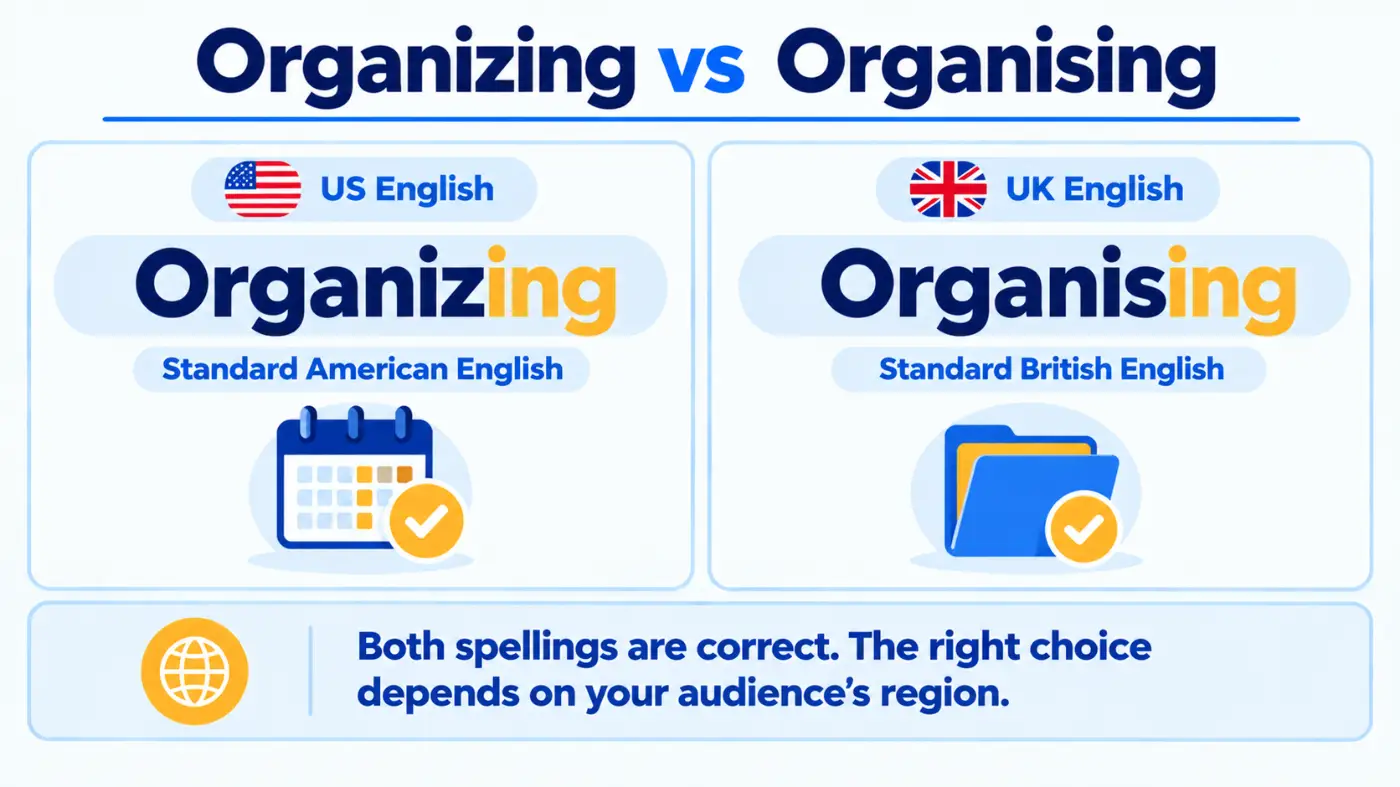
Both spellings are correct. Organizing is standard American English, and organising is standard British English, and the right choice depends entirely on which regional spelling convention your audience expects.
The Short Answer at a Glance
| Form | Region | What it does | Example |
|---|---|---|---|
| organizing | American English | Present participle of organize, describing the act of arranging or structuring something | She’s organizing the garage this weekend. |
| organising | British English | Identical meaning to organizing | She’s organising the garage this weekend. |
Choose based on your reader’s regional spelling convention, not on which one looks more correct. Neither spelling outranks the other.
What Organizing Means and How It Works
Organizing is the present participle of the verb organize, meaning to arrange something into a structured, orderly system, or to coordinate the planning and execution of an event, group, or project. It’s used constantly across everyday life, from tidying a closet to coordinating a company-wide conference.
Grammatically, organizing functions in progressive verb tenses, paired with a form of “to be,” as in “they are organizing the fundraiser” or “he was organizing his notes before the exam.” It also works as a gerund, functioning like a noun, as in “organizing takes real patience,” and as an adjective in phrases like “an organizing committee” or “organizing principle.”
The base verb follows this pattern in American English:
- organize (base form)
- organizes (third-person present)
- organized (past tense and past participle)
- organizing (present participle)
The related noun is organization, referring either to the structured arrangement itself or to a formal group, company, or institution. Organizing is standard throughout American English, appearing in US business writing, education, journalism, and everyday conversation.
What Organising Means and How It Works
Organising means exactly the same thing as organizing: arranging something into order, or coordinating the planning of an event, group, or task. The definition, grammatical behavior, and typical usage are identical to the American form.
The spelling difference reflects a broader pattern affecting a large family of English verbs. British English has traditionally favored “-ise” as the default ending for verbs derived from Greek and Latin roots, including realise, recognise, and standardise, alongside organise. American English standardized on “-ize” for this same group instead.
As with other pairs in this family, the split isn’t perfectly clean. Some British publishers, most notably Oxford University Press, prefer “-ize” spellings for etymological reasons, since many of these words trace back to Greek roots that used a “z” sound. This is often called Oxford spelling, which means “-ize” isn’t purely an American convention, even though “-ise” remains the more common British default.
Organising is standard throughout most British and Commonwealth writing, appearing in UK business communication, education, journalism, and everyday conversation across the UK, Australia, and similar regions that generally favor British spelling conventions.
Organizing vs Organising: Key Differences Side by Side
| Feature | Organizing | Organising |
|---|---|---|
| Part of speech | Verb (present participle), gerund, adjective | Verb (present participle), gerund, adjective |
| Core meaning | Arranging or coordinating something into order | Identical meaning |
| Typical use | American business, education, and everyday writing | British and Commonwealth business, education, and everyday writing |
| Register | Standard in all registers | Standard in all registers |
| Example | He’s organizing his files by project instead of by date. | He’s organising his files by project instead of by date. |
What the table can’t fully capture is how closely this split tracks the broader American versus British “-ize” versus “-ise” pattern seen across dozens of related words. If a document already uses American spellings like realizing and recognizing, organizing will match. If it uses British spellings like realising and recognising, organising is the expected companion.
Correct Examples in Real-Life Contexts
Everyday speech (American)
- I’ve been organizing my closet all weekend and I’m only halfway done.
- She’s always organizing something, whether it’s a party or a spreadsheet.
- We’re organizing a surprise trip for my dad’s sixtieth birthday.
Everyday speech (British)
- I’ve been organising my wardrobe all weekend and I’m only halfway done.
- She’s always organising something, whether it’s a party or a spreadsheet.
Workplace writing (American)
- The team is organizing a client appreciation event for next month.
- HR is organizing the onboarding schedule for new hires starting in January.
- We’re currently organizing feedback from the last round of user testing.
- The committee responsible for organizing the conference meets every Tuesday.
Workplace writing (British)
- The team is organising a client appreciation event for next month.
- HR is organising the onboarding schedule for new hires starting in January.
Texting (American)
- finally organizing my photos from the trip, it’s been months lol
- she’s organizing a group dinner for everyone’s birthdays this quarter
School and academic (American)
- The students are organizing a charity drive for the local food bank.
- Her thesis involved organizing years of historical data into a single database.
- The club is responsible for organizing the annual science fair.
School and academic (British)
- The students are organising a charity drive for the local food bank.
- Her dissertation involved organising years of historical data into a single database.
Formal writing (American)
- The agency is organizing a public hearing to address community concerns.
- The nonprofit’s board is organizing its first annual gala this fall.
- Staff are organizing archival records in preparation for digitization.
Formal writing (British)
- The agency is organising a public hearing to address community concerns.
- Staff are organising archival records in preparation for digitisation.
Common Mistakes People Make (and How to Catch Them)
Mixing spellings within one document
Wrong: The team is organizing the venue, and separately they are organising the catering. Right: The team is organizing the venue, and separately they are organizing the catering.
Switching between spellings mid-document looks inconsistent and often happens when writers combine text from sources using different regional conventions without reviewing for consistency.
Assuming one spelling is more modern or more correct
Wrong belief: Organizing is the newer, more widely accepted spelling, while organising is outdated. Right understanding: Both are equally current and equally correct, differing only by region, not by era or formality.
Because so much global software and business content originates in American English, some writers assume organizing is simply the universal standard. It’s the American spelling, not a more advanced or accurate one.
Ignoring an organization’s established style guide
Wrong: A UK-based company’s internal documents use organizing in some sections and organising in others, depending on who wrote them. Right: The company consistently applies one spelling throughout its materials, matching its stated style guide.
This isn’t a language error exactly, but an inconsistency that becomes noticeable at scale, particularly for organizations communicating across multiple English-speaking markets.
Autocorrect flipping the spelling unexpectedly
Wrong: A writer types organizing, but a British-English spellcheck setting quietly changes it to organising mid-document. Right: Checking your document’s language settings before finalizing content meant for a specific regional audience.
This is a formatting hazard rather than a language mistake, but it can slip through unnoticed in templates or documents shared internationally.
A Fast Trick to Choose the Right One
Match it to your audience’s broader spelling system. If your document already uses American spellings like realizing, recognizing, and color, stick with organizing. If it uses British spellings like realising, recognising, and colour, use organising.
A second trick: think of organizing and organising as part of the same family as realize and realise, or recognize and recognise. If you already know which convention you’re following for those words, organizing and organising will follow the identical pattern.
This trick works well because the “-ize” versus “-ise” split applies consistently across this entire group of verbs within each regional standard. Its main limitation is the Oxford spelling exception, where some British publishers use “-ize” endings for historical reasons even while otherwise following British conventions.
How They Sound in Real Situations
A text exchange (American)
Priya: What are you up to today?
Marcus: Organizing my entire closet, finally.
Priya: Send pics when you’re done, I need the motivation.
Organizing is correct here because the conversation uses standard American spelling throughout.
A workplace email (British)
Subject: Conference planning update
Hi Tom,
I’m currently organising the speaker schedule for next month’s conference and should have a draft ready by Thursday. Let me know if there are any last-minute changes to the agenda.
Regards, Priya
Organising is correct because the email follows British spelling conventions consistently.
An article-style excerpt (American)
Volunteers across the city are organizing donation drives ahead of the winter season, collecting coats, blankets, and non-perishable food for local shelters. Organizers say demand has grown significantly compared to previous years.
Organizing fits naturally here in a piece written for an American audience covering community news.
Formal Writing vs Casual Writing
The spelling choice doesn’t shift based on formality. Both organizing and organising are fully standard in academic papers, government documents, casual conversation, and business writing within their respective regions.
What matters more than formality is audience and publication standard. A US-based company or school will expect organizing consistently throughout its documentation and communications. A UK-based company or school will expect organising in the same spots. Mixing the two within one formal document, regardless of tone, tends to read as an editing oversight rather than a deliberate choice.
AP style, which is American, uses organizing consistently. Most British style guides favor organising, though some UK publishers following Oxford spelling conventions use “-izing” instead. Neither approach treats the other spelling as incorrect; they simply reflect different, equally legitimate editorial standards.
US vs UK English Differences
This is a genuine US versus UK spelling split, following the same broader pattern as many other “-ize” versus “-ise” verb pairs. Organizing is standard throughout American English, appearing in US business, education, and everyday writing. Organising is standard throughout most British English and Commonwealth writing, including much of the UK, Australia, and similar regions that generally favor British spelling conventions.
This pattern mirrors other well-known American versus British pairs like realizing versus realising and recognizing versus recognising. If you’re already familiar with that broader pattern, you already understand this one. The added wrinkle, as with those other pairs, is that some British publishers following Oxford University Press style use “-ize” spellings across this whole word family for historical reasons, even while otherwise using British English.
Related Mix-Ups People Also Search For
Organize vs Organise
This pair follows the identical US versus UK pattern as organizing and organising, differing only in that it’s the base verb form rather than the present participle. Example: The American committee decided to organize the fundraiser themselves, while their British partners offered to organise the venue.
Organizing vs Organizer
Organizing is the verb form describing the action itself, while organizer is the noun referring to the person who performs that action or, in a separate sense, a tool or container used to arrange items. Example: The lead organizer spent weeks organizing every detail of the charity gala.
Organizing vs Organization
Organizing describes the ongoing action of arranging something, while organization is the noun referring either to the resulting structure or to a formal group or institution. Example: Her talent for organizing eventually led her to start her own nonprofit organization.
Quick Practice: Test Yourself
Choose the spelling that fits each context.
- A US-based nonprofit’s newsletter describes volunteers ______ a weekend food drive. (organizing / organising)
- A British event planning company’s website describes its team ______ weddings across the UK. (organizing / organising)
- An American project management course teaches students strategies for ______ large teams. (organizing / organising)
- A UK university’s student union is responsible for ______ campus events. (organizing / organising)
- A US patent filing describes a system for automatically ______ digital files. (organizing / organising)
- An Australian business report discusses best practices for ______ remote teams. (organizing / organising)
Answer Key
- organizing: American context calls for the American spelling.
- organising: British context calls for the British spelling.
- organizing: matches the American course’s regional convention.
- organising: matches UK academic and institutional spelling standards.
- organizing: US patents follow American spelling conventions.
- organising: Australian business writing typically follows British spelling conventions.
Frequently Asked Questions
Is organizing or organising the correct spelling?
Both are correct. Organizing is standard American English, and organising is standard British English, so the right choice depends on your audience’s regional spelling convention.
Do organizing and organising mean the same thing?
Yes. Both words describe the act of arranging something into order or coordinating a task, event, or project, with no difference in meaning or grammatical function.
Why does British English sometimes use “-ise” instead of “-ize”?
British English traditionally favors “-ise” endings for many verbs derived from Greek and Latin roots, though some British publishers, notably Oxford University Press, use “-ize” instead for etymological reasons, a convention known as Oxford spelling.
Which spelling should I use for a US-based audience?
Use organizing for American audiences, since it matches standard US spelling conventions used in business, education, and everyday writing.
Is one spelling more correct than the other?
No. Neither spelling is more accurate or more official than the other. The difference is regional, not a matter of correctness.
Can I use organizing and organising interchangeably in the same document?
It’s best to choose one and use it consistently throughout a single document, since mixing the two regional spellings can look inconsistent even though both are individually correct.

Sophia Bennett writes educational content about English vocabulary, grammar, slang, and communication. She is passionate about making complex language topics accessible to students, professionals, and curious readers around the world.