Lay vs Lie: Which Verb Goes Where
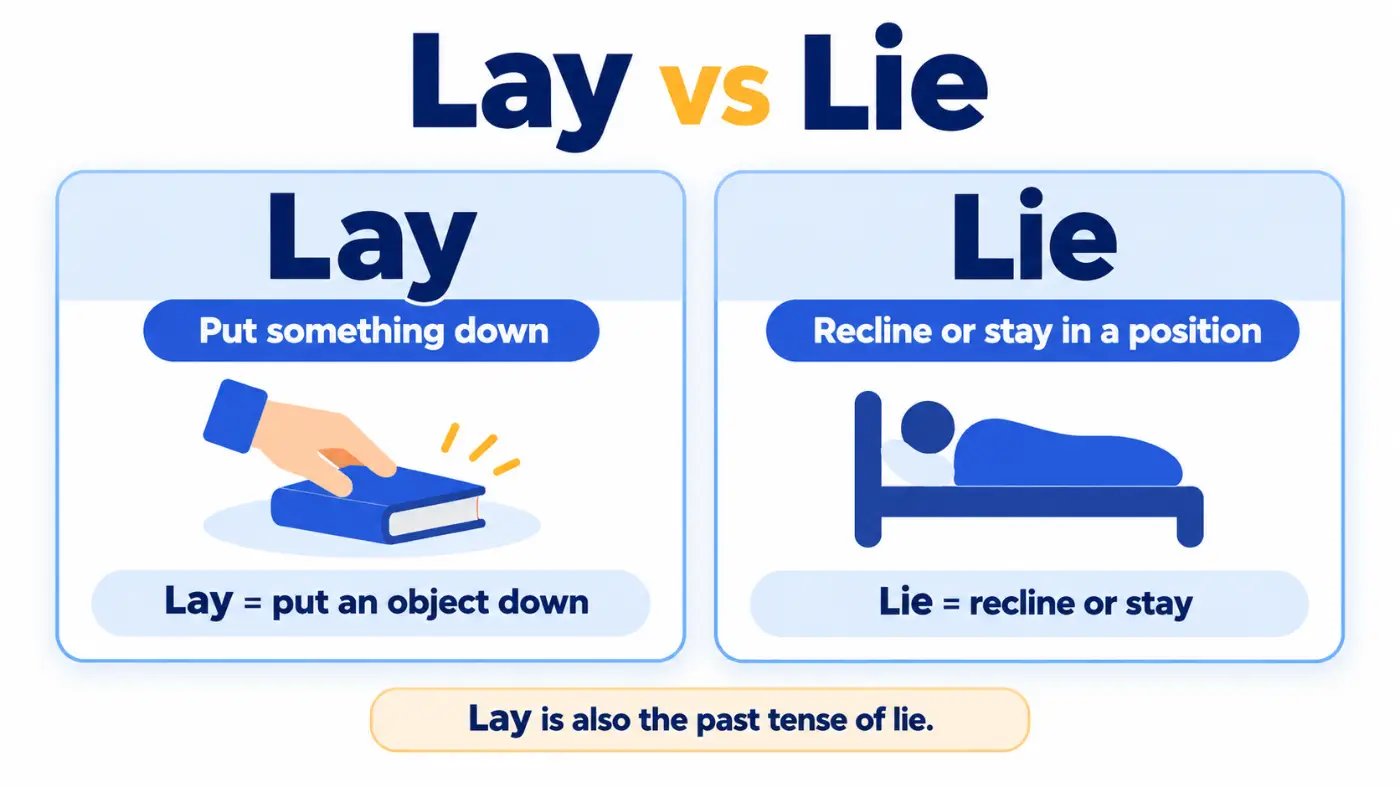
Use lay when you put something down, and use lie when you recline or stay in a position. Lay always needs an object, meaning a thing that gets placed. Lie never takes one. The twist is that lay is also the past tense of lie, and that overlap is the heart of the lay vs lie problem.
The Short Answer at a Glance
| Verb | Core meaning | Needs an object? | Forms | Example |
|---|---|---|---|---|
| Lay | Put or place something. | Yes. | lay, laid, laid, laying | Wen laid the keys on the counter. |
| Lie (recline) | Rest flat or be positioned somewhere. | No. | lie, lay, lain, lying | The dog lay in the shade all afternoon. |
| Lie (untruth) | Say something false. | No. | lie, lied, lied, lying | He lied about the delivery date. |
What Lay Means and How It Works
Lay means to put or place something somewhere, and it’s a transitive verb. Transitive just means the verb has to act on a thing, which grammar calls the direct object. Ask lay what? If you can answer with a rug, a plan, or an egg, you’re in the right place.
The forms are lay, lays, laid, laid, and laying. The past tense and the past participle are the same word, so Pedro laid the rug yesterday and the rug has been laid since Tuesday.
Lay covers physical placing, such as tile, cable, bricks, or a tablecloth. It also covers abstract setting up, like laying a trap, laying the groundwork, laying blame, or laying claim. Common phrasal verbs include lay out, lay off, lay aside, and lay down the rules. Hens lay eggs too.
When a sentence flips into the passive voice, the object moves to the front but the verb stays in the lay family. The cable was laid in a single weekend. Nobody stumbles there, because laid sounds natural.
The trouble starts because the present tense of lay looks exactly like the past tense of lie.
What Lie Means and How It Works
Lie means to rest in a flat position or to be located somewhere, and it never takes an object. Grammar calls this an intransitive verb. Nothing gets placed. The subject just stays put or reclines.
The forms are lie, lies, lay, lain, and lying. The odd one is the past tense, which is lay. The participle lain follows has, have, or had, as in the boat has lain at the dock all winter. Lain is uncommon in everyday speech, which is why people reach for laid instead.
Lie reaches past bodies. A village lies at the foot of a ridge. A problem lies in the budget. An answer lies somewhere in the data. Fixed phrases include lie ahead, lie in wait, lie awake, lie low, and lie in state.
A second, unrelated verb is also spelled lie. It means to say something false, and it’s regular: lie, lied, lied, lying. It works as a noun too, as in that was a lie. Since lying is spelled identically for both verbs, context decides which one you mean. Lying in bed means reclining, and lying about it means fibbing.
Lay vs Lie Key Differences Side by Side
| Feature | Lay | Lie (recline) |
|---|---|---|
| Verb type | Transitive, takes an object. | Intransitive, no object. |
| Core meaning | Put or place something. | Rest, recline, or be located. |
| Present tense | lay, lays | lie, lies |
| Past tense | laid | lay |
| Past participle | laid | lain |
| Ing form | laying | lying |
| Register | Standard at every level. | Standard at every level. |
| Example | Imani laid the blueprints on the table. | The blueprints lay on the table all week. |
Here’s the picture that helps most. Lay carries a package, and lie travels light. Lay can’t leave the house without the thing it’s setting down, and lie needs nothing at all.
The table can’t show how the collision feels in real sentences. The word lay shows up on both sides of the divide, once as a present tense verb with an object and once as a past tense verb without one. Only the meaning tells you which one you’re reading.
Correct Examples in Real Life Contexts
Lay in Action
- Everyday speech: Carmen laid the quilt over her sleeping nephew and switched off the hallway light.
- Workplace writing: The finance team will lay out next quarter’s hiring plan on Monday.
- Texting: Just lay the spare key under the blue flowerpot and I’ll grab it after practice.
- School: The textbook asks students to lay a ruler along the edge of the graph before drawing the line.
- Formal writing: The treaty lays the groundwork for a shared water management system along the border.
- Farm life: Her hens lay about a dozen eggs a week, even in January.
Lie in Action
- Everyday speech: After the long hike, Tobias likes to lie flat on the cool kitchen floor.
- Past tense: Last night the baby lay awake for an hour before she finally drifted off.
- Past participle: The old tractor has lain in that field since the farm was sold.
- Workplace writing: The real bottleneck lies in the approval process, not in the design phase.
- Texting: I’m lying on the couch with a heating pad, so call me when you land.
- The untruth verb: Priyanka never lied to her clients, even when the news was bad.
Common Mistakes People Make and How to Catch Them
- Lay down for a nap. Wrong → I’m going to lay down for a nap. Right → I’m going to lie down for a nap. Spoken English blurs the two verbs, and a nap doesn’t put anything anywhere.
- Laid for the past of lie. Wrong → Yesterday I laid in bed until noon. Right → Yesterday I lay in bed until noon. Laid belongs to lay, but resting is lie, and the past of lie is lay.
- Laid for the participle of lie. Wrong → The files have laid untouched for years. Right → The files have lain untouched for years. Lain feels rare and stiff, so laid fills the gap.
- Laying for lying. Wrong → She was laying on the beach. Right → She was lying on the beach. Both end in ing, but only one needs an object.
- Overcorrecting to lie. Wrong → Lie the groceries on the counter. Right → Lay the groceries on the counter. After being corrected once for lay, some writers start avoiding it everywhere.
- Pet commands. Wrong → Lay down, Bruno. Right → Lie down, Bruno. This may be the most common spoken slip, since you’re telling the dog to recline and nothing is being placed.
A Fast Trick to Choose the Right One
Run the package test. Ask what is being put down. If there’s an answer, write a form of lay. If there’s no answer, write a form of lie.
You can also swap in a plain word. If place or put fits, you want lay. If recline or rest fits, you want lie. In Sofia lay the folder on my desk, place works. In I lay awake all night, rest works.
The trick has limits. It tells you which verb you need, but it can’t hand you the right form. For that, memorize two short lines. Lie goes lie, lay, lain. Lay goes lay, laid, laid. For the untruth verb, add a third: lie, lied, lied.
How Lay and Lie Sound in Real Situations
A text exchange
Rhea: Where’s the spare charger?
Joel: I laid it on the shelf above the dryer. I’m lying on the couch if you need me.
Rhea: Found it. It had lain behind the detergent all week.
Laid has an object, the charger. Lying and lain belong to the reclining verb, which takes no object.
An email snippet
Hi Marcus, the survey crew will lay the final markers on Thursday. The remaining risk lies in the permit timeline, so please keep that date open. Last week the permit lay on the county desk for four days before anyone reviewed it.
Lay the markers puts something in place. Lies in means is located in. The permit lay is the past tense of lie, with no object.
An article excerpt
The old mill has lain empty since 2009, and its owners plan to lay new floors before opening a market hall next spring. Local residents say the building’s future lies in food vendors and weekend concerts.
Has lain is the participle of lie, and lay new floors puts something in place. Lies in works the same way as in the email.
Formal Writing vs Casual Writing
Edited writing keeps the two verbs apart. News stories, academic papers, business emails, and published books all treat lie down and lay the book down as different actions. AP and Chicago both treat the distinction as standard in edited prose.
Casual speech is looser. Lay down for lie down is extremely common in conversation, and it rarely draws a reaction from the listener. Fiction writers sometimes let a character say it on purpose, because real people talk that way.
The practical rule is simple. In anything an editor will see, keep the distinction. In a quick text or a line of dialogue, use your judgment about the voice you want.
Lay vs Lie in American and British English
The core grammar is identical in American and British English. A few fixed phrases differ.
| American | British |
|---|---|
| Set the table | Lay the table |
| Lay of the land | Lie of the land |
Lie of the land is the traditional form and leans British, while lay of the land is the usual American phrasing. Both come from the idea of how terrain is positioned. Americans seldom say lay the table, but a British host might, and both are normal in their own regions.
Related Mix Ups People Also Search For
Laid vs Lain
Laid is the past tense and participle of lay, and lain is the participle of lie. Because lain is rare, many writers rephrase to dodge it. The files have lain untouched can become the files sat untouched, which avoids the issue entirely.
Lying vs Laying
Lying comes from lie, and laying comes from lay. Two workers were laying cable while a third was lying under the truck checking the connections.
Set vs Sit
This is the same kind of pair. Set takes an object, as in set the box down. Sit doesn’t, as in sit on the bench. Their past forms are set and sat.
Raise vs Rise
Another pair built on the same split. Raise takes an object, and rise doesn’t. Prices rise when suppliers raise their rates.
Exceptions Edge Cases and Tricky Situations
- Lie low and lay low. The traditional phrase is lie low, meaning stay out of sight. Lay low is widespread in speech and sometimes appears in print, though careful editors prefer lie low. Lay someone low, as in the flu laid him low, is a separate and correct use because it has an object.
- Dropped objects. A transitive verb can leave its object unstated when everyone knows what it is. The hens are laying well this spring is fine, because eggs are understood.
- Lay yourself down. When the object is a reflexive pronoun, lay down becomes correct. She laid herself down on the hammock is grammatical, though it sounds formal or old fashioned.
- Lay as an adjective. In lay audience or layperson, lay means nonprofessional and has no connection to the verb.
- Compound nouns. Layout, layoff, and layover are single words. The verb forms are lay out, lay off, and lay over.
- Lie plus a preposition. The untruth verb usually takes to or about. He lied to the board about the numbers.
Quick Practice Test Yourself
Choose the correct form for each sentence.
- Please ____ the folded towels on the guest bed.
- Grandpa likes to ____ on the porch swing after lunch.
- Last night I ____ awake until three.
- The hens have ____ more eggs this month than ever.
- The old bicycle has ____ in the garage since spring.
- The crew is (laying or lying) cable under Main Street.
Answer Key
- Lay. Towels are being placed, so the verb needs an object.
- Lie. Grandpa is reclining, and nothing is being placed.
- Lay. It’s the past tense of lie, with no object.
- Laid. It’s the participle of lay, and the hens produced eggs.
- Lain. It’s the participle of lie, because the bicycle is just sitting there.
- Laying. The crew is placing cable.
Frequently Asked Questions
Is it lay down or lie down?
Lie down is correct when a person or animal reclines. Lay down fits only when something is being placed, as in lay the tools down.
What is the past tense of lie?
It depends on the meaning. For reclining, the past tense is lay and the participle is lain. For telling a falsehood, both are lied.
Is it lying or laying in bed?
It’s lying in bed. You’re reclining, and nothing is being put anywhere.
Is I laid in bed ever acceptable?
In edited writing, I lay in bed is the standard form. I laid in bed is common in speech and informal writing, but editors usually correct it.
Why do lay and lie cause so much trouble?
The past tense of lie is lay, which is also the present tense of the other verb. Add a rare participle, lain, and the two verbs overlap in ways few other pairs do.
Is it lay low or lie low?
Lie low is the traditional phrase and the one editors prefer. Lay low is common in speech and does appear in print.

Sophia Bennett writes educational content about English vocabulary, grammar, slang, and communication. She is passionate about making complex language topics accessible to students, professionals, and curious readers around the world.