Adstotally Com Review: Content, Trust, and Guest Posts
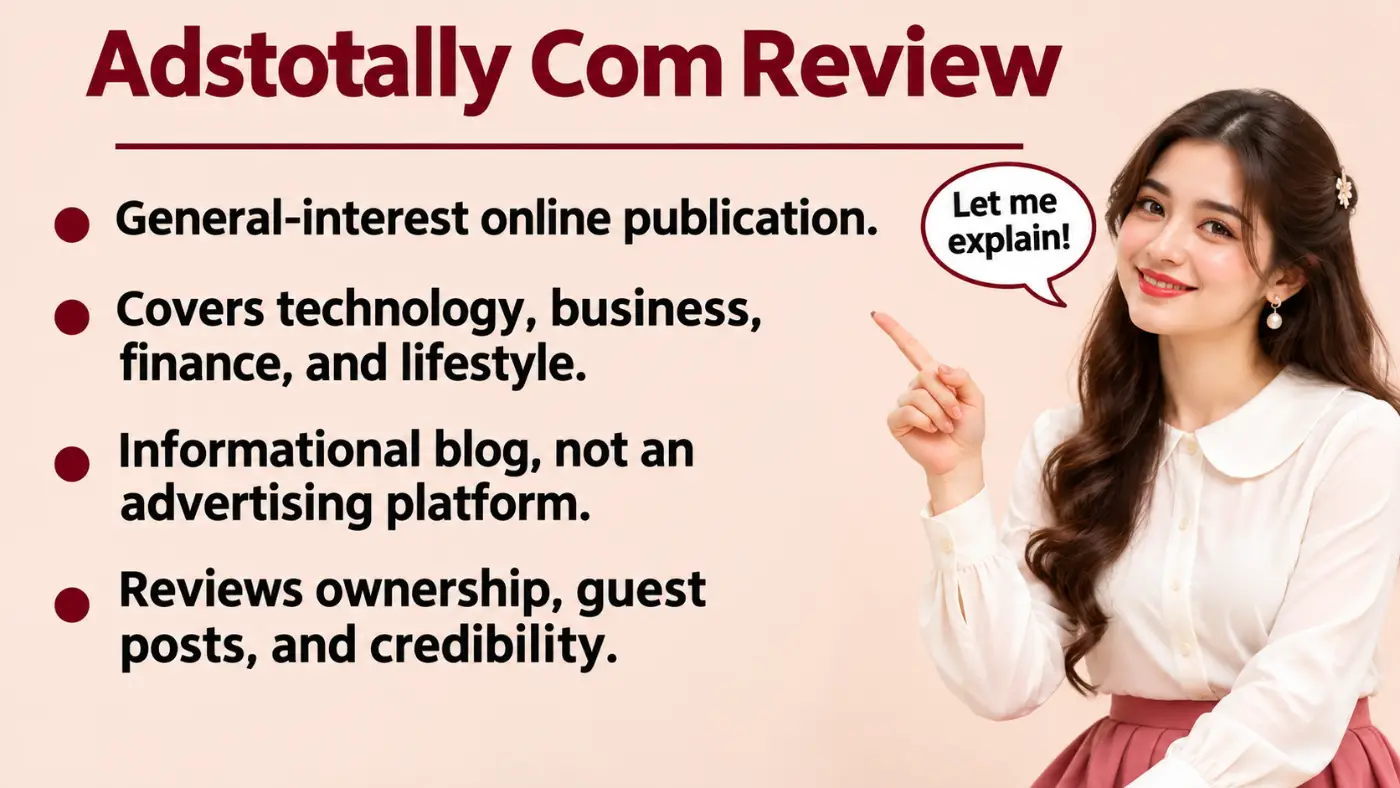
Adstotally Com appears to be a general-interest online publication, rather than the advertising management platform its name might suggest. Independent examinations describe articles on technology, business, personal finance, lifestyle, education, and other everyday subjects. The central service visible in those reports is publishing information for readers, not selling campaign software or operating a publisher earnings dashboard.
That distinction matters to three audiences. Casual visitors want to know what they can read. People researching financial or health topics need to assess the quality of individual claims. Businesses and writers considering a guest article need to understand who controls submissions, whether placements are sponsored, and what evidence supports any audience claims. This review separates reported observations from independently established facts, examines conflicting descriptions, and offers practical checks without treating an unfamiliar name as either an endorsement or an accusation.
Related Post: goralblue com
What Is Adstotally Com?
Adstotally.com is described in multiple independent reviews as a multi-topic article website. Its reported format resembles an online magazine or blog: readers browse categories, open posts, and explore subjects that are not limited to one industry. The name may create an expectation of advertising tools, but available examinations primarily document editorial pages.
The apparent audience includes people seeking introductory explanations, practical tips, and general background information.
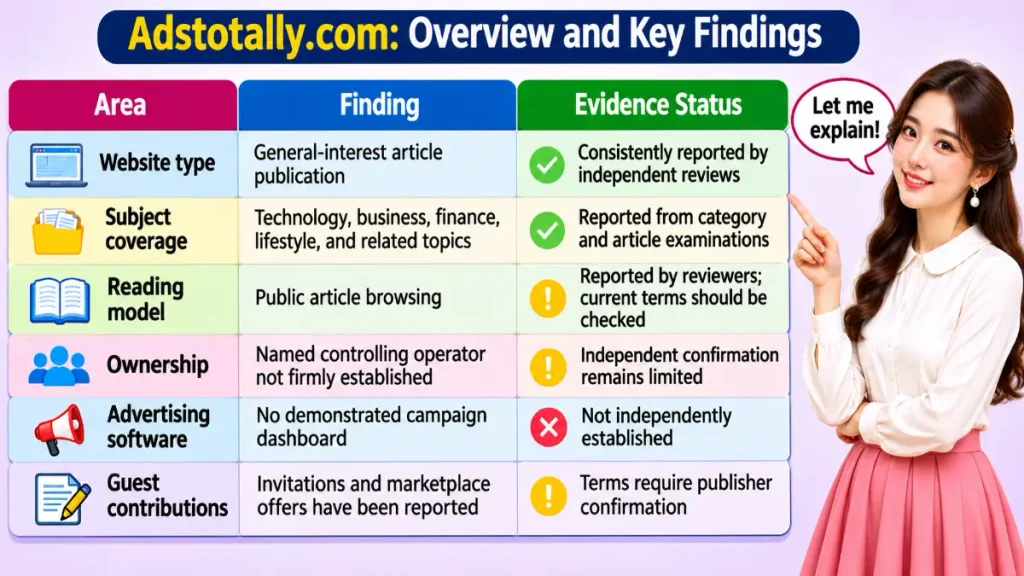
A published article archive is not evidence of a licensed financial service, advertising network, or professional consultancy. Those activities require separate proof.
A Publication, an Ad Platform, or a Service Provider?
Four activities are easily confused. A publication writes or hosts articles. An ad-supported publisher may display advertisements beside those articles. A publisher may also sell clearly disclosed sponsored placements. An advertising platform, by contrast, generally provides operational tools for advertisers or participating publishers, such as campaign creation, targeting, reporting, billing, or payouts.
The first three activities can exist without the fourth. Reports about Adstotally.com describe editorial content and references to advertising or affiliate relationships. They do not establish a functioning advertiser registration system, campaign builder, revenue dashboard, or publisher payout program on the exact domain.
This does not prove that no private commercial service has ever existed. It means readers should not assume advertising-platform capabilities from the word “Ads” in the name. A genuine service claim should be supported by a clear provider identity, actual product documentation, terms, and a usable service pathway.
Some descriptions of the website also mention agency-style digital services. Such wording deserves separate investigation: promotional text, especially text inherited from a website template, does not establish that a company actually delivers those services. Before hiring any provider, request a contract identifying the responsible business, deliverables, price, and support arrangements.
What Topics Does the Website Cover?
Independent reviews identify broad coverage rather than a single specialist subject. Technology and artificial intelligence appear alongside business, finance, education, lifestyle, entertainment, and home-related material. Some reviewers also report health, travel, real estate, fashion, and legal topics. These are reported subject areas, not a claim that every category currently appears as a dedicated navigation tab.
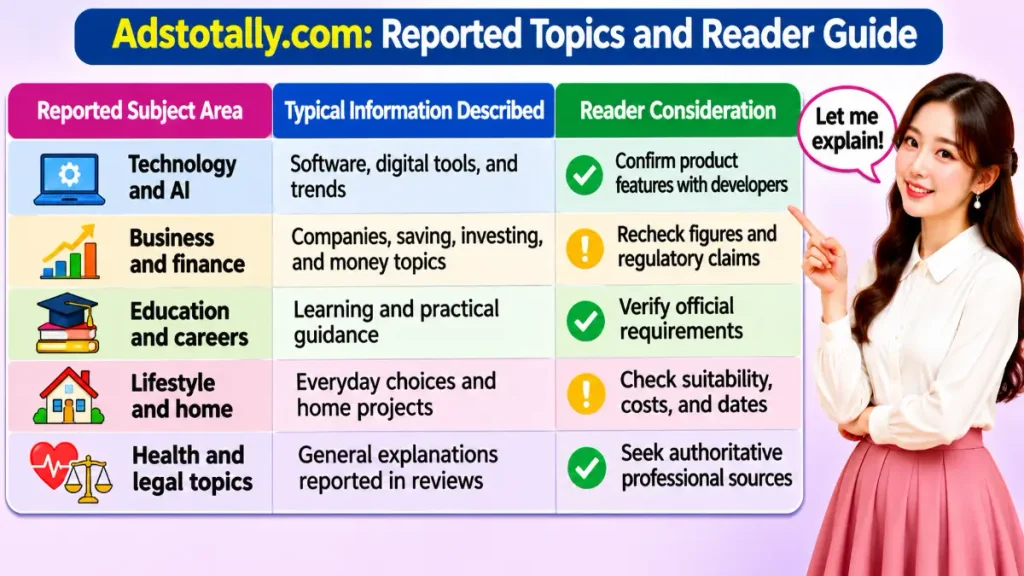
Wide coverage can be useful when a reader wants a starting point. It can also make accountability harder to judge. A writer knowledgeable about home improvement may not be qualified to interpret investment rules or medical studies. The appropriate question is not merely whether an article exists, but whether its author, sources, date, and level of expertise fit the claim being made.
How to Evaluate Its Articles
A rigorous article-level audit requires original titles, publication dates, author records, citations, and update histories. The available secondary examinations discuss examples from different subject areas, but they do not provide a consistently complete five-article evidence record suitable for declaring the whole archive reliable or unreliable. Rather than inventing such a sample, readers can use a repeatable method.
First, check the headline against the body. Does the article actually answer the promised question, or does it offer generic paragraphs that could apply to many websites? Second, find the byline. A username may identify the publishing account without establishing the author’s real identity or qualifications.
Third, examine references. For software instructions, look for official product documentation. For personal finance, compare rates, eligibility rules, and legal obligations with the original provider or regulator. Fourth, inspect the date. A post from several years ago may remain useful for background but be unsuitable for current prices, rules, or product features.
Finally, look for a meaningful correction or update history. An “updated” label is most helpful when readers can tell what changed. An article can be readable and still need independent verification. Conversely, a missing citation does not automatically prove a statement false; it means the reader has less evidence on which to rely.
Ownership, Authors, and Editorial Accountability
Ownership transparency is one of the clearest questions surrounding Adstotally.com. Independent reviews discuss policy and contact pages, but do not consistently establish a named legal operator, responsible editor, or independently verified editorial team. The identity of the website’s controlling operator has not been independently confirmed in this review.
Some examinations describe generic author labels, while others mention additional display names. A display name identifies how an article is presented, not necessarily who researched or fact-checked it. For subjects such as insurance, investing, medical care, or legal obligations, readers should look for relevant credentials and original sources rather than relying on the presence of any byline alone.
Reviewers also describe editorial-policy language addressing sourcing, disclosures, and corrections. Such a policy is a useful statement of intent. It does not, by itself, prove every article complies. The strongest evidence would be clear author biographies, consistently cited articles, visible sponsorship labels, and an understandable process for reporting factual errors.
A responsible publisher should make it practical to request corrections and identify who is accountable for them. Where that responsibility remains unclear, treat the issue as an editorial transparency limitation, not automatic evidence of misconduct.
Domain Age and Publication History Are Different
Reports about Adstotally.com contain dates that may seem inconsistent. Ranktracker reports a domain registration in October 2018. Another independent examination says the homepage displayed an establishment claim referring to 2018 while an About-page description referred to a 2023 founding date. These details are historical third-party reports, not independently refreshed registration findings.
The dates can describe different events. A domain can be registered years before a publication launches, and a site can change its name, format, or publishing model later. Registration does not demonstrate continuous publication, identical ownership, or unchanged editorial standards.
Without a documented timeline, it would be speculative to claim the dates prove deception or a transfer of ownership. The useful next step is to compare original registration records, dated historical snapshots, and statements published by the operator.
Claims, Supporting Evidence, and Remaining Questions
Several recurring descriptions deserve different levels of confidence. The table distinguishes reported observations from functions or figures that require stronger proof.

A particularly important distinction concerns audience statistics. A site may claim a cumulative reader count while a measurement service estimates monthly search visits. These are not interchangeable figures. Tools also use different databases, dates, and models. None should be presented as first-party analytics without supporting records.
Guest Posts and Commercial Offers: What to Confirm
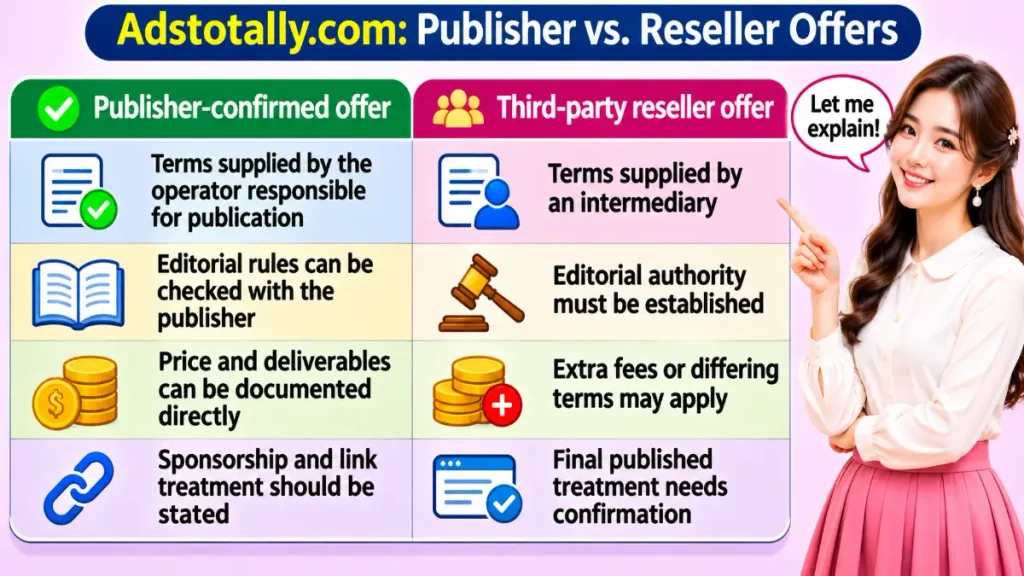
Guest posting is relevant because third-party marketplaces have advertised placements associated with Adstotally.com. Other independent examinations describe an invitation for contributions or partnerships through the publisher’s contact materials. However, a reseller’s listing does not automatically establish the website’s present editorial policy or the reseller’s authority to promise publication.
Before submitting an article or paying for placement, obtain the terms directly from the responsible publisher. Ask who approves submissions, which subjects are acceptable, and whether a human editor reviews factual claims. Confirm whether sponsored content is labeled and how any promotional links are treated.
The commercial terms should specify the fee, what writing or editing is included, whether revisions are permitted, how long the article is expected to remain published, and what happens if a submission is rejected or removed. Refund conditions matter particularly when a seller promises a specific result.
Do not judge a placement solely by estimated domain traffic. A publication might receive visits to its homepage while an individual sponsored article attracts few readers. Request recent, relevant page-level evidence, not merely a domain-wide number.
Is It Legitimate and Safe to Use?
The evidence supports describing Adstotally.com as a reported online publication with an article archive and publicly discussed policies. It does not justify treating every article as authoritative or guaranteeing the safety of every interaction.
Three questions should remain separate. Operational identity concerns whether the domain is associated with the publication described. Editorial reliability concerns whether a particular article is accurate, sourced, and current. Transaction safety concerns the operator and terms involved if money or personal information changes hands.
For ordinary reading, evaluate links and claims with the same caution used on other unfamiliar publications. A browser connection using HTTPS protects data in transit; it does not certify editorial accuracy or prove that a commercial offer is trustworthy.
For health, finance, or legal decisions, verify claims through original institutions or qualified professionals. For contributor payments, confirm the recipient, written agreement, and refund conditions before sending funds. Never provide banking passwords, identification documents, or sensitive account credentials merely because a website or intermediary asks for them.
Limited ownership information is a reason to seek more evidence, not a basis for declaring the publication fraudulent.
Check the Exact Domain Before Trusting a Claim
Research results also mention similarly named domains, including theadstotally.com. A shared word or familiar branding does not prove common ownership, an official partnership, or an identical service.
Check the address character by character before attributing an About-page statement, price, author, or service claim to Adstotally.com. A claim found on a different domain should remain associated with that different domain unless there is explicit, verifiable evidence linking the operators.
This matters especially when responding to a guest-post solicitation or payment request. Ask the sender to establish its relationship to the exact publication, rather than accepting a lookalike name as confirmation.
Strengths, Limitations, and Who It May Suit
The publication’s reported strengths are varied introductory subjects, familiar article-style browsing, and policy pages discussed in independent reviews. These may make it useful for discovering topics or gathering questions to research further.
Its main limitations are less clearly established ownership, unevenly documented author expertise, and uncertainty around commercial terms and audience claims. Breadth of coverage does not automatically supply depth or specialist review.
Casual readers may use an article as an initial explanation. Readers making financial, health, or legal decisions should move to authoritative primary sources. Prospective contributors should assess topic fit, editorial standards, sponsorship labeling, and written commercial conditions before agreeing to publish.
Final Assessment
Adstotally Com is best understood, on the available evidence, as a broad informational publication rather than a demonstrated advertising software platform. Its subject variety may help readers explore everyday questions, but ownership transparency, individual article sourcing, and commercial publishing terms deserve closer examination. Do not confuse domain age with expertise or marketplace figures with audited readership. Read the specific article critically, confirm consequential claims independently, and request written terms before paying for a placement.
Frequently Asked Questions
Is Adstotally.com an advertising network or an article website?
Independent reviews consistently describe an article-based publication. No working advertiser campaign system or publisher earnings dashboard has been established in the evidence considered here. Advertising displayed on a blog is different from operating an advertising network.
Can visitors earn money through the platform?
A publisher payout program has not been independently verified. Do not assume there is a registration process, earnings account, or withdrawal service because the domain contains the word “Ads.” Any such offer needs official documentation.
Is an account required to read articles?
Third-party examinations describe publicly readable articles without a routine registration requirement. That is a reported observation, not a guarantee that every feature or future publication option will have the same access rules.
Who is responsible for the published content?
The controlling operator and a named accountable editorial team have not been independently established here. Readers should inspect individual bylines, cited sources, and the publisher’s correction process when judging a particular article.
Can independent writers submit articles?
Independent reports describe contributor invitations and commercial listings. Submission eligibility, approval standards, and current publication terms should be confirmed with the responsible publisher rather than inferred from a reseller advertisement.
Are guest-post prices publicly confirmed?
Third-party marketplaces have reported different offers, but those amounts are not verified current official prices. Request a written quotation specifying editing, disclosures, link treatment, duration, and refund conditions before paying.
Why do different sources give different founding dates?
Some historical reporting distinguishes a 2018 domain or establishment reference from a 2023 publication founding statement. Domain registration and editorial launch can occur at different times. The difference alone does not establish wrongdoing.
Are similarly named websites connected?
Not necessarily. Domains that look alike may have unrelated operators. Check the exact address and seek explicit evidence of shared ownership or partnership before transferring any claim, contact information, or payment instruction between them.

Sophia Bennett writes educational content about English vocabulary, grammar, slang, and communication. She is passionate about making complex language topics accessible to students, professionals, and curious readers around the world.