Accommodate vs Accomodate: Which Spelling Is Correct?
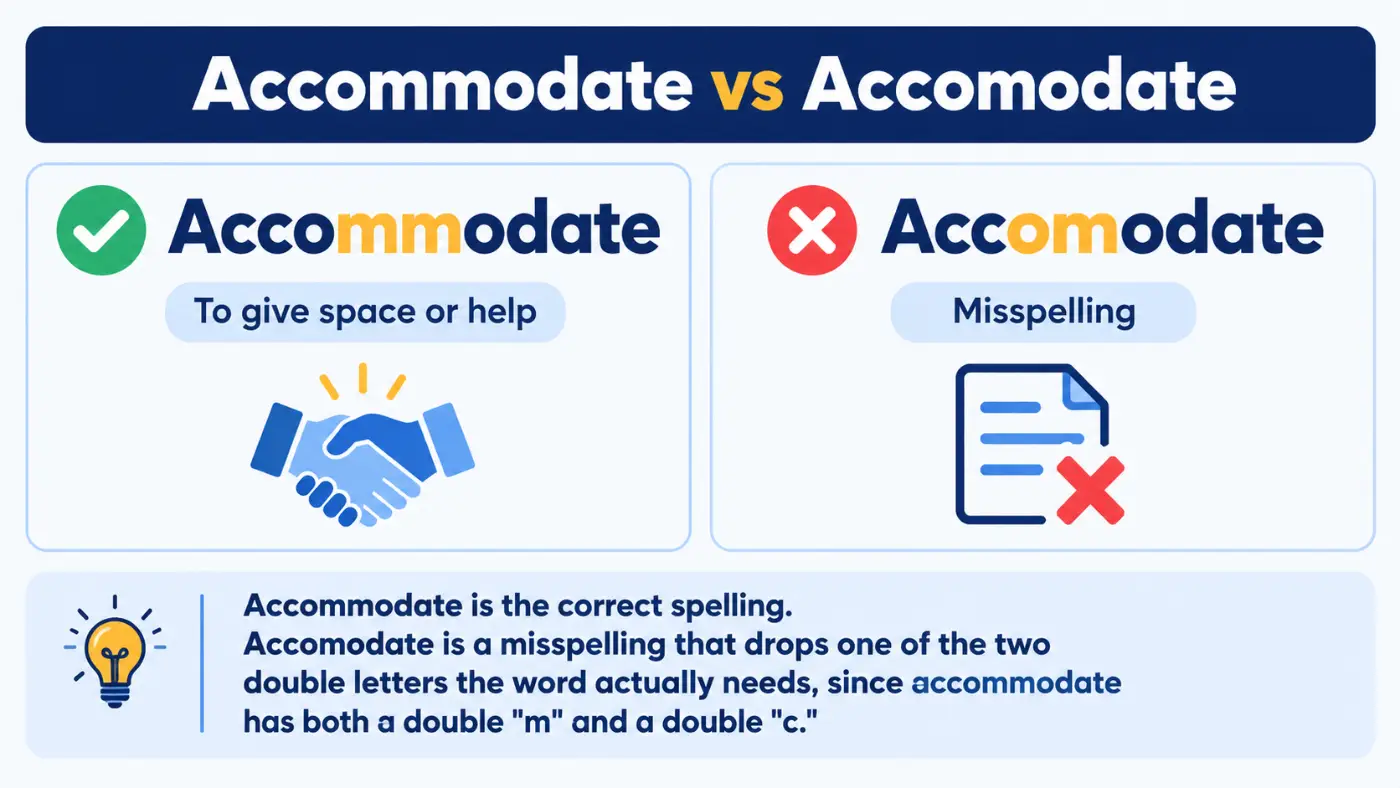
Accommodate is the correct spelling. Accomodate is a misspelling that drops one of the two double letters the word actually needs, since accommodate has both a double “m” and a double “c.”
The Short Answer at a Glance
| Form | Status | What it does | Example |
|---|---|---|---|
| accommodate | Correct | Verb meaning to provide space, adjust for, or fulfill someone’s needs | The hotel accommodated our late check-in without charging extra. |
| accomodate | Misspelling | Not a word in standard English | Correct it to accommodate every time. |
Only one spelling exists here. The double “c” and double “m” both belong in the word, and losing either one produces an error.
What Accommodate Means and How It Works
Accommodate is a verb with a few related meanings, all centered on making room for something or someone. A venue that accommodates five hundred guests is providing physical space. A teacher who accommodates a student’s learning style is adjusting to that student’s needs. And a manager who accommodates an employee’s schedule change is doing them a favor or obliging a request.
Grammatically, accommodate is almost always transitive, meaning it takes a direct object. You accommodate a guest, a request, a disability, or a group. It’s rare to see the verb standing completely alone without something following it.
The verb conjugates in the regular pattern:
- accommodate (base form)
- accommodates (third-person present)
- accommodated (past tense and past participle)
- accommodating (present participle, also used as an adjective, as in “an accommodating host”)
The related noun is accommodation, often used in the plural, accommodations, to describe lodging or arrangements made for someone’s comfort or needs. Both the verb and the noun keep the same double letters.
The spelling traces back to Latin roots involving the idea of fitting or suiting something to a purpose. English absorbed the word with two doubled consonants intact, which is exactly the part that trips people up when writing it from memory.
Is “Accomodate” Ever Correct?
No. Accomodate is one of the most commonly misspelled words in English, and it isn’t a recognized variant, regional spelling, or informal shortcut. It’s simply wrong.
The word has two separate sets of double letters: “cc” and “mm.” Most spelling mistakes here involve dropping one “m,” turning “accommodate” into “accomodate.” Some writers also drop a “c,” though that error is somewhat less frequent.
The core problem is that English doesn’t have a reliable rule for predicting which consonants double and which don’t. Compare accommodate to a word like recommend, which has only one doubled letter (the “mm,” not the “cc”). There’s no shortcut that tells you accommodate needs two sets of doubles while recommend needs only one. You largely have to memorize each word’s specific pattern.
Because the mistake is so common, it’s worth treating as a word to double-check rather than a word to spell from instinct, especially in professional documents like resumes, business letters, and formal requests, where the word appears often.
Accommodate vs Accomodate: Key Differences Side by Side
| Feature | Accommodate | Accomodate |
|---|---|---|
| Recognized word | Yes | No |
| Part of speech | Transitive verb | None |
| Core meaning | To provide space, adjust for, or fulfill a need | No meaning |
| Typical use | Hospitality, workplace requests, accessibility, travel | Appears only as a typo |
| Register | Works in formal and casual writing | Never appropriate |
| Example | The airline accommodated her wheelchair without issue. | The airline accomodated her wheelchair without issue. (wrong) |
The table shows a contrast, but it’s really a contrast between a correctly spelled word and a common typing slip. What the table doesn’t show is how often this exact mistake appears even in otherwise polished writing, since the double “m” is easy to drop without noticing, especially when typing quickly.
Correct Examples in Real-Life Contexts
Everyday speech
- Can your car accommodate all six of us, or should we take two vehicles?
- The restaurant accommodated our last-minute reservation for a party of ten.
- I don’t think this apartment can accommodate a couch that big.
- She’s usually pretty accommodating when plans change at the last minute.
Workplace writing
- HR confirmed they can accommodate a flexible start time for employees with childcare needs.
- The conference room can accommodate up to twenty people comfortably.
- We’ve adjusted the project timeline to accommodate the client’s new budget constraints.
- Please let us know if you require any accommodations for the training session.
Texting
- checking if the airbnb can accommodate an extra guest, one sec
- so glad the venue could accommodate us moving the date last minute
School and academic
- The university’s disability services office arranges accommodations for students who need them.
- Her dissertation examines how urban housing policy could better accommodate multigenerational families.
- The professor agreed to accommodate a makeup exam due to the medical emergency.
- Classrooms are being redesigned to accommodate a wider range of learning needs.
Formal writing
- The facility was renovated to accommodate visitors with mobility impairments.
- Under the agreement, the landlord must accommodate reasonable requests for repairs within thirty days.
- The airline’s policy accommodates passengers traveling with service animals.
- The proposed zoning change would accommodate additional housing density downtown.
Common Mistakes People Make (and How to Catch Them)
Dropping one of the two “m”s
Wrong: The hotel could accomodate our early arrival. Right: The hotel could accommodate our early arrival.
This is by far the most frequent error. Writers remember one doubled consonant but not both, and the “mm” is the one most often reduced to a single letter.
Dropping one of the two “c”s
Wrong: We asked the venue to acommodate a wheelchair user. Right: We asked the venue to accommodate a wheelchair user.
Less common than the missing “m,” but it happens for the same reason: the word simply has more doubled letters than most writers expect.
Confusing it with recommend’s pattern
Wrong: Can you accomodate a same-day appointment? Right: Can you accommodate a same-day appointment?
Because recommend has only one doubled letter, some writers unconsciously apply that simpler pattern to accommodate, which needs two.
Relying on sound instead of spelling
Wrong: The apartment can’t acommadate a large dog. Right: The apartment can’t accommodate a large dog.
Spoken English doesn’t clearly signal double consonants, so writers who sound the word out sometimes guess incorrectly on both the vowels and the doubled letters.
Typing too quickly and skipping a letter
Wrong: They accomodated every request we made. Right: They accommodated every request we made.
Fast typing often drops a repeated letter, since your fingers don’t naturally pause to type the same key twice.
A Fast Trick to Choose the Right One
Break the word into three parts: ac-com-modate. Each syllable hints at a doubled letter. “Ac” plus “com” already gives you two c’s split across the syllable break, and “com” plus “modate” gives you two m’s split the same way.
Another memory aid: think of the word as offering two rooms. One room holds the double “c,” and one room holds the double “m.” If you picture the word as having two separate “double” features, you’re less likely to supply just one.
A quick way to check your work is to say the word slowly, stressing each doubled letter mentally: ac-CC-om-MM-odate. It sounds a little silly, but it forces you to notice both doublings instead of just one.
This trick has one limit. It’s built specifically for this word and doesn’t generalize to other double-letter words like recommend or embarrass, which follow their own individual patterns.
How They Sound in Real Situations
A text exchange
Jordan: Did the restaurant have room for all nine of us?
Alicia: Yes! They accommodated us at a long table in the back.
Jordan: Perfect, see you at 7.
Accommodated is correct here because the restaurant made physical space for the whole group.
A workplace email
Subject: Meeting room request
Hi Facilities,
Could you confirm whether Conference Room B can accommodate fifteen people for Thursday’s training session? If not, please let me know which room would work better.
Thanks, Priya
Accommodate fits because the sentence is asking about physical capacity for a group.
An article-style excerpt
The new terminal was designed to accommodate a sharp rise in international travelers, with wider corridors and additional security lanes. Airport officials say the changes should reduce wait times significantly during peak holiday periods.
Accommodate works well here because the terminal is adjusting its capacity to meet a growing need.
Formal Writing vs Casual Writing
The correct spelling never changes based on register. Accommodate is right in a legal contract, a business email, a text message, and a casual conversation. Accomodate is wrong everywhere, regardless of tone.
What shifts slightly is frequency. Accommodate and its noun form, accommodations, appear constantly in formal writing tied to travel, hospitality, disability access, and workplace policy, since these fields regularly discuss adjusting for people’s needs. In casual speech, people might use simpler alternatives like “fit,” “make room for,” or “work around,” saving accommodate for situations that feel a bit more official or considerate in tone.
AP and Chicago style both treat accommodate as a standard verb with a fixed spelling, and neither offers any accepted shortcut or variant.
Related Mix-Ups People Also Search For
Accommodate vs Accommodation
Accommodate is the verb, describing the act of providing space or adjusting for a need. Accommodation is the noun, often referring to lodging or an arrangement made to meet someone’s requirements. Example: The hotel’s accommodation options were limited, so the staff worked hard to accommodate our group anyway.
Accommodate vs Recommend
Both words contain doubled letters, but the pattern differs. Accommodate doubles both the “c” and the “m,” while recommend doubles only the “m.” Example: I recommend this venue because it can easily accommodate large events.
Accommodating vs Accommodate
Accommodate is the base verb. Accommodating is the adjective form, describing someone or something that readily makes adjustments for others. Example: The staff was incredibly accommodating when we needed to accommodate a wheelchair at the last minute.
Embarrass vs Accommodate
These two are often grouped together as commonly misspelled double-letter words, though their patterns aren’t identical. Embarrass doubles both the “r” and the “s,” while accommodate doubles the “c” and the “m.” Example: It would be embarrassing if the venue couldn’t accommodate the number of guests we invited.
Exceptions, Edge Cases, and Tricky Situations
Accommodate in accessibility contexts
In disability and workplace accommodation contexts, the word carries specific legal weight in many settings, referring to reasonable adjustments made for someone’s needs. The spelling doesn’t change in this specialized use, but it’s worth noting that “accommodation” in this sense often appears as a formal, documented request rather than a casual favor.
Overuse in vague writing
Some writers lean on accommodate as a catch-all verb when a more specific word would communicate more clearly, such as “seat,” “house,” “fit,” or “adjust for.” This isn’t a spelling issue, but it’s a common style habit worth watching for in editing.
Quick Practice: Test Yourself
Choose the correct spelling for each blank.
- The banquet hall can ______ up to two hundred guests. (accommodate / accomodate)
- Our ______ for the trip fell through at the last minute. (accommodations / accomodations)
- The teacher agreed to ______ students who needed extra time on the exam. (accommodate / accomodate)
- She’s known for being extremely ______ when schedules change. (accommodating / accomodating)
- The new policy will ______ employees working from multiple time zones. (accommodate / accomodate)
- We asked the airline whether they could ______ a service dog on the flight. (accommodate / accomodate)
Answer Key
- accommodate: the correct spelling always includes both double letters, “cc” and “mm.”
- accommodations: the noun form keeps the same double letters as the verb.
- accommodate: base form, correctly spelled with both doublings intact.
- accommodating: the adjective form follows the same spelling pattern.
- accommodate: again, both double letters are required.
- accommodate: consistent with every other correct form of the word.
Frequently Asked Questions
Is “accomodate” ever an acceptable spelling?
No. Accomodate is a misspelling in every context, not a regional variant or informal shortcut. The correct spelling always includes both double letters.
Why does accommodate have two sets of double letters?
The word inherited its spelling from Latin roots, and English preserved both doubled consonants when it adopted the word. There’s no simpler explanation beyond that historical spelling.
What’s the difference between accommodate and accommodation?
Accommodate is a verb describing the act of making room for or adjusting to someone’s needs. Accommodation is the noun form, often referring to lodging or a specific arrangement made for someone.
Is accommodate spelled the same in British and American English?
Yes. Both British and American English use the identical spelling, accommodate, with no regional variation.
How can I remember both double letters in accommodate?
Breaking the word into ac-com-modate can help, since the syllable split lines up with where each doubled letter falls. Practicing the word slowly, emphasizing both doublings, also reinforces the correct spelling over time.
Does accommodate always mean providing physical space?
No. It can also mean adjusting to someone’s needs, granting a request, or adapting a plan, in addition to providing room or lodging..

Sophia Bennett writes educational content about English vocabulary, grammar, slang, and communication. She is passionate about making complex language topics accessible to students, professionals, and curious readers around the world.