Amateur vs Amatuer: Which Spelling Is Correct?
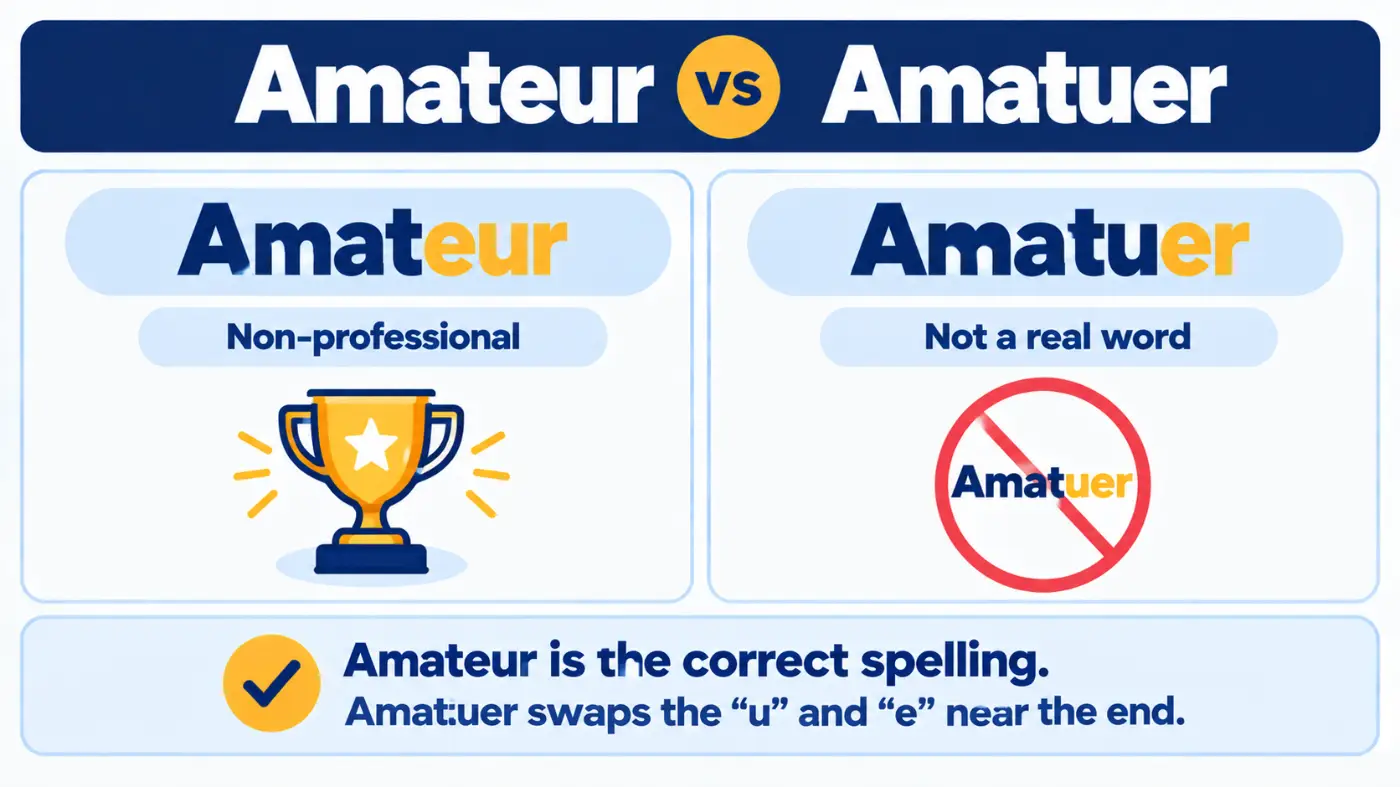
Amateur is the correct spelling. Amatuer is a misspelling that swaps the order of the “u” and the “e” near the end of the word, a slip that happens easily because the ending doesn’t sound the way it looks.
The Short Answer at a Glance
| Form | Status | What it does | Example |
|---|---|---|---|
| amateur | Correct | Noun or adjective describing someone who does something without pay, or without professional skill | Nadia is an amateur photographer who shoots weddings for fun. |
| amatuer | Misspelling | Not a word in standard English | Correct it to amateur every time. |
Only one spelling is real. The letters “e” and “u” are simply in the wrong order in the incorrect version.
What Amateur Means and How It Works
Amateur works as both a noun and an adjective, and the two uses cover related but slightly different ground. As a noun, an amateur is someone who takes part in an activity, often a sport, art, or hobby, without being paid for it or without pursuing it as a profession. As an adjective, amateur describes something connected to that non-professional status, as in an amateur boxer or an amateur film.
There’s a second layer to the word that goes beyond payment. Amateur can also describe a lower level of skill or polish, regardless of whether money changes hands. A professional’s amateur mistake is a slip that seems beneath their usual standard. This sense carries a mildly critical edge that the “unpaid participant” sense doesn’t necessarily have.
Grammatically, amateur behaves like a regular noun when it names a person: an amateur, the amateur, several amateurs. As an adjective, it sits directly before the noun it modifies, the same way most English adjectives do: an amateur chef, an amateur radio operator, an amateur mistake.
The word comes from a root related to love or fondness, which explains the underlying idea: an amateur originally engages in something purely out of enthusiasm, not for money. That root also explains the tricky spelling, since English borrowed the word largely intact rather than reshaping its ending to match more familiar patterns.
The related adjective amateurish describes something that looks unpolished or unskilled, often with a critical tone. The noun amateurism refers to the status or philosophy of remaining unpaid in a given field, which shows up often in discussions of sports eligibility.
Is “Amatuer” Ever Correct?
No. Amatuer isn’t recognized in any standard dictionary, and it isn’t a regional variant, informal shortcut, or older spelling. It’s a straightforward letter-order mistake.
The word’s ending, “-ateur,” doesn’t map cleanly onto how English speakers hear the word spoken aloud. Say amateur out loud, and the final syllable comes out close to “-tur” or “-cher,” depending on your accent. Neither pronunciation gives a strong clue about whether the “e” or the “u” comes first in the spelling, which is exactly why so many people guess wrong.
This kind of error, where two letters near the end of a word get flipped, is common in borrowed words that don’t follow typical English spelling patterns. Amateur came into English largely unchanged from French, and its ending doesn’t behave the way native English word endings usually do.
Because the mistake is about letter order rather than missing or extra letters, it can be easy to miss on a quick read, since amatuer still looks roughly like the right word at a glance.
Amateur vs Amatuer: Key Differences Side by Side
| Feature | Amateur | Amatuer |
|---|---|---|
| Recognized word | Yes | No |
| Part of speech | Noun and adjective | None |
| Core meaning | Someone unpaid or unskilled in an activity; relating to that status | No meaning |
| Typical use | Sports, arts, hobbies, casual criticism of skill level | Appears only as a typo |
| Register | Works in formal and casual writing | Never appropriate |
| Example | The amateur astronomer spotted the comet before professionals did. | The amatuer astronomer spotted the comet before professionals did. (wrong) |
The table lines the two up as if they were competing options, but really it’s showing one correct word and one transposed error. What the table can’t fully capture is how often this particular flip slips past a quick proofread, since the misspelling preserves every letter the real word has, just in a different order near the end.
Correct Examples in Real-Life Contexts
Everyday speech
- My uncle is an amateur beekeeper, and he’s convinced every guest to try his honey at least once.
- That was an amateur move, forgetting the tickets in the car.
- She’s strictly an amateur painter, but her landscapes look like they belong in a gallery.
- He picked up amateur radio as a hobby during the pandemic and never stopped.
Workplace writing
- The marketing intern’s amateur attempt at the campaign slide deck still needs significant revision.
- We’re partnering with several amateur athletes for the new sponsorship campaign.
- The client called our first draft amateurish, so we’re reworking the entire proposal.
- Please avoid amateur terminology in the technical documentation going forward.
Texting
- lol that was such an amateur mistake, forgot to hit save before closing the file
- my cousin is competing in an amateur boxing match this weekend, wanna come
School and academic
- The debate club welcomes both experienced students and complete amateurs.
- Her thesis explores the history of amateur astronomy clubs in the twentieth century.
- The coach explained the difference between amateur and professional eligibility rules.
- Amateur theater groups often rely entirely on volunteer labor and community donations.
Formal writing
- The organization maintains strict guidelines distinguishing amateur status from professional status.
- Amateur athletes competing in the tournament must meet the eligibility requirements outlined in section four.
- The gallery’s current exhibit features work exclusively from amateur artists in the region.
- Regulatory bodies have debated redefining amateur status for decades.
Common Mistakes People Make (and How to Catch Them)
Swapping the final “e” and “u”
Wrong: He’s just an amatuer, but his work looks professional. Right: He’s just an amateur, but his work looks professional.
This is the core error behind the whole confusion. The ending sounds ambiguous when spoken, so writers guess at the letter order and often get it backward.
Typing from memory without double-checking
Wrong: The competition is open to amatuers of all skill levels. Right: The competition is open to amateurs of all skill levels.
Because amateur doesn’t follow familiar English spelling patterns, writers relying purely on memory are more likely to transpose the tricky letters near the end.
Trusting autocorrect blindly
Wrong: My phone changed it to amatuer and I didn’t catch it before sending. Right: Reviewing autocorrect suggestions before sending, since some keyboards don’t always flag this specific transposition.
Not every spellchecker catches every transposition error, especially in less common words, so a quick visual check still matters.
Confusing amateur with a completely different word
Wrong: The amature radio hobbyist upgraded his antenna. Right: The amateur radio hobbyist upgraded his antenna.
This variant drops a letter entirely rather than swapping two, but it stems from the same core uncertainty about how the ending is built.
A Fast Trick to Choose the Right One
Anchor the ending to the word “amateurish.” Because amateurish is a common word in its own right, and its spelling makes the “e-u-r” sequence clearer in context, recalling it can help you lock in the base word’s correct ending.
A second trick is to break the word into two chunks: “ama” and “teur.” The second chunk, “teur,” shows up in other French-derived English words like chauffeur and connoisseur, where the same “e” before “u” pattern holds. If you can spell chauffeur, the ending of amateur follows the identical shape.
This trick works well for amateur specifically, but it won’t help with every “e” and “u” combination in English, since spelling patterns vary widely depending on a word’s origin.
How They Sound in Real Situations
A text exchange
Reese: Are you actually good at chess or just messing around?
Priya: Strictly amateur level, but I’ve been practicing.
Reese: Amateur or not, you beat me twice last week.
Amateur is correct here because Priya is describing her skill level honestly, without claiming professional status.
A workplace email
Subject: Sponsorship opportunity
Hi Daniel,
We’re reaching out because your gym coaches several amateur boxers who’ve had strong regional results this year. We’d love to discuss a small sponsorship package ahead of next month’s tournament.
Best, Carla
Amateur fits because the email is specifically about unpaid competitors, not professionals under contract.
An article-style excerpt
The community theater’s latest production leans heavily on amateur talent, with most cast members holding full-time jobs unrelated to the stage. Despite the modest budget, reviewers praised the show’s energy and heart.
Amateur is the right word because it precisely captures the unpaid, non-professional nature of the cast.
Formal Writing vs Casual Writing
The correct spelling stays the same across every register. Amateur is right in a legal document, a sports federation’s bylaws, a text message, and a casual blog post. Amatuer is wrong no matter how formal or informal the writing is.
What shifts with register is tone. In formal writing, amateur often appears in precise, rule-based contexts, such as eligibility requirements for competitions or classifications in creative fields. In casual speech, amateur frequently carries a lighter, sometimes self-deprecating tone, as when someone describes their own cooking or DIY skills as “amateur at best.”
AP and Chicago style both treat amateur as a standard word requiring no special formatting, and neither offers any accepted alternative spelling.
Related Mix-Ups People Also Search For
Amateur vs Professional
These two describe opposite ends of the same spectrum. An amateur typically participates without pay or formal training, while a professional does the same activity for a living, often with certification or extensive experience. Example: The amateur chef’s dish impressed even the professional judges on the panel.
Amateurish vs Amateur
Amateur is the noun or adjective describing someone’s status or a related activity. Amateurish is a separate adjective describing something that looks unskilled or unpolished, regardless of who made it. Example: The professional firm’s amateurish website redesign disappointed the client.
Chauffeur vs Amateur
These words share the same “eur” ending pattern, both borrowed largely intact from French. Getting one right can help you remember the other. Example: The amateur driver still hired a professional chauffeur for the wedding.
Connoisseur vs Amateur
Another French-derived word sharing a similar ending shape, though connoisseur refers to someone with refined expertise or taste, which can sit in tension with the more casual sense of amateur. Example: Despite being an amateur collector, she’s become something of a connoisseur of vintage postcards.
Exceptions, Edge Cases, and Tricky Situations
Amateur as a mild criticism
When amateur describes an action rather than a person’s status, it often carries a subtly negative tone, as in “that was an amateur mistake.” This use doesn’t require the person to actually be unpaid or inexperienced in general; it simply flags one specific misstep as unpolished.
Amateur status in organized sports
In sports contexts, amateur status often carries formal, rule-based definitions tied to eligibility for certain competitions, scholarships, or leagues. These definitions can be more precise and technical than the everyday meaning of the word, though the spelling never changes.
Amateur radio as a specific hobby name
Amateur radio, often called ham radio informally, is a specific, named hobby and licensed activity, not just a casual description of someone dabbling in radio equipment. The term functions almost like a fixed name in this context.
Quick Practice: Test Yourself
Choose the correct spelling for each blank.
- My neighbor is an ______ gardener who somehow grows better tomatoes than the local farm stand. (amateur / amatuer)
- That presentation looked pretty ______, honestly. (amateurish / amatuerish)
- The tournament is open to both ______ and professional players. (amateurs / amatuers)
- He picked up ______ photography as a way to relax after work. (amateur / amatuer)
- She’s no ______, but she still has a lot to learn about wine tasting. (amateur / amatuer)
- The ______ astronomer’s photo of the eclipse went viral online. (amateur / amatuer)
Answer Key
- amateur: the correct spelling always places the “e” before the “u” near the ending.
- amateurish: the adjective form follows the same correct letter order as amateur.
- amateurs: the plural noun, spelled the same way with an added “s.”
- amateur: base form, correctly spelled.
- amateur: correct here even in a sentence implying some skill, since the spelling doesn’t change based on tone.
- amateur: consistent with every other correct form of the word.
Frequently Asked Questions
Is “amatuer” ever an acceptable spelling?
No. Amatuer is a misspelling in every context, not a regional variant or informal option. The correct spelling is always amateur.
Why is amateur spelled with “eu” instead of “ue”?
Amateur comes from French largely unchanged, and English preserved that ending rather than reshaping it to match more typical English spelling patterns.
Is amateur always used to criticize someone’s skill?
No. Amateur often simply describes someone’s unpaid or non-professional status, without implying anything negative about their actual ability.
What’s the difference between amateur and amateurish?
Amateur describes a person’s status or something related to that status, while amateurish specifically describes something that looks unskilled or unpolished, regardless of who created it.
Can a highly skilled person still be called an amateur?
Yes. Amateur status is often based on payment or professional classification rather than actual skill level, so a highly skilled hobbyist can still be an amateur in the technical sense.
What is the noun form describing the general concept of being an amateur?
The noun is amateurism, which refers to the status, philosophy, or practice of participating in an activity without pay.

Sophia Bennett writes educational content about English vocabulary, grammar, slang, and communication. She is passionate about making complex language topics accessible to students, professionals, and curious readers around the world.