Sightseeing vs Siteseeing: Which Spelling Is Correct?
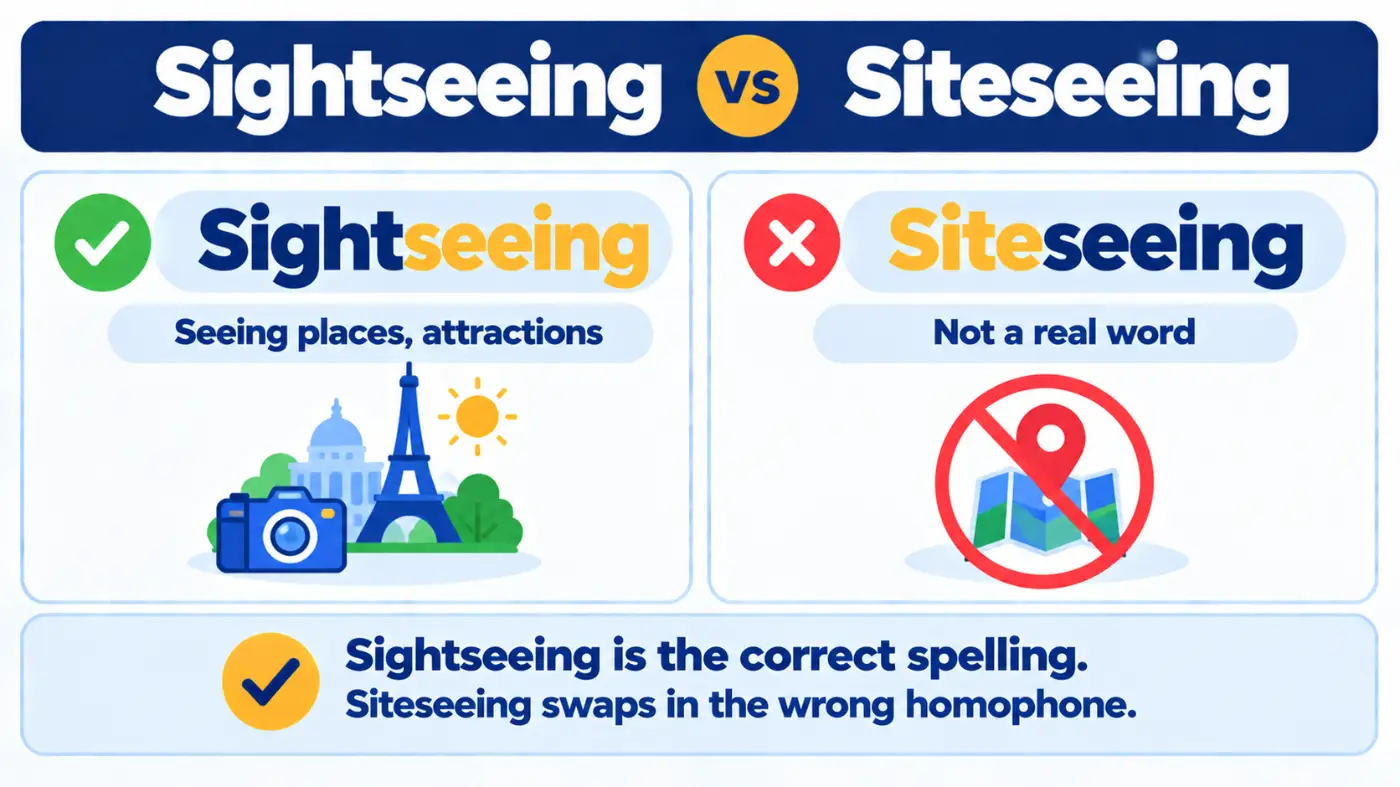
Sightseeing is the correct spelling. Siteseeing is a misspelling that swaps in the wrong homophone, since the word is built from “sight,” meaning something you view, not “site,” meaning a location.
The Short Answer at a Glance
| Form | Status | What it does | Example |
|---|---|---|---|
| sightseeing | Correct | Noun describing the activity of visiting and viewing places of interest | We spent the whole afternoon sightseeing around the old town. |
| siteseeing | Misspelling | Not a word in standard English | Correct it to sightseeing every time. |
Only one spelling is real. The confusion comes from a pair of homophones, “sight” and “site,” not from two competing forms of the same word.
What Sightseeing Means and How It Works
Sightseeing is a noun that describes the activity of visiting places of interest, particularly for tourists exploring landmarks, scenery, or notable locations. It’s what you’re doing when you tour a city’s monuments, wander through a historic district, or drive along a scenic route just to take in the views.
The word is a compound built from “sight,” meaning something worth looking at, and “seeing,” the act of viewing it. Put together, sightseeing literally describes seeing sights, which is a fitting origin for a word about tourism and exploration.
Grammatically, sightseeing functions primarily as a noun, often paired with “go” as in “go sightseeing,” similar to how you’d say “go shopping” or “go swimming.” It can also function as an adjective in phrases like “a sightseeing tour” or “a sightseeing bus,” describing something related to that activity.
There’s also a related noun form, sightseer, referring to a person who engages in sightseeing. Both words keep the same “sight” spelling throughout, since the whole family of terms is built on the idea of viewing something notable.
Sightseeing typically implies a somewhat leisurely, tourist-oriented activity rather than a purposeful visit to one specific destination. You go sightseeing around a city, taking in multiple views and locations, rather than sightseeing to a single restaurant or office building.
Is “Siteseeing” Ever Correct?
No. Siteseeing isn’t recognized in any standard dictionary, and it isn’t a regional variant, dated form, or accepted alternative spelling. It’s a homophone mistake, meaning it swaps in a word that sounds identical but means something different.
English has three words that all sound alike: sight, site, and cite. Sight relates to vision and things worth viewing. Site relates to a location or place, as in a construction site or a website. Cite relates to referencing or quoting a source. Because sightseeing is entirely about visually experiencing places, it’s easy to see how “site,” a word specifically about location, might feel like it fits just as naturally.
The mix-up makes intuitive sense on the surface, since sightseeing does involve visiting sites in the general sense of the word. But the actual compound word isn’t built from “site” at all. It’s built from “sight,” the noun describing something seen, paired with “seeing,” the verb form describing the act of viewing it.
Because “sight” and “site” are pronounced identically, this error is purely a spelling issue rather than a pronunciation one, and it tends to show up more often in casual or quickly typed writing than in carefully proofread text.
Sightseeing vs Siteseeing: Key Differences Side by Side
| Feature | Sightseeing | Siteseeing |
|---|---|---|
| Recognized word | Yes | No |
| Part of speech | Noun and adjective | None |
| Core meaning | Visiting and viewing places of interest | No meaning |
| Typical use | Travel, tourism, vacation planning | Appears only as a typo |
| Register | Works in formal and casual writing | Never appropriate |
| Example | The tour includes a full day of sightseeing in the historic district. | The tour includes a full day of siteseeing in the historic district. (wrong) |
The table lays out a clear contrast, but what it can’t fully explain is how plausible siteseeing looks at a glance. Because “site” is such a common, correctly spelled word on its own, the misspelling doesn’t jump out the way an obviously garbled word would, which is part of why it persists in casual writing.
Correct Examples in Real-Life Contexts
Everyday speech
- We’re planning to spend our first day in Rome just sightseeing before the tour officially starts.
- I love sightseeing more than shopping when I travel.
- After the wedding, we squeezed in a bit of sightseeing before flying home.
- The kids got tired of sightseeing by the third museum, honestly.
Workplace writing
- The travel agency’s package includes three guided sightseeing excursions.
- Our client requested a lighter itinerary with more sightseeing and fewer scheduled meetings.
- The conference schedule leaves Friday afternoon open for optional sightseeing.
- Please confirm whether the sightseeing bus tour requires advance booking.
Texting
- day one was just sightseeing, tomorrow we actually do stuff
- can’t wait for the sightseeing part of the trip, I’m so ready to see everything
School and academic
- The study examines how sightseeing patterns have shifted among younger travelers.
- Students on the exchange program spent their first weekend sightseeing around the capital.
- Her research paper explores the economic impact of sightseeing tourism on small coastal towns.
- The class discussed how sightseeing behavior differs between first-time and repeat visitors.
Formal writing
- The itinerary allocates two full days for sightseeing before the conference begins.
- Sightseeing revenue accounts for a significant portion of the region’s tourism economy.
- The report recommends expanding sightseeing infrastructure to accommodate rising visitor numbers.
- Guided sightseeing tours are included in the total cost of the package.
Common Mistakes People Make (and How to Catch Them)
Swapping “sight” for its homophone “site”
Wrong: We spent the afternoon siteseeing near the harbor. Right: We spent the afternoon sightseeing near the harbor.
This is the core error. Because “sight” and “site” sound identical, writers relying on pronunciation alone often guess the wrong spelling.
Assuming the word relates to physical locations rather than viewing
Wrong: The siteseeing tour stops at five different sites downtown. Right: The sightseeing tour stops at five different sites downtown.
Interestingly, this sentence can correctly use “sites” for the locations themselves while still needing “sightseeing” for the activity name, since the two words serve different roles even within the same sentence.
Typing quickly without noticing the swapped letter
Wrong: Let’s go siteseeing this weekend instead of staying in. Right: Let’s go sightseeing this weekend instead of staying in.
Fast typing sometimes defaults to the more visually familiar “site,” especially for writers who type website-related terms often and have that spelling more readily available in muscle memory.
Trusting autocorrect inconsistently
Wrong: My phone didn’t catch it, so siteseeing made it into the final email. Right: Sightseeing is the version that should appear in any proofread document.
Not all spellcheck tools flag this error, since “site” is a correctly spelled word on its own, just the wrong one for this particular compound.
A Fast Trick to Choose the Right One
Think about what sightseeing actually involves: using your eyes to view something. That connects directly to “sight,” the word about vision and visible things, not “site,” the word about a location or piece of land.
A useful substitution test: try replacing “sight” with “view” in your mind. Sightseeing becomes roughly “view-seeing,” which still makes sense as the act of viewing notable things. Trying the same swap with “site” gives you “location-seeing,” which doesn’t capture the meaning nearly as well.
This trick works because it grounds the spelling in the word’s actual meaning rather than its sound. Its only limitation is that it requires pausing for a second to think it through, rather than relying purely on instinct, which is exactly the habit that helps prevent homophone errors in general.
How They Sound in Real Situations
A text exchange
Mia: What’s the plan for tomorrow?
Jordan: Sightseeing all morning, then we’re free in the afternoon.
Mia: Perfect, I really want to see the old cathedral.
Sightseeing is correct here because the conversation is specifically about touring and viewing landmarks.
A workplace email
Subject: Updated conference itinerary
Hi everyone,
I’ve adjusted Thursday’s schedule to include an optional sightseeing tour of the city center for anyone who arrives early. Let me know by Monday if you’d like to join.
Best, Renata
Sightseeing is correct because the email describes a leisure activity centered on viewing local landmarks.
An article-style excerpt
Tourism officials reported a sharp rise in sightseeing visits to the coastal region this summer, with several new walking tours launched to accommodate demand. Local guides say the increase reflects growing interest in slower, more immersive travel experiences.
Sightseeing fits naturally here, describing the broader activity of touring and viewing the region’s attractions.
Formal Writing vs Casual Writing
The correct spelling doesn’t change based on formality. Sightseeing is right in a travel brochure, a tourism report, a text message, and a casual conversation. Siteseeing is wrong everywhere, regardless of tone or setting.
What shifts slightly with register is phrasing. In casual speech, people often say “go sightseeing” as a simple, informal way to describe a day of touring. In formal or industry writing, sightseeing frequently appears as a modifier in more structured phrases, such as “sightseeing tourism,” “sightseeing infrastructure,” or “sightseeing revenue,” reflecting its role as an economic and planning category rather than just a leisure activity.
AP and Chicago style both treat sightseeing as a standard compound word with a fixed spelling, and neither offers any accepted alternate form.
Related Mix-Ups People Also Search For
Sight vs Site vs Cite
These three words are the root of the entire confusion behind sightseeing versus siteseeing. Sight relates to vision, site relates to a location, and cite relates to referencing a source. Example: The historic site offered a stunning sight of the valley, which the guidebook cited as one of the region’s top attractions.
Sightseeing vs Site-seeing (Hyphenated)
Some writers hyphenate incorrectly as “site-seeing,” which combines both the wrong homophone and an unnecessary hyphen, since standard sightseeing is written as one solid word without a hyphen. Example: The brochure advertised a full day of sightseeing, not site-seeing, through the region’s vineyards.
Insight vs Incite
These two share the same “sight” versus a different-sounding word pattern that causes similar confusion, though the words themselves aren’t homophones. Insight relates to understanding, while incite means to provoke action. Example: Her insight into local history helped incite genuine excitement among the sightseeing group.
Quick Practice: Test Yourself
Choose the correct spelling for each blank.
- We spent our honeymoon mostly ______ through small coastal towns. (sightseeing / siteseeing)
- The construction ______ was closed to visitors during our trip. (site / sight)
- Our guide recommended a full day of ______ before the festival begins. (sightseeing / siteseeing)
- The mountain view was truly a breathtaking ______. (site / sight)
- The travel package includes airfare, hotel, and guided ______ tours. (sightseeing / siteseeing)
- Please ______ your sources at the end of the report. (cite / site)
Answer Key
- sightseeing: the correct spelling for the tourism activity, built from “sight.”
- site: correctly refers to a specific location, in this case a construction area.
- sightseeing: consistent with the correct compound word spelling.
- sight: refers to something visually impressive, not a location.
- sightseeing: correct spelling describing the guided tours.
- cite: refers to referencing sources, a different homophone entirely.
Frequently Asked Questions
Is “siteseeing” ever an acceptable spelling?
No. Siteseeing isn’t recognized in standard dictionaries and isn’t used as a regional or informal variant. The correct spelling in every context is sightseeing.
Why is sightseeing spelled with “sight” instead of “site”?
Sightseeing is built from “sight,” meaning something visually notable, combined with “seeing,” the act of viewing it. It has nothing to do with “site,” which refers to a location or piece of land.
Is sightseeing one word or two words?
Sightseeing is written as a single word, without a space or hyphen, in standard English.
What’s the difference between sightseeing and touring?
The two overlap significantly, but sightseeing typically emphasizes viewing landmarks and scenery for leisure, while touring can describe a more structured visit that may include guided explanations, historical context, or specific stops beyond just visual sightseeing.
Is a sightseer the same as a tourist?
Not exactly. A sightseer specifically describes someone engaged in the activity of viewing notable places, while a tourist is a broader term for anyone traveling for leisure, which may or may not include active sightseeing.
Can sightseeing be used as a verb?
Not directly. Sightseeing functions as a noun or adjective, so it’s typically paired with a verb like “go,” as in “go sightseeing,” rather than used as a verb on its own.

Sophia Bennett writes educational content about English vocabulary, grammar, slang, and communication. She is passionate about making complex language topics accessible to students, professionals, and curious readers around the world.