Phoenix vs Pheonix: Which Spelling Is Correct?
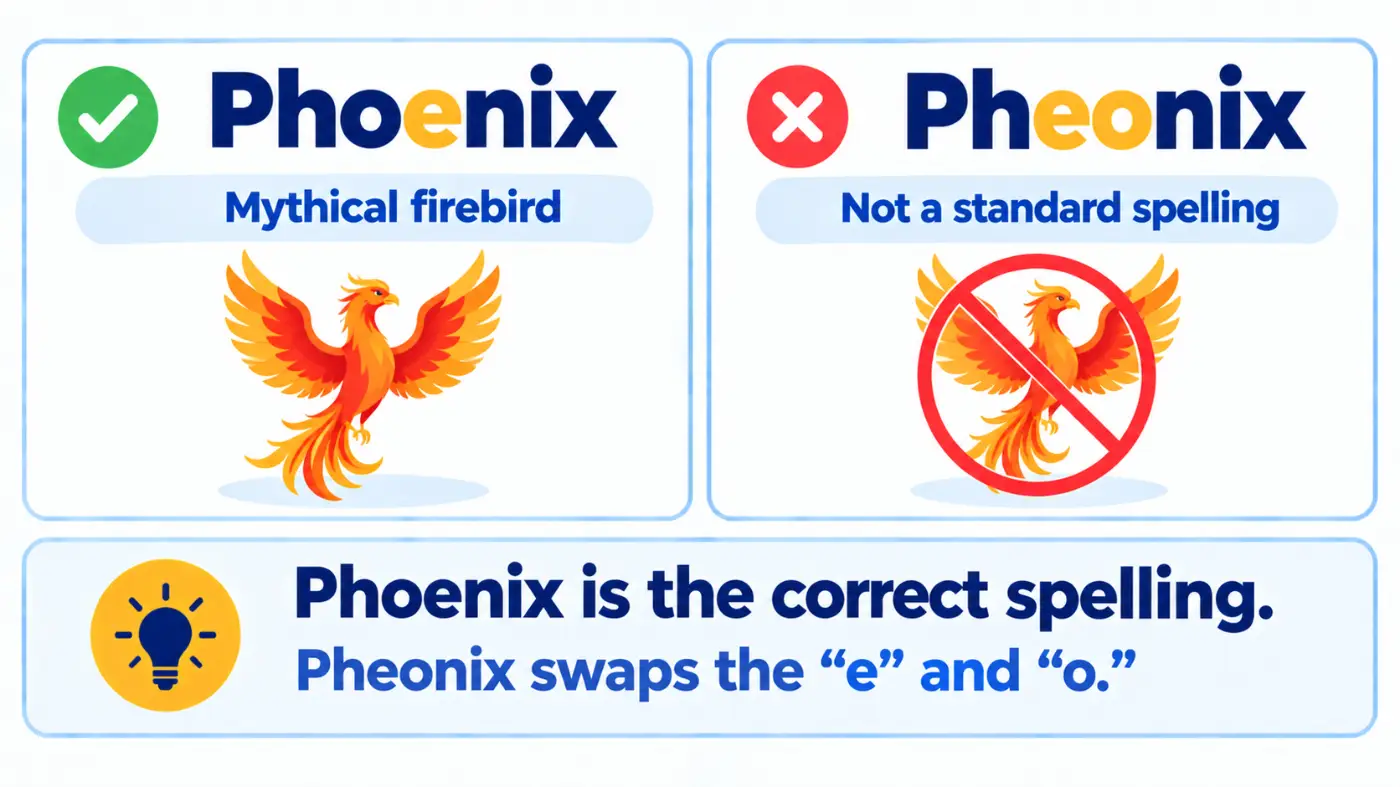
Phoenix is the correct spelling. Pheonix simply transposes the “e” and “o,” a swap that happens easily because the word’s middle section doesn’t map cleanly onto how it sounds when spoken.
The Short Answer at a Glance
| Form | Status | What it does | Example |
|---|---|---|---|
| phoenix | Correct | Noun referring to the mythical bird, or used as a proper noun for people and places | The story’s hero rises from failure like a phoenix. |
| pheonix | Misspelling | Not a word in standard English | Correct it to phoenix every time. |
There’s only one real spelling here. The letters “o” and “e” are simply reversed in the incorrect version.
What Phoenix Means and How It Works
Phoenix is a noun most commonly known as the name of a mythical bird associated with cycles of destruction and renewal, often described as bursting into flame and being reborn from its own ashes. This legendary bird appears across various mythological and literary traditions, and the word has become a widely recognized symbol for rebirth, resilience, and starting over after hardship.
Beyond the mythological creature, phoenix functions as a common English word used figuratively to describe anything that recovers or rises again after apparent defeat or destruction. A company might “rise like a phoenix” after bankruptcy, or a neighborhood might be described as a phoenix after rebuilding following a disaster. This figurative use is extremely common in journalism, business writing, and everyday conversation.
Phoenix is also a proper noun with several important uses. It’s the name of a major American city, the capital of Arizona. It appears as a given name for people. It shows up as a name for organizations, sports teams, products, and creative works, often chosen specifically because of the symbolic association with rebirth and resilience.
Grammatically, phoenix behaves as a standard singular noun when used generically (a phoenix, the phoenix), and its plural form is phoenixes. As a proper noun naming a specific city, person, or brand, it’s capitalized and doesn’t take an article, following the normal rules for proper nouns.
The word traces back to ancient Greek, where it referred to this same legendary bird, and English adopted the spelling largely intact from that source, which is part of why its internal letter order doesn’t follow typical English spelling patterns.
Is “Pheonix” Ever Correct?
No. Pheonix isn’t recognized in any standard dictionary, and it isn’t a regional variant, alternate spelling, or acceptable shorthand. It’s a straightforward letter-transposition error.
The word’s middle section, “hoe,” doesn’t give any clear pronunciation cues about letter order. When you say phoenix aloud, the “oe” combination blends into a single vowel sound, roughly “ee,” and that sound doesn’t obviously tell you whether the “o” or the “e” comes first in the spelling. This kind of ambiguity is exactly the condition under which transposition errors thrive.
Because phoenix comes from Greek rather than following native English spelling conventions, its letter order doesn’t match patterns that English speakers might otherwise rely on instinctively. Words borrowed from other languages often carry these kinds of spelling quirks, and phoenix is a clear example of one that trips up even careful writers.
This particular transposition, swapping “oe” to “eo,” is common enough that it shows up regularly in casual writing, social media, and even occasionally in unedited professional content, precisely because the correct order isn’t something most people consciously verify before typing.
Phoenix vs Pheonix: Key Differences Side by Side
| Feature | Phoenix | Pheonix |
|---|---|---|
| Recognized word | Yes | No |
| Part of speech | Noun (common and proper) | None |
| Core meaning | The mythical bird; symbolically, rebirth or recovery; a proper name | No meaning |
| Typical use | Mythology, literature, branding, place names, personal names | Appears only as a typo |
| Register | Works in formal and casual writing | Never appropriate |
| Example | The team’s comeback season felt like watching a phoenix rise from the ashes. | The team’s comeback season felt like watching a pheonix rise from the ashes. (wrong) |
The table shows a clean contrast, but what it can’t fully capture is how often this specific transposition slips past a quick read, since pheonix still looks roughly phoenix-shaped at a glance, especially in fast-scrolling contexts like social media captions or texts.
Correct Examples in Real-Life Contexts
Everyday speech
- After losing everything in the fire, they rebuilt the house like a phoenix rising from the ashes.
- My grandmother always said grief works like that, you fall apart and somehow come back like a phoenix.
- The old diner reopened under new ownership, a real phoenix moment for that block.
- He got his tattoo of a phoenix right after finishing chemotherapy.
Workplace writing
- The rebranding campaign leans heavily on phoenix imagery to symbolize the company’s turnaround.
- Our Phoenix office reported strong quarterly numbers despite the regional slowdown.
- The startup’s founder described the pivot as a phoenix moment for the entire team.
- Please coordinate travel arrangements for the Phoenix conference in October.
Texting
- did you see her new phoenix tattoo, it’s gorgeous
- flying into Phoenix Friday, anyone want to grab dinner before the conference
School and academic
- The mythology unit compares phoenix legends across Greek, Egyptian, and Chinese traditions.
- Her senior thesis examines the phoenix as a recurring literary symbol of resilience.
- Students researched how ancient civilizations depicted the phoenix in art and religious texts.
- The English class discussed how the novel’s title character embodies phoenix-like renewal.
Formal writing
- The city’s post-disaster recovery has been widely described as a phoenix-like resurgence.
- Analysts noted the company’s phoenix trajectory following its near-collapse in 2022.
- The museum’s new exhibit traces phoenix symbolism through several ancient cultures.
- Phoenix, Arizona, remains one of the fastest-growing metropolitan areas in the country.
Common Mistakes People Make (and How to Catch Them)
Swapping the “o” and “e”
Wrong: The team’s turnaround felt like a true pheonix story. Right: The team’s turnaround felt like a true phoenix story.
This is the core error. Because the “oe” sound doesn’t clearly indicate letter order, writers often guess and land on the reversed version.
Typing quickly and transposing letters out of habit
Wrong: We’re relocating to Pheonix next spring. Right: We’re relocating to Phoenix next spring.
Fast typing sometimes flips adjacent letters without the writer noticing, especially in a word where both letter orders look plausible at a glance.
Relying on pronunciation alone
Wrong: She got a small pheonix charm for her bracelet. Right: She got a small phoenix charm for her bracelet.
Since the “oe” combination is pronounced as a single blended sound, spelling by ear alone doesn’t reliably produce the correct letter order.
Autocorrect not catching the transposition
Wrong: My phone didn’t flag pheonix, so it made it into the final draft. Right: A careful proofread catches this error even when software doesn’t.
Not every spellchecker flags this specific transposition, since “pheonix” can sometimes pass unnoticed depending on the tool and context.
A Fast Trick to Choose the Right One
Break the word into its two natural halves: “pho” and “enix.” Say them slowly and separately: pho-enix. That first syllable, “pho,” shares its spelling pattern with a completely unrelated but visually similar word, “photo,” which starts with the same “pho” combination. If you can spell “photo” correctly, you already know the “o” comes right after the “h” in phoenix as well.
A second trick is to remember that phoenix is a proper-sounding, ancient word, and ancient Greek-derived English words often keep unusual spellings intact. Rather than trying to sound the middle section out, memorizing the visual shape “pho-enix” as a single unit tends to work better than any phonetic approach.
This trick works reliably for phoenix specifically, but it won’t help with unrelated Greek-derived spelling patterns elsewhere in English, since each borrowed word tends to carry its own quirks.
How They Sound in Real Situations
A text exchange
Maya: Did you hear the bakery on Fifth reopened?
Josh: Yeah! Total phoenix moment after that fire last year.
Maya: We have to go this weekend.
Phoenix is correct here, used figuratively to describe a business bouncing back after hardship.
A workplace email
Subject: Q3 travel to Phoenix
Hi team,
Flights and hotel reservations for next month’s Phoenix conference have been booked. Please confirm your arrival times by Friday so we can finalize the shuttle schedule.
Thanks, Renata
Phoenix is correct because it’s naming the city where the conference is being held.
An article-style excerpt
The historic theater, once slated for demolition, has become something of a phoenix story for the downtown district, reopening this month after a decade of fundraising and restoration work. Longtime residents say its return marks a turning point for the neighborhood.
Phoenix fits naturally here, used figuratively to describe a meaningful comeback.
Formal Writing vs Casual Writing
The correct spelling doesn’t change based on formality. Phoenix is right in a museum exhibit description, a corporate press release, a text message, and a casual conversation. Pheonix is wrong everywhere, regardless of tone or context.
What shifts with register is how the word gets used rather than how it’s spelled. In formal and journalistic writing, phoenix often appears in more measured, analytical framing, such as describing an economic recovery or a company’s turnaround. In casual speech, it’s used more loosely and emotionally, often attached to personal stories of resilience, tattoos, or dramatic comebacks.
Related Mix-Ups People Also Search For
Phoenix vs Fenix
Fenix is a stylized or brand-specific spelling sometimes used for product names, sports team nicknames, or usernames, but it isn’t a standard English spelling of the mythological bird. Example: The company chose “Fenix” as a stylized brand name, even though the standard English word remains phoenix.
Phoenix vs Phenix
Phenix occasionally appears as a place name or surname in certain regions, but it isn’t a standard alternate spelling of the mythological creature. Example: Phenix City, Alabama, keeps its own historical spelling, separate from the word phoenix.
Phoenix, Arizona vs Phoenix (the Mythical Bird)
Both uses share identical spelling, but one is a proper noun naming a specific American city, while the other refers to the legendary creature or its figurative meaning. Example: She moved to Phoenix, Arizona, the same year she got her phoenix tattoo, and joked that both felt like a fresh start.
Quick Practice: Test Yourself
Choose the correct spelling for each blank.
- The novel’s protagonist rises from tragedy like a ______ throughout the final chapters. (phoenix / pheonix)
- We’re flying into ______ for my cousin’s wedding next month. (Phoenix / Pheonix)
- Her recovery from the accident felt like watching a ______ story unfold. (phoenix / pheonix)
- The mythology exhibit features artwork depicting the ______ from several ancient cultures. (phoenix / pheonix)
- After the factory fire, the town rebuilt itself in true ______ fashion. (phoenix / pheonix)
- He named his new business venture “______ Ventures” after his own comeback story. (Phoenix / Pheonix)
Answer Key
- phoenix: the correct spelling, with “o” before “e.”
- Phoenix: correctly capitalized and spelled as the city name.
- phoenix: consistent spelling in a figurative context.
- phoenix: correct spelling describing the mythological creature.
- phoenix: correct spelling used figuratively to describe recovery.
- Phoenix: correctly capitalized as part of a proper business name.
Frequently Asked Questions
Is “pheonix” ever an acceptable spelling?
No. Pheonix isn’t recognized in standard dictionaries and isn’t used as a regional or informal variant. The correct spelling in every context is phoenix.
Why is phoenix spelled with “oe” instead of “eo”?
Phoenix comes from ancient Greek largely unchanged, and English preserved that specific letter order rather than reshaping it to match more typical English spelling patterns.
Is phoenix always capitalized?
Not always. When referring generically to the mythological bird or using it figuratively, it’s lowercase, as in “a phoenix rising from the ashes.” When it names a specific place, person, or brand, such as the city of Phoenix, it’s capitalized as a proper noun.
What does “rise like a phoenix” mean?
This common expression means to recover, rebuild, or succeed again after a significant failure, setback, or destruction, drawing on the mythological bird’s association with rebirth.
Is Phoenix only used as a city name in the United States?
No. While Phoenix, Arizona, is a well-known American city, “phoenix” is also used more broadly as a given name, a brand name, and a figurative term across many contexts unrelated to that specific city.
What is the plural of phoenix?
The standard plural is phoenixes, following the regular pattern for English nouns ending in “x.”

Sophia Bennett writes educational content about English vocabulary, grammar, slang, and communication. She is passionate about making complex language topics accessible to students, professionals, and curious readers around the world.