Existence vs Existance: The Typo That Reveals Your Weakness
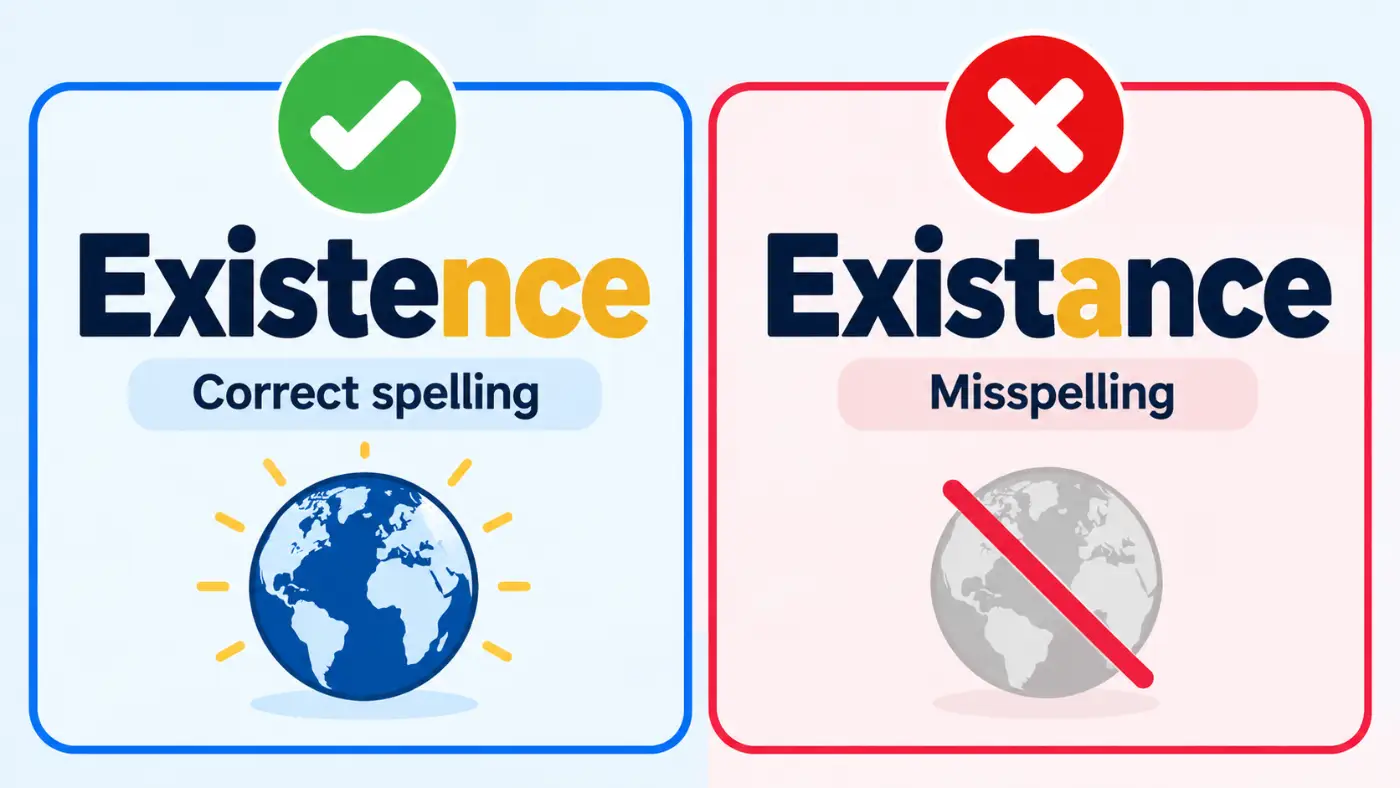
Existence is the correct spelling. Existance is a misspelling, and standard dictionaries don’t list it as a variant. The word ends in ence because it comes from the adjective existent.
The Short Answer at a Glance
| Form | Status | Meaning | Example |
|---|---|---|---|
| Existence | Correct noun | The state of being real or alive | Nobody doubted the existence of the second key. |
| Existance | Misspelling | No meaning of its own | Corrected: The report confirms the existence of a backup. |
If you need the word in a sentence, use existence. The other spelling only shows up by accident.
What Existence Means and How It Works
Existence is a noun that names the state of being real, present, or alive. It answers a simple question: is this thing here, or isn’t it? A fossil has an existence, a rumor has an existence, and so does a small business on Maple Street.
It’s mostly an uncountable noun, which means it doesn’t usually take a plural. You say the existence of a problem, not the existences of a problem. It turns countable in one narrower sense: a way of living, as in a quiet existence in rural Vermont.
The word is built from exist plus the ending ence. That ending matters for spelling, and it explains the whole confusion. Related words follow the same pattern: existent, existing, nonexistent, coexistence, and existential.
Existence appears in a few fixed phrases. You can come into existence, bring something into existence, or go out of existence. The most common pattern is existence of followed by the thing in question, as in the existence of a loophole.
Is Existance a Real Word?
No. Existance is a misspelling of existence, and it has no separate meaning. Standard US dictionaries don’t list it, so it isn’t a regional variant or an older spelling that editors accept.
The error happens because the ending sounds the same in speech. In existence, the last syllable is unstressed, so the vowel collapses into a soft uh sound. Your ear can’t tell ance from ence. Only memory or a rule can.
Many common nouns end in ance, including importance, resistance, distance, and performance. A writer who has seen those words thousands of times may apply that pattern to existence without noticing. That’s overgeneralizing, and it’s the most common cause of this error.
Existence vs Existance: Key Differences Side by Side
| Feature | Existence | Existance |
|---|---|---|
| Part of speech | Noun | Not a word |
| Core meaning | The state of being real or present | None |
| Typical use | Any context that names being or presence | None, apart from accidental typos |
| Register | Standard in every register | Reads as an error in every register |
| Example | The existence of a reserve fund calmed the board. | The existance of a reserve fund calmed the board. (Incorrect) |
This isn’t a pair of words with different meanings, so the usual contrast doesn’t apply. One form is right, and the other is a slip.
The table also can’t show how invisible the mistake can be. Existence and existance look alike at a glance, so proofreading passes often skip over the error. A quick search for the wrong spelling before you publish catches it.
Correct Examples in Real-Life Contexts
Because existance isn’t a word, every example below uses the correct spelling. The sentences show how existence works in different settings.
- Everyday speech: I didn’t know about the existence of that trail until my neighbor Rosa walked me down it.
- Texting: wait the existence of a third season?? nobody told me
- Workplace writing: Please confirm the existence of a signed contract before we release the final payment.
- School or academic: Philosophy students often start the semester by debating the existence of free will.
- Journalism: A county survey confirmed the existence of a forgotten cemetery behind the old grain depot.
- Formal writing: The clause takes effect upon the existence of a written agreement between both parties.
Common Mistakes People Make (and How to Catch Them)
Mistake 1: Ending the noun in ance. Wrong: The existance of the bridge changed the town. → Right: The existence of the bridge changed the town. The ending sounds identical, and ance is a very common noun ending. Your ear can’t settle it, so check the spelling.
Mistake 2: Misspelling the adjective. Wrong: The existant policy needs a rewrite. → Right: The existent policy needs a rewrite. Writers carry the wrong ending over from the noun. The adjective ends in ent, and so does the real noun’s source.
Mistake 3: Misspelling coexistence. Wrong: Peaceful coexistance between the two clubs took years. → Right: Peaceful coexistence between the two clubs took years. Adding a prefix doesn’t change the ending. Coexistence keeps every letter that existence has.
Mistake 4: Misspelling nonexistent. Wrong: The permit was nonexistant in the system. → Right: The permit was nonexistent in the system. The same ent ending applies. Adding non doesn’t alter the spelling.
Mistake 5: Scrambling letters. Wrong: The exsistence of the file puzzled everyone. → Right: The existence of the file puzzled everyone. Fast typing can swap the s and the i. This one is a typo, not a spelling belief, and a spellchecker usually catches it.
Mistake 6: Trusting a blank spellchecker. Forms, usernames, and some design tools have no spellcheck at all. Wrong spellings survive there because nothing flags them. Reread anything typed in those places.
A Fast Trick to Choose Between Existence and Existance
Change the noun into the adjective. The adjective is existent, and it ends in ent. A noun that comes from an ent adjective usually ends in ence. So existent gives you existence.
The pattern works on many familiar words. Persistent becomes persistence, different becomes difference, and dependent becomes dependence. Compare the ant adjectives: important becomes importance, and resistant becomes resistance.
A second aid is to hide the word ten in the middle. Look at exisTENce. If you can find ten near the end, the spelling has the right ending.
The trick has limits. Some words end in ance without any matching adjective, such as guidance, maintenance, and performance. For those words, the trick doesn’t help. For existence, though, the adjective exists, so the trick works every time.
How They Sound in Real Situations
A text exchange
Kendra: Quick spelling check. Is it existence or existance? Malik: Existence. Think existent. Kendra: Thanks. The existence of my typo was driving me up the wall.
Existence is the noun here, and it follows the ent to ence pattern. Malik gives the adjective as proof.
An email snippet
Subject: Invoice follow up
Hi Dana, I can’t find any evidence of the existence of a second invoice for March. Could you check the shared folder and send me the file? I’ll hold the payment until then.
The phrase the existence of a second invoice is the most common pattern for this noun. It names whether something is real.
An article excerpt
For decades, the old mill stood empty, and most residents forgot its existence. Then a retired teacher found a ledger in the attic, and the building came back into public memory.
Here existence is a plain noun meaning the fact of being there. The phrase back into public memory echoes it without repeating it.
Formal Writing vs Casual Writing
Register doesn’t change the spelling. Existence is correct in academic papers, business emails, journalism, social media, and texting. Existance reads as an error in every one of them.
In casual writing, people sometimes think a misspelling feels relaxed. It doesn’t. Readers simply see a typo, and in a resume or a report it may count against you. A text message can shrug off the slip, but a professional document can’t.
One more point: no spelling difference exists between American and British usage for this word. Both use existence, so there’s no regional choice to make.
Related Mix-Ups People Also Search For
Coexistence and Nonexistent
Both words keep the same ence and ent endings as their parent. A prefix never changes the spelling of the core word.
The coexistence of old shops and new cafes keeps the street lively.
Existent vs Existant
Existent is the adjective, and existant is a misspelling. The adjective describes something that is real or present, though existing is far more common in everyday writing.
The existing contract is still valid, and no existent copy has been lost.
Persistence, Resistance, and Other Ance vs Ence Pairs
These two nouns look alike, but they end differently. The first comes from persistent, so it takes ence. For the second, the source is resistant, which is why it takes ance.
Her persistence paid off, and the team’s resistance to the change faded.
Exceptions, Edge Cases, and Tricky Situations
Names and usernames. A band, brand, or online handle may spell the word however its owner likes. Follow the owner’s spelling when you refer to the name itself, and use existence everywhere else.
Existence in philosophy. The word has a special role in philosophy, where existence is a core topic and existential is its adjective. The spelling stays the same. Only the topic changes.
The countable sense. When existence means a way of living, it can take an article, as in a lonely existence. It rarely takes a plural, but a phrase such as their separate existences can appear in literary writing.
Quoting older or informal text. If you quote a source that contains the misspelling, keep the original and add a note such as sic after it, or fix the spelling if your style guide permits silent corrections.
Quick Practice: Test Yourself
Choose the correct spelling for each sentence.
- The inspector asked for proof of the ___ of a second exit. (existence or existance)
- After the merger, the two teams reached a peaceful ___. (coexistence or coexistance)
- The missing permit turned out to be ___. (nonexistent or nonexistant)
- Nadia lived a quiet ___ in a small coastal town. (existence or existance)
- Her ___ finally won over the committee. (persistence or persistance)
- Which sentence is correct? A) The existance of the tape surprised everyone. B) The existence of the tape surprised everyone.
Answer key
- Existence. The noun comes from existent, so it takes ence.
- Coexistence. The prefix co doesn’t change the ending.
- Nonexistent. The adjective ends in ent.
- Existence. The countable sense still uses the same spelling.
- Persistence. The adjective persistent leads to ence.
- B. Existence is the only accepted spelling of this noun.
Frequently Asked Questions
Is it existence or existance?
Existence is correct. Existance is a misspelling that standard dictionaries don’t list.
Is existance ever correct?
Not as a spelling of this word. It might appear in a brand name or username, but the standard noun is always existence.
Why does existence end in ence?
It comes from the adjective existent, and nouns from ent adjectives usually end in ence. The same pattern gives persistence and difference.
How do you spell the adjective?
The adjective is existent. It ends in ent, not ant.
Is it coexistence or coexistance?
Coexistence is correct. The prefix co doesn’t change the ending of existence.
What is the verb form of existence?
The verb is exist. Its forms are exists, existed, and existing.

Sophia Bennett writes educational content about English vocabulary, grammar, slang, and communication. She is passionate about making complex language topics accessible to students, professionals, and curious readers around the world.