Spicy vs Spicey: The Correct Spelling and Why the E Disappears
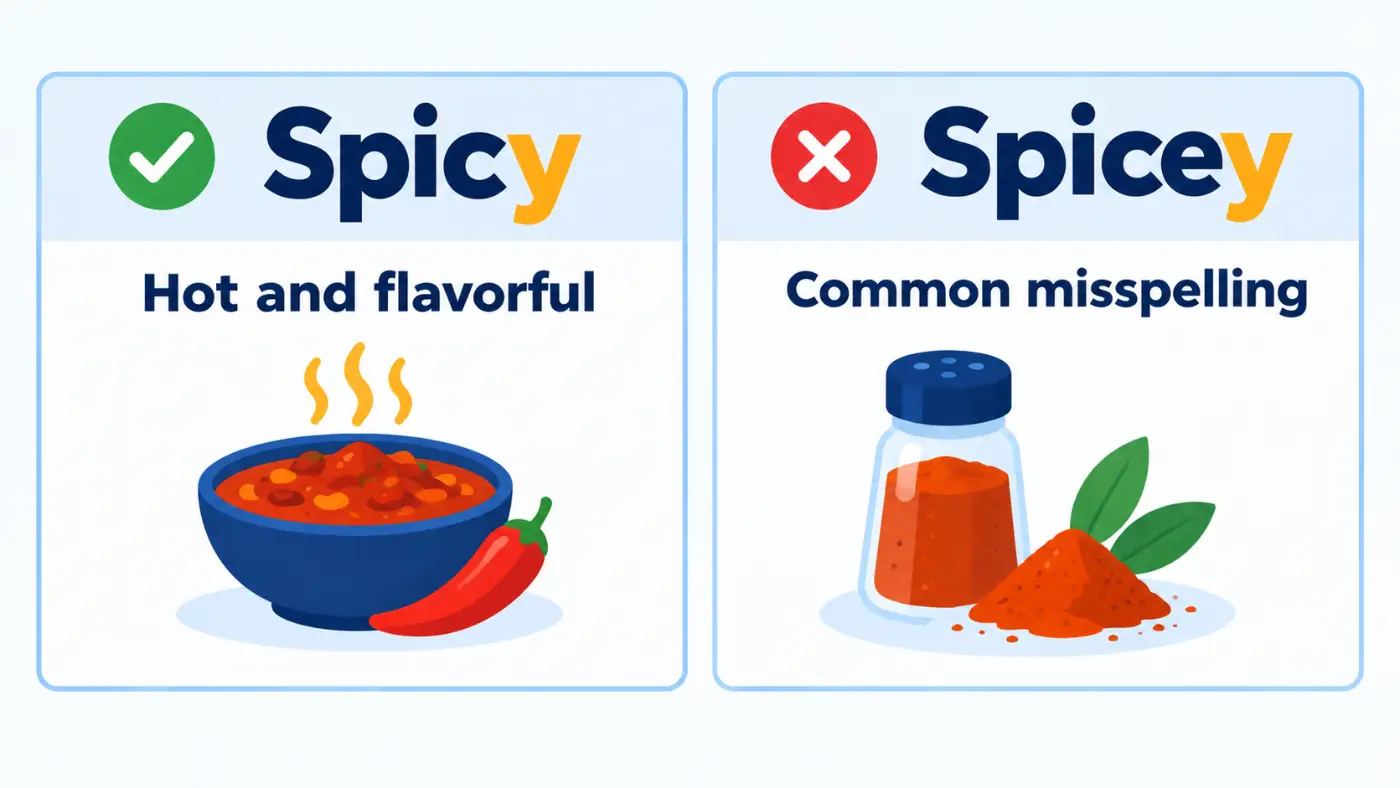
Spicy is the correct spelling. Spicey is a common misspelling that dictionaries don’t list. When you add y to spice, the silent e drops out, just as it does in icy and juicy.
The Short Answer at a Glance
| Form | Status | Meaning | Example |
|---|---|---|---|
| Spicy | Correct adjective | Flavored with spice, often hot; also lively or racy | The salsa at Lupe’s Cantina is spicy enough to make your forehead sweat. |
| Spicey | Misspelling | No meaning of its own | Corrected: The salsa is spicy. |
If you’re describing flavor, heat, or a juicy piece of gossip, write spicy. Spicey has no accepted use in standard writing.
What Spicy Means and How It Works
Spicy is an adjective that describes food with a strong, bold flavor from spices. In everyday American speech, it usually means hot, as in chili heat. It can also describe aromatic flavors, such as a chai with cinnamon and clove, even when the drink has no burn at all.
The word has a figurative side too. A spicy rumor is scandalous, a spicy exchange is heated, and a spicy joke leans a little risqué. Online, a spicy take means an opinion bold enough to start an argument.
Spicy follows regular adjective patterns. It can come before a noun (a spicy stew) or after a linking verb (the stew tastes spicy). The comparative is spicier, the superlative is spiciest, and the noun form is spiciness.
The word is built from spice plus the ending y, which turns a noun into an adjective. During that step, the silent e at the end of spice disappears. That one change causes the whole spelling confusion.
Is Spicey Correct?
No. Spicey is a misspelling of spicy, and standard dictionaries don’t record it as a variant. It isn’t an older form or a regional choice. It’s a slip, and a very common one.
The error happens because the base word, spice, ends in e. Writers see that e in their mind and keep it when they attach the y. The result looks logical, and that’s why it fools so many people.
English has a general habit of dropping a silent e before an ending that begins with a vowel or y. Ice becomes icy, juice becomes juicy, and lace becomes lacy. Spice follows the same path to spicy.
Spicey does show up in the wild, usually in nicknames, band names, or hot sauce labels. A business can spell its name any way it likes. That’s a naming choice, not a spelling rule.
Spicy vs Spicey: Key Differences Side by Side
| Feature | Spicy | Spicey |
|---|---|---|
| Part of speech | Adjective | Not a word |
| Core meaning | Flavored with spice; hot; racy | None |
| Typical use | Food, drinks, gossip, opinions | None, apart from names and typos |
| Register | Standard in every register | Reads as an error |
| Example | The curry was spicy, and the second helping was spicier. | The curry was spicey. (Incorrect) |
This isn’t a pair of different words, so there’s no meaning contrast to learn. One form is right, and the other is a mistake.
The table also can’t show how convincing the wrong spelling looks. Spicey keeps the full word spice intact, so the eye reads it as sensible. That’s why a quick proofread often misses it, and why a dedicated check is worth the few seconds.
Correct Examples in Real-Life Contexts
Because spicey isn’t a word, every example below uses the correct spelling. The sentences show how spicy works across different settings.
- Everyday speech: The salsa at Lupe’s Cantina is spicy enough to make my forehead sweat.
- Texting: that ramen was so spicy my nose is still running
- Workplace writing: Our cafeteria now labels every dish mild, medium, or spicy.
- School or academic: Chili peppers taste spicy because they contain capsaicin, a compound that triggers heat receptors in your mouth.
- Journalism: A spicy exchange between the two candidates dominated the final ten minutes of the debate.
- Formal writing: The menu describes the curry as spicy and notes that kitchen staff can adjust the heat on request.
Common Mistakes People Make (and How to Catch Them)
Mistake 1: Keeping the e before the y. Wrong: The wings were way too spicey for my cousin. → Right: The wings were way too spicy for my cousin. The word spice stays visible in the writer’s mind, so the e feels necessary. Standard spelling drops it before y.
Mistake 2: Stacking endings on the wrong base. Wrong: This batch is spiceyer than the last one. → Right: This batch is spicier than the last one. Wrong: The kitchen rates each dish by its spiceyness. → Right: The kitchen rates each dish by its spiciness. Once the first mistake sets in, it carries into the comparative and the noun. Spicy turns into spicier, spiciest, and spiciness.
Mistake 3: Copying a brand or menu spelling. Wrong: The article praised the restaurant’s spicey noodles. → Right: The article praised the restaurant’s spicy noodles. A menu may use a creative spelling for style. Unless you’re quoting the product name, use the standard form.
Mistake 4: Trusting a custom dictionary. Wrong: A saved contact name, a menu template, or an old document lets spicey slip past the spellchecker. → Right: Check the final text one more time before you publish. Most spellcheckers flag the word, but custom entries can silence the warning.
Mistake 5: Overcorrecting other words. Wrong: The mountain road looked dicy after the rain. → Right: The mountain road looked dicey after the rain. A writer who has learned to drop the e may drop it everywhere. Some words keep the e, and dicey is one of them.
A Fast Trick to Choose Between Spicy and Spicey
Think of ice and juice. Both end in ce, and both lose the e before y: icy and juicy. Spice ends in ce too, so it follows the same pattern and becomes spicy.
You can also test the sentence out loud. Spicy sounds like SPY-see, and the final syllable is just a short ee sound. No extra letter is needed to make that sound, so the extra e adds nothing.
The trick has an honest limit. Dicey and pricey also end in ce, but they keep the e. The pattern is a strong guide for spicy, but it isn’t a law for every word. When you’re unsure about a different word, check a dictionary.
How They Sound in Real Situations
A text exchange
Nadia: Is the pad thai at that new place spicy? Chris: Medium spicy. Ask for it mild if you’re nervous. Nadia: Done. I can’t handle a spicier version.
Spicy is an adjective, and it follows the usual drop the e pattern. Spicier is the comparative form of the same word.
An email snippet
Subject: Friday lunch order
Hi Marco, please label the chicken tray spicy and the vegetable tray mild. Two people on the team avoid heat, so clear signs will help. Thanks for handling this.
Spicy labels the heat level of a dish. The standard spelling matters in a sign or label that many people will read.
An article excerpt
At the Ferris Creek cook off, the winning chili earned its title with a slow, smoky heat. Judges called the recipe spicy but balanced, and the line for samples ran past the parking lot.
Spicy describes the flavor, and it appears in a sentence that a journalist would publish. The correct spelling keeps the copy clean.
Formal Writing vs Casual Writing
Spicy is correct in every register. Menus, recipes, news stories, academic papers, texts, and social posts all use it. Spicey reads as a mistake wherever it appears, so there’s no casual setting where it becomes acceptable.
The figurative sense of spicy leans informal. A spicy take or a spicy rumor fits casual writing and feature journalism better than a formal report. In formal writing, you may prefer a more neutral word, such as provocative or heated.
No spelling difference exists between American and British English for this word. Both use spicy, so there’s no regional choice to make.
Related Mix-Ups People Also Search For
Spicy vs Spiced
Spiced means that spices were added, and it doesn’t promise heat. Spicy describes the result, which is often hot. A spiced cider tastes warm and fragrant, while a spicy cider would suggest actual burn.
The bakery sells spiced pear cake, not spicy pear cake.
Spicier vs More Spicy
Spicier is the standard comparative. More spicy appears in speech and informal writing, and readers understand it easily. In careful writing, spicier is the smoother choice.
The second sauce was spicier than the first.
Spicy vs Dicey and Pricey
Dicey and pricey keep their e, while spicy drops it. All three come from a noun that ends in ce, which is why they get confused. The difference comes from convention, so each word has to be learned.
The location was pricey, and the weather made the trip dicey.
Exceptions, Edge Cases, and Tricky Situations
Words that keep the e. Dicey, pricey, and cagey keep the final e of the base word. Some dictionaries list a second spelling for a few of them. Check the word before you apply the spicy rule.
Heat versus flavor. Spicy doesn’t always mean hot. A chai or a gingerbread cookie can taste spicy because of cinnamon and clove, with no chili in sight. If you need to describe heat, hot or fiery is clearer.
Figurative uses. A spicy story, a spicy comeback, or a spicy debate refers to boldness or scandal. This sense is common in casual and media writing.
Names and brands. A hot sauce, a restaurant, or a performer may choose spicey as a name. Follow the owner’s spelling when you refer to the name itself, and use spicy everywhere else.
Quoting informal text. If a source contains the misspelling, keep the original inside a direct quote. Add sic after it if your style guide asks for that, or correct it silently if your style guide allows it.
Quick Practice: Test Yourself
Choose the correct spelling for each sentence.
- The buffalo wings at the tailgate were far too ___ for my cousin. (spicy or spicey)
- Which is correct? A) spicier B) spiceier
- Her ___ remark about the keynote got a few laughs. (spicy or spicey)
- The kitchen rates each dish by its ___. (spiciness or spiceyness)
- The mountain road looked ___ after the rain. (dicey or dicy)
- Which sentence is correct? A) The soup is spicey. B) The soup is spicy.
Answer key
- Spicy. The silent e drops before y.
- A. The comparative follows the base spicy, not spicey.
- Spicy. The word works figuratively for a bold or edgy remark.
- Spiciness. The noun form comes from spicy.
- Dicey. This word keeps its e, even though it also ends in ce before y.
- B. Spicy is the only standard spelling.
Frequently Asked Questions
Is it spicy or spicey?
Spicy is correct. Spicey is a misspelling that dictionaries don’t list.
Is spicey ever correct?
Only as a chosen name, such as a brand or nickname. In ordinary writing, use spicy.
Why does spicy drop the e?
English usually drops a silent e before an ending that starts with y. The same thing happens in icy and juicy.
What is the comparative of spicy?
The comparative is spicier, and the superlative is spiciest. More spicy is also understood, but spicier is the standard form.
Does spicy always mean hot?
No. In everyday American use it often means hot, but it can also describe aromatic spice flavors without chili heat.
What is the noun form of spicy?
The noun is spiciness. It names the quality of being spicy.

Sophia Bennett writes educational content about English vocabulary, grammar, slang, and communication. She is passionate about making complex language topics accessible to students, professionals, and curious readers around the world.