A Lot vs Allot: The Mistake That Embarrasses Writers Instantly
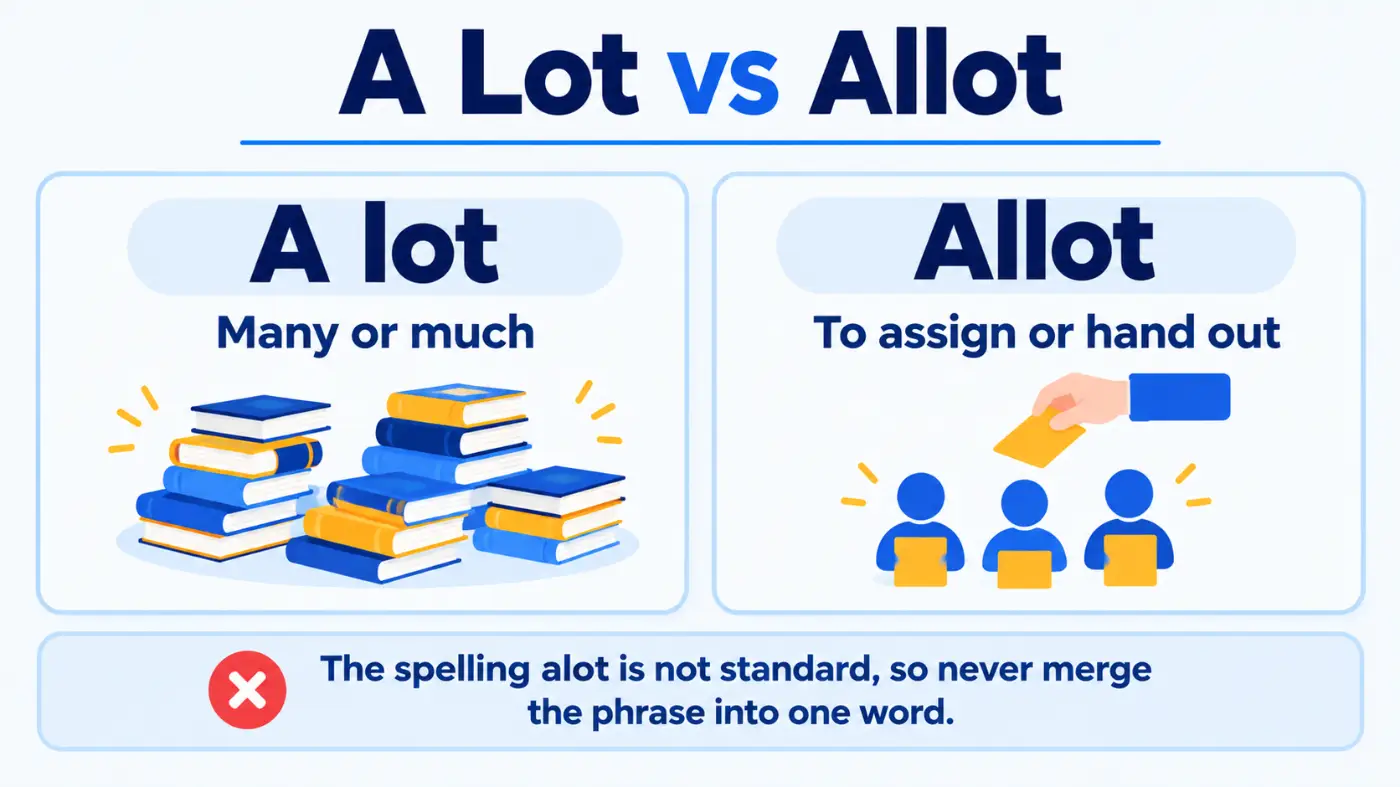
A lot is a two word phrase that means many or much. Allot is a one word verb that means to assign or hand out a portion. The spelling alot is not standard, so never merge the phrase into one word.
The Short Answer at a Glance
| Form | What It Is | Meaning | Example |
|---|---|---|---|
| A lot | Two word phrase | Many, much, or very often | Priya reads a lot on the train. |
| Allot | Verb | To assign or give out a share | The coach will allot each player two minutes. |
| Alot | Misspelling | None | Corrected: Priya reads a lot on the train. |
Say them out loud and they sound identical. Only the spelling shows which one you mean.
What A Lot Means and How It Works
A lot is a casual way to express a large amount, a large number, or a high frequency. It works as a pronoun (a lot happened), as a quantity phrase before a noun (a lot of rain), and as an adverb (the new route helps a lot). It also strengthens comparisons, as in a lot better or a lot slower.
The phrase is always two words. The a is an article, and lot is a noun that once meant a share or a portion. Together they act like a single unit, but the spelling keeps the space.
Alot is not a standard spelling. Writers merge the words because the pronunciation runs together, with the a blending into lot. Dictionaries don’t accept the merged form, so it reads as an error in nearly every setting.
The phrase is common and acceptable in everyday English. In formal writing, many editors prefer a more precise choice, such as many, much, or a considerable amount. That’s a style preference, not a grammar rule.
What Allot Means and How It Works
Allot is a transitive verb, which means it takes an object. It means to assign a share, a portion, or an amount to someone or something. You allot time to a speaker, money to a project, and seats to a group.
The forms are allot, allots, allotted, and allotting. The t doubles in the past tense and the ing form because the stress falls on the last syllable, al-LOT. The same pattern appears in words like regret and regretted.
Allot usually follows one of two patterns. You can allot something to someone (the board allotted three seats to students), or you can allot someone something (the host allotted each speaker five minutes). Allotted also works as an adjective, as in the allotted time.
The word is built on lot, the same word that once named a share drawn by chance. That history explains the double l. The prefix al joins the base, and the base keeps its own l.
The related noun is allotment. It names the share itself, the act of assigning it, or in some places a small plot of land for growing food.
A Lot vs Allot: Key Differences Side by Side
| Feature | A lot | Allot |
|---|---|---|
| Part of speech | Phrase (pronoun, quantity word, adverb) | Verb |
| Core meaning | Many, much, very often | Assign or hand out a portion |
| Spelling | Two words | One word with two l’s |
| Register | Informal to neutral | Neutral to formal |
| Example | The kitchen wastes a lot of parsley. | The chef will allot each cook one station. |
The words match in sound, which is why the confusion exists. You can’t hear the difference, so only context and spelling keep them apart.
What the table can’t show is the direction of the common errors. Writers merge a lot into alot, and they also write a lot when they mean allot. The second slip is harder to catch, because every part of the phrase is a real word.
Correct Examples in Real-Life Contexts
A Lot
- Everyday speech: We walked a lot in Lisbon, and my sneakers gave out by Friday.
- Texting: thanks a lot for covering my shift!!
- Workplace writing: The product team has a lot to cover before Thursday’s launch.
- School or academic: Your second paragraph needs a lot more evidence before it can support the claim.
- Formal writing: A lot of the foundation work remains unfinished, according to the inspector’s report.
Allot
- Everyday speech: The coach will allot each player two minutes in the passing drill.
- Texting: can you allot me twenty mins tomorrow to go over the slides?
- Workplace writing: Finance will allot $12,000 to the fourth quarter training budget.
- School or academic: The teacher allotted each group one table and one hour for the lab.
- Formal writing: The charter allots two board seats to community representatives.
Common Mistakes People Make (and How to Catch Them)
Mistake 1: Merging a lot into alot. Wrong: I like this playlist alot. → Right: I like this playlist a lot. In speech, the article blends into lot. Writers copy that sound and skip the space.
Mistake 2: Writing a lot for allot. Wrong: The manager will a lot each person fifteen minutes. → Right: The manager will allot each person fifteen minutes. The verb sounds exactly like the phrase. Ask whether the sentence needs an action of assigning, and if so, write one word.
Mistake 3: Writing alot for allot. Wrong: We alot funds to the program every spring. → Right: We allot funds to the program every spring. The single l looks like a common prefix, so the spelling seems fine. The base word lot keeps its own l, so the verb needs two.
Mistake 4: Spelling the past tense by ear. Wrong: Each team was alloted one hour. → Right: Each team was allotted one hour. The sound doesn’t reveal the extra t. Remember that the stressed final syllable doubles its consonant.
Mistake 5: Trusting the spellchecker. Wrong: Thanks allot for the ride. → Right: Thanks a lot for the ride. Allot is a real word, so the tool may not flag it. A wrong word that is spelled correctly slips through, and the sentence needs a human reread.
A Fast Trick to Choose Between A Lot and Allot
Swap in the word many or much. If it fits, write a lot as two words. If you can swap in assign, you want allot.
Test it on a real sentence. The committee has ___ of questions. Many fits, so the answer is a lot. The committee will ___ each speaker three minutes. Assign fits, so the answer is allot.
A spelling aid helps too. Allot and allocate both start with all, and both describe dividing something up. If you picture all of a budget split into portions, you’ll remember the double l.
The trick has one limit. It works for the quantity sense and the verb sense, but it can’t help with the land sense of a lot. When a lot means a parcel, the substitution test fails, and the context has to guide you.
How They Sound in Real Situations
A text exchange
Jordan: Can you handle the intro slides? Maya: Sure. I have a lot of notes from last week. Jordan: Great. I’ll allot you ten minutes in the agenda.
A lot describes a large amount of notes, and allot is the verb for assigning time. The two forms sit in the same exchange and keep their separate jobs.
An email snippet
Subject: Budget update
Hi Carlos, the leadership team will allot another $8,000 to the spring campaign, and we have a lot of detail to finalize before the kickoff. I’ll send the revised plan by Friday. Let me know if the timeline works.
Allot appears as a verb that assigns money. A lot describes the amount of detail, so the two words never compete.
An article excerpt
The city council voted to allot twelve parking spaces to food trucks near the waterfront. Residents had a lot to say about the plan, and the meeting ran past midnight.
Allot is the formal verb for assigning spaces in a news report. A lot is the casual phrase for many opinions.
Formal Writing vs Casual Writing
A lot fits casual and neutral writing, while allot fits neutral and formal writing. That’s the main difference in register.
In texts, social posts, and friendly emails, a lot is natural. In academic papers, business reports, and formal letters, many editors favor words like numerous, considerable, or substantial. Allot works well in contracts, budgets, and policies, where assigning shares is a common action.
Alot isn’t acceptable in any register. Even in a quick text, it can look careless. A reader may forgive it, but a professional audience may not.
US vs UK English Differences
The spelling of both words is the same in American and British English. A real difference does exist for the noun allotment.
In British English, an allotment often means a small plot of land rented for growing vegetables and flowers. In American English, it more commonly means a share or ration, such as a ticket allotment or a budget allotment. American readers may not recognize the garden meaning at once.
The verb allot works the same way on both sides of the Atlantic.
Related Mix-Ups People Also Search For
Allot vs Allocate
Allot and allocate are close in meaning. Both describe dividing something into portions for specific uses. Allocate often suggests a larger or more formal plan, such as funds across departments, while allot can sound more direct and personal.
The school will allocate funds to every department and allot each club one meeting room.
A Lot vs Lots
Lots is a more casual version of a lot of. Both mean many, but lots has a breezier feel. In formal writing, neither is the best choice, and a more precise word works better.
We have lots of time, and there’s a lot of food left too.
Allotted vs Alloted
Allotted is the standard spelling of the past tense and the adjective. Alloted is a misspelling. The doubled t follows the stress pattern of the verb.
The allotted time ran out before the final question.
Exceptions, Edge Cases, and Tricky Situations
A lot as a parcel of land. In real estate, a lot is a defined piece of land. The couple bought a lot on Elm Street is a correct sentence, and the two words are an article plus a noun. The meaning is unrelated to quantity.
Lot in auctions and manufacturing. Auction houses sell items by lot number, and factories track products by production lot. In these cases, lot is a noun that stands alone.
Fixed intensifiers. Phrases such as a whole lot, quite a lot, and a lot more are standard. The article stays separate in every one of them.
Allotted as an adjective. The allotted time and the allotted seats are normal phrases. The adjective keeps both the double l and the double t.
Lot in other idioms. Phrases such as cast your lot with someone, or one’s lot in life, use lot to mean fate or share. The connection to allot is real, but the spelling stays as lot.
Quick Practice: Test Yourself
Choose the correct word or spelling for each sentence.
- The new bike lanes have helped commuters ___. (a lot or allot)
- The festival committee will ___ each food truck a ten foot space. (a lot or allot)
- Which is correct? A) Thanks alot! B) Thanks a lot!
- Mara’s team was ___ ninety minutes to finish the exam. (allotted or alloted)
- We still have ___ of paperwork to file. (a lot or allot)
- The couple bought ___ on the north side of town and plan to build a studio. (a lot or allot)
Answer key
- A lot. It works as an adverb that means very much.
- Allot. The sentence needs a verb that means assign.
- B. A lot is always two words.
- Allotted. The past tense doubles the t.
- A lot. It means many, and it takes of before the noun.
- A lot. Here it means a parcel of land, an article plus a noun.
Frequently Asked Questions
Is it a lot or alot?
A lot is correct, and it is always two words. Alot is not a standard spelling.
Is alot a word?
No. Dictionaries don’t list it, and most editors treat it as an error.
What does allot mean?
Allot means to assign or give out a share, such as time, money, or space. It’s a verb, and it takes an object.
Is it allotted or alloted?
Allotted is correct. The final consonant doubles in the past tense and the ing form.
Is a lot too informal for essays?
It’s acceptable in many essays, but formal writing often benefits from a more precise word. Many, numerous, and considerable are common alternatives.
Can a lot mean a piece of land?
Yes. In real estate, a lot is a defined parcel of land. It’s still written as two words.

Sophia Bennett writes educational content about English vocabulary, grammar, slang, and communication. She is passionate about making complex language topics accessible to students, professionals, and curious readers around the world.