Standardized vs Standardised: Which Spelling Is Correct?
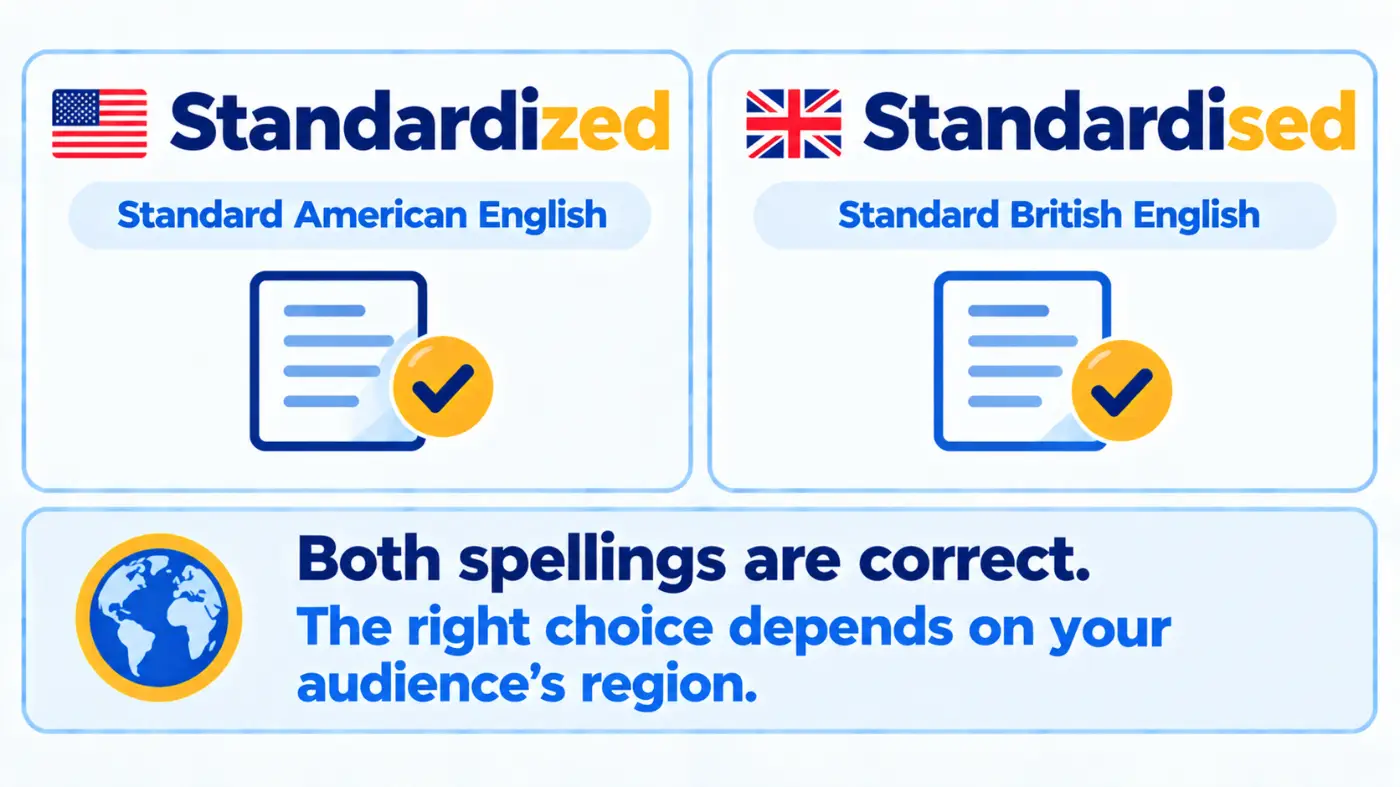
Both spellings are correct. Standardized is standard American English, and standardised is standard British English, and the right choice depends entirely on which regional spelling convention your audience expects.
The Short Answer at a Glance
| Form | Region | What it does | Example |
|---|---|---|---|
| standardized | American English | Adjective/past tense describing something made uniform or consistent | The company standardized its onboarding process across every branch. |
| standardised | British English | Identical meaning to standardized | The company standardised its onboarding process across every branch. |
Choose based on your reader’s regional spelling convention, not on which one seems more official or correct. Neither spelling outranks the other.
What Standardized Means and How It Works
Standardized is the past tense and past participle of the verb standardize, meaning to make something conform to a single, consistent set of rules, measurements, or procedures. It’s used constantly across education, manufacturing, healthcare, technology, and business, anywhere consistency and uniformity matter.
Grammatically, standardize is transitive, taking a direct object: you standardize a process, a test, a format, or a set of measurements. Standardized also functions as an adjective describing something that has already been made uniform, as in “a standardized test” or “standardized packaging.”
The verb follows the regular pattern:
- standardize (base form)
- standardizes (third-person present)
- standardized (past tense and past participle)
- standardizing (present participle)
The related noun is standardization, referring to the process or result of making something consistent, as in “standardization of safety protocols” or “international standardization efforts.” The base word “standard,” meaning an established norm or level of quality, sits at the root of the entire word family.
Standardized is the expected spelling throughout American English, appearing in US education policy, manufacturing documentation, medical guidelines, and everyday business writing. American style consistently applies the “-ize” ending across this entire family of words, not just to standardize specifically.
What Standardised Means and How It Works
Standardised means exactly the same thing as standardized: made uniform or consistent according to an established set of rules or measurements. The definition, grammatical behavior, and typical usage are identical to the American form.
The spelling difference reflects a much broader pattern affecting a large group of English verbs. British English has traditionally favored “-ise” as the default ending for verbs derived from Greek and Latin roots, including organise, realise, and recognise, alongside standardise. American English standardized (fittingly) on “-ize” for this entire group instead.
As with similar word pairs, this split isn’t perfectly clean. Some British publishers, most notably Oxford University Press, prefer “-ize” spellings for etymological reasons, since many of these words trace back to Greek roots that used a “z” sound. This is often called Oxford spelling, and it means “-ize” isn’t purely an American convention, even though “-ise” remains the more common British default.
Standardised is the expected spelling throughout most British and Commonwealth writing, appearing in UK education policy, manufacturing standards, healthcare documentation, and everyday business communication across the UK, Australia, and similar regions that generally follow British spelling conventions.
Standardized vs Standardised: Key Differences Side by Side
| Feature | Standardized | Standardised |
|---|---|---|
| Part of speech | Verb (past tense) and adjective | Verb (past tense) and adjective |
| Core meaning | Made uniform or consistent according to an established standard | Identical meaning |
| Typical use | American education, manufacturing, healthcare, business | British and Commonwealth education, manufacturing, healthcare, business |
| Register | Standard in all registers | Standard in all registers |
| Example | The lab standardized its testing procedures across all locations. | The lab standardised its testing procedures across all locations. |
What the table can’t fully capture is how closely this split tracks the broader American versus British “-ize” versus “-ise” pattern seen across dozens of related words. If a document already uses American spellings like organized and realized, standardized will match. If it uses British spellings like organised and realised, standardised is the expected companion.
Correct Examples in Real-Life Contexts
Everyday speech (American)
- The school district standardized the grading scale across all its middle schools.
- I wish restaurant menus were more standardized, calorie counts are all over the place.
- The recipe app standardized every measurement to cups instead of grams.
Everyday speech (British)
- The school standardised the grading scale across all its secondary schools.
- I wish restaurant menus were more standardised, portion sizes vary so much.
Workplace writing (American)
- HR standardized the interview questions to ensure consistency across departments.
- The manufacturing team standardized part dimensions to reduce defects.
- Our new template standardizes how each region reports quarterly earnings.
- The IT department standardized login procedures across all company devices.
Workplace writing (British)
- HR standardised the interview questions to ensure consistency across departments.
- Our new template standardises how each region reports quarterly earnings.
Texting (American)
- they finally standardized the return policy across all store locations, thank god
- wish they’d standardize phone chargers years ago honestly
School and academic (American)
- The study examines how standardized testing affects student performance metrics.
- Researchers standardized the survey questions to allow for accurate comparisons.
- The university standardized its citation requirements across all departments.
School and academic (British)
- The dissertation examines how standardised testing affects student performance metrics.
- The university standardised its referencing requirements across all departments.
Formal writing (American)
- The agency standardized safety protocols following the industry-wide review.
- International trade relies on standardized shipping container dimensions.
- The hospital network standardized its patient intake forms system-wide.
Formal writing (British)
- The agency standardised safety protocols following the industry-wide review.
- The hospital network standardised its patient intake forms system-wide.
Common Mistakes People Make (and How to Catch Them)
Mixing spellings within one document
Wrong: The team standardized the checklist, but later they standardised the training manual. Right: The team standardized the checklist, and later they standardized the training manual.
Switching between spellings mid-document looks inconsistent and often happens when writers combine text from sources using different regional conventions without reviewing for consistency.
Assuming one spelling is more formal or official
Wrong belief: Standardized is the more official, government-approved spelling, while standardised is casual. Right understanding: Both are equally formal and official within their respective regions; the difference is purely geographic, not a matter of formality.
Because standardized testing is such a common phrase in American education policy, some writers assume “-ize” is inherently the more official form. It’s simply the American spelling.
Ignoring an organization’s established style guide
Wrong: A UK-based company’s reports use standardized in some sections and standardised in others, depending on the author. Right: The company consistently applies one spelling throughout its documentation, matching its house style guide.
This isn’t a language error exactly, but an inconsistency that becomes noticeable in official documents, particularly for organizations operating across multiple English-speaking markets.
Autocorrect flipping the spelling unexpectedly
Wrong: A writer types standardized, but a British-English spellcheck setting quietly changes it to standardised mid-document. Right: Checking document language settings before finalizing content meant for a specific regional audience.
This is a formatting hazard rather than a language mistake, but it can slip through unnoticed in templates or documents shared internationally.
A Fast Trick to Choose the Right One
Match it to your audience’s broader spelling system. If your document already uses American spellings like organized, realized, and color, stick with standardized. If it uses British spellings like organised, realised, and colour, use standardised.
A second trick: think of standardized and standardised as part of the same family as organize and organise, or recognize and recognise. If you already know which convention you’re following for those words, standardized and standardised will follow the identical pattern.
This trick works well because the “-ize” versus “-ise” split applies consistently across this entire group of verbs within each regional standard. Its main limitation is the Oxford spelling exception, where some British publishers use “-ize” endings for historical reasons even while otherwise following British conventions.
How They Sound in Real Situations
A text exchange (American)
Priya: Did the new hire training finally get standardized?
Marcus: Yep, same modules for everyone now, no more inconsistent onboarding.
Priya: About time.
Standardized is correct here because the conversation uses standard American spelling throughout.
A workplace email (British)
Subject: Updated reporting templates
Hi Tom,
I’ve standardised the quarterly reporting templates so every regional office uses the same format going forward. Please review the attached version before Thursday’s meeting.
Regards, Priya
Standardised is correct because the email follows British spelling conventions consistently.
An article-style excerpt (American)
Health officials say standardized labeling requirements have made it easier for consumers to compare nutritional content across brands. The change followed years of pressure from advocacy groups pushing for clearer, more consistent packaging.
Standardized fits naturally here in a piece written for an American audience covering health policy.
Formal Writing vs Casual Writing
The spelling choice doesn’t shift based on formality. Both standardized and standardised are fully standard in academic papers, government policy documents, casual conversation, and business writing within their respective regions.
What matters more than formality is audience and publication standard. A US-based government agency or school district will expect standardized consistently throughout its policy documents and public communications. A UK-based agency or school will expect standardised in the same spots. Mixing the two within one formal document, regardless of tone, tends to read as an editing oversight rather than a deliberate choice.
AP style, which is American, uses standardized consistently. Most British style guides favor standardised, though some UK publishers following Oxford spelling conventions use “-ize” instead. Neither approach treats the other spelling as incorrect; they simply reflect different, equally legitimate editorial standards.
US vs UK English Differences
This is a genuine US versus UK spelling split, following the same broader pattern as many other “-ize” versus “-ise” verb pairs. Standardized is standard throughout American English, appearing in US education, manufacturing, and government writing. Standardised is standard throughout most British English and Commonwealth writing, including much of the UK, Australia, and similar regions that generally favor British spelling conventions.
This pattern mirrors other well-known American versus British pairs like organize versus organise and realize versus realise. If you’re already familiar with that broader pattern, you already understand this one. The added wrinkle, as with those other pairs, is that some British publishers following Oxford University Press style use “-ize” spellings across this whole word family for historical reasons, even while otherwise using British English.
Related Mix-Ups People Also Search For
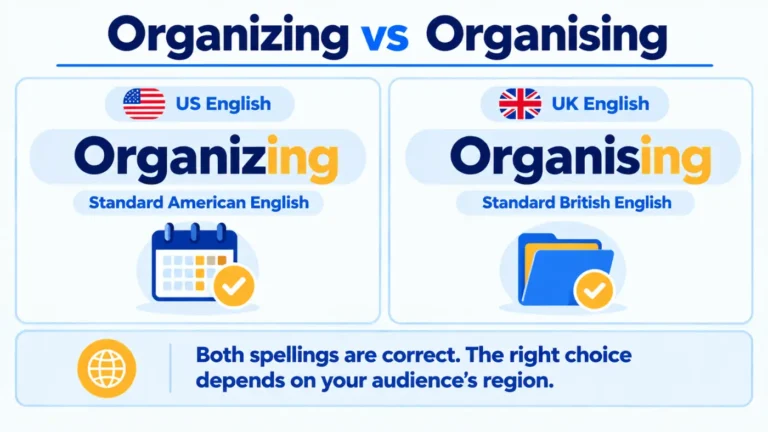
Organize vs Organise
This pair follows the identical US versus UK pattern as standardized and standardised. Organize is standard American English, and organise is standard British English. Example: The American committee organized the fundraiser, while the British branch organised the accompanying auction.
Standardize vs Standard
Standardize is the verb describing the action of making something uniform, while standard is the noun or adjective referring to the established norm or benchmark itself. Example: The new standard for packaging took months to standardize across every supplier.
Standardization vs Standardisation
This pair mirrors the verb split exactly, since the noun form follows the same regional spelling convention as the verb it comes from. Example: The American report focused on cost standardization, while the British version of the same study used cost standardisation throughout.
Standardized vs Uniform
These two are closely related in meaning, though “uniform” as an adjective describes the resulting consistency itself, while “standardized” describes the process of achieving that consistency according to an established rule. Example: After the process was standardized, the results across all locations finally looked uniform.
Quick Practice: Test Yourself
Choose the spelling that fits each context.
- A US school district’s policy document explains how testing was ______ statewide. (standardized / standardised)
- A British manufacturing report describes how part dimensions were ______ across suppliers. (standardized / standardised)
- An American healthcare journal discusses efforts to ______ patient intake forms. (standardize / standardise)
- A UK university’s research paper outlines how survey questions were ______. (standardized / standardised)
- A US patent application describes a ______ measurement system used in the device. (standardized / standardised)
- An Australian business report recommends ways to ______ supply chain documentation. (standardize / standardise)
Answer Key
- standardized: American context calls for the American spelling.
- standardised: British context calls for the British spelling.
- standardize: matches the American journal’s regional convention.
- standardised: matches UK academic spelling standards.
- standardized: US patents follow American spelling conventions.
- standardise: Australian business writing typically follows British spelling conventions.
Frequently Asked Questions
Is standardized or standardised the correct spelling?
Both are correct. Standardized is standard American English, and standardised is standard British English, so the right choice depends on your audience’s regional spelling convention.
Do standardized and standardised mean the same thing?
Yes. Both words describe the process of making something conform to a consistent set of rules or measurements, with no difference in meaning or grammatical function.
Why does British English sometimes use “-ize” instead of “-ise”?
Some British publishers, most notably Oxford University Press, use “-ize” spellings for etymological reasons, since many of these verbs derive from Greek roots that historically used a “z” sound. This is often called Oxford spelling.
Which spelling should I use for a US-based audience?
Use standardized for American audiences, since it matches standard US spelling conventions used in education, manufacturing, and business writing.
Is one spelling more official than the other?
No. Neither spelling is more official, accurate, or authoritative than the other. The difference is regional, not a matter of correctness or formality.
Can I use standardized and standardised interchangeably in the same document?
It’s best to choose one and use it consistently throughout a single document, since mixing the two regional spellings can look inconsistent even though both are individually correct.

Sophia Bennett writes educational content about English vocabulary, grammar, slang, and communication. She is passionate about making complex language topics accessible to students, professionals, and curious readers around the world.