Homie vs Homey: The Spelling That Divides True Friends
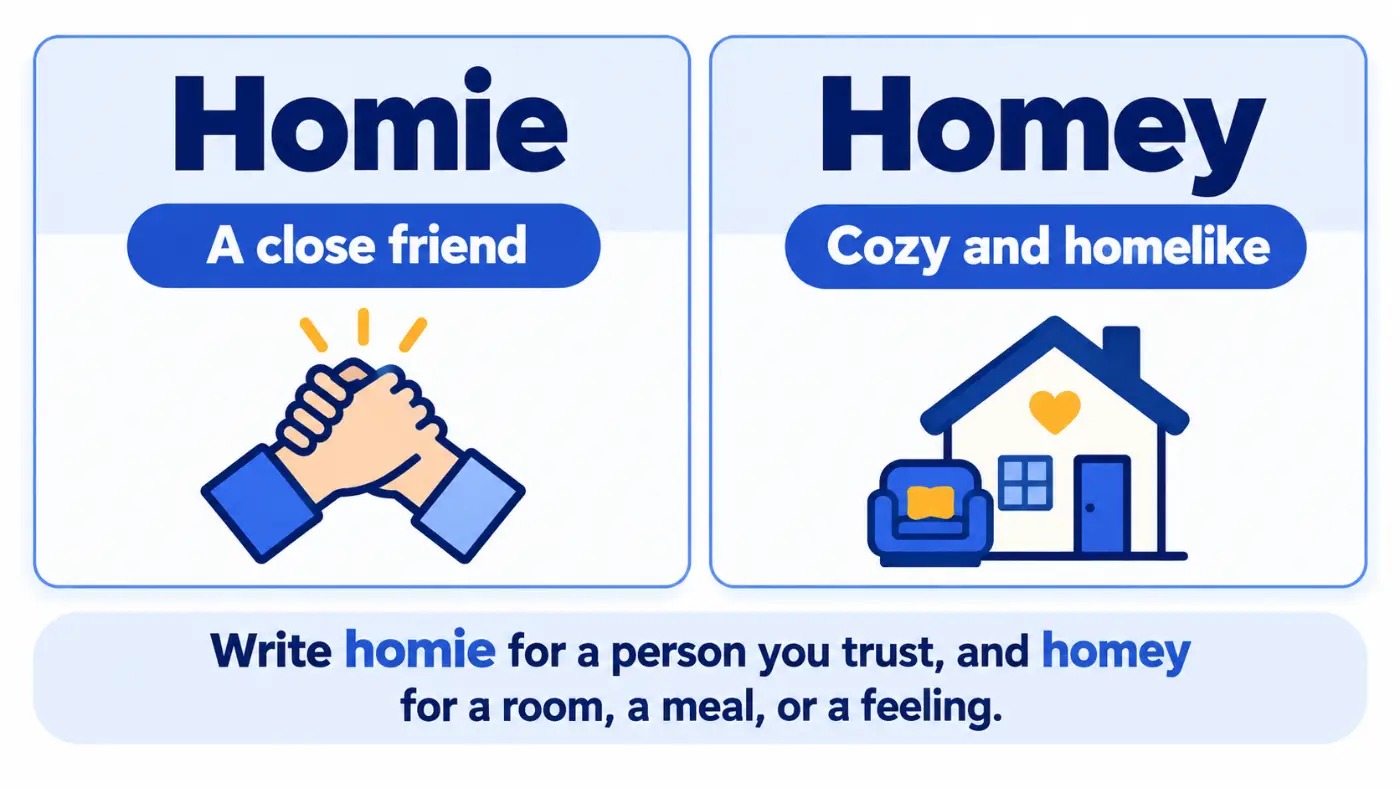
Homie is slang for a close friend. Homey is an adjective that means cozy, comfortable, and like home. Write homie when you mean a person you trust, and write homey when you describe a room, a meal, or a feeling.
The Short Answer at a Glance
| Word | What It Is | What It Means | Example |
|---|---|---|---|
| Homie | Noun (slang) | A close friend or buddy | Marcus saved me a seat, because that’s what a homie does. |
| Homey | Adjective | Cozy, warm, familiar | The bakery felt homey the second I stepped inside. |
Dictionaries also record homey as a less common spelling of the friend meaning. Today, homie is the standard choice for that sense, and most readers will expect it.
What Homie Means and How It Works
Homie is a noun that means a close friend, a buddy, or someone from your own circle whom you trust. It is informal slang, and it started as a shortened form of homeboy. Homeboy first pointed to someone from your neighborhood or hometown. The geography faded over time, and the word now just signals a tight bond.
As a noun, homie is countable. The plural is homies, the singular possessive is homie’s, and the plural possessive is homies’. You can use it two ways. You can talk about someone (my homie from the warehouse), or you can speak to someone directly (Thanks for the ride, homie).
Homie works for any gender. Homeboy and homegirl point to a specific gender, but homie doesn’t.
The word grew out of Black American English and hip hop culture before spreading into everyday casual speech. That history shapes its tone. Homie sounds warm and relaxed with friends. It can sound forced when a speaker uses it out of character, but that’s a social issue, not a grammar one.
What Homey Means and How It Works
Homey is an adjective that describes anything that feels the way a good home feels: comfortable, relaxed, and unpretentious. You can use it for places, food, decor, and atmosphere. It isn’t slang. It fits easily in reviews, travel writing, and real estate copy.
Homey follows two common patterns. It can sit before a noun (a homey kitchen), or it can follow a linking verb (the kitchen felt homey). Words like very, surprisingly, and pretty modify it. The comparative is homier, the superlative is homiest, and the noun form is homeyness.
Homey can also describe a person who comes across as warm and down to earth. That use sounds a little dated, but it’s still understood.
One wrinkle deserves a mention. Some dictionaries list homey as a noun spelling for friend. You’ll see it in older writing and in a few lyrics. It isn’t a mistake, but it’s the less common choice now.
Homie vs Homey: Key Differences Side by Side
| Feature | Homie | Homey |
|---|---|---|
| Part of speech | Noun | Adjective |
| Core meaning | Close friend, buddy | Cozy, comfortable, like home |
| Typical use | Naming or addressing a friend | Describing places, food, moods |
| Register | Informal slang | Standard, informal to semiformal |
| Forms | Homies, homie’s | Homier, homiest, homeyness |
| Example | My homie Elise drove six hours to help me move. | Elise’s cabin has a homey glow at night. |
The two words sound identical out loud, so the difference only shows up on the page. That’s why the mix up is so common in texts and captions. Speech never forces you to choose a spelling, but writing does.
The table also can’t show the overlap. Homey occasionally stands in for the friend noun, but homie never works as an adjective. That asymmetry is the most useful thing to remember.
Correct Examples in Real-Life Contexts
Homie
- Everyday speech: Tell Devon I said thanks, homie, because that airport pickup saved my whole week.
- Texting: my homie Priya just got the keys to her first apartment!!
- Workplace chat: Big thanks to Omar, a true homie, for covering my Friday shift.
- School or academic: The narrator calls Malik his homie in the opening paragraph, which tells us how close the two boys are.
- Journalism: The profile notes that the mayor still calls his old classmates homies when they visit city hall.
Homey
- Everyday speech: Your apartment feels so homey that I could nap on that couch right now.
- Texting: that soup place on 5th is tiny but so homey, we’re going back Friday
- Workplace writing: Our onboarding emails aim for a homey tone without sounding sloppy.
- School or academic: The author builds a homey mood in chapter one with kettle steam and a worn quilt.
- Formal writing: A reviewer said the inn’s homey charm outweighed its dated plumbing.
Common Mistakes People Make (and How to Catch Them)
Mistake 1: Using homey for a friend. Wrong: That’s my homey from college. → Right: That’s my homie from college. The adjective is more familiar, so the eye trusts it. Most readers will read the homey spelling here as a typo, even though dictionaries record it as a variant.
Mistake 2: Using homie to describe a place. Wrong: Her grandmother’s kitchen felt warm and homie. → Right: Her grandmother’s kitchen felt warm and homey. This usually comes from overcorrection. A writer who has been texting homie all week starts applying it everywhere.
Mistake 3: Letting autocorrect decide. Wrong: The lodge was cozy and homie, with a fire in every room. → Right: The lodge was cozy and homey, with a fire in every room. Phones learn your habits. If you type homie often, your keyboard may quietly replace homey. Reread before you send.
Mistake 4: Fumbling the plural and possessive. Wrong: Two of my homie’s moved to Austin. → Right: Two of my homies moved to Austin. Wrong: My homies car broke down. → Right: My homie’s car broke down. An apostrophe signals ownership, not plurality. Decide first how many friends you mean, then decide whether anything belongs to them.
A Fast Trick to Choose Between Homie and Homey
Swap in the word buddy. If buddy fits, write homie. If cozy fits, write homey.
Try it on a real sentence. My ___ from the gym lifts more than I do. Buddy works, so the answer is homie. The porch swing gives the house a ___ feel. Cozy works, so the answer is homey.
A spelling memory aid helps too. The word friend contains the letters ie, and so does homie. Words for comfort tend to end in y, like cozy and comfy, and so does homey.
The trick has one limit. It points you to the standard spelling, but it can’t tell you that homey is a recorded variant for friend. If you want the spelling nearly every reader expects, follow the trick and ignore the variant.
How They Sound in Real Situations
A text exchange
Jordan: Who’s picking up Tavian from the airport? Lena: Me. He’s my homie, and I’m not letting him take a rideshare at 6 a.m. Jordan: You’re a good homie.
Homie names a person, so it’s a noun. Lena uses it as a label, and Jordan uses it as a compliment.
An email snippet
Subject: Saturday open house
Hi Carla, the listing photos make the place look sterile, but it feels homey in person. There’s a wood stove, a window seat, and a kitchen built for crowds. I think your clients will love it.
Homey describes how the house feels, so it’s an adjective.
An article excerpt
Every Sunday, Ray opens his garage to the neighborhood. His homies bring folding chairs, and the smell of grilled corn makes the whole block feel homey.
Both words appear, and each does its own job. Homies names the people, and homey describes the atmosphere.
Homie vs Homey in Formal Writing vs Casual Writing
Homie belongs in casual writing, while homey works in both casual and semiformal writing. Register is the main thing that separates them.
In texts, captions, and social posts, homie is perfectly natural. In business emails and academic papers, formal prose generally steers clear of slang. Homie shows up there only when you quote someone or study the word itself.
Journalism sits in the middle. Feature writers may use homie for voice or inside a quotation. Homey is easy to use in hospitality, design, and real estate writing, where a warm tone sells the place. In a formal report, consider cozy or welcoming if you want a neutral alternative.
US vs UK English Differences
Homie and homey are spelled the same in American and British English. The real difference lives in a neighboring word: homely.
In the US, homely usually means plain looking, and it’s most often said about people. In the UK, homely often means cozy and welcoming, much like homey. A British reviewer who calls an inn homely is giving praise, but an American reader might take it the wrong way.
Homie is most at home in American English. British speakers tend to reach for mate or pal, though homie is widely understood through music and media.
Related Mix-Ups People Also Search For
Homey vs Homely
Homey means cozy in both countries. Homely splits by region: plain looking in most American usage, cozy in much British usage. If you want to avoid any misunderstanding, choose homey.
The guesthouse was homey, with wool blankets on every bed.
Homie vs Homeboy and Homegirl
Homie is the general word, and it covers any gender. Homeboy and homegirl are gender specific and often carry a stronger neighborhood flavor. Homie is the safer pick when you want a single term for a mixed group.
Yasmin, Theo, and Kwame have been my homies since middle school.
Homies vs Homie’s vs Homies’
Homies is the plural. Homie’s shows that one friend owns something. Homies’ shows that several friends share something.
My homie’s couch is comfortable, but my homies’ apartment is where we all end up.
Exceptions, Edge Cases, and Tricky Situations
The noun spelling homey. Dictionaries record it, and older writing uses it. You can quote it or keep it when you reprint an older text. In new writing, homie is the clearer choice.
The catchphrase. Homey D. Clown, the character Damon Wayans played on the sketch show In Living Color, popularized the line Homey don’t play that. The spelling in the catchphrase may be one reason some people still write homey for a friend. Keep that spelling when you quote the line.
A friend who is also homey. Greta is the homey type, the friend who bakes bread for no reason. Here, homey describes a person’s warmth, so it stays an adjective even though it’s about a friend.
Names and brands. A business or a band can spell the word however it likes. When you refer to the name itself, follow the owner’s spelling.
Quick Practice: Test Yourself
Choose homie or homey for each sentence.
- Dario texted his ___ to ask for a couch to crash on.
- The diner’s checkered curtains and chipped mugs give it a ___ charm.
- My college ___ flew in for my wedding.
- The lobby looks sleek, but the third floor lounge feels surprisingly ___.
- Two of my ___ are moving to Austin. (homies or homey’s)
- Which is correct? A) Nadia’s kitchen is warm and homie. B) Nadia’s kitchen is warm and homey.
Answer key
- Homie. It names a friend, so it needs the noun.
- Homey. It describes the charm of a place.
- Homie. It’s a noun for a friend, and homie is the standard spelling.
- Homey. It describes how the lounge feels.
- Homies. You need a plain plural, with no apostrophe.
- B. Warm and homey describes the kitchen, and only the adjective can do that.
Frequently Asked Questions
Is it homie or homey?
It depends on the meaning. Homie is the noun for a close friend, and homey is the adjective for cozy or homelike.
Is homey a real word?
Yes. Homey is a standard adjective that means cozy, comfortable, and like home. Some dictionaries also list it as a variant spelling of the friend noun.
Can homey mean friend?
It can in some dictionaries, but it’s the less common spelling. Homie is the form most readers expect.
Where does homie come from?
Homie is a shortened form of homeboy. Homeboy originally meant someone from your neighborhood or hometown.
Is homie offensive?
No, not by nature. It’s friendly slang, but using it with strangers or in formal settings can feel awkward.
What is the plural of homie?
The plural is homies. The possessive forms are homie’s for one friend and homies’ for several.

Sophia Bennett writes educational content about English vocabulary, grammar, slang, and communication. She is passionate about making complex language topics accessible to students, professionals, and curious readers around the world.