Cue vs Queue Which Word Fits Your Sentence
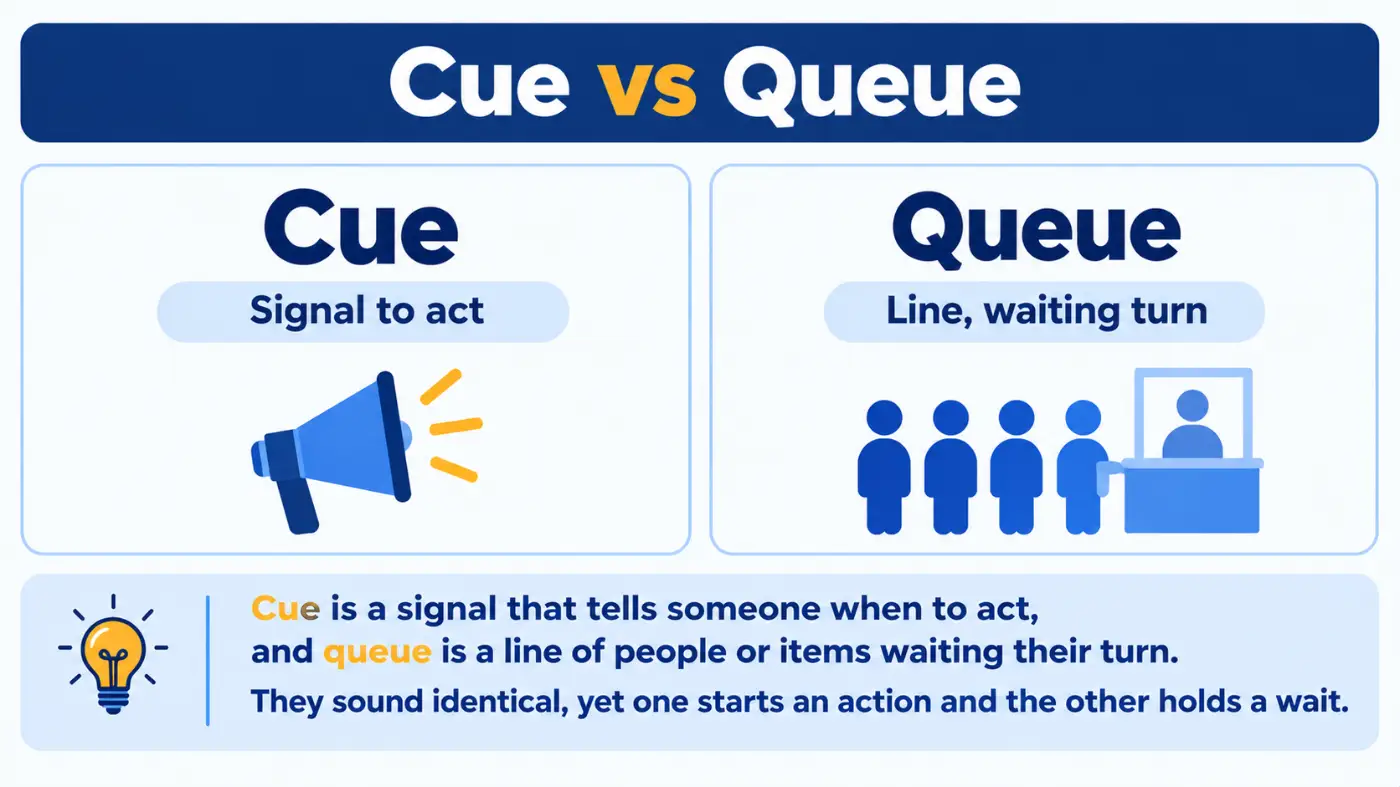
Cue is a signal that tells someone when to act, and queue is a line of people or items waiting their turn. They sound identical, yet one starts an action and the other holds a wait.
The Short Answer at a Glance
Reach for cue when something prompts a move. Reach for queue when things are lining up.
| Word | Core meaning | Example |
|---|---|---|
| Cue | A signal or prompt to act, plus the stick used in pool. | The sudden silence was Marcus’s cue to begin his toast. |
| Queue | A line of people or items waiting in order. | A queue of forty shoppers wrapped around the bakery. |
What Cue Means and How It Works
Cue is both a noun and a verb, and its main job is to signal that it’s time to do something. A stage manager gives an actor a cue to enter. A yawn at a dinner party gives guests a cue to head for the door. A hint in a conversation can work as a cue too.
The same word also names the tapered stick used in pool, billiards, and snooker. That’s where the cue ball gets its name, because the stick strikes it.
As a verb, cue means to give a signal or to get something ready to play. A sound engineer cues the music, and a host cues up the next video.
You’ll see cue in a handful of steady patterns. On cue means at exactly the right moment. Take a cue from someone means follow their example. Social cues are the small signals people read in body language and tone. A cue card is a prompt held up for a speaker.
What Queue Means and How It Works
Queue is a noun for a line of people, vehicles, or things waiting in order. It’s also a verb meaning to form or join such a line. Past tense is queued, and the ing form appears as both queuing and queueing.
The word has a second life in computing. A queue there is a list where items join at the back and leave from the front, so the first one in is the first one out. Print queues, job queues, and message queues all follow that logic.
Everyday patterns include join the queue, wait in the queue, and queue up. Media apps borrowed the idea, so people talk about a music queue or a watchlist queue. Theme parks now run a virtual queue, where you hold a place through your phone instead of standing in a corridor.
The spelling looks odd because the last four letters are silent. Only the Q is pronounced. The word is said exactly like the letter itself.
Cue vs Queue Key Differences Side by Side
| Feature | Cue | Queue |
|---|---|---|
| Part of speech | Noun and verb. | Noun and verb. |
| Core meaning | A signal, prompt, or hint to act. Also a pool stick. | A line of people or items waiting in order. |
| Typical use | Theater, film, conversation, billiards. | Customer service, computing, media apps, British everyday speech. |
| Register | Standard at every level of formality. | Standard at every level of formality. |
| Example | The lighting cue came two beats too late. | Your request is third in the support queue. |
The table can’t show how often the two words get swapped, and that’s the real story. They’re homophones, so the ear gives no help. Only meaning separates them. A cue is about timing and triggers. A queue is about order and waiting.
Correct Examples in Real Life Contexts
Cue in Action
- Everyday speech: The porch light flicked on right on cue, just as the first raindrops hit the windshield.
- Workplace writing: When Priya glanced at her watch for the third time, her manager took the cue and wrapped up the call.
- Texting: Soon as you see the green truck pull up, that’s my cue to carry the cake out.
- School: In her stage management class, Tamika learned to pencil every light cue into the script margin.
- Formal writing: Investors often take their cue from the central bank’s tone, not only its numbers.
- Pool hall: Dev chalked the tip of his cue and lined up the corner pocket.
Queue in Action
- Everyday speech: A queue snaked from the pharmacy counter to the cereal aisle by noon on Saturday.
- Workplace writing: Your ticket is third in the support queue, and an agent should reach you within the hour.
- Texting: I queued three songs before the road trip so nobody fights over the aux cord.
- School: For the lab, we built a queue in Python that serves requests in the order they arrive.
- Formal writing: The permit queue grows every spring when contractors file for summer projects.
- Theme park: Guests who join the virtual queue get a text when their boarding window opens.
Common Mistakes People Make and How to Catch Them
- Writing cue for a waiting line. Wrong → Please cue behind the others at the register. Right → Please queue behind the others at the register. The words sound alike, and the short one is easier to type.
- Writing queue for a signal. Wrong → The conductor’s queue told the violins to enter. Right → The conductor’s cue told the violins to enter. Queue looks more formal, so writers overcorrect.
- Splitting an idiom. Wrong → The guest arrived right on queue. Right → The guest arrived right on cue. On cue is a fixed phrase about timing, and nobody is waiting in line.
- Misnaming the pool equipment. Wrong → Shoot the queue ball gently. Right → Shoot the cue ball gently. The ball is named after the stick that strikes it.
- Trimming the silent letters. Wrong → Que up your playlist. Right → Queue up your playlist. Typing by ear skips the quiet letters, and que looks like a word from another language.
- Dropping the wrong letter in the ing form. Wrong → We’re queing for tickets. Right → We’re queuing for tickets, or queueing. Writers apply the usual rule of dropping a final e, but they drop the second e instead of the first one in the last syllable.
A Fast Trick to Choose the Right One
Picture the letters after the Q in queue as people standing in a line. Look at them lined up: u, e, u, e. Four silent letters trail behind one Q like a patient crowd. Cue has only two letters after the Q, so it’s short and quick, just like a signal.
For a second check, try substituting a plain word. If you can swap in signal or prompt, you want cue. If you can swap in line or waiting list, you want queue.
The test has limits. It breaks down for the pool stick, because a stick isn’t a signal. It also gets fuzzy with cue up and queue up in music apps, which the edge cases section covers.
How Cue and Queue Sound in Real Situations
A text exchange
Jess: Did the doors open yet?
Omar: Not yet. The queue stretches around the block.
Jess: Save me a spot. When the band takes the stage, that’s my cue to walk over.
Omar’s queue is a line of waiting people, and Jess’s cue is a signal that tells her when to move.
An email snippet
Hi Dana, your request is now in the billing queue. Once Hector finishes the audit, I’ll take my cue from his notes and send the revised invoice by Thursday.
The first word is a waiting list of tasks. The second is a prompt that guides what happens next.
An article excerpt
At the Oakridge Playhouse, the house lights dimmed on cue while a last queue of latecomers hurried to their seats. The orchestra took its cue from the conductor’s raised hand.
Both words appear here for different reasons. The lights obey a timed signal, and the latecomers form a short line.
Cue vs Queue in American and British English
Both words are standard in American and British English, but queue as an everyday waiting line leans British. Americans usually say line, as in stand in line or cut in line. A Briton says join the queue or jump the queue.
| American | British |
|---|---|
| Wait in line | Wait in a queue |
| Cut in line | Jump the queue |
| Line up | Queue up |
Americans still use queue constantly, just in other places. Print queue, music queue, and virtual queue are all common in American writing. Cue, by contrast, works the same on both sides of the Atlantic.
Register doesn’t change the choice, either. A text, a term paper, and a news story all use cue and queue under the same rules.
Related Mix Ups People Also Search For
Cue vs Clue
A cue prompts you to act, while a clue helps you figure something out. A detective follows a clue. An actor follows a cue. Muddy boots by the door were a clue that someone had come in through the garden.
Cue Up vs Queue Up
Cue up usually means get something ready to play, and queue up means line up or add something to a waiting list. In practice the two overlap in music and video apps, and context usually carries the meaning. The DJ will cue up the next track after the announcement.
Queuing vs Queueing
Both spellings are accepted. Queuing follows the usual rule of dropping a final e before ing, while queueing keeps every letter. Pick one and stay consistent. The crowd was queuing patiently outside the stadium.
Exceptions Edge Cases and Tricky Situations
- Cue up and queue up overlap in media. A person who says queue up the song and a person who says cue up the song are often describing the same action. Neither counts as an error, so let your sentence and your audience guide you.
- Cue can work as a plain verb. Stage crews cue the lights, and film editors cue the music. No up is required.
- Some phrases are locked. Right on cue and take a cue from never change to queue.
- Both ing spellings stand. Queuing and queueing are both in use, and neither one is a typo.
- The pool stick stays cue. The word covers the stick in billiards and snooker, and the cue ball is named after it.
Quick Practice Test Yourself
Choose cue or queue for each sentence.
- Her yawn was my ____ to wrap up the meeting.
- Please add this song to the ____ so it plays after the next one.
- The actor missed his ____ and walked on three lines late.
- Rosa chalked her pool ____ before the break.
- A London commuter might say the bus ____ was longer than usual.
- Your ticket is waiting in the support ____.
Answer Key
- Cue. A yawn is a signal that prompts action.
- Queue. A list of songs waiting to play is a queue.
- Cue. It’s a theater signal for entering.
- Cue. It’s the pool stick.
- Queue. It’s a British line of waiting riders.
- Queue. Support tickets wait in order.
Frequently Asked Questions
Do cue and queue sound the same?
Yes. Both are pronounced exactly like the letter Q, so only spelling and meaning separate them.
Is it on cue or on queue?
It’s on cue. The phrase means at precisely the right moment, and it has nothing to do with a line.
Is queue a British word?
For a waiting line in daily speech, it leans British, while Americans usually say line. In computing and media apps, queue is standard in American English too.
Is cue up or queue up correct for music?
Both appear in real use. Cue up usually means get a track ready to play, and queue up means add it to a waiting list.
Is it queuing or queueing?
Both spellings are accepted. Queuing drops the final e before ing, and queueing keeps it.
What is the stick used in pool called?
It’s called a cue. The ball it strikes is the cue ball.

Sophia Bennett writes educational content about English vocabulary, grammar, slang, and communication. She is passionate about making complex language topics accessible to students, professionals, and curious readers around the world.