Aerofoil vs Airfoil: Which Spelling Is Correct?
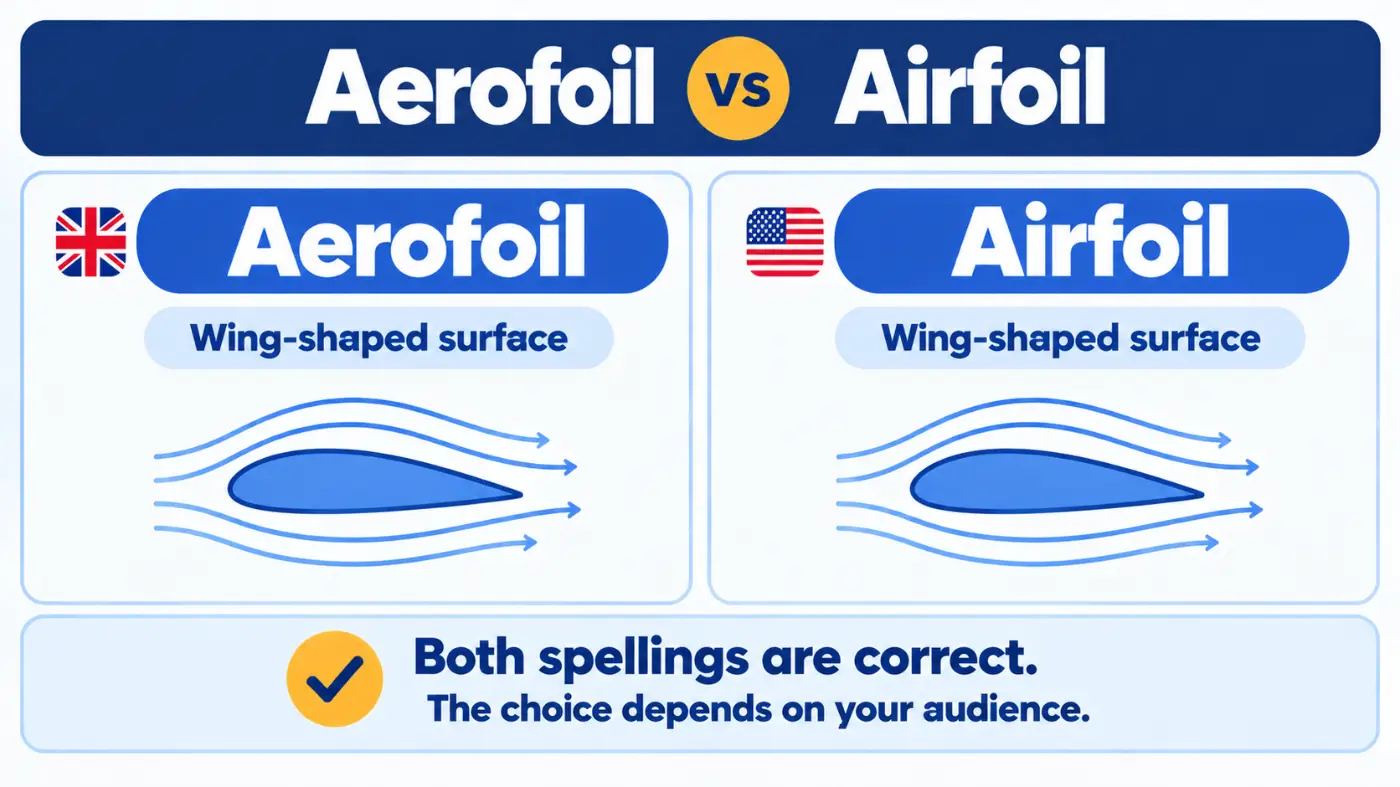
Both spellings are correct. Airfoil is the standard American English spelling, and aerofoil is the standard British English spelling, and the choice comes down to which regional convention your audience expects.
The Short Answer at a Glance
| Form | Region | What it names | Example |
|---|---|---|---|
| airfoil | American English | A shaped surface, like a wing, designed to produce lift | The airfoil’s curved top surface helps the plane climb. |
| aerofoil | British English | The same shaped surface, used to produce lift | The engineer tested the aerofoil in a wind tunnel. |
Pick based on your reader, not on which one sounds more technical. Neither spelling is more correct than the other.
What Airfoil Means and How It Works
Airfoil is a noun that names the cross-sectional shape of a wing, propeller blade, turbine blade, or similar surface designed to interact with moving air in a useful way. When air flows across an airfoil’s curved surfaces, it generates lift, drag, or both, depending on the shape and angle involved.
The word breaks down plainly: “air” plus “foil,” where foil here relates to a thin, shaped surface, not the kitchen kind. Put together, it describes a shape built specifically to work with airflow.
Airfoil functions as a standard countable noun. You can talk about one airfoil, several airfoils, a symmetric airfoil, or a high-lift airfoil. It also works as a modifier in compound terms like airfoil shape, airfoil section, and airfoil design.
In American aerospace writing, airfoil is the default term. It shows up in textbooks, technical manuals, flight training materials, and engineering papers published in the United States. Pilots training in the US learn about airfoils, not aerofoils, from their very first ground school lesson.
What Aerofoil Means and How It Works
Aerofoil means exactly the same thing as airfoil. It’s a noun describing the shaped cross-section of a wing or blade that generates lift as air moves across it. The definition, the physics, and the grammatical behavior are identical to the American form.
The spelling difference traces back to a broader pattern in British English, where many words built from the Greek root “aero-” keep that spelling rather than shortening to “air-.” You’ll see this same pattern in aeroplane, the British form of airplane, and in aerodrome, an older British term for an airfield.
Aerofoil is standard in British English aviation and engineering writing, and it’s also common across other regions that follow British spelling conventions, including much of the Commonwealth. A student in a UK engineering program will read about aerofoil sections, aerofoil profiles, and aerofoil testing throughout their coursework.
Neither the meaning nor the technical concept changes based on which spelling a text uses. An aerofoil and an airfoil placed side by side would be the exact same physical object.
Aerofoil vs Airfoil: Key Differences Side by Side
| Feature | Airfoil | Aerofoil |
|---|---|---|
| Part of speech | Noun | Noun |
| Core meaning | A shaped surface that generates lift from airflow | Identical meaning |
| Typical use | American aviation, engineering, and physics writing | British and Commonwealth aviation and engineering writing |
| Register | Standard technical term | Standard technical term |
| Example | The airfoil’s angle of attack affects lift production. | The aerofoil’s angle of attack affects lift production. |
What the table can’t fully convey is how consistently this split follows the broader American versus British spelling pattern. If a document already uses American spellings like color and airplane, airfoil will match. If it uses British spellings like colour and aeroplane, aerofoil is the expected companion.
Correct Examples in Real-Life Contexts
Everyday speech (American)
- My nephew built a little airfoil out of foam board for his science fair project.
- The drone’s rotor blades are basically tiny airfoils spinning really fast.
- She explained how an airfoil creates lift using nothing more than a paper strip and a straw.
- Watching that kite dip and climb, you can actually see the airfoil doing its job.
Everyday speech (British)
- The model glider club spent the afternoon comparing different aerofoil shapes.
- He picked up a basic understanding of aerofoils from building model planes as a kid.
Workplace writing (American)
- The design team ran three airfoil configurations through the simulation before choosing one.
- Our airfoil supplier confirmed the new blade geometry meets the updated specifications.
- The report compares airfoil performance across a range of wind speeds.
- Engineering flagged an issue with airfoil icing during the cold-weather testing phase.
Workplace writing (British)
- The aerofoil manufacturer has requested revised tolerances for the next production run.
- Our aerofoil testing schedule has been pushed back due to wind tunnel availability.
Texting (American)
- just read about airfoils for my aviation class, way more math than i expected
- check out this diagram of an airfoil, it explains lift so well
School and academic (American)
- The physics lecture covered how airfoil shape influences the pressure difference above and below a wing.
- Students measured lift and drag on a scale-model airfoil in the wind tunnel lab.
- The textbook chapter on airfoils introduces both symmetric and cambered designs.
School and academic (British)
- The dissertation examines aerofoil efficiency at low Reynolds numbers.
- Coursework included a practical session on aerofoil testing procedures.
Formal writing (American)
- The patent describes a novel airfoil geometry intended to reduce drag at cruising speed.
- Federal aviation regulations reference airfoil certification standards for new aircraft designs.
- The airfoil’s leading edge was redesigned to improve performance in icing conditions.
Formal writing (British)
- The technical specification outlines the required aerofoil tolerances for each production batch.
- Aerofoil design remains a central focus of the university’s aerospace engineering programme.
Common Mistakes People Make (and How to Catch Them)
Mixing spellings within one document
Wrong: The airfoil was tested extensively, and the aerofoil’s data was compiled afterward. Right: The airfoil was tested extensively, and the airfoil’s data was compiled afterward.
Switching spellings mid-document is jarring for readers and often happens when writers copy text from sources using different regional conventions without checking consistency.
Assuming one spelling is more technical or advanced
Wrong belief: Aerofoil is the “proper” scientific term, and airfoil is a casual shortcut. Right understanding: Both are equally correct and equally technical, differing only by region.
Some writers assume the longer or more Latin-looking spelling must be more scientific. That’s not the case here. The difference is purely regional, not a matter of precision or formality.
Spelling it by ear without checking regional context
Wrong: A student writing for a US audience uses aerofoil without realizing it reads as unusual in that context. Right: Matching the spelling to airfoil for a US audience, or aerofoil for a UK audience, keeps the writing consistent with reader expectations.
This isn’t really an error in the way a true misspelling is, but it can look inconsistent if a US-based publication or app suddenly uses aerofoil without explanation.
Autocorrect flipping the spelling unexpectedly
Wrong: A writer types airfoil, but a British-English spellcheck setting quietly changes it to aerofoil. Right: Checking your document’s language and spellcheck settings before finalizing technical writing.
This is a formatting hazard rather than a language error, but it can slip through unnoticed in documents shared internationally.
A Fast Trick to Choose the Right One
Match it to your audience’s spelling system. If your document already uses American spellings like color, airplane, and analyze, stick with airfoil. If it uses British spellings like colour, aeroplane, and analyse, use aerofoil.
A second trick: think of airplane and aeroplane as a pair you already recognize. Airfoil and aerofoil follow that exact same split, word for word, letter for letter in the part that changes.
This trick works reliably because the “air-” to “aero-” substitution here mirrors the far more familiar airplane and aeroplane pattern almost exactly. The only real limit is that you still need to know which regional convention your specific document or publication follows.
How They Sound in Real Situations
A text exchange (American)
Kayla: My physics homework is all about airfoils tonight.
Ben: Ugh, lift and drag equations? Good luck.
Kayla: At least the diagrams make sense once you see the airfoil shape.
Airfoil is correct here because the conversation uses standard American spelling throughout.
A workplace email (British)
Subject: Aerofoil testing update
Hi Priya,
The wind tunnel slot for the new aerofoil prototype has been confirmed for Thursday. Please make sure the sensor calibration is finished beforehand so we don’t lose testing time.
Regards, Tom
Aerofoil is correct because the email follows British spelling conventions consistently.
An article-style excerpt (American)
Engineers unveiled a redesigned airfoil this week, claiming a measurable improvement in fuel efficiency across the aircraft’s cruising range. The new shape reduces drag without sacrificing the lift needed during takeoff and landing.
Airfoil fits naturally here in a piece written for an American technical audience.
Formal Writing vs Casual Writing
The spelling choice doesn’t shift based on formality. Both airfoil and aerofoil are fully standard in academic papers, engineering reports, casual conversation, and technical manuals within their respective regions.
What matters more than formality is audience and publication standard. A US-based aerospace journal will expect airfoil throughout, including in headlines, abstracts, and figure captions. A UK-based publication will expect aerofoil in the same spots. Mixing the two within one formal document, regardless of how casual or technical the tone, tends to look like an editing oversight rather than a stylistic choice.
AP style, which is American, uses airfoil consistently. British style guides and publications favor aerofoil. Neither guide treats the other spelling as incorrect; they simply reflect their respective regional standards.
US vs UK English Differences
This is a genuine US versus UK spelling split, not a case of one form being wrong. Airfoil is the standard spelling throughout American English, appearing in US textbooks, government aviation documents, and technical publications. Aerofoil is the standard spelling throughout British English and in many Commonwealth countries that follow British conventions, including much of aerospace writing in the UK, Australia, and similar regions.
This split mirrors other well-known “air-” versus “aero-” pairs, most notably airplane and aeroplane. If you already know that pattern, you already understand this one.
Related Mix-Ups People Also Search For
Airplane vs Aeroplane
This pair follows the identical US versus UK pattern as airfoil and aerofoil. Airplane is standard American English, and aeroplane is standard British English. Example: The American pilot referred to the aircraft as an airplane, while his British colleague called it an aeroplane.
Airfoil vs Wing
An airfoil refers specifically to the cross-sectional shape that produces lift, while a wing is the full three-dimensional structure built using that shape. Example: The wing’s airfoil changes slightly from root to tip to optimize performance across the whole span.
Aerodynamics vs Aeronautics
Aerodynamics is the study of how air moves around objects, including airfoils, while aeronautics is the broader field covering aircraft design, construction, and operation. Example: Her research in aerodynamics directly informed the aerofoil shape used in the new aircraft’s wings.
Quick Practice: Test Yourself
Choose the spelling that fits each context.
- A US flight training manual explains how an ______ generates lift during takeoff. (airfoil / aerofoil)
- A British engineering report describes testing a new ______ shape in a wind tunnel. (airfoil / aerofoil)
- An American physics textbook includes a diagram labeled “parts of an ______.” (airfoil / aerofoil)
- A UK university course syllabus lists a module on ______ design. (airfoil / aerofoil)
- A US patent application describes a curved ______ intended to reduce drag. (airfoil / aerofoil)
- An Australian aerospace journal publishes a paper on ______ efficiency. (airfoil / aerofoil)
Answer Key
- airfoil: American context calls for the American spelling.
- aerofoil: British context calls for the British spelling.
- airfoil: matches the American textbook’s regional convention.
- aerofoil: matches UK academic spelling standards.
- airfoil: US patents follow American spelling conventions.
- aerofoil: Australian publications typically follow British spelling.
Frequently Asked Questions
Is airfoil or aerofoil the correct spelling?
Both are correct. Airfoil is standard American English, and aerofoil is standard British English, so the right choice depends on your audience’s regional spelling convention.
Do airfoil and aerofoil mean the same thing?
Yes. Both words describe the same shaped surface that generates lift when air flows across it, with no difference in meaning or function.
Why does British English use “aero-” instead of “air-“?
British English tends to preserve the fuller Greek-derived “aero-” root in several aviation terms, which is the same pattern seen in aeroplane versus airplane.
Which spelling should I use in a US-based publication?
Use airfoil for American audiences, since it matches standard US spelling conventions used in aviation, engineering, and physics writing.
Is one spelling more scientifically accurate than the other?
No. Neither spelling is more precise or more technical than the other. The difference is purely regional, not a matter of accuracy.
Can I use aerofoil and airfoil interchangeably in the same document?
It’s best to pick one and use it consistently throughout a single document, since mixing the two regional spellings can look inconsistent even though both are individually correct.

Sophia Bennett writes educational content about English vocabulary, grammar, slang, and communication. She is passionate about making complex language topics accessible to students, professionals, and curious readers around the world.