Occurring vs Occuring: Which Spelling Is Correct?
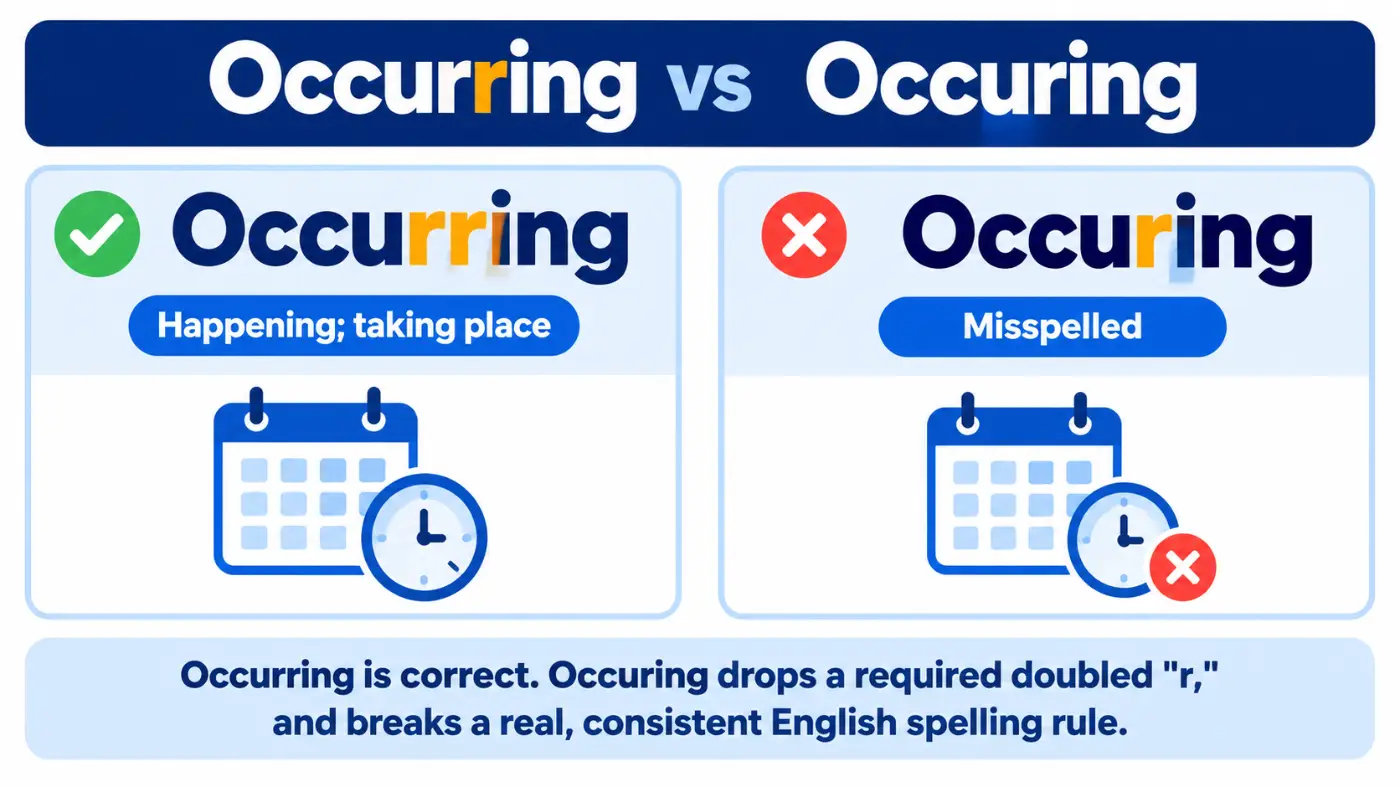
Occurring is the correct spelling. Occuring drops a required doubled “r,” and unlike some doubling mistakes, this one actually breaks a real, consistent English spelling rule rather than just looking wrong by habit.
The Short Answer at a Glance
| Form | Status | What it does | Example |
|---|---|---|---|
| occurring | Correct | Present participle of occur, describing something happening or taking place | The delays kept occurring throughout the entire construction project. |
| occuring | Misspelling | Not a word in standard English | Correct it to occurring every time. |
Only one spelling is real. Occur needs a doubled “r” before “-ing” is added, and occuring simply skips that required step.
What Occurring Means and How It Works
Occurring is the present participle of the verb occur, meaning to happen, take place, or exist at a particular time. It’s a common word across nearly every kind of writing, from casual conversation about everyday events to formal scientific and legal writing describing specific incidents or phenomena.
The verb occur can describe a wide range of things: an event happening, a thought coming to mind, a pattern showing up in data, or a condition existing somewhere. “A problem occurred,” “an idea occurred to her,” and “the disease occurs mostly in colder climates” all use the same base verb in slightly different but related ways.
Grammatically, occurring functions as part of progressive verb tenses, paired with a form of “to be”: is occurring, was occurring, has been occurring. It can also function as a gerund, acting like a noun, as in “the repeated occurring of this issue is concerning,” though “occurrence,” the noun form, is more commonly used for that purpose.
The verb follows this pattern:
- occur (base form)
- occurs (third-person present)
- occurred (past tense and past participle)
- occurring (present participle)
Every one of these forms beyond the base verb doubles the final “r” before adding a suffix, which is the key detail that separates the correct spelling from the common error.
Is “Occuring” Ever Correct?
No. Occuring isn’t recognized in any standard dictionary, and it isn’t a regional variant, dated form, or accepted alternative spelling. It’s a spelling error that breaks an otherwise reliable English rule.
English doubles a final consonant before adding “-ing” when a word ends in a single vowel followed by a single consonant, and that final syllable carries the stress. Occur fits this pattern exactly: it ends in “u” plus “r,” and the stress falls on that final syllable, “oc-CUR.” Because of that stress pattern, the “r” doubles before “-ing” is added, producing occurring.
This is the same rule responsible for correctly doubling consonants in words like begin (beginning), admit (admitting), and refer (referring), all of which share that same structure: a final stressed syllable ending in one vowel and one consonant. Occur behaves exactly like these words, so if you already spell “beginning” or “referring” correctly, you’re already applying the same rule that governs occurring.
Writers who type occuring are often either unfamiliar with this specific doubling rule or simply moving quickly enough that the doubled letter gets skipped. Since occur is a shorter, very common word, it’s easy to underestimate that it follows the same doubling pattern as longer, more visually “complex” looking words.
Occurring vs Occuring: Key Differences Side by Side
| Feature | Occurring | Occuring |
|---|---|---|
| Recognized word | Yes | No |
| Part of speech | Present participle / gerund | None |
| Core meaning | Happening, taking place, or existing at a given time | No meaning |
| Typical use | Everyday events, scientific writing, legal and medical documentation | Appears only as a typo |
| Register | Works in formal and casual writing | Never appropriate |
| Example | Symptoms were occurring more frequently as the illness progressed. | Symptoms were occuring more frequently as the illness progressed. (wrong) |
The table shows a clear contrast, but what it can’t fully capture is that this isn’t an arbitrary or unpredictable spelling quirk. Occurring follows a genuine, well-defined English rule about consonant doubling, the same rule that governs dozens of other common words, which makes it a useful word to anchor that rule in memory.
Correct Examples in Real-Life Contexts
Everyday speech
- These power outages keep occurring every time it storms.
- I noticed the same mistake occurring again in the report.
- It’s strange how that dream keeps occurring almost every week.
- The leak seems to be occurring somewhere near the ceiling.
Workplace writing
- We’ve flagged an issue that’s been occurring intermittently on the checkout page.
- Please document any errors occurring during the software’s beta testing phase.
- The delays have been occurring more frequently since the new supplier took over.
- A pattern of late shipments has been occurring for the past three months.
Texting
- ugh this same glitch keeps occurring every time I open the app
- weird stuff keeps occurring in this group chat lately lol
School and academic
- The study tracked how often certain mutations were occurring across generations.
- Her research focuses on natural disasters occurring more frequently in coastal regions.
- The professor asked students to note any patterns occurring in the historical data.
- Symptoms occurring within the first 48 hours were considered most significant to the study.
Formal writing
- Any incidents occurring on company property must be reported within 24 hours.
- The audit identified several discrepancies occurring across multiple financial quarters.
- Side effects occurring during the trial were documented in detail by clinical staff.
- The court noted that similar violations had been occurring for several years prior.
Common Mistakes People Make (and How to Catch Them)
Dropping the doubled “r”
Wrong: The error kept occuring throughout the entire test run. Right: The error kept occurring throughout the entire test run.
This is the core mistake. Writers skip the required doubling because it’s easy to underestimate that occur follows the same rule as longer, more obviously complex-looking words.
Assuming shorter words are exceptions to doubling rules
Wrong: Similar issues have been occuring across several departments. Right: Similar issues have been occurring across several departments.
Some writers assume that because occur is short and common, it might not follow the same rules as less familiar words. It follows the identical rule as begin, admit, and refer.
Typing quickly and missing the second “r”
Wrong: This keeps occuring no matter how many times we fix it. Right: This keeps occurring no matter how many times we fix it.
Fast typing tends to favor the minimal, single-letter version of a word, especially since the doubled consonant doesn’t add an obviously different sound.
Confusing occurring with occurrence’s spelling pattern
Wrong: The occurence of this issue is becoming a real concern. (also missing a doubled “r”) Right: The occurrence of this issue is becoming a real concern.
This related noun follows the same doubling rule and is frequently misspelled in the exact same way, dropping the second “r” that the word actually requires.
A Fast Trick to Choose the Right One
Group occur with other short, similarly structured verbs that double their final consonant before “-ing”: begin, admit, refer, and prefer. All of these end in a single stressed syllable with one vowel followed by one consonant, and all of them double that consonant the same way occur does.
A useful test: say the word aloud and notice where the stress falls. “Oc-CUR” places the stress clearly on the second syllable, which is exactly the condition that triggers doubling in English. If the stress instead fell on the first syllable, the doubling rule wouldn’t apply, but for occur, it does.
This trick works reliably for occur and similarly structured verbs, but it won’t cover every irregular case in English, since a handful of words with unusual stress patterns or origins don’t perfectly follow this general rule.
How They Sound in Real Situations
A text exchange
Priya: Is your app still crashing?
Jordan: Yeah, it’s occurring almost every time I open the camera.
Priya: That’s so annoying, have you reported it?
Occurring is correct here, describing a repeated technical problem in casual conversation.
A workplace email
Subject: Recurring shipment delays
Hi team,
I wanted to flag that shipment delays have been occurring more frequently over the past month. Could we schedule a call with the logistics provider to address this before it affects customer satisfaction further?
Thanks, Devon
Occurring is correct because the email describes an ongoing pattern of delays in a professional context.
An article-style excerpt
Researchers say the unusual weather pattern has been occurring with increasing frequency over the past decade, raising questions about long-term climate shifts in the region. Local officials are monitoring the trend closely.
Occurring is correct here, used in a scientific and journalistic context describing a recurring phenomenon.
Formal Writing vs Casual Writing
The correct spelling doesn’t shift based on formality. Occurring is right in a scientific journal, a legal document, a text message, and a casual conversation. Occuring is wrong everywhere, regardless of tone or setting.
What does shift with register is how the word tends to appear. In formal and scientific writing, occurring often describes precise, documented patterns or events, as in “adverse effects occurring during treatment” or “seismic activity occurring along the fault line.” In casual speech, it’s used more loosely to describe anything repeatedly happening, from technical glitches to recurring dreams.
AP and Chicago style both treat occurring as a standard word requiring no special formatting, and neither offers any accepted alternate spelling.
Related Mix-Ups People Also Search For
Occurring vs Occurrence
Occurring is the present participle verb form, while occurrence is the related noun describing an instance of something happening. Both correctly double the “r,” and both are commonly misspelled by dropping that same letter. Example: The frequent occurrence of software bugs kept occurring despite multiple rounds of testing.
Occur vs Happen
These two verbs are closely related in meaning, though occur tends to sound slightly more formal or clinical, while happen is more common in everyday, casual speech. Example: The accident happened so fast that witnesses struggled to describe exactly how it occurred.
Beginning vs Begining
This pair follows the identical doubling pattern as occurring versus occuring, since begin also ends in a single stressed syllable with one vowel and one consonant. Example: The meeting kept occurring at the beginning of the workday, which nobody liked.
Referring vs Refering
Another word sharing the exact same doubling rule as occur, since refer also places its stress on the final syllable. Example: The report kept referring to incidents occurring earlier that same year.
Quick Practice: Test Yourself
Choose the correct spelling for each blank.
- The technical issue has been ______ since the last software update. (occurring / occuring)
- Several errors were ______ throughout the trial period. (occurring / occuring)
- This same problem keeps ______ no matter what we try. (occurring / occuring)
- The pattern has been ______ for several months now. (occurring / occuring)
- Side effects were ______ more often than the initial study predicted. (occurring / occuring)
- Delays have been ______ across multiple shipments this quarter. (occurring / occuring)
Answer Key
- occurring: the correct spelling always doubles the “r” before “-ing.”
- occurring: consistent with the same doubling rule.
- occurring: correct spelling regardless of sentence structure.
- occurring: correct spelling describing an ongoing pattern.
- occurring: correct spelling in a clinical or research context.
- occurring: correct spelling in a business or logistics context.
Frequently Asked Questions
Is “occuring” ever an acceptable spelling?
No. Occuring isn’t recognized in standard dictionaries and isn’t used as a regional or informal variant. The correct spelling in every context is occurring.
Why does occur double its final “r” before adding “-ing”?
Occur ends in a single stressed syllable with one vowel followed by one consonant, which is exactly the condition that triggers consonant doubling in English, the same rule that applies to words like begin and refer.
Is occurrence spelled the same way, with a doubled “r”?
Yes. Occurrence, the noun form, follows the identical doubling rule and is often misspelled the same way, by dropping the second “r.”
What’s the difference between occur and happen?
The two are very similar in meaning, though occur tends to sound slightly more formal or precise, while happen is more commonly used in everyday, casual speech.
Is occurring always used in progressive tenses?
Most commonly, yes, paired with a form of “to be,” as in “is occurring” or “was occurring,” though it can also function as a gerund in certain sentence structures.
Are there other common words that follow the same doubling pattern as occurring?
Yes. Words like beginning, admitting, referring, and preferring all follow the identical rule, doubling their final consonant because of the same stressed, single vowel-consonant ending.

Sophia Bennett writes educational content about English vocabulary, grammar, slang, and communication. She is passionate about making complex language topics accessible to students, professionals, and curious readers around the world.