Minuscule vs Miniscule: Which Spelling Is Right?
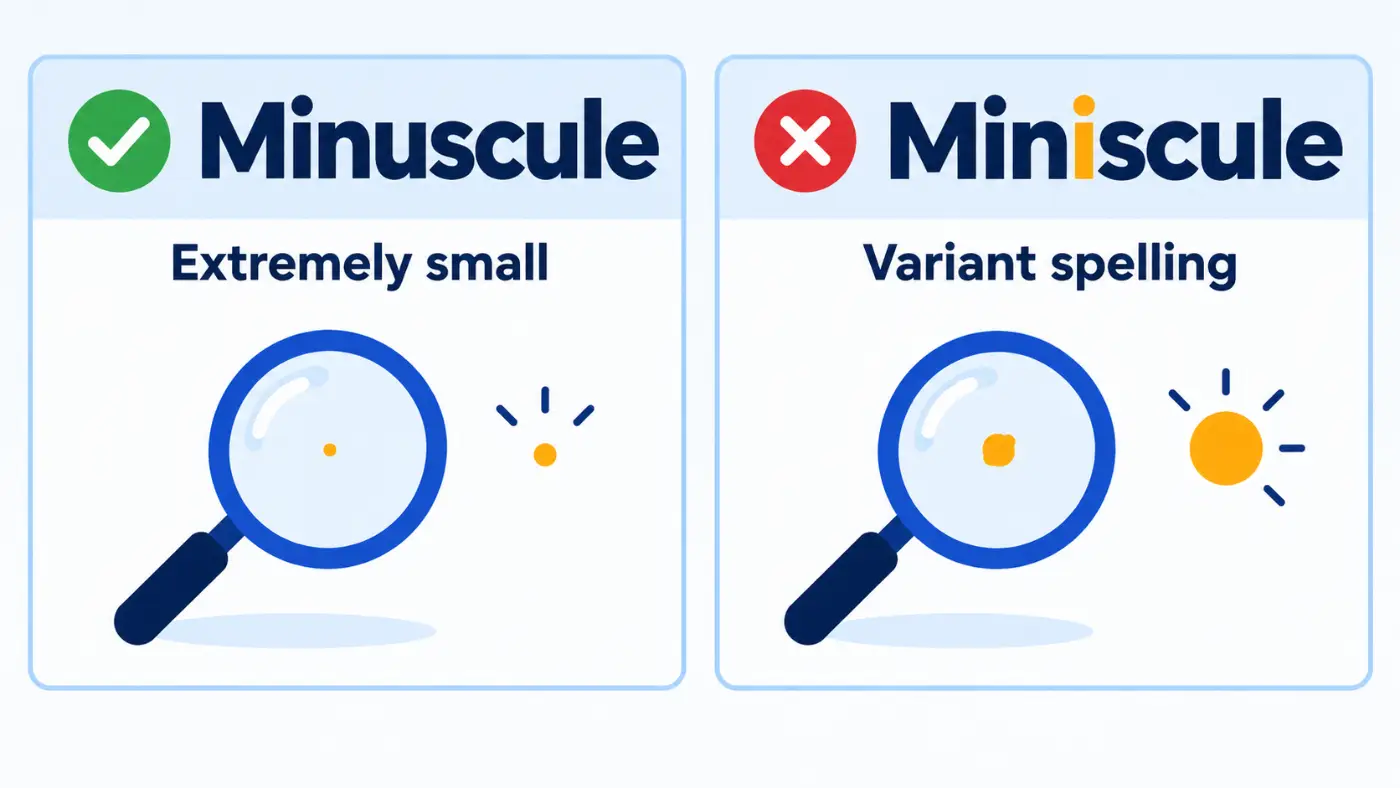
Minuscule is the standard spelling, and it means extremely small. Miniscule is a widespread variant that dictionaries note, but many editors treat it as an error. Choose minuscule in anything you publish, and you’ll never get a second look.
The Short Answer at a Glance
| Form | Status | Meaning | Example |
|---|---|---|---|
| Minuscule | Preferred standard spelling | Extremely small; also a lowercase letter | The gap between the two scores was minuscule. |
| Miniscule | Common variant, often edited out | Same meaning as minuscule | Corrected: The gap between the two scores was minuscule. |
Both spellings point to the same idea. Only one of them survives a careful edit.
What Minuscule Means and How It Works
Minuscule is an adjective that means extremely small. It describes amounts, sizes, and chances that barely register. A minuscule leak, a minuscule budget, and a minuscule margin all share that feel of almost nothing.
It follows the usual adjective patterns. It can sit before a noun (a minuscule crack) or after a linking verb (the crack was minuscule). Writers also stretch it with adverbs, though it already points to the far end of small, so words like quite and relatively often add little.
The word has a second, narrower job. As a noun, a minuscule is a lowercase letter, and as an adjective it can describe lowercase script. Specialists in typography and old manuscripts use this sense. The opposite term is majuscule, which means a capital letter.
The spelling carries a clue about the word’s family. It is built on the same Latin root as minus and minimum, and not on the modern prefix mini, as in miniskirt. That difference explains why the second letter after the m is a u and not an i.
What Miniscule Means and Where It Comes From
Miniscule is a variant spelling of minuscule, and it carries the same meaning. It’s an adjective, and it works in the same sentences. Dictionaries record it as a common alternative, and it shows up regularly in published writing.
Most people trace the variant to the prefix mini. That prefix is everywhere in modern English, in words like minivan, miniature, and minimal. When a word starts with a min sound and means small, writers reach for mini without thinking.
Here’s the catch. Many editors, teachers, and style conscious readers treat miniscule as a mistake. The variant is real, but it’s the riskier choice. Minuscule is accepted everywhere, while miniscule is accepted in some places.
One more point matters for fairness. Calling a common variant a typo isn’t quite accurate, and calling it a preferred spelling isn’t either. The honest description is that it’s widespread, recorded, and frequently corrected.
Minuscule vs Miniscule: Key Differences Side by Side
| Feature | Minuscule | Miniscule |
|---|---|---|
| Part of speech | Adjective; also a noun for a lowercase letter | Adjective |
| Core meaning | Extremely small | Extremely small |
| Typical use | Everyday and technical writing | Casual writing and unedited text |
| Register | Standard in every register | Common variant, often changed by editors |
| Example | A minuscule fraction of the crowd stayed. | A miniscule fraction of the crowd stayed. |
Because the meanings match, the choice is about reputation, not logic. A reader who sees minuscule never stops to think. A reader who sees miniscule may stop, and some will quietly lower their opinion of the writer.
The table also can’t show the noun sense. Only minuscule is established as the word for a lowercase letter, and it has a classic partner in majuscule. If you write about letters, scripts, or fonts, stick with the traditional spelling.
Correct Examples in Real-Life Contexts
All of these use the standard spelling, and they show the word across different settings.
- Everyday speech: The tip from the food truck guy was minuscule, and he still smiled and said thanks.
- Texting: lol my phone battery is at a minuscule 3% and i still have to find the train
- Workplace writing: The variance in the March report is minuscule, so no escalation is needed.
- School or academic: A minuscule trace of copper turned the solution a pale blue.
- Journalism: Residents of the valley have a minuscule chance of seeing frost before November.
- Formal writing: The appendix lists every minuscule in the manuscript, from the first folio to the last.
Miniscule in the Wild
You’ll still run into the variant, especially in social posts and unedited drafts.
- The mayor’s miniscule lead evaporated after the second count.
- She found a miniscule scratch on the screen the day it arrived.
Both sentences read fine and carry the right meaning. They would also draw an edit at most publications.
Common Mistakes People Make (and How to Catch Them)
Mistake 1: Spelling it by analogy with mini. Wrong: A miniscule amount of salt is enough. → Right: A minuscule amount of salt is enough. The first syllable sounds like min, and many words with that sound do spell it mini, such as minimum and miniature. The writer follows the pattern without checking.
Mistake 2: Writing it the way it sounds. Wrong: The difference was minisule. → Right: The difference was minuscule. The ending sounds like a quick skyool, so some writers drop the c or reshuffle the letters. The sound gives only a loose hint of the spelling.
Mistake 3: Dropping the u before the final letters. Wrong: The risk is minuscle. → Right: The risk is minuscule. Words ending in le are common, so the brain wants to skip the u. Minuscule keeps it, and the word ends in cule.
Mistake 4: Trusting a spellchecker that allows the variant. Wrong: Her miniscule pension barely covered rent, and the spellchecker raised no flag. → Right: Her minuscule pension barely covered rent. Because dictionaries record miniscule as a variant, some tools may not underline it. A missing red line doesn’t mean an editor would approve.
Mistake 5: Mixing both spellings in one document. Wrong: A minuscule error appeared in chapter one, and a miniscule error appeared in chapter two. → Right: A minuscule error appeared in chapter one, and another minuscule error appeared in chapter two. Consistency is the minimum standard. Search the whole file for the variant before you publish.
A Fast Trick to Choose Between Minuscule and Miniscule
Look for the word minus inside minuscule. The spelling begins with minus, and the meaning leans the same way: less than usual, almost nothing. If you can find minus, you’ve got the right spelling.
Try it on a sentence. The profit was ___ last quarter. Minus sits inside minuscule, so you write minuscule. The trick also works on the odd spelling, since it has no minus in it.
A backup aid is to remember that the mini of miniskirt isn’t in this word. The mini in miniskirt describes a small garment. Minuscule describes a size, but its spelling comes from a different path.
The trick has one limit. It fixes the spelling, but it can’t tell you which sense you need. The adjective and the lowercase noun share one spelling, so the sentence has to decide.
How They Sound in Real Situations
A text exchange
Priya: Is it minuscule or miniscule? I’m editing the newsletter. Tomas: Minuscule. Look for minus in the middle. Priya: Done. The difference in sales was minuscule, and now it’s spelled right.
Minuscule is an adjective here, and Tomas gives the minus clue as proof.
An email snippet
Subject: Q3 cost review
Hi Elena, the overage on shipping was minuscule, about a tenth of a percent of the budget. I don’t think we need a separate meeting. I can add a line to Friday’s summary instead.
Minuscule describes the overage, and the standard spelling protects the writer from an editor’s pen.
An article excerpt
The archivist held the page under a lamp and pointed to the tiny, rounded letters. Scribes in the ninth century wrote in a neat minuscule, she explained, which made long books easier to copy.
Here minuscule is a noun meaning a lowercase script. The adjective sense appears in tiny, but the noun sense is the one that matters.
Formal Writing vs Casual Writing
Minuscule is safe in every register, so use it in academic papers, business emails, journalism, social media, and texts. Miniscule is more likely to pass in casual writing than in formal work.
In a casual post, a reader may not notice the variant. In a report, a grant application, or a news story, it may flag the writer as careless. Many editors and style conscious publications prefer minuscule, though the exact policy varies.
No American or British split exists for this pair. Both varieties prefer minuscule, and both see miniscule as a common variant.
Related Mix-Ups People Also Search For
Minuscule vs Majuscule
Minuscule means lowercase, and majuscule means uppercase. The terms belong to typography and manuscript study, but they show why the traditional spelling matters. If you describe a script, you’ll want the right word.
The scribe wrote headings in majuscule and body text in minuscule.
Minuscule vs Minute
The adjective minute, pronounced my-NOOT, also means extremely small. It’s a close synonym, but it’s spelled the same as the unit of time, so context carries the weight. Minuscule is clearer in writing because it can’t be misread.
A minute crack ran along the base of the vase.
Minuscule vs Miniature
Miniature describes a small scale version of something, such as a model or a copy. Minuscule describes a quantity or a size that is almost too small to count. A miniature train can be charming, but a minuscule train sounds closer to microscopic.
He built a miniature of the old lighthouse for the school fair.
Exceptions, Edge Cases, and Tricky Situations
Comparing minuscule. Some writers avoid more minuscule and most minuscule because the word already means extremely small. Other writers use these forms for emphasis, and they appear in published work. The safe choice is to pick a different adjective, such as smaller or tiniest.
The paleography sense. In studies of old handwriting, minuscule names a script made of small letters. Carolingian minuscule is one famous example. Here the noun sense isn’t optional, and miniscule would look out of place.
Lowercase versus minuscule. In everyday computing and design, lowercase is the normal word. Minuscule sounds more technical, so use it when you write about scripts or typefaces, and use lowercase for general instructions.
Names and brands. A company or a product may spell the word however its owner chooses. Follow that spelling when you refer to the name itself, and use minuscule elsewhere.
Quoting older or informal text. If a source contains miniscule, you can keep the original inside a direct quote. Add sic after it if your style guide requires that, or correct it silently if your style guide allows it.
Quick Practice: Test Yourself
Choose the best spelling for each sentence.
- The two phones differ by a ___ amount of memory. (minuscule or miniscule)
- The lab found a ___ trace of lead in the water sample. (minuscule or miniscule)
- A medieval scribe wrote the book in a neat ___. (minuscule or miniscule)
- Which is correct? A) minuscle B) minuscule
- The old budget left a ___ margin for error. (minuscule or miniscule)
- A writer used minuscule in paragraph one and miniscule in paragraph three. What should happen?
Answer key
- Minuscule. It’s the standard spelling, and it contains minus.
- Minuscule. The preferred spelling fits formal and scientific writing.
- Minuscule. In this noun sense, only the traditional spelling is established.
- B. The word ends in cule, with a u before the final e.
- Minuscule. The same rule applies to every ordinary adjective use.
- Change paragraph three to minuscule. Consistency matters, and the standard form is safest.
Frequently Asked Questions
Is it minuscule or miniscule?
Minuscule is the standard spelling. Miniscule is a common variant that many editors correct.
Is miniscule a real word?
It’s a recorded variant of minuscule, and it carries the same meaning. It isn’t an invented word, but it’s less accepted in careful writing.
Why do people spell it miniscule?
The prefix mini is everywhere in English, and it sounds like the start of the word. Writers apply that pattern without realizing the word comes from a different root.
What does minuscule mean?
It means extremely small. It can also name a lowercase letter or a script of lowercase letters.
What is the opposite of minuscule?
For size, the opposite is enormous or huge. For letters, the opposite is majuscule, which means a capital letter.
Is there a US and UK difference for this word?
No. Both varieties prefer minuscule, and both see miniscule as a variant.

Sophia Bennett writes educational content about English vocabulary, grammar, slang, and communication. She is passionate about making complex language topics accessible to students, professionals, and curious readers around the world.