Paid vs Payed: Which Spelling Is Correct?
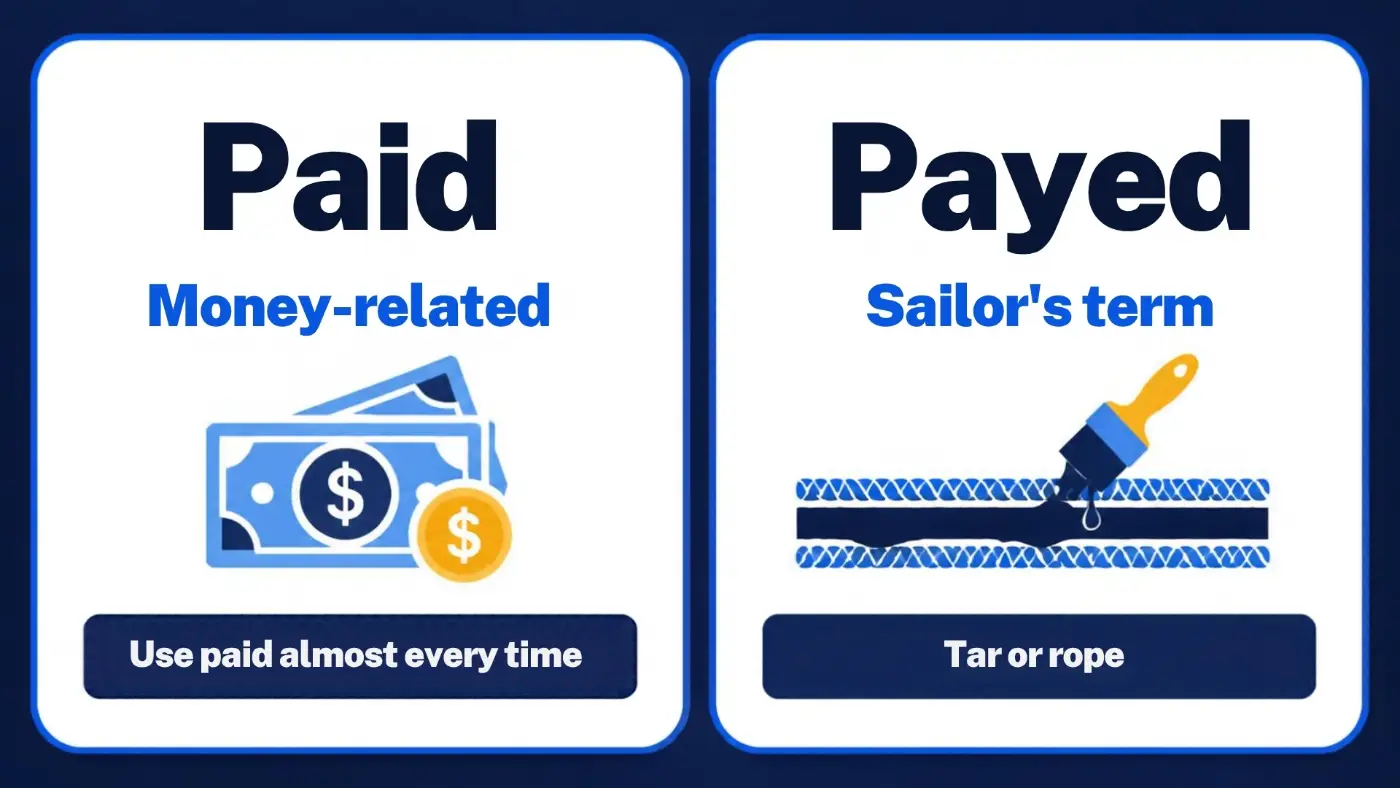
Use “paid” almost every time. It is the standard past tense and past participle of “pay” in every money-related sense. “Payed” is a real word, but it belongs to sailors: it covers sealing seams with tar and letting out rope, and you will likely never need it.
The Short Answer at a Glance
- Paid = the past tense and past participle of “pay” for money, attention, visits, compliments, penalties, and nearly everything else.
- Payed = a rare nautical form meaning “sealed with pitch” or “let out (a line).”
- If your sentence involves a bill, a salary, a debt, a favor, or a price, write paid.
- Spellcheck often won’t flag “payed,” because it is a legitimate word. You have to catch it yourself.
| Situation | Correct form |
|---|---|
| Money changed hands | paid |
| You gave attention or respect | paid |
| A boat’s deck seams were sealed with tar | payed |
| Rope was fed out gradually from a spool or cleat | payed (or paid) out |
What “Paid” Means and How It Works
“Paid” is the past form of the verb “pay,” and it does two jobs. As a simple past tense, it describes a finished action: Tomasz paid the plumber on Friday. As a past participle, it pairs with helping verbs like “has,” “had,” “was,” or “will have”: The invoice has been paid.
The verb “pay” stretches well beyond handing over cash. You pay a compliment, a visit, a toll, a price, a debt, a tribute, and attention. All of those take “paid” in the past: She paid the toll, paid her respects, and paid no attention to the traffic report.
“Paid” also works as an adjective. A paid internship comes with a wage. Paid leave is time off that still produces a paycheck. Fully paid describes a balance at zero. In these roles it sits in front of a noun or after a linking verb, and the spelling never changes.
Prefixes keep the same spelling. Prepaid, overpaid, underpaid, unpaid, repaid, and postpaid all use “-paid,” never “-payed.”
What “Payed” Means and How It Works
“Payed” is a specialized nautical past form, not a general alternative to “paid.” It has two sailing meanings, both traceable to a separate old sense of the verb “pay” connected with pitch, the sticky tar used on wooden ships.
The first meaning is to coat or seal something with a waterproofing substance. A boatwright might say, The crew payed the deck seams with pitch before launch. The second is to let out a rope or cable by slackening it. The deckhand payed out the anchor line one fathom at a time.
In that second sense, “paid out” is also common, and many writers treat the two as interchangeable. Dictionaries record “payed” for these seagoing uses specifically, which is why the form isn’t simply an error. Outside boats, ropes, and tar, it is a misspelling.
Think of it as a technical term, like “luffed” or “trimmed.” It carries no weight in everyday life, and you can write for years without needing it.
Paid vs Payed: Key Differences Side by Side
The difference is domain. “Paid” covers ordinary English; “payed” covers a narrow slice of seamanship.
| Feature | Paid | Payed |
|---|---|---|
| Part of speech | Past tense and past participle of “pay” | Past tense and past participle of nautical “pay” |
| Core meaning | Gave money, attention, or a due | Sealed with pitch; let out a rope |
| Frequency | Extremely common | Very rare |
| Works as adjective? | Yes (paid vacation) | No |
| Safe for general writing? | Always | Only in nautical contexts |
| Used with prefixes | Yes (unpaid, prepaid) | No |
If you are not writing about caulking, rigging, or a ship’s lines, “paid” is the only choice. And even in sailing prose, “paid out” is acceptable for rope, so “payed” is never your only option.
Correct Examples in Real-Life Contexts
Each of these sentences uses “paid” correctly. Notice that the money-adjacent meanings dominate, but the verb spreads into other territory too.
Examples with “paid”
- Everyday speech: “Dariusz already paid for the pizza, so we owe him a drink.”
- Workplace: “Our freelancers are paid within fifteen days of invoice approval.”
- Texting: “Paid the rent. Finally. Going to sleep for twelve hours.”
- School: “Noor paid close attention during the lab demonstration, which is why her titration came out clean.”
- Formal: “The balance of $4,200 was paid in full on the closing date.”
- Idiom: “Years of early mornings finally paid off when Marisol won the regional bakery award.”
Examples with “payed”
- Nautical work: “The restorers payed the planking seams with hot pitch before relaunching the sloop.”
- Rope handling: “As the wind eased, the crew payed out the mooring line to give the boat room to swing.”
- Historical narrative: “The ship’s carpenter payed the hull below the waterline every spring.”
- Maritime manual: “Once the seams were payed, the deck had to cure for two days.”
Common Mistakes People Make (and How to Catch Them)
The most frequent slip is writing “payed” for any money action. It tends to happen because “pay” plus “-ed” feels logical, the way “stay” becomes “stayed.” Here are the patterns to watch.
- ❌ I payed the electricity bill online. → ✅ I paid the electricity bill online. Money is involved, so use “paid.”
- ❌ She payed attention to every word. → ✅ She paid attention to every word. Attention is “paid,” not “payed.”
- ❌ The unpayed invoices are piling up. → ✅ The unpaid invoices are piling up. The prefix attaches to “paid.”
- ❌ They have payed off the car. → ✅ They have paid off the car. “Have” plus a past participle still calls for “paid.”
- ❌ Our overpayed manager left. → ✅ Our overpaid manager left. Adjectives built on “pay” use “-paid.”
- ❌ He payed me a compliment. → ✅ He paid me a compliment. Figurative “pay” is regular “paid.”
A quick catch: if you can swap in “handed over” or “gave,” or if the verb takes an object like attention, a visit, or a debt, it is “paid.”
A Fast Trick to Choose the Right One
Match “pay” with “say” and “lay.” Three common verbs drop the “-y” and take “-id” in the past: pay → paid, say → said, lay → laid. If you would never write “sayed” or “layed,” you shouldn’t write “payed.”
A second aid: “payed” is the pitch-and-rope spelling. If neither tar nor a mooring line is in your sentence, you don’t want it.
Be honest about the limit of the first trick. It works only for those three verbs. Many other verbs ending in “-ay” behave normally: play → played, stay → stayed, delay → delayed. So don’t generalize the pattern. Memorize that “pay,” “say,” and “lay” are the odd trio.
How They Sound in Real Situations
Real conversations almost always call for “paid.” These short passages show it in context, including one rare “payed.”
1. Group chat
Kaveh: Did anyone cover the cabin deposit? Lina: I paid it Tuesday. Just send me your share. Kaveh: Done. Paid you through the app.
Both “paid” forms are simple past tense, the way people use them in casual money talk. There is no scenario here where “payed” would be correct.
2. Office email
Hi Renata, the vendor confirmed that invoice #5518 was paid on March 3. They also noted that the earlier shipment had been overpaid by about $120, so a credit will appear next cycle.
The first “paid” is a passive past participle, and “overpaid” keeps the same spelling with its prefix. Business writing never needs “payed.”
3. Restoration blog
By Saturday afternoon we had payed every seam on the lower hull with pitch. The next morning, we payed out the stern line so the boat could settle in its new cradle.
This is the one setting where “payed” is correct. Even here, a careful editor might switch the second one to “paid out,” since both are accepted for rope.
Formal Writing vs Casual Writing
There is no register difference: “paid” is correct in every tone. It suits legal contracts, tax notices, text messages, and wedding speeches alike.
In formal documents you will see it in stock phrases such as paid in full, amount paid, and paid-up capital. In casual writing you will see it in paid for lunch, got paid, and paid it forward.
“Payed” does not become more acceptable in informal contexts. Writing it in a text message looks like a typo, and writing it in a contract looks like an error. Its only home is nautical writing, where it signals expertise rather than informality.
Related Mix-Ups People Also Search For
Laid vs layed
“Laid” is correct, and “layed” is a misspelling. The reasoning mirrors “paid.” The verb “lay” (to place something down) turns into “laid.” Bao laid the tiles in a herringbone pattern. Related forms such as mislaid and inlaid follow suit.
Said vs sayed
“Said” is the past tense of “say,” and “sayed” is not a word in standard English. It sometimes appears in rushed typing. Priya said she would call after the meeting. Its compound “unsaid” follows the same rule.
Repaid, prepaid, and overpaid vs “-payed” versions
All compounds of “pay” take “-paid.” The loan was repaid early. Adel bought a prepaid SIM card. The consultant felt overpaid. The versions “repayed,” “prepayed,” and “overpayed” do not exist as standard forms, even though they look plausible.
Pay off vs paid off vs payoff
“Pay off” is the verb phrase, “paid off” is its past form, and “payoff” is the noun. If you pay off the loan this month, the bank will waive the fee. Last year’s discipline paid off. The final payoff was larger than expected. Only the verb changes spelling with tense.
Exceptions, Edge Cases, and Tricky Situations
The real edge cases all involve nautical “payed” and the pull of rope vocabulary.
- Rope work is flexible. For letting out a line, “paid out” and “payed out” both appear. If you are unsure, “paid out” is the safer choice, since readers will never question it.
- Mixed passages need care. A story about a sailor who “payed out the line and paid his debts” uses both forms correctly, but readers may assume a typo. Clarity may justify using “paid” in both places.
- Figurative nautical phrases follow “paid.” If a metaphor borrows from sailing but isn’t literally about pitch or rope, such as “the risk paid off,” use “paid.”
- “Paid” as an adjective stays fixed. A paid subscription never becomes “payed subscription,” no matter how technical the context.
- Names and brands are separate. If a company or surname happens to be spelled “Payed,” keep it as written. That is a proper noun, not a verb choice.
Quick Practice: Test Yourself
Choose “paid” or “payed” for each blank.
- Selin ______ for the concert tickets with her last gift card.
- The harbor crew ______ the deck seams with warm pitch before the regatta.
- After eight years, Hugo finally ______ off his student loans.
- Everyone ______ attention when the fire alarm started ringing.
- The un______ overtime hours became a point of tension in the department.
- Which spelling is safer when letting out a rope: “payed out” or “paid out”?
Answer Key
- paid. Money was exchanged, so it is the standard past tense.
- payed. Sealing seams with pitch is the nautical sense.
- paid. “Paid off” is the past form of the phrasal verb “pay off.”
- paid. “Pay attention” always becomes “paid attention.”
- unpaid (paid). The prefix “un-” attaches to the adjective “paid.”
- paid out. Both are accepted, but “paid out” will not raise an eyebrow.
Frequently Asked Questions
Is “payed” ever correct?
Yes, but only in two nautical senses: sealing seams with pitch and letting out a rope or cable. In all other uses, including every money-related one, the correct form is “paid.”
Why doesn’t spellcheck catch “payed”?
Because it is a recognized word in dictionaries. Spellcheck tools check whether a word exists, not whether it fits your meaning, so “I payed the bill” may slip through unmarked.
Is “payed” British English and “paid” American English?
No. Both varieties use “paid” for ordinary meanings, and both reserve “payed” for the nautical senses. The difference is not regional.
Is “paid for” or “payed for” correct?
“Paid for” is correct. Mireille paid for the groceries. The phrase “payed for” would be a misspelling in any normal context.
What is the past participle of “pay”?
“Paid.” It follows helping verbs, as in has paid, had paid, and was paid. The nautical participle “payed” is the lone exception, limited to tar and rope.
Can I say “I have payed”?
Not in any everyday sense. Write “I have paid” for money, attention, or any other non-nautical meaning.

Sophia Bennett writes educational content about English vocabulary, grammar, slang, and communication. She is passionate about making complex language topics accessible to students, professionals, and curious readers around the world.