Tomorrow vs Tommorow: Which Spelling Is Correct?
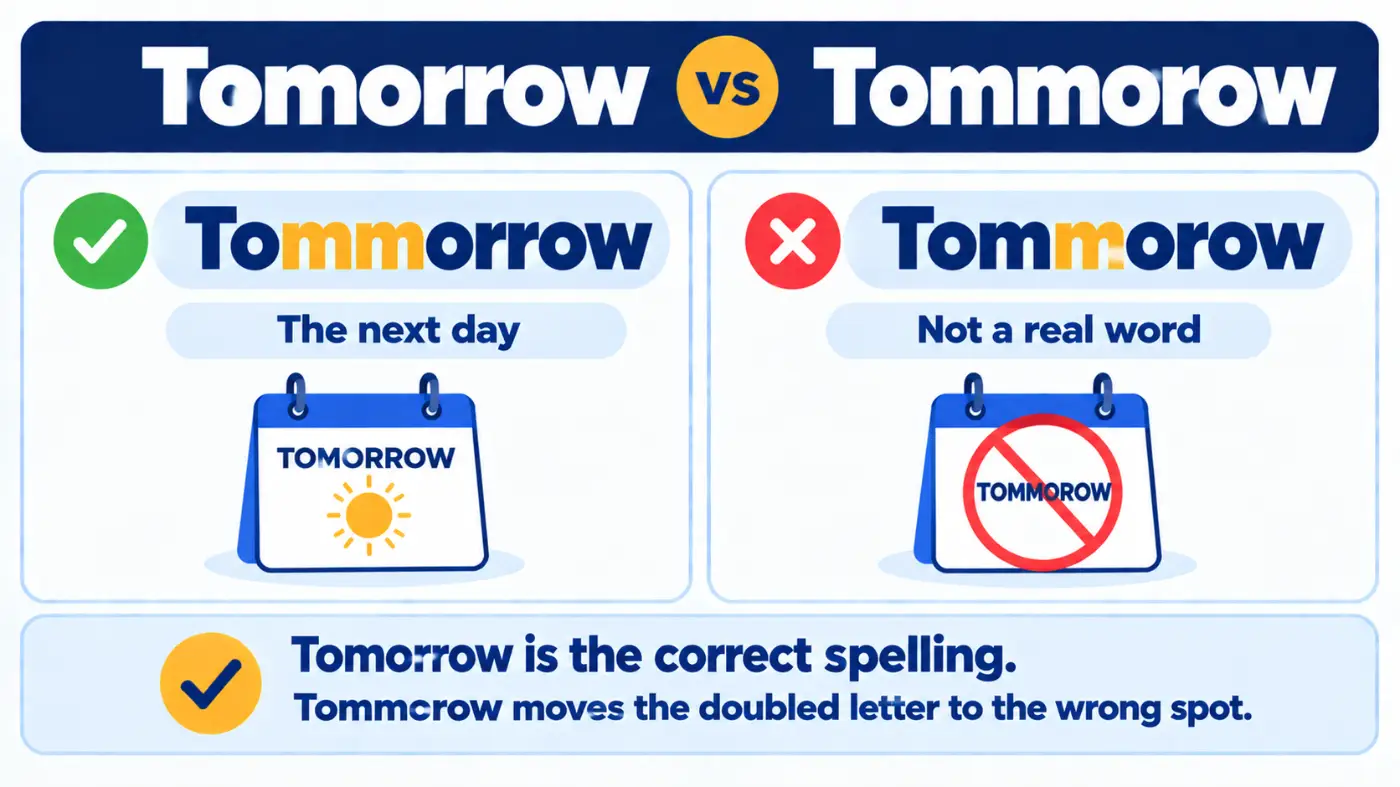
Tomorrow is the correct spelling. Tommorow moves the doubled letter to the wrong spot, since tomorrow doubles its “m,” not its “r,” and putting two letters in the wrong place is exactly why this word trips so many people up.
The Short Answer at a Glance
| Form | Status | What it does | Example |
|---|---|---|---|
| tomorrow | Correct | Noun or adverb referring to the day after today | We’re leaving for the airport tomorrow morning. |
| tommorow | Misspelling | Not a word in standard English | Correct it to tomorrow every time. |
There’s only one real spelling here. The doubled letter belongs on the “m,” and tommorow puts it in the wrong place while also dropping a letter elsewhere.
What Tomorrow Means and How It Works
Tomorrow refers to the day immediately following today, and it works both as a noun and as an adverb depending on how it’s used in a sentence. As a noun, tomorrow can be the subject or object of a sentence: “Tomorrow is a holiday,” or “I’ll deal with that problem tomorrow.” As an adverb, it modifies a verb by indicating when something will happen: “She’s arriving tomorrow.”
The word also carries a broader, more figurative meaning beyond the literal next calendar day. Tomorrow often stands in for the future in general, as in “the leaders of tomorrow” or “planning for tomorrow.” This extended sense shows up constantly in speeches, headlines, and everyday reflection about what’s ahead.
Grammatically, tomorrow doesn’t take an article the way most nouns do. You wouldn’t say “the tomorrow” in standard usage; the word functions almost like a proper noun for a specific day relative to now, similar to how today and yesterday behave.
Tomorrow is built from three older English word parts meaning roughly “on” and “morning,” which is why the word centers around the idea of the next day beginning fresh. That history also explains the specific letter pattern the word settled into, with a single “t,” a single “o,” a doubled “r,” and a single “m,” before ending in “-ow.”
Is “Tommorow” Ever Correct?
No. Tommorow isn’t recognized in any standard dictionary, and it isn’t a regional variant, dated form, or informal shortcut. It’s a spelling error, and a fairly common one given how the word sounds when spoken quickly.
Tomorrow has one doubled letter, the “rr,” positioned right in the middle of the word: to-mor-row. Tommorow shifts that doubling to the “m” instead, producing an incorrect pattern that doesn’t match the actual spelling. In many versions of this mistake, the word also ends up short one “r,” since writers focus their attention on doubling the wrong letter and lose track of the one that’s supposed to be doubled.
Because tomorrow is spoken so often and so quickly in casual conversation, the internal structure of the word tends to blur together in people’s minds. The “m” and “r” sounds sit close together in the middle of the word, and it’s easy to misremember which one actually repeats.
This is one of the most frequently misspelled everyday words in English, not because the concept is difficult, but because the word gets used constantly in speech, where nobody consciously tracks its letter-by-letter structure.
Tomorrow vs Tommorow: Key Differences Side by Side
| Feature | Tomorrow | Tommorow |
|---|---|---|
| Recognized word | Yes | No |
| Part of speech | Noun and adverb | None |
| Core meaning | The day after today, or the future in general | No meaning |
| Typical use | Scheduling, planning, everyday conversation, forward-looking statements | Appears only as a typo |
| Register | Works in all writing | Never appropriate |
| Example | The meeting has been moved to tomorrow afternoon. | The meeting has been moved to tommorow afternoon. (wrong) |
The table draws a clean line between right and wrong, but what it doesn’t fully capture is how instinctive this particular error feels. Because tomorrow is one of the most commonly spoken words in English, many people have never had to consciously spell it out, which leaves plenty of room for the doubled letter to land in the wrong spot.
Correct Examples in Real-Life Contexts
Everyday speech
- I promise I’ll call you back tomorrow, I just need to finish this first.
- Tomorrow’s supposed to be sunny, so let’s plan the picnic then.
- He keeps saying he’ll start the diet tomorrow, and it’s been three weeks.
- We’re driving up to the cabin tomorrow morning before traffic gets bad.
Workplace writing
- The client requested that we push the deadline to tomorrow instead of Friday.
- Please have the revised proposal ready by tomorrow’s team meeting.
- Tomorrow marks the official launch date for the new product line.
- I’ll follow up on this thread first thing tomorrow.
Texting
- see you tomorrow at the usual spot
- can we push our call to tomorrow, something came up today
School and academic
- The assignment is due tomorrow by midnight, no extensions.
- Tomorrow’s lecture will cover the second half of the chapter.
- Students should submit their lab reports before tomorrow’s class begins.
- The debate on climate policy is scheduled for tomorrow afternoon.
Formal writing
- The board will reconvene tomorrow to finalize the budget proposal.
- Shipments delayed today are expected to arrive tomorrow without additional charges.
- The hearing has been rescheduled for tomorrow at nine in the morning.
- Investors are watching closely to see how the market responds tomorrow.
Common Mistakes People Make (and How to Catch Them)
Doubling the wrong letter
Wrong: Let’s finish this tommorow instead. Right: Let’s finish this tomorrow instead.
This is the classic version of the error. Writers double the “m” instead of the “r,” reversing the word’s actual internal pattern.
Dropping a letter while doubling the wrong one
Wrong: I’ll see you tommorow morning. Right: I’ll see you tomorrow morning.
In many cases, this mistake also shortchanges the word by one letter overall, since attention shifts entirely to the incorrect doubled letter.
Typing quickly and losing track of letter order
Wrong: We can talk more tommorow if you’re free. Right: We can talk more tomorrow if you’re free.
Fast typing on a phone keyboard makes it especially easy to mix up which letter repeats, since both “m” and “r” sit close together in the middle of the word.
Spelling by ear without checking
Wrong: The forecast says rain is coming tommorow afternoon. Right: The forecast says rain is coming tomorrow afternoon.
Because tomorrow is said so casually and so often, many writers never slow down to actually spell it out, relying instead on how it sounds, which doesn’t clearly indicate where the doubled letter belongs.
A Fast Trick to Choose the Right One
Break the word into its three natural parts: to-mor-row. Notice that the doubled letter appears at the seam between the second and third syllables, where “mor” meets “row.” That’s your visual cue: the doubling happens on the “r,” right where those two syllables connect.
A second trick is to think of the word “morrow,” an older, less common English word that still occasionally shows up in phrases like “on the morrow.” Morrow itself is spelled with a doubled “r,” and tomorrow is essentially “to” plus that same word. If you can picture morrow correctly, tomorrow’s spelling follows naturally.
This trick works well because it’s based on the word’s actual structure rather than guesswork. Its only limitation is that “morrow” isn’t a word most people use regularly today, so it may take a moment of extra thought the first few times you rely on it.
How They Sound in Real Situations
A text exchange
Priya: Are we still on for coffee tomorrow?
Sam: Yes! What time works for you tomorrow morning?
Priya: Let’s say 9, same place as always.
Tomorrow is correct throughout because both people are confirming plans for the next day.
A workplace email
Subject: Schedule change for tomorrow
Hi team,
Just a quick note that tomorrow’s stand-up has been moved from 9am to 10am to accommodate a client call. Please adjust your calendars accordingly.
Thanks, Devon
Tomorrow is correct because the email is specifically referencing the day right after today.
An article-style excerpt
City officials announced that road closures downtown will begin tomorrow morning and continue through the weekend. Drivers are being encouraged to seek alternate routes starting tomorrow to avoid delays.
Tomorrow fits naturally here, describing an event set to begin the very next day.
Formal Writing vs Casual Writing
The correct spelling doesn’t shift based on formality. Tomorrow is right in a legal filing, a news article, a text message, and a casual conversation. Tommorow is wrong in all of them, with no exceptions based on tone or setting.
What changes with register is usage frequency and phrasing. In casual speech, tomorrow often appears in loose, open-ended statements like “I’ll get to it tomorrow,” which can carry a slightly noncommittal tone. In formal and journalistic writing, tomorrow tends to appear with more precision, often paired with specific times, events, or scheduled actions, as in “the vote is scheduled for tomorrow at noon.”
AP and Chicago style both treat tomorrow as a standard word requiring no special formatting, and neither guide offers any accepted alternate spelling.
Related Mix-Ups People Also Search For
Tomorrow vs Tomorow
Tomorow drops one of the two “r”s entirely, leaving the word one letter short of its correct form. The fix is the same either way: use tomorrow, with both r’s intact. Example: I’ll finalize the report tomorrow, not tomorow, once I have the final numbers.
Tomorrow vs Yesterday
These two sit on opposite ends of the calendar relative to today, and neither one is a spelling variant of the other. Tomorrow refers to the day ahead, while yesterday refers to the day before. Example: What felt impossible yesterday suddenly seemed manageable by tomorrow.
Tomorrow vs Today
Today and tomorrow are separate words describing adjacent days, often confused only in casual speech when someone means to specify one but says the other by mistake. Example: If we can’t finish this today, we’ll have to pick it back up tomorrow.
Morrow vs Tomorrow
Morrow is an older, less common standalone word meaning the next day, and tomorrow is essentially built from it. Outside of poetic, historical, or formal phrasing, it rarely appears today. Example: The knight vowed to depart on the morrow, which modern readers would simply call tomorrow.
Quick Practice: Test Yourself
Choose the correct spelling for each blank.
- We’re rescheduling the appointment for ______ at noon. (tomorrow / tommorow)
- She promised to send the files ______ morning without fail. (tomorrow / tommorow)
- The store is closed today but opens again ______. (tomorrow / tomorow)
- ______’s forecast calls for scattered thunderstorms. (Tomorrow / Tommorow)
- I can’t make it tonight, but I’m free ______ evening. (tomorrow / tommorow)
- The results won’t be available until sometime ______. (tomorrow / tomorow)
Answer Key
- tomorrow: the correct spelling always doubles the “r,” not the “m.”
- tomorrow: consistent spelling regardless of sentence position.
- tomorrow: correct spelling with both r’s intact.
- Tomorrow: correctly capitalized and spelled at the start of a sentence.
- tomorrow: same correct pattern used throughout every context.
- tomorrow: correct spelling, avoiding both the doubled-m error and the dropped-r error.
Frequently Asked Questions
Is “tommorow” ever an acceptable spelling?
No. Tommorow isn’t recognized in standard dictionaries and isn’t used as a regional or informal variant. The correct spelling in every context is tomorrow.
Why does tomorrow double the “r” instead of the “m”?
Tomorrow is built from older word parts related to “morning,” and that portion of the word, “morrow,” has always used a doubled “r.” The doubling simply carried over into the modern word.
Is tomorrow always a noun?
No. Tomorrow can function as either a noun or an adverb, depending on whether it’s naming the day itself or describing when an action will happen.
Does tomorrow ever take the word “the” in front of it?
Not in standard usage. Tomorrow typically stands alone without an article, similar to how today and yesterday are used.
What’s the difference between tomorrow and “the future”?
Tomorrow most often refers specifically to the next calendar day, though it can also be used more broadly and figuratively to describe the future in general, depending on context.
Is there a shorter or informal version of tomorrow?
Not in standard written English. While people sometimes abbreviate it casually in texting as “tmrw,” that’s an informal shorthand rather than an accepted alternate spelling.

Sophia Bennett writes educational content about English vocabulary, grammar, slang, and communication. She is passionate about making complex language topics accessible to students, professionals, and curious readers around the world.