Lefty vs Leftie: Which Spelling Is Correct?
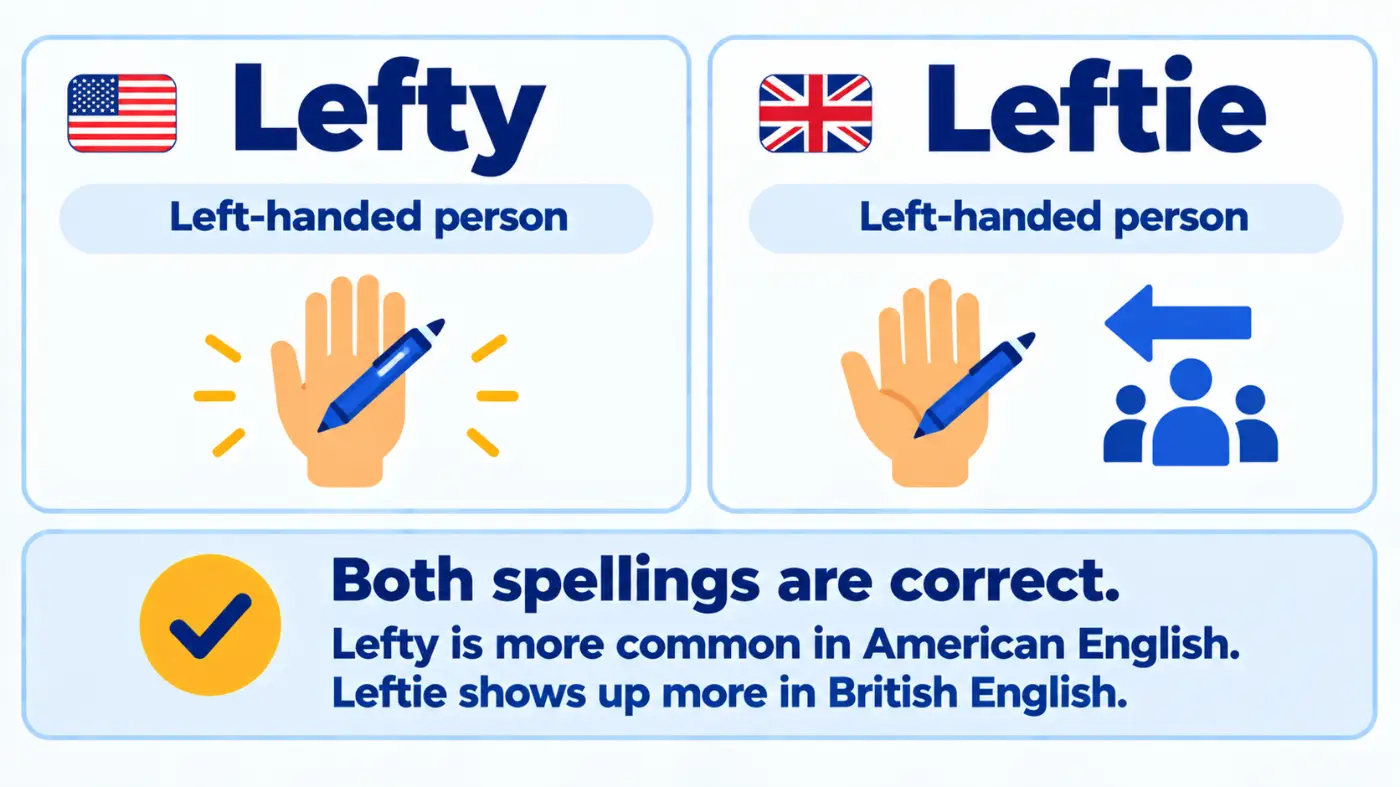
Both spellings are correct, but they lean toward different regions. Lefty is the more common spelling in American English, while leftie shows up more often in British and Commonwealth English, and both describe the same thing: someone left-handed, or informally, someone with left-leaning political views.
The Short Answer at a Glance
| Form | Region | What it names | Example |
|---|---|---|---|
| lefty | More common in American English | A left-handed person, or informally, someone politically left-leaning | She’s a lefty, so the spiral notebooks always smudge under her hand. |
| leftie | More common in British English | Identical meaning to lefty | He’s a leftie, so he always sits on the end of the table at dinner. |
Pick based on your audience’s regional convention rather than any rule about correctness, since neither spelling outranks the other in accuracy.
What Lefty Means and How It Works
Lefty is an informal noun with two overlapping but distinct uses. Most literally, it describes a person who is left-handed, someone who naturally writes, throws, or performs most manual tasks with their left hand rather than their right. Informally and often in political commentary, lefty also describes someone whose political views lean toward the left side of the spectrum, typically associated with progressive or liberal positions.
Both senses are casual in tone. Lefty isn’t the term you’d reach for in a medical report about handedness or in a formal academic paper about political ideology. It’s the word you’d use in conversation, in a nickname, or in casual commentary, similar to how “righty” works as the informal counterpart for right-handed people.
Grammatically, lefty functions as a standard countable noun: a lefty, several lefties, the lefties in the room. It can also function loosely as an adjective in casual speech, as in “a lefty pitcher” describing a left-handed baseball player, though this use blurs slightly with the noun form functioning as a modifier.
The word is built simply from “left” plus the informal “-y” suffix, the same pattern used in other casual nicknames like “righty,” “softy,” or “chubby.” That suffix signals familiarity and casualness, which is exactly the tone lefty carries in everyday use.
What Leftie Means and How It Works
Leftie means exactly the same thing as lefty: someone who is left-handed, or informally, someone with left-leaning political views. The definition, tone, and grammatical behavior are identical between the two spellings.
The difference lies entirely in which regional spelling convention it follows. Leftie tends to appear more frequently in British English and in English used across parts of the Commonwealth, while American English gravitates more toward lefty. Neither version is a misspelling of the other; they’re parallel spellings of the same informal word, similar to how some casual words develop slightly different forms across English-speaking regions.
Grammatically, leftie behaves exactly like lefty. It’s a countable noun (a leftie, several lefties), and it carries the same informal, conversational register. A British sports commentator might describe a cricketer as “a natural leftie” the same way an American commentator might call a baseball pitcher “a lefty.”
Because this word is informal by nature and not tied to any formal etymological rule, its spelling has simply settled into slightly different regional habits over time, the same way many casual or slang terms do.
Lefty vs Leftie: Key Differences Side by Side
| Feature | Lefty | Leftie |
|---|---|---|
| Part of speech | Noun (and loosely adjective) | Noun (and loosely adjective) |
| Core meaning | Someone left-handed, or informally left-leaning politically | Identical meaning |
| Typical use | American casual speech, sports commentary, nicknames | British and Commonwealth casual speech, sports commentary |
| Register | Informal | Informal |
| Example | The coach noticed he was a lefty and adjusted his batting stance. | The coach noticed he was a leftie and adjusted his batting stance. |
What the table can’t fully capture is how genuinely interchangeable these two spellings are in casual use. This isn’t a case where one form is rare or outdated; both spellings appear regularly in their respective regions, and plenty of writers use either one without any confusion arising, since context always makes the meaning clear.
Correct Examples in Real-Life Contexts
Everyday speech (American, lefty)
- My daughter’s a lefty, so we had to find special scissors for her.
- He’s such a lefty that he always ends up elbow-to-elbow with people at dinner.
- The whole family jokes that being a lefty runs in our genes.
- She switched to a lefty guitar after years of struggling with a standard one.
Everyday speech (British, leftie)
- My brother’s a leftie, so he always sits on my left at the table.
- She’s been a leftie since she was a toddler, scribbling with her left hand from day one.
Workplace writing (American)
- The design team is testing a lefty-friendly version of the ergonomic mouse.
- HR received feedback that the new desks aren’t ideal for lefty employees.
- Our product photography includes a lefty model to showcase the reversible strap design.
Workplace writing (British)
- The stationery order should include a few leftie-friendly pens for the design team.
- Feedback suggested our workstation layout isn’t ideal for leftie staff.
Texting (American)
- lol forgot you’re a lefty, my bad for sitting on your left
- he pitches lefty, it’s honestly kind of intimidating to face
School and academic (American)
- The study examined whether being a lefty affects handwriting speed in young children.
- Teachers were asked to provide lefty-friendly desks for students who needed them.
- Her project explored common myths about lefties and creativity.
School and academic (British)
- The research paper considered whether lefties process language differently than right-handed peers.
- As a leftie himself, the professor was especially interested in classroom accommodations.
Formal writing
Note: Neither spelling typically appears in strictly formal writing, since both are informal terms. In more formal contexts, “left-handed” or “left-handedness” is the standard choice instead.
- The clinic offers specialized tools designed for left-handed patients. (formal alternative to lefty/leftie)
- Studies on left-handedness suggest a range of possible genetic factors. (formal alternative)
Common Mistakes People Make (and How to Catch Them)
Treating one spelling as simply wrong
Wrong assumption: Leftie is a misspelling of lefty, or vice versa. Right understanding: Both are legitimate, correct spellings that reflect different regional preferences.
This isn’t really an error in the traditional sense, but a common misunderstanding. Neither version should be corrected to match the other, since both are accepted in their respective regions.
Inconsistent spelling within the same document
Wrong: The article refers to the athlete as a lefty in one paragraph and a leftie in another. Right: The article consistently uses one spelling throughout, matching its target audience’s regional convention.
Since both spellings are valid, the real risk is mixing them within a single piece of writing, which can look like a proofreading oversight even though neither spelling is individually incorrect.
Assuming the political meaning is always intended
Wrong assumption: Calling someone a lefty always refers to their political views. Right understanding: Context determines the meaning; lefty and leftie describe left-handedness far more often than political leaning in everyday conversation.
Because the political sense of the word is genuinely used, especially in commentary and casual political discussion, writers should ensure context makes clear which meaning is intended, since the two senses are quite different.
Using either spelling in strictly formal writing
Wrong: The clinical report noted that the patient is a lefty. Right: The clinical report noted that the patient is left-handed.
Since both lefty and leftie are informal by nature, using either in a medical, legal, or highly formal academic document can feel out of place compared to the more neutral “left-handed.”
A Fast Trick to Choose the Right One
Match your audience’s broader spelling conventions. If you’re writing for an American audience, or your document already uses American spellings like “color” and “favorite,” lefty will feel consistent. If you’re writing for a British or Commonwealth audience, or your document uses “colour” and “favourite,” leftie fits more naturally.
A second trick: think of the word as similar to how “movie” versus certain British informal terms sometimes diverge slightly by region, even when the underlying concept is identical. Neither version needs correcting; the choice is really about matching the tone and region of your intended reader.
This trick works well for general audience-matching, but it has one limit: because both spellings are genuinely used across regions in casual writing, you’ll still see plenty of overlap, especially online, where regional lines blur more easily than in traditionally published, region-specific print.
How They Sound in Real Situations
A text exchange (American)
Jordan: You’re a lefty, right? Should we get you the left-handed baseball glove?
Casey: Yes please, my current one is basically unusable.
Jordan: On it.
Lefty is correct here, reflecting casual American phrasing about left-handedness.
A workplace email (British)
Subject: Office supply order
Hi Priya,
Could we add a couple of leftie-friendly pens to the next stationery order? A few of the design team members mentioned their current pens smudge constantly.
Thanks, Tom
Leftie fits naturally here, following standard British informal usage.
An article-style excerpt (American)
The rookie pitcher, a natural lefty, has quickly become a fan favorite for his unpredictable curveball. Scouts say his left-handed delivery gives batters an unusually difficult angle to read.
Lefty works well here, matching the casual, sports-commentary tone typical of American sports journalism.
Formal Writing vs Casual Writing
Neither lefty nor leftie is typically appropriate in strictly formal writing, regardless of region. Both terms are informal by nature, and “left-handed” or “left-handedness” is the standard, neutral choice for medical documents, academic papers, legal writing, and other formal contexts.
In casual writing, both spellings are entirely appropriate, and the choice comes down to regional habit rather than formality level. Sports commentary, casual conversation, social media, and lighthearted feature articles all comfortably use lefty or leftie depending on the audience.
Neither AP nor Chicago style specifically prescribes one spelling over the other, since both guides generally favor more formal terminology like “left-handed” in professional and journalistic writing anyway.
US vs UK English Differences
This is a genuine, though not absolute, regional pattern. Lefty is more commonly used in American English, appearing frequently in US sports commentary, casual conversation, and informal writing. Leftie is more commonly used in British English and across parts of the Commonwealth, showing up in similar casual and sports-related contexts.
Neither spelling is considered incorrect in the other region; it’s simply a matter of which form appears more frequently in each area’s everyday, informal writing. Unlike stricter regional splits such as color versus colour, this pattern is looser, and both spellings do appear across regions, particularly in informal online writing where regional boundaries blur.
Related Mix-Ups People Also Search For
Lefty vs Left-Handed
Lefty is the casual, informal noun, while left-handed is the more neutral, formal adjective describing the same trait. Example: As a lefty, she always requests left-handed scissors for craft projects.
Righty vs Rightie
This pair mirrors lefty and leftie exactly, describing someone right-handed instead. Righty tends to follow the same American preference, while rightie is less common overall but occasionally appears as a parallel British form. Example: Her brother’s a righty, so they’ve never had to fight over elbow room at the dinner table.
Lefty (Handedness) vs Lefty (Political)
Within the same spelling, lefty can describe either left-handedness or left-leaning political views, and only context distinguishes the two. Example: He’s a lefty pitcher and, coincidentally, also a self-described political lefty.
Quick Practice: Test Yourself
Choose the spelling that best matches the described context.
- An American sports article describes a pitcher as a natural ______. (lefty / leftie)
- A British parent mentions that her toddler seems to be a ______. (lefty / leftie)
- A US-based product listing advertises scissors designed for young ______. (lefties / leftys)
- A UK office email requests more ______-friendly desk setups. (lefty / leftie)
- An American teenager texts a friend that their new guitar is ______-friendly. (lefty / leftie)
- A British commentator jokes that the batsman is a natural ______. (lefty / leftie)
Answer Key
- lefty: matches standard American sports commentary conventions.
- leftie: matches standard British casual conventions.
- lefties: the correct plural, formed by changing “y” to “ies,” not by simply adding “s.”
- leftie: matches British workplace phrasing.
- lefty: fits casual American texting conventions.
- leftie: matches British sports commentary style.
Frequently Asked Questions
Is lefty or leftie the correct spelling?
Both are correct. Lefty is more common in American English, while leftie is more common in British and Commonwealth English, and neither is considered a misspelling of the other.
Do lefty and leftie mean the same thing?
Yes. Both words describe someone who is left-handed, and both can also informally describe someone with left-leaning political views, depending on context.
Is lefty considered formal or informal?
Lefty, along with leftie, is informal. Formal writing typically uses “left-handed” or “left-handedness” instead.
Can lefty refer to politics instead of handedness?
Yes. Lefty and leftie can both informally describe someone whose political views lean left, though this usage depends entirely on context to avoid confusion with the handedness meaning.
Which spelling should I use for a US-based audience?
Lefty is generally the better choice for American audiences, since it matches the more common spelling convention used in US casual and sports writing.
Is there a plural form of lefty or leftie?
Yes. Both pluralize by changing the final “y” to “ies,” producing lefties in either case, following the standard English pattern for nouns ending in a consonant plus “y.”

Sophia Bennett writes educational content about English vocabulary, grammar, slang, and communication. She is passionate about making complex language topics accessible to students, professionals, and curious readers around the world.