Habit vs Habbit: Which Spelling Is Correct?
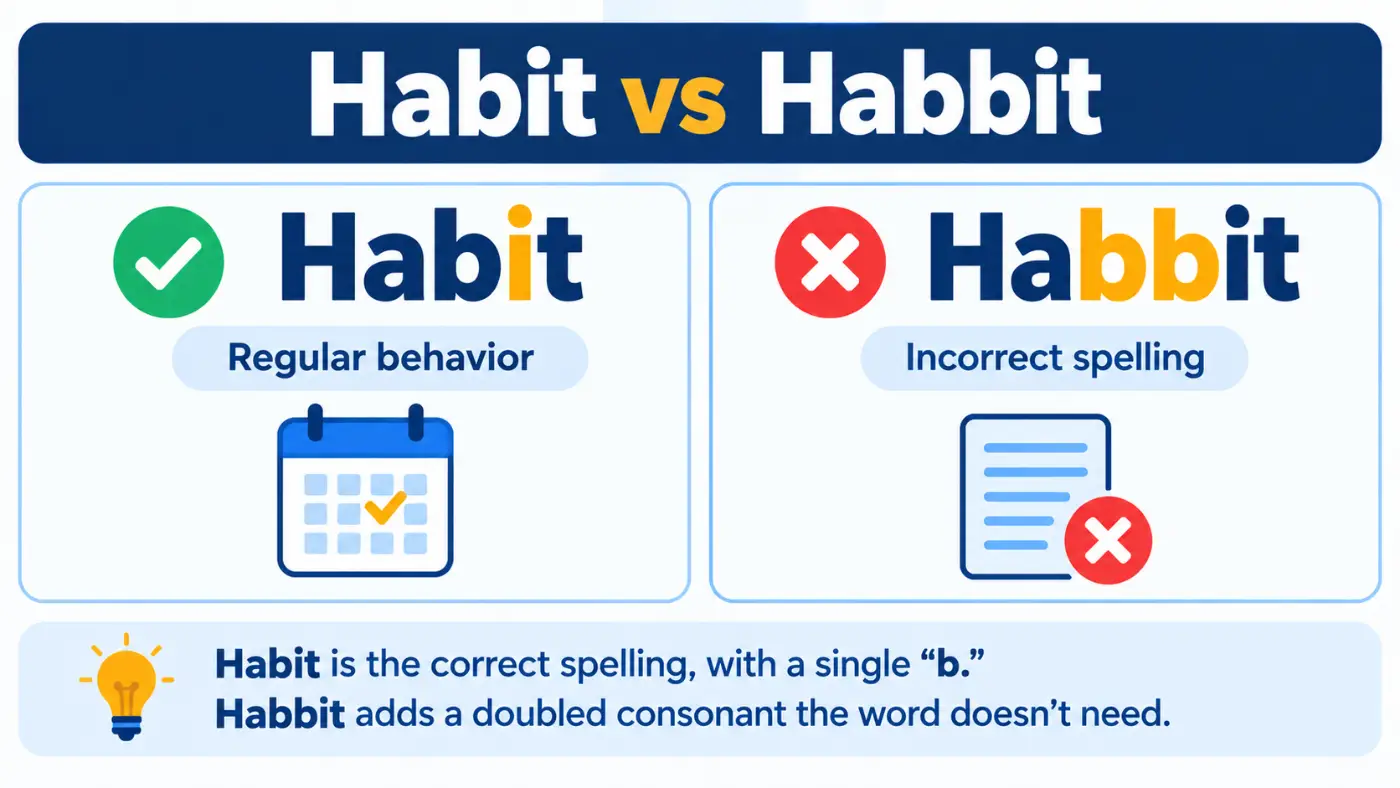
Habit is the correct spelling, with a single “b.” Habbit adds a doubled consonant the word doesn’t need, likely borrowed from the pattern in visually similar words like “rabbit,” which really do double their middle letter.
The Short Answer at a Glance
| Form | Status | What it does | Example |
|---|---|---|---|
| habit | Correct | Noun describing a regular, often automatic pattern of behavior | Checking her phone first thing in the morning had become a habit. |
| habbit | Misspelling | Not a word in standard English | Correct it to habit every time. |
Only one spelling is real. The “b” in habit appears just once, and habbit incorrectly doubles it.
What Habit Means and How It Works
Habit is a noun describing a settled or regular tendency, particularly one that’s hard to give up and often performed without conscious thought. It covers everything from small daily routines, like brewing coffee first thing in the morning, to more significant behavioral patterns, like exercising regularly or biting one’s nails.
The word carries a slightly different weight depending on context. A habit can be neutral or positive, like a habit of reading before bed, or it can carry a more negative connotation, like a smoking habit or a habit of procrastinating. Context and the surrounding words usually make clear which shade of meaning is intended.
Grammatically, habit functions as a standard countable noun: a habit, several habits, a bad habit, a lifelong habit. It frequently pairs with specific verbs, including “form,” “break,” “kick,” and “develop,” as in “form a habit” or “break a bad habit.” It also appears in the common phrasal expression “out of habit,” describing an action done automatically, without conscious intention.
The related adjective is “habitual,” describing something done regularly or as a matter of habit, as in “a habitual latecomer.” The adverb “habitually” modifies verbs to describe an action performed as a matter of routine, as in “she habitually checks the locks before bed.”
Habit comes from a Latin root related to having or holding, which connects to the idea of a behavior someone “holds onto” through repetition. That single “b” in the word’s spelling has remained consistent throughout its use in English, unlike a number of other words that do legitimately double consonants for various reasons.
Is “Habbit” Ever Correct?
No. Habbit isn’t recognized in any standard dictionary, and it isn’t a regional variant, dated spelling, or accepted alternative. It’s a straightforward doubling error.
English is full of short words that do double a consonant, particularly when a suffix is added to a word with a short vowel sound, like “rabbit,” “hobbit,” and “ribbon.” Because these words share a similar rhythm and vowel-consonant pattern with habit, it’s easy to see how a writer’s memory might blur the two spelling patterns together.
Habit, however, simply doesn’t follow that doubling pattern. There’s no suffix being added to a shorter root word here, and no grammatical rule that calls for a doubled “b” in this particular case. The correct spelling has always used a single “b,” reflecting the word’s original Latin-derived form rather than any native English doubling convention.
This kind of cross-word confusion, where a correctly doubled consonant in one word gets mistakenly applied to a similar-looking word, is a common source of spelling errors throughout English, and habit versus habbit is a clear, frequently searched example of exactly that pattern.
Habit vs Habbit: Key Differences Side by Side
| Feature | Habit | Habbit |
|---|---|---|
| Recognized word | Yes | No |
| Part of speech | Noun | None |
| Core meaning | A regular, often automatic pattern of behavior | No meaning |
| Typical use | Daily routines, psychology, self-improvement, behavior description | Appears only as a typo |
| Register | Works in formal and casual writing | Never appropriate |
| Example | Journaling every night has become a comforting habit. | Journaling every night has become a comforting habbit. (wrong) |
The table shows a clean contrast, but what it can’t fully capture is how understandable this particular mistake is. Because so many short English words really do double their consonants, and because “habbit” is visually so close to genuinely double-lettered words like “rabbit,” this error tends to slip past writers who aren’t specifically checking for it.
Correct Examples in Real-Life Contexts
Everyday speech
- I’ve gotten into the habit of going for a walk every evening.
- Biting my nails is such a hard habit to break.
- She has a habit of humming without even realizing it.
- Out of habit, he still reaches for his old phone charger even though he upgraded months ago.
Workplace writing
- The team has developed a habit of checking in briefly every Monday morning.
- Please avoid the habit of scheduling back-to-back meetings without breaks.
- Good time management often starts with building small, consistent habits.
- HR is encouraging employees to form healthier work-life balance habits.
Texting
- ugh I really need to break the habit of snoozing my alarm five times
- it’s honestly become a habit to check my email before I even get out of bed
School and academic
- The psychology unit examines how habits form through repeated behavior and reward.
- Students were asked to track one daily habit for their behavioral science project.
- Her thesis explores how habitual study patterns affect long-term retention.
- The workshop focused on strategies for replacing unproductive habits with better ones.
Formal writing
- The report recommends interventions aimed at reducing habitual smoking among teenagers.
- Clinical guidelines suggest gradual behavioral changes are more effective than abrupt habit reversal.
- The study tracked participants’ spending habits over a twelve-month period.
- Employees are encouraged to develop sustainable habits that support long-term productivity.
Common Mistakes People Make (and How to Catch Them)
Doubling the “b” out of habit (so to speak)
Wrong: It’s become a real habbit of mine to check the weather every morning. Right: It’s become a real habit of mine to check the weather every morning.
This is the core error, likely influenced by similar-looking, genuinely double-lettered words like “rabbit” and “hobbit.”
Typing quickly and adding an extra letter
Wrong: I need to break this habbit before it gets worse. Right: I need to break this habit before it gets worse.
Fast typing sometimes results in an accidental repeated letter, especially when a writer’s fingers are moving faster than their attention to spelling.
Confusing habit with visually similar words
Wrong: She has a habbit of losing her keys at least once a week. Right: She has a habit of losing her keys at least once a week.
Writers who spell “rabbit” correctly sometimes unconsciously apply that same doubling pattern to habit, since the two words share a similar shape and rhythm.
Overcorrecting after learning about the error
Wrong: I finally learned it’s “habit,” not “habbit,” but now I second-guess every double letter in similar words. Right: Recognizing that habit is simply a single-b word, without needing to second-guess related but different words individually.
Once writers learn about this specific mistake, they sometimes become overly cautious about doubled letters in general, which isn’t necessary since each word’s spelling pattern needs to be learned on its own.
A Fast Trick to Choose the Right One
Anchor habit to its related word “habitat,” which most people already spell correctly without hesitation. Habitat also uses a single “b,” and since it’s a longer, more visually distinct word, it’s less likely to be confused with double-lettered words like rabbit. If you can spell habitat correctly, you already know habit follows the same single-“b” pattern.
A second trick is to remember that habit has no suffix attached to a shorter root word, unlike genuinely doubled words such as “shopping” (shop plus -ing) or “hopped” (hop plus -ed). Since there’s no such structural reason for doubling here, the single “b” is the natural, correct choice.
This trick works well for habit specifically, but it won’t help you determine which other short words do or don’t double their consonants, since that depends on each word’s individual origin and structure.
How They Sound in Real Situations
A text exchange
Priya: Do you always check your phone right when you wake up?
Marcus: Yeah, it’s basically a habit at this point, not even a choice anymore.
Priya: Same, honestly.
Habit is correct here, describing an automatic, repeated behavior in casual conversation.
A workplace email
Subject: Team wellness initiative
Hi everyone,
As part of our new wellness program, we’re encouraging small daily habits like stepping away from your desk for a short walk. Let us know if you’d like to join the optional group challenge starting next week.
Thanks, Renata
Habits is correct because the email describes small, repeated behaviors related to workplace wellness.
An article-style excerpt
Researchers found that most people underestimate how quickly a new habit can form, with some behaviors becoming automatic in as little as a few weeks under the right conditions. The findings suggest that consistency matters more than intensity when building lasting change.
Habit is correct here, used in a research-based context describing behavioral patterns.
Formal Writing vs Casual Writing
The correct spelling doesn’t shift based on formality. Habit is right in a psychology journal, a business memo, a text message, and a casual conversation. Habbit is wrong in every one of those contexts, with no exceptions.
What does shift with register is tone and specificity. In formal and academic writing, habit often appears in more precise, clinical language, discussing behavioral patterns, habit formation, or habitual tendencies within a research or health context. In casual speech, it’s used more loosely and personally, often describing small quirks or routines without any deeper analysis attached.
AP and Chicago style both treat habit as a standard word requiring no special formatting, and neither offers any accepted alternate spelling.
Related Mix-Ups People Also Search For
Habit vs Habitat
These two share a root but mean different things. Habit describes a regular behavior, while habitat describes the natural environment where a plant or animal lives. Example: Researchers studied the animal’s habitat to better understand its feeding habits.
Habit vs Habitual
Habit is the noun describing the behavior itself, while habitual is the adjective describing something done as a matter of routine. Example: His habitual lateness became such a habit that colleagues stopped expecting him on time.
Rabbit vs Habit
These two words are unrelated in meaning but visually similar enough to cause spelling confusion, since rabbit correctly doubles its “b” while habit does not. Example: The rabbit hopped past the garden every morning, almost like it had made a habit of it.
Quick Practice: Test Yourself
Choose the correct spelling for each blank.
- Reading before bed has become a nightly ______ for her. (habit / habbit)
- He’s trying to break the ______ of checking his phone during meals. (habit / habbit)
- Good study ______ can make a huge difference in exam performance. (habits / habbits)
- It’s just ______ at this point, not something I even think about anymore. (habit / habbit)
- The therapist helped him identify unhealthy ______ patterns. (habit / habbit)
- She developed a ______ of writing in her journal every morning. (habit / habbit)
Answer Key
- habit: the correct spelling always uses a single “b.”
- habit: consistent spelling regardless of sentence structure.
- habits: the plural form, still spelled with one “b.”
- habit: correct spelling in casual, everyday phrasing.
- habit: correct spelling in a therapeutic or psychological context.
- habit: correct spelling describing a personal routine.
Frequently Asked Questions
Is “habbit” ever an acceptable spelling?
No. Habbit isn’t recognized in standard dictionaries and isn’t used as a regional or informal variant. The correct spelling in every context is habit.
Why do people accidentally double the “b” in habit?
The mistake likely comes from confusion with visually similar words that genuinely double their consonant, like “rabbit” and “hobbit,” even though habit doesn’t follow that same pattern.
What’s the adjective form of habit?
The adjective is “habitual,” describing something done regularly or as a matter of routine.
Is habit always used to describe a bad behavior?
No. Habit is a neutral word that can describe positive, negative, or simply routine behaviors, depending on the context in which it’s used.
What’s the difference between habit and habitat?
Habit refers to a regular pattern of behavior, while habitat refers to the natural environment where an organism lives. The two words share a root but have completely different meanings.
Is there a verb form of habit?
Not directly. English typically uses phrases like “form a habit” or “get into the habit of” rather than a standalone verb form of the word itself.

Sophia Bennett writes educational content about English vocabulary, grammar, slang, and communication. She is passionate about making complex language topics accessible to students, professionals, and curious readers around the world.