Censored vs Sensored: Which Word Do You Mean?
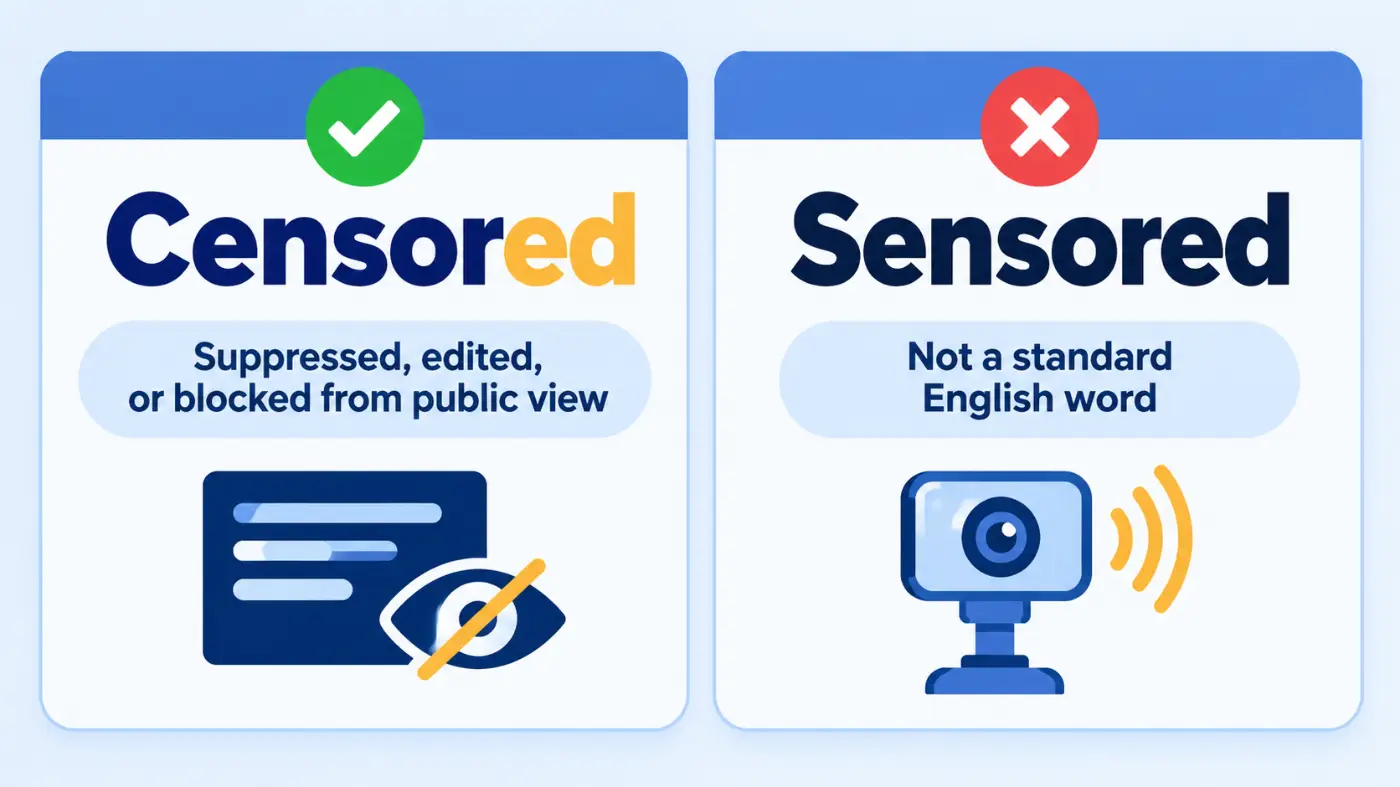
Censored is almost always the word you want. It means suppressed, edited, or blocked from public view, while sensored isn’t a standard English word at all, even though it looks like it should relate to “sensor.”
The Short Answer at a Glance
| Form | Status | What it does | Example |
|---|---|---|---|
| censored | Correct | Past tense/adjective describing content that was suppressed, edited, or restricted | The network censored the scene before airing it. |
| sensored | Not standard | Not a recognized verb form; “sensor” is a noun, not typically a verb | Avoid it; use censored or rephrase with “sensor-equipped.” |
If you mean something was blocked, edited, or restricted from being shown or said, you want censored. Sensored isn’t the word you’re reaching for, even if it sounds plausible.
What Censored Means and How It Works
Censored is the past tense and past participle of the verb censor, meaning to examine material and suppress, remove, or restrict parts of it, typically because it’s considered objectionable, offensive, sensitive, or against certain rules or laws. It’s most often applied to media: films, books, broadcasts, social media posts, and news coverage.
As a verb, censor takes a direct object: someone censors a film, a report, a photo, or a broadcast. The word carries an implication of authority or control, since censoring usually involves someone with the power to decide what gets shown and what gets cut, whether that’s a government, a network, a platform, or an institution.
Censored also functions as an adjective describing the resulting content, as in “a censored version of the film” or “heavily censored footage.” In this use, it modifies a noun directly, describing something that has already gone through the process of censorship.
The related noun is censorship, referring to the practice or policy of suppressing content. Another related noun, censor, can also refer to the person or body doing the suppressing, as in “the state censor rejected the script.”
Censor comes from a Latin root associated with judgment and oversight, which explains the word’s long history in contexts involving official review of speech, publishing, and media. That history is part of why censored carries such a specific, weighty connotation compared to more neutral words like “edited” or “cut.”
Is “Sensored” a Real Word?
Not really, at least not as a standalone verb describing suppression or restriction. Sensored isn’t listed as a standard verb form in major dictionaries, and it doesn’t carry an established meaning of its own the way censored does.
The confusion almost certainly comes from the word “sensor,” a noun referring to a device that detects and responds to physical input, like light, motion, heat, or pressure. Because censor and sensor are pronounced almost identically, and because both words are common in modern technology and media discussions, it’s easy to see how someone typing quickly might reach for the wrong one.
“Sensor” itself is a completely legitimate word, just not usually used as a verb in the way “sensored” implies. You wouldn’t typically say a camera “sensored” motion; you’d say it “detected” motion, or that its sensor picked up movement. Attempts to verb “sensor” into “sensored” aren’t part of standard usage, so if you see or write that word, it’s worth double-checking what you actually mean.
In rare, informal, or highly technical contexts, someone might loosely use “sensored” to mean something like “equipped with a sensor” or “detected by a sensor,” but this isn’t an accepted standard usage, and it risks confusing readers who will likely read it as a misspelling of censored instead.
Censored vs Sensored: Key Differences Side by Side
| Feature | Censored | Sensored |
|---|---|---|
| Recognized word | Yes | Not as a standard verb |
| Part of speech | Verb (past tense) and adjective | Not established; “sensor” is normally a noun |
| Core meaning | Suppressed, restricted, or edited due to content concerns | No standard meaning; often a mix-up with “censored” or an attempt to verb “sensor” |
| Typical use | Media, publishing, broadcasting, government and platform policy | Rarely appears correctly; usually a typo |
| Register | Works in formal and casual writing | Avoid in all writing |
| Example | The interview was censored to remove the controversial remarks. | The interview was sensored to remove the controversial remarks. (should be censored) |
The table draws a clear line, but what it can’t fully capture is how genuinely different these two root words are in meaning, despite sounding so similar. Censor is about judgment and control over content. Sensor is about physical detection. They just happen to rhyme almost perfectly, which is the entire source of the confusion.
Correct Examples in Real-Life Contexts
Everyday speech
- They completely censored the ending of that documentary for the TV broadcast.
- My little brother thinks the swear words were bleeped out, but really the whole scene was censored.
- The airline’s in-flight movie was censored so heavily that half the jokes made no sense.
- I hate when song lyrics get censored on the radio version.
Workplace writing
- Legal asked us to review whether the internal report needs to be censored before it’s shared externally.
- The marketing team confirmed the ad was censored to comply with the platform’s content guidelines.
- Please note that any personally identifiable information will be censored from the public version of this document.
- The press release was censored slightly to remove a reference to the pending lawsuit.
Texting
- lol they censored the whole episode, you can barely tell what happened
- did you see how much of that interview got censored before it aired
School and academic
- The historian’s paper examines how wartime letters were routinely censored before reaching soldiers’ families.
- Students debated whether social media platforms should be allowed to censor political speech.
- The library’s archive includes both the original and the censored version of the banned novel.
- Her thesis explores how censorship shaped early twentieth-century film distribution.
Formal writing
- The government censored several passages of the report before its public release.
- The publisher confirmed that no content had been censored from the final printed edition.
- Under the new policy, flagged content will be reviewed and censored if it violates community guidelines.
- The court ruled that censoring the documents violated the plaintiff’s First Amendment rights.
Common Mistakes People Make (and How to Catch Them)
Confusing censor with sensor due to identical pronunciation
Wrong: The footage was sensored before it aired on the evening news. Right: The footage was censored before it aired on the evening news.
Since censor and sensor sound exactly alike when spoken, writers relying on pronunciation alone often pick the wrong spelling entirely.
Assuming “sensor” can be verbed the same way as “censor”
Wrong: The system sensored the intruder and triggered the alarm. Right: The system’s sensor detected the intruder and triggered the alarm.
Sensor is a noun in standard usage, so turning it into “sensored” to mean “detected” isn’t an accepted construction, even though censor legitimately functions as a verb.
Autocorrect swapping the word unexpectedly
Wrong: My post got sensored for no reason. Right: My post got censored for no reason.
Some autocorrect systems, especially on mobile devices, may not catch this error since “sensored” isn’t flagged as clearly wrong the way a nonsense word would be.
Overcorrecting technical writing about sensors
Wrong: The device was censored to detect motion in low light. Right: The device was equipped with a sensor to detect motion in low light.
This reverse error happens when someone means to discuss an actual physical sensor but accidentally writes “censored” instead, producing a sentence that suddenly implies content suppression rather than technology.
A Fast Trick to Choose the Right One
Think about what’s actually happening in your sentence: is something being blocked, edited, or restricted? Or is something detecting a physical signal like motion, light, or temperature? If it’s the former, you want censored. If it’s the latter, you’re probably talking about a sensor, likely as a noun rather than a verb.
A helpful substitution test: try replacing the word with “suppressed” or “edited.” If the sentence still makes sense, censored is correct. “The scene was suppressed before airing” works, so “The scene was censored before airing” is the right choice.
This trick works well for distinguishing meaning, but it has one limit: it won’t help if you’re simply unsure how to spell censored itself. For that, it helps to remember that censor relates to judgment and control, the same root idea behind words like “censure,” which also involves formal criticism or disapproval.
How They Sound in Real Situations
A text exchange
Priya: Did you watch the uncut version of that show?
Jordan: No, only the censored one on the streaming platform.
Priya: You’re missing so much context then.
Censored is correct here because Jordan is describing a version of the show with content removed.
A workplace email
Subject: Review before external release
Hi Marcus,
Before we send this report to the board, legal wants to confirm that the client’s financial details have been censored from the shared version. Can you double-check the final draft before Friday?
Thanks, Elena
Censored is correct because the email is about removing sensitive information before distribution.
An article-style excerpt
The streaming service confirmed that several scenes were censored for the platform’s family-friendly rating, cutting roughly four minutes from the original theatrical release. Fans have criticized the changes online, arguing the edits disrupt the film’s pacing.
Censored fits naturally here, describing content that was cut for rating purposes.
Formal Writing vs Casual Writing
The correct word choice doesn’t shift based on formality, since sensored isn’t a standard alternative in any register. Censored is appropriate in legal documents, journalism, casual conversation, and academic writing alike, whenever the topic involves suppressing or editing content.
What does shift with register is tone. In formal writing, censored often appears in precise, policy-driven contexts, such as legal rulings, platform guidelines, or government transparency reports. In casual speech, it’s frequently used more loosely, even humorously, as when someone jokes that a friend’s story got “censored” for being too embarrassing to repeat in full.
AP and Chicago style both treat censored as a standard word with a fixed spelling, and neither offers “sensored” as an accepted variant in any context.
Related Mix-Ups People Also Search For
Censor vs Sensor
This is the root confusion behind censored versus sensored. Censor relates to suppressing or reviewing content, while sensor is a device that detects physical input like motion or light. Example: The security camera’s sensor triggered a recording, which was later censored before being shown to the public.
Censor vs Censure
These two look and sound similar and share a Latin root related to judgment, but they mean different things. Censor means to suppress or edit content, while censure means to formally criticize or reprimand someone, often in an official capacity. Example: The senator was censured by his colleagues after his censored remarks leaked to the press.
Censorship vs Editing
Censorship specifically implies suppression based on content being considered objectionable, harmful, or against certain rules, while editing is a broader, more neutral term covering any kind of revision, including for length, clarity, or style. Example: The documentary was edited for length, but critics argued the removal of one interview amounted to censorship.
Quick Practice: Test Yourself
Choose the correct word for each blank.
- The film was heavily ______ before its release in certain countries. (censored / sensored)
- The motion ______ in the hallway triggered the security lights. (sensor / censor)
- Reporters accused the government of trying to ______ coverage of the protest. (censor / sensor)
- The device relies on a heat ______ to detect changes in temperature. (sensor / censor)
- Several scenes were ______ from the streaming version for content reasons. (censored / sensored)
- The committee’s job is to review and, if necessary, ______ sensitive material. (censor / sensor)
Answer Key
- censored: describes content that was suppressed or edited before release.
- sensor: refers to the physical device detecting motion.
- censor: the verb form describing an attempt to suppress coverage.
- sensor: again, the physical detecting device, used as a noun.
- censored: correct verb form describing removed content.
- censor: correct verb form describing the act of reviewing and restricting material.
Frequently Asked Questions
Is “sensored” ever a correct word to use instead of censored?
No. Sensored isn’t a standard verb form in English, and it’s almost always a mix-up with censored, which is the correct word for describing suppressed or edited content.
Why do people confuse censor and sensor?
The two words are pronounced almost identically, even though they come from unrelated roots and mean completely different things, which makes them easy to mix up in fast speech or quick typing.
Can “sensor” ever be used as a verb?
Not in standard, widely accepted usage. Sensor is normally a noun, and while some informal or technical writing might stretch it into a verb, it isn’t a recognized standard construction.
What’s the difference between censor and censure?
Censor means to suppress or edit content, while censure means to formally criticize or reprimand someone, often in a professional or governmental context.
Is censorship always considered negative?
Not universally. Views on censorship vary widely depending on context, such as protecting children from harmful content versus restricting political speech, so the word itself is neutral even though its applications are often debated.
What part of speech is “censored” most commonly?
Censored most often functions as either the past tense of the verb censor or as an adjective describing content that has already been suppressed or edited.

Sophia Bennett writes educational content about English vocabulary, grammar, slang, and communication. She is passionate about making complex language topics accessible to students, professionals, and curious readers around the world.