Parties vs Partys: Which Spelling Is Correct?
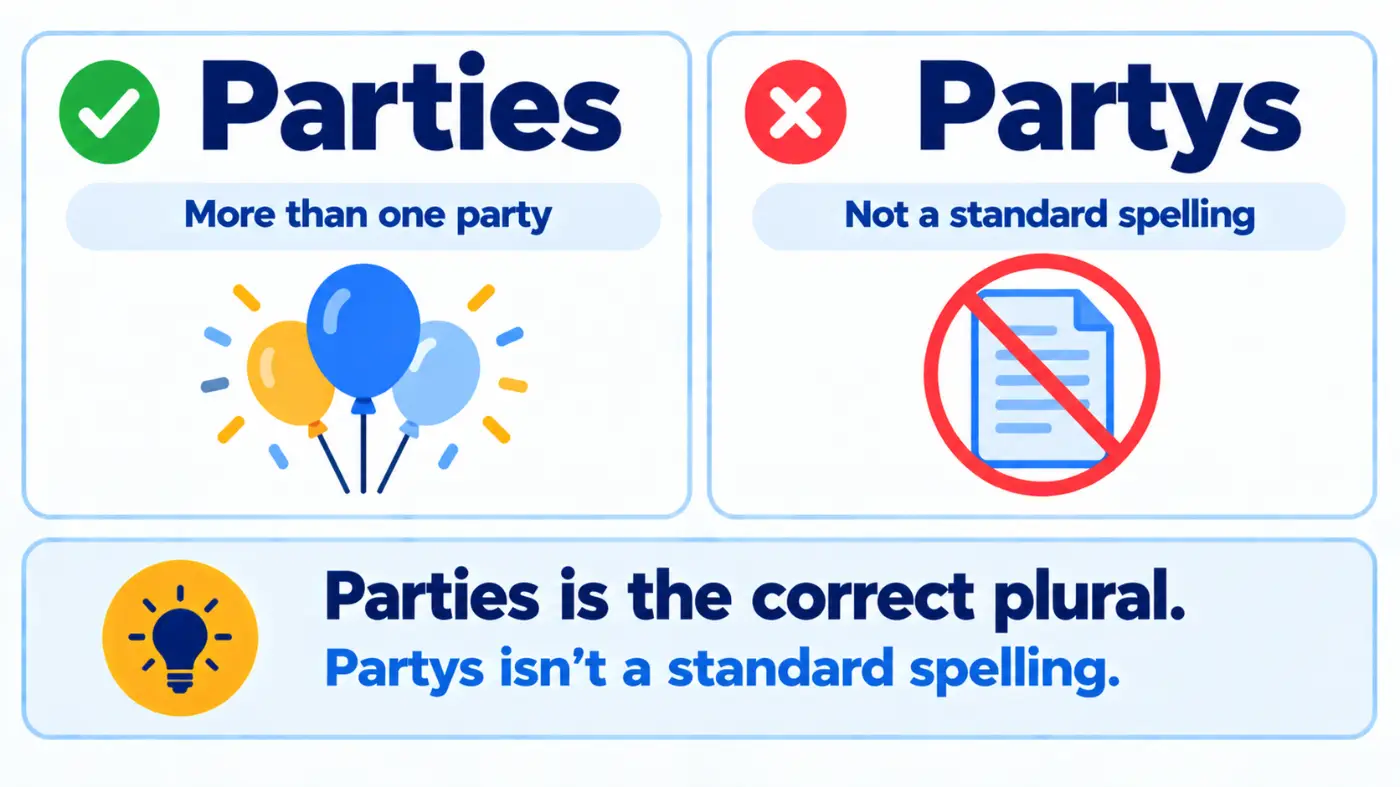
Parties is the correct plural of party. Partys isn’t a standard spelling, and the confusion usually comes from mixing up the plural parties with the possessive party’s, which does keep a “y” before its ending.
The Short Answer at a Glance
| Form | Status | What it does | Example |
|---|---|---|---|
| parties | Correct plural | More than one party | Three different parties showed up to the same venue that night. |
| party’s | Correct possessive | Shows something belongs to one party | The party’s theme was decided at the last minute. |
| partys | Incorrect | Not a standard spelling of any form | Always replace it with parties or party’s. |
There’s no legitimate use for partys on its own. If you mean more than one party, use parties. If you mean something belonging to a party, use party’s with an apostrophe.
What Parties Means and How It Works
Parties is the plural form of the noun party, and it follows a spelling pattern shared by many English nouns ending in a consonant plus “y.” Words like city, baby, and story all change that final “y” to “ies” in the plural: cities, babies, stories, parties.
The rule applies specifically because “y” sits directly after a consonant. Party ends in “t” plus “y,” so the plural drops the “y,” adds “ie,” and then adds “s.” That gives you parties, not partys.
Grammatically, parties functions like any regular plural noun. It pairs with a plural verb, so you’d write “the parties are scheduled for the same weekend,” not “the parties is scheduled.” It also works naturally with plural determiners like these, those, several, and many: these parties, those parties, several parties.
Beyond social gatherings, party also has a legal and formal sense, referring to a person or group involved in an agreement, contract, or lawsuit, as in “both parties agreed to the terms.” The plural works identically in this sense: parties to a contract, parties in a dispute, parties involved in negotiations.
The same “y to ies” rule explains why “partys” never appears as a correct plural anywhere in standard English, whether the context is a birthday celebration or a legal filing.
What Party’s Means and How It Works
Party’s is the possessive form of party, showing ownership or a close relationship between the party and something else. It answers the question “whose?” The party’s guest list means the guest list belonging to that party.
This is exactly where confusion with parties tends to start. Party’s does contain a “y” right before the apostrophe, and at a quick glance, it can look similar to a plural someone might misspell as partys. But the apostrophe changes the meaning entirely. Party’s is singular possessive, referring to something belonging to one specific party.
Grammatically, party’s functions as a modifier placed directly before the noun it describes: the party’s decorations, the party’s host, the party’s outcome. It never stands alone as a subject or object the way parties does.
The possessive form follows the standard rule for singular nouns: add an apostrophe and an “s.” Party becomes party’s the same way city becomes city’s or baby becomes baby’s. The only twist is that people sometimes drop the apostrophe entirely and write “partys,” which isn’t correct in either the plural or possessive sense.
There’s also a plural possessive form, parties’, used when something belongs to more than one party. The venue coordinated both parties’ schedules to avoid a double booking, for example, refers to schedules belonging to two separate parties. That form takes the plural parties and adds only an apostrophe after the “s.”
Parties vs Partys: Key Differences Side by Side
| Feature | Parties | Partys |
|---|---|---|
| Recognized word | Yes | No |
| Part of speech | Plural noun | None |
| Core meaning | More than one party, or multiple involved groups | No meaning |
| Typical use | Social events, legal agreements, political groups | Appears only as a typo |
| Register | Works in all writing | Never appropriate |
| Example | The venue hosted three parties over the same weekend. | The venue hosted three partys over the same weekend. (wrong) |
The table can’t fully explain why this mistake is so persistent. Because party’s possessive form does include a “y” right before its ending, writers sometimes assume the plural must follow a similar-looking pattern. It doesn’t. The plural changes the “y” to “ies,” while the possessive keeps the “y” and adds an apostrophe plus “s.”
Correct Examples in Real-Life Contexts
Everyday speech
- We had three birthday parties to attend in one weekend, which was exhausting.
- Both parties showed up fashionably late, as usual.
- I’ve been to so many holiday parties this year that I’ve lost count.
- The neighborhood block parties always end with someone’s karaoke machine coming out.
Workplace writing
- Both parties signed the revised contract after the final round of negotiations.
- HR is coordinating three separate holiday parties for different office locations.
- The vendor agreement outlines the responsibilities of both parties clearly.
- Please confirm which parties are attending the client dinner on Thursday.
Texting
- omg we have literally four parties to hit tonight, let’s plan the route
- so many parties this weekend, my liver needs a break honestly
School and academic
- The debate covered how political parties have shifted their platforms over the past decade.
- Students studied how opposing parties in a negotiation reach compromise.
- The history lecture examined the rise of third parties in American elections.
- Her thesis explores how political parties use social media during campaign season.
Formal writing
- All parties involved in the settlement must sign the agreement by Friday.
- The merger requires approval from both parties’ legal representatives.
- Representatives from all interested parties attended the public hearing.
- The contract specifies the obligations of each of the three parties.
Common Mistakes People Make (and How to Catch Them)
Applying the wrong plural pattern
Wrong: We’re hosting two separate partys this month for the two kids’ birthdays. Right: We’re hosting two separate parties this month for the two kids’ birthdays.
Writers sometimes treat party like a word that simply adds “s” for the plural, the way most English nouns do. Party follows the “consonant plus y” rule instead, so the “y” changes to “ies.”
Confusing the plural with the possessive
Wrong: Both partys decorations were left up for weeks afterward. Right: Both parties’ decorations were left up for weeks afterward.
When more than one party owns something, the correct form is parties’ with an apostrophe after the “s,” not partys without one.
Dropping the apostrophe in the singular possessive
Wrong: The partys theme was decided by committee vote. Right: The party’s theme was decided by committee vote.
This happens when a writer means one party’s specific details but forgets the apostrophe that marks possession.
Autocorrect and quick typing errors
Wrong: We need more chairs for both partys this weekend. Right: We need more chairs for both parties this weekend.
Fast typing sometimes skips the vowel change entirely, especially on a phone keyboard where autocorrect doesn’t always catch the error.
Overcorrecting into an unnecessary apostrophe
Wrong: The venue can host up to five partie’s at once. Right: The venue can host up to five parties at once.
Some writers, sensing something is off, add an apostrophe to the plural by mistake. Parties as a plural never takes an apostrophe.
A Fast Trick to Choose the Right One
Ask whether you’re counting parties or describing something that belongs to a party. If you’re counting, more than one becomes parties, following the same pattern as cities and babies. If you’re showing ownership, add an apostrophe: party’s for one party, parties’ for more than one.
A quick test: try substituting a word that doesn’t end in “y,” like event. “Two events” becomes “two parties,” not “two partys.” “The event’s location” becomes “the party’s location,” with the apostrophe landing in the same spot.
This trick works reliably for regular nouns like party, but it won’t help with truly irregular plurals, since those follow different patterns entirely. For party specifically, though, the “y to ies” swap always applies to the plural.
How They Sound in Real Situations
A text exchange
Priya: How many parties are we actually going to tonight?
Sam: Three, if we’re being ambitious. Two, realistically.
Priya: Let’s aim for realistic.
Parties is correct here because Sam and Priya are counting more than one event.
A workplace email
Subject: Holiday party logistics
Hi team,
We’re finalizing details for both holiday parties this year, one for the east coast office and one for the west coast team. Please let me know your dietary restrictions by Friday so catering can plan accordingly.
Thanks, Diane
Parties is correct because the email refers to a total of two separate events.
An article-style excerpt
Both parties in the merger negotiation expressed cautious optimism after Tuesday’s meeting, though sources say several key terms remain unresolved. A follow-up session is expected before the end of the month.
Parties is correct here because it refers to the two groups involved in the negotiation.
Formal Writing vs Casual Writing
The spelling rules don’t shift based on formality. Parties is correct in a legal contract, a political science journal, a text message, and a party invitation. Partys is never correct in any of them.
What changes with register is meaning emphasis. In casual writing, parties almost always refers to social gatherings, as in “birthday parties” or “holiday parties.” In formal and legal writing, parties frequently refers to the people or groups involved in an agreement or dispute, as in “the parties to this contract” or “all parties present at the hearing.” Both senses follow the identical spelling rules.
AP and Chicago style both follow standard English pluralization and possession rules here, with no special guidance needed for party specifically.
Related Mix-Ups People Also Search For
Parties vs Party’s
Parties is the plural noun for more than one party, while party’s is the singular possessive, showing something belongs to one specific party. Example: Each of the three parties had its own agenda, but the winning party’s proposal covered every concern.
Parties vs Parties’
Parties is simply the plural. Add an apostrophe after the “s” to get parties’, the plural possessive used when something belongs to more than one party. Example: Both parties’ attorneys reviewed the settlement before it was finalized.
City’s vs Cities vs Cities’
This trio follows the exact same pattern as party, since city also ends in a consonant plus “y.” Example: The city’s budget covers infrastructure projects across three neighboring cities’ shared water system.
Baby’s vs Babies vs Babies’
Another word with the identical spelling pattern, since baby also ends in a consonant plus “y.” Example: All the babies’ toys were mixed up, but eventually each baby’s blanket was returned to the right family.
Exceptions, Edge Cases, and Tricky Situations
When “party” refers to a single person
In legal and formal contexts, “party” can refer to a single individual involved in an agreement or case, not just a group. The plural still follows the same rule regardless: multiple individual parties remain parties, spelled identically to the social-gathering sense.
Political parties versus social parties
The word “parties” covers both political organizations and social gatherings without any change in spelling. Context alone tells readers which sense is meant, as in “the two major parties debated policy” versus “we’re hosting three parties this weekend.”
Compound and hyphenated forms
Terms like “party favor” or “party planner” don’t pluralize the word “party” directly, since “party” functions as a modifier there. You’d say party favors or party planners, keeping “party” singular because it describes the noun that follows rather than being counted itself.
Quick Practice: Test Yourself
Choose the correct form for each blank.
- We’re attending three different ______ this Saturday alone. (parties / partys)
- Whose decorations are these? They’re from the ______ downstairs. (party’s / partys)
- Both ______ agreed to the terms of the settlement. (parties / partys)
- All the ______ leftover snacks got mixed up in the fridge. (parties’ / partys)
- The ______ guest list kept growing every day. (party’s / partys)
- The negotiation involved representatives from four separate ______. (parties / partys)
Answer Key
- parties: a plain plural counting more than one event.
- party’s: singular possessive showing the decorations belong to one specific party.
- parties: plain plural referring to the groups involved in the settlement.
- parties’: plural possessive, since the snacks belong to more than one party.
- party’s: singular possessive describing one party’s guest list.
- parties: plain plural, referring to the groups in the negotiation.
Frequently Asked Questions
Is “partys” ever a correct spelling?
No. Partys isn’t a recognized plural or possessive form in standard English. The plural is parties, and the singular possessive is party’s.
Why does party become parties instead of partys?
Party ends in a consonant followed by “y,” and English typically changes that “y” to “ies” when forming the plural, the same pattern used in words like city and baby.
What’s the difference between party’s and parties’?
Party’s is singular possessive, showing something belongs to one party. Parties’ is plural possessive, showing something belongs to more than one party.
Do you ever write “party’s” without an apostrophe?
No. The apostrophe is what marks possession. Without it, “partys” isn’t a standard word in any context.
Is parties always the correct plural, even in casual writing about celebrations?
Yes. Parties is the correct plural regardless of how formal or casual the writing is, whether you’re discussing birthday celebrations or legal agreements.
How do you know whether to use parties or party’s in a sentence?
Check whether you’re counting more than one party or showing that something belongs to a party. Counting calls for parties. Ownership calls for party’s or parties’, depending on how many parties are involved.

Sophia Bennett writes educational content about English vocabulary, grammar, slang, and communication. She is passionate about making complex language topics accessible to students, professionals, and curious readers around the world.